HSCT for MS in India at HSCT Hospital India: Treatment, Cost and Your 30 Day Stay
Medically reviewed by the board of haematologists at HSCT Hospital India.
HSCT for MS in India is carried out at HSCT Hospital India in New Delhi, a JCI-USA accredited hospital. Since 2016 it has treated more than 1,500 MS patients from over 30 countries. HSCT stands for haematopoietic stem cell transplantation, which means rebuilding the immune system from a patient’s own blood forming stem cells. In MS the immune system damages myelin, the protective coating around the nerves, and HSCT aims to stop that immune attack.
HSCT Hospital India follows the non-myeloablative protocol developed by Dr Richard Burt. Non-myeloablative means the chemotherapy is strong enough to remove the faulty immune cells but is not meant to destroy the bone marrow itself. The whole treatment takes place in one in-patient stay of up to 30 days, for one all inclusive price of US$30,000.

What happens when I come to HSCT Hospital India for HSCT for MS?
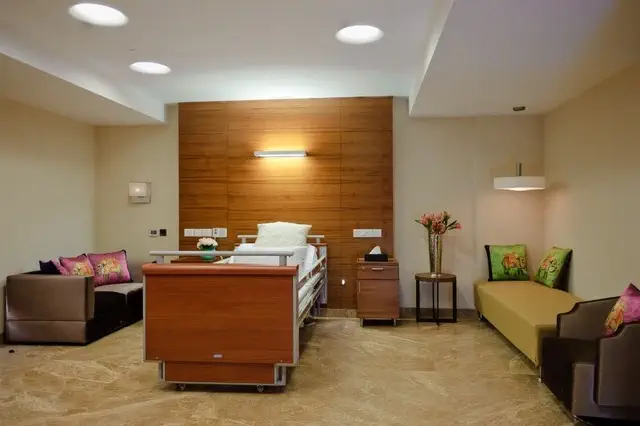
Your 30 days in New Delhi follow a fixed order, and you stay in the hospital for all of it. An HSCT Hospital India executive meets you and your attendant at New Delhi airport and brings you straight to a private room. You are discharged straight back to the airport at the end, so there is no hotel stay at any point.
How am I checked before treatment starts?
The first four days are given to tests and consultations, all done as an in-patient. A multidisciplinary team of specialists reviews your results and confirms whether HSCT is suitable for you. These tests, including MRI, are part of the package price, so nothing is billed separately for this stage.
What are the four stages of HSCT, and what does each one do for me?
Once you are confirmed as suitable, treatment moves through four stages. Each stage has one job, and together they replace the immune cells that have been damaging your nerves.
The first stage is called mobilisation. You are given medicine that moves stem cells out of your bone marrow and into your bloodstream, where they can be collected. Stem cells here means the young blood forming cells that rebuild your blood and immune cells after treatment.
In the second stage, known as the harvest or leukapheresis, the stem cells are collected. Your blood passes through a machine that separates out the stem cells and returns the rest to you, a little like giving blood. The collected cells are then stored safely until they are needed.
The third stage is conditioning. You receive chemotherapy with cyclophosphamide and ATG, which is short for anti-thymocyte globulin, an antibody that targets the immune cells involved in MS. During chemotherapy you also receive methylprednisolone, a steroid that helps ease side effects, and anti-nausea treatment is given if you feel sick.
The fourth stage is reinfusion. Your own stored stem cells are returned to you through a drip, much like a blood transfusion. Over the following days they make new blood and immune cells, and your counts are checked every day until they recover.
Why do I stay in hospital for the whole 30 days?
In the days after conditioning, your infection fighting white blood cells fall very low. This stretch is known as the aplastic phase, and infections are more likely during it than at any other point. For this reason HSCT Hospital India keeps every patient as an in-patient for the whole stay, in a private room with triple level HEPA air filtration.
Because you are in hospital, nurses and HSCT specialists monitor you 24 hours a day. A fever or any change in your blood counts is seen and treated straight away, rather than waiting for you to travel in from a hotel. Your attendant stays in the same filtered room, so you are never apart during the hardest part of the treatment.
How much does HSCT for MS cost in India, and what does the price cover?
HSCT for MS at HSCT Hospital India costs US$30,000, and that one price covers the full stay of up to 30 days. Nothing inside those 30 days is billed separately. Additional charges apply only in the rare case that a hospital stay runs longer than 30 days.
The price covers all tests and consultations before treatment, including MRI, and the HSCT treatment itself. It also covers your stay of up to 30 days, doctors’ fees, medicines and consumables, and neuro-physiotherapy during your recovery. Food and laundry for both you and your attendant are included, together with airport pick-up and drop-back.
If you have nobody who can travel with you, HSCT Hospital India can arrange a full time private nurse to act as your attendant. This costs an extra US$1,500 for the 30 day stay. Every other cost of the treatment stays inside the single price.
Is HSCT Hospital India accredited, and how experienced is it with MS?
HSCT Hospital India is accredited by the Joint Commission International of the USA, known as JCI. It also holds NABH accreditation for hospital care and NABL accreditation for its laboratories, the two national standards in India. These three accreditations cover how patients are kept safe, how care is delivered and how test results are produced.

HSCT Hospital India has delivered HSCT for MS since 2016, and more than 1,500 MS patients have been treated in that time. The hospital is a 480 bed super speciality hospital with a dedicated bone marrow transplant centre, a full laboratory and a blood bank on site. For you, this means the tests, the transplant and any specialist you need are all under one roof.
Can I have HSCT at HSCT Hospital India if I have progressive MS or a high EDSS score?
Yes, HSCT Hospital India accepts all forms of MS. That includes relapsing remitting MS, where symptoms come and go in relapses, and the progressive forms, where disability builds up steadily. Secondary progressive, primary progressive and progressive relapsing MS are all considered.
Patients with an EDSS score of up to 6.5 are accepted. EDSS is the Expanded Disability Status Scale, the score neurologists use to measure how much MS affects walking and daily life. You can estimate your own on the EDSS page. You do not need to have tried disease modifying drugs first, which are the long term MS medicines such as Ocrevus or Tysabri. The final decision on suitability is made after your evaluation in New Delhi.
What does the research say about HSCT for MS?
HSCT is not a clinical trial at HSCT Hospital India, and it is a one time treatment rather than an ongoing course of infusions. The protocol used is the one tested in a randomised trial of 110 people with relapsing remitting MS, published in JAMA in 2019. In that trial, 3 of 52 people who had HSCT saw their disability get worse, against 30 of 50 people who stayed on standard MS medicines.
Results differ from one person to the next, and progressive MS is assessed case by case. HSCT Hospital India reports patient progress to national and international HSCT databases after treatment. The 10 year outcomes article sets out the longer term published data.
Who has come to HSCT Hospital India for HSCT for MS?
Patients travel to HSCT Hospital India from over 30 countries across Europe, North America, Australia and beyond. Many of them recorded a video during or after their stay, in their own words, about why they chose India and what the 30 days were like.
Jose from the Netherlands shares her story of HSCT at HSCT Hospital India

I’m Jose from Netherlands, I’m 59 years old, I am married to Tim, and I’m a mother of two daughters. I had Multiple Sclerosis (MSRR) EDSS 2.5.
Six months ago I underwent the HSCT treatment at HSCT Hospital India. This is my story:
The first MS shup was probably in 1987. Until 2008 my family doctor unfortunately was convinced that it was psychological. For years I had a new shup for every 10 months and I had to manage by myself without any medication. I often felt that I would become depressed and would faint from pain.
Mr David from USA shares his experience 11 months after HSCT at HSCT Hospital India.

My MS journey started like most people. My daily symptoms included numbness in my legs and feet, speech issues, chronic fatigue, balance and dexterity just to name a few.
I was constantly thinking of my future with MS and the prognosis did not look good. I wasn’t going to leave it up to the Gods to determine my fate, I still had some fighting to do. HSCT was a family decision as well as a deep personal one. I went through the treatment at HSCT Hospital India. After I returned home, I did what the hospital asked me to do to get healthy again. I am now eleven months post HSCT.
Paul from Ireland shares his experience of HSCT at HSCT Hospital India

I was diagnosed with SPMS and have been confined to a wheelchair for five years and my MS rapidly progressed over the last two year.
I researched HSCT treatments available worldwide and was accepted by HSCT Hospital to be taken up for HSCT after rigorous tests to ascertain my strength and suitability for the treatment. This was very reassuring for me and proved to me that HSCT Hospital were not just after money.
Watch this video in which Christa from USA shares her experience of traveling to HSCT Hospital India for HSCT treatment.
Watch this video in which Christa from USA shares her experience of traveling all the way to HSCT Hospital India for HSCT treatment.
She is delighted with the outcome of HSCT at HSCT Hospital India and also about the excellent care she received from the Indian doctors, Nurses and other support staff during her month long stay at HSCT Hospital India. We wish her a very happy and healthy life ahead
Real Story of Athena B from Tunisia who came to HSCT Hospital, India for HSCT Treatment
I researched HSCT groups on Facebook and received encouragement from previous patients who had HSCT at HSCT Hospital India.
who had HSCT at HSCT Hospital, India. After I thoroghly checked out the website www.hsctindia.com, I applied in December 2017 and wa offered an appointment to arrive at HSCT Hospital on March 11, which I confirmed immediately. My decision was done and I was impatient to get the treatment as my case of SPMS.
Gudrun R from UK shares her valuable experience after HSCT for MS at HSCT Hospital India
Watch this emotional true experience recounted by Ms. Gudrun R from UK who was diagnosed with RRMS in 2007 and how she finally decided to come to HSCT Hospital India for HSCT.
She is delighted with the care she received at HSCT Hospital and has some valuable words about the importance of the attendant’s vital role to support the patients through the HSCT treatment.
Marjorie from Australia shares her experience of HSCT at HSCT Hospital India

I was diagnosed with MS in 1992/3 after going through a great deal of stress and anxiety. I turned SPMS about 8 years ago in 2010 and found that I was starting to limp, not ferociously but subtly.I would get tired often and decided to give up working in the fast paced city and retire early. Wasn’t easy but I found it necessary as my symptoms became more noticeable as time went by.
My research looked at Mexico and Russia but I was put off applying to these hospitals as there was up to a year waiting list. I couldn’t wait that long as I seemed to be deteriorating fast and, since I managed to get a confirmation with the HSCT Hospital India.
Justin from USA shares his experience HSCT for MS at HSCT Hospital India
Watch this true experience shared by Mr Justin an MS patient from USA who decided to come to HSCT Hospital India for HSCT.
He is delighted with the outcome of HSCT at HSCT Hospital India and also about the excellent care he received from the Indian doctors, Nurses and other support staff during his month long stay at HSCT Hospital India. We wish him a very healthy life ahead.
Do I need to bring someone with me to HSCT Hospital India?
Yes, every patient comes with an attendant, who is a family member or friend able to help you physically when needed. Your attendant should be able to help you on and off transport and to the toilet at airports. During the stay, most of your physical care is handled by the hospital nurses.
Your attendant’s main role in hospital is to keep you company and support you. The 30 days include long hours in one room, and a familiar person beside you helps with homesickness and worry. Your attendant’s room, food and laundry are part of the package price.
What do I need to do before I travel to India?
You do not need to collect your medical files or scans before you apply. All tests, consultations and evaluations are done at the hospital after you arrive in New Delhi. This is helpful for patients from countries where records are slow to obtain.
You will need an India medical visa, and your HSCT Case Manager helps you apply for it online. Smoking must be stopped completely before the transplant to avoid complications. Around one in three patients become infertile after high dose cyclophosphamide, so younger women are advised to consider freezing their eggs before treatment. The fertility preservation article explains how.
What happens after I go home from HSCT Hospital India?
On the day you leave, the hospital hands you two documents: a Discharge Summary and an Aftercare Manual. The Discharge Summary is written for your GP or neurologist at home, and the Aftercare Manual guides your recovery day to day. On the flight home and for the first month, you wear a mask and use hand sanitiser in public places.
Your blood counts are checked twice a month for the first two months, then once a month until they are back to normal. Most patients return to normal activities after two to four months, and full recovery from the transplant usually takes three to twelve months. You keep HSCT Hospital India updated on your progress so the team can follow your recovery.
How do I start HSCT for MS at HSCT Hospital India?
Starting takes three steps, and none of them costs anything. You fill in the application form as accurately as you can, and the HSCT specialist doctors review it. An HSCT Case Manager then contacts you by email with their opinion and the next steps.
The review is free and carries no obligation. Your HSCT Case Manager answers your questions personally, from eligibility and dates to the visa and travel.
Questions patients ask about HSCT for MS in India
Is HSCT for MS at HSCT Hospital India a clinical trial?
No, HSCT for MS at HSCT Hospital India is not a trial and is not experimental. It uses the non-myeloablative protocol developed by Dr Richard Burt, which is backed by published outcome data stretching back more than ten years. It is also a one time treatment, so you do not need further chemotherapy infusions once you are home. Your specialists explain the evidence that applies to your type of MS during your evaluation.
Will I lose my hair during HSCT?
You lose about a third of your hair after the chemotherapy, and many patients cut it short before they travel. The head is usually shaved once the hair starts to fall out. Regrowth typically starts around three months after HSCT.
How soon can I go back to work after HSCT at HSCT Hospital India?
Most patients can think about returning to work once their platelet count is back above 100,000, which the regular blood tests will show. Timing also depends on your stamina and on how physical your job is. Starting with half days or half weeks is the usual advice. Your Aftercare Manual sets out what to watch for in the first months.
Can I bring my own clothes to HSCT Hospital India?
Patients wear hospital gowns while admitted, because this helps keep the room clean during the low immunity phase. Attendants are given hospital uniforms for the same reason. Your own clothes are kept for the flight home. Everything is laundered by the hospital as part of the package.
Real Patients, Real Stories
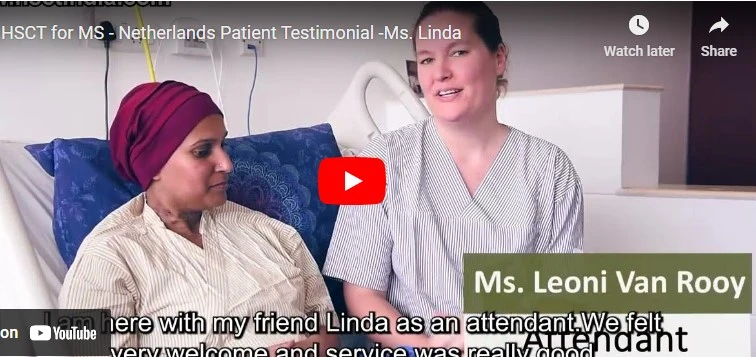
Linda’s Story: MS patient from Netherlands talks about her HSCT Treatment at HSCT Hospital India
Linda from the Netherlands, diagnosed with MS in 2007, describes her HSCT for multiple sclerosis at HSCT Hospital India on video.

Primary Progressive MS: David Ellis on His HSCT Treatment in India
David Ellis from California, with primary progressive MS since 2011, arrived using a cane. After HSCT he could lift his left leg again.
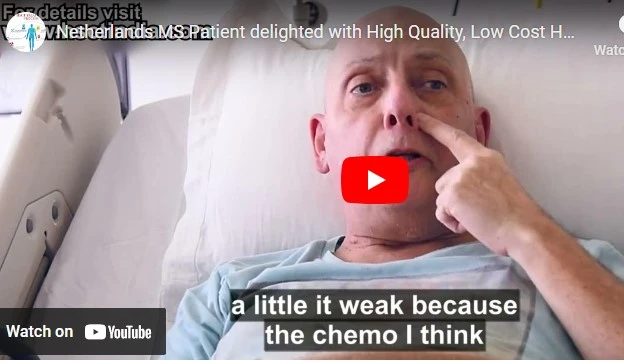
Netherlands MS Patient delighted with High Quality, Low Cost HSCT for MS Treatment
Watch this video where Mr. Jacobus from the Netherlands shares his happy experience about travelling to India with his girlfriend as a Caregiver for HSCT
References
- Burt RK, Balabanov R, Burman J, et al. Effect of Nonmyeloablative Hematopoietic Stem Cell Transplantation vs Continued Disease-Modifying Therapy on Disease Progression in Patients With Relapsing-Remitting Multiple Sclerosis: A Randomized Clinical Trial. JAMA. 2019;321(2):165 to 174.