HSCT – Life Changing Treatment for Chronic Inflammatory Demyelinating Polyneuropathy (CIDP)
Medically reviewed by Dr. Rahul Bhargava, MBBS, MD (Medicine), DM (Clinical Haematology, AIIMS), Fellowship in Stem Cell Transplantation, Vancouver. Principal Director and Chief of HSCT, Haematology, Haemato-Oncology and Bone Marrow Transplantation, HSCT Hospital India.
Last reviewed: 14 July 2026.
The same non-myeloablative protocol is used across our autoimmune programme.
What the evidence shows. A systematic review and meta-analysis of 89 patients across 11 studies found that autologous HSCT achieves marked, sustained clinical improvement in refractory CIDP and allows many patients to come off long-term immunotherapy (PubMed 37170791). Earlier work established it as a viable option in patients who had exhausted conventional treatment (PubMed 24262917), and the Francophone Society of Bone Marrow Transplantation has published formal indications for its use in CIDP (PubMed 31818426). Roughly 20 to 30 percent of patients with CIDP do not respond adequately to first-line immunomodulatory treatment, and it is that group for whom transplantation is considered.
Related reading: HSCT for multiple sclerosis, HSCT for NMOSD, lupus stem cell therapy, Crohn’s disease new treatment, HSCT for myasthenia gravis, HSCT for small fibre neuropathy. See also the HSCT treatment package and cost and patient testimonial videos.
CIDP is a serious autoimmune condition, one that slowly chips away at the nerves and, without the right treatment, can significantly change the way you live. But for many patients, Hematopoietic Stem Cell Transplantation (HSCT) is opening a door that once felt firmly closed.
At HSCT Hospital India, a JCI-USA accredited centre, we’ve helped patients from Europe, North America, and Australia get their lives back through HSCT treatment that is both world-class and carefully matched to each individual.
What Is CIDP?
HSCT is not only for CIDP. We also treat multiple sclerosis, lupus (SLE), myasthenia gravis and NMOSD with the same autologous stem cell transplant.
Your immune system is supposed to protect you. In CIDP, it turns on you instead, specifically on the myelin sheath, the protective coating that wraps around your peripheral nerve fibres. When that coating gets damaged, nerve signals slow down or stop getting through altogether. The result is weakness, numbness, and a loss of coordination that tends to creep up gradually rather than arriving all at once.
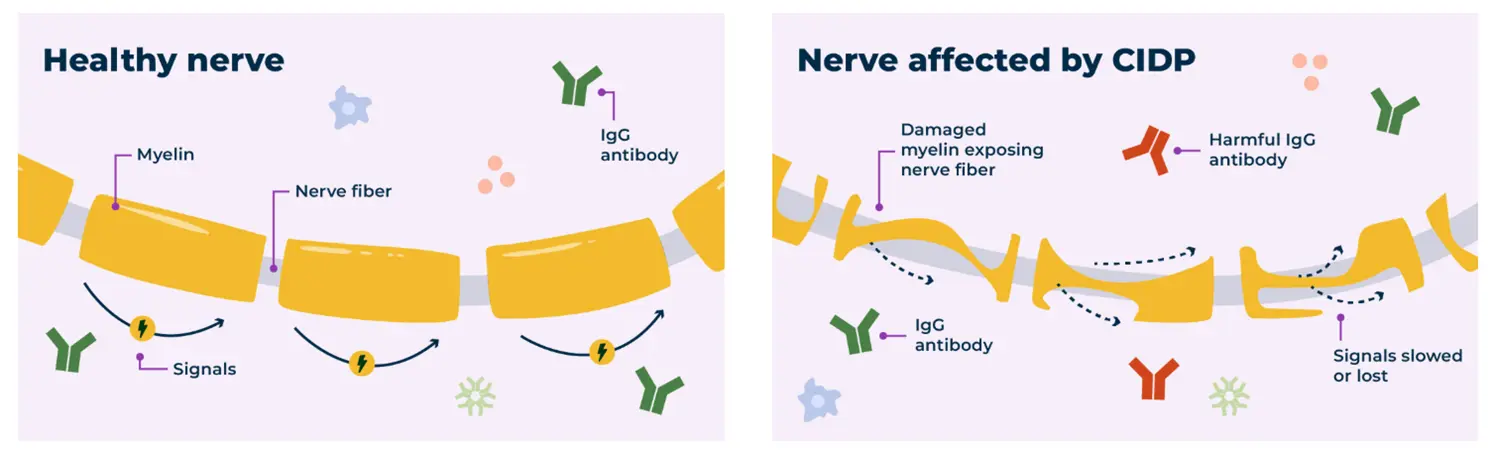
CIDP isn’t a short-term problem. Symptoms usually develop over eight weeks or longer, and they can stick around for months or even years. It’s more common in men than women, and while it can happen at any age, most people are diagnosed in their 50s or 60s. Typically, symptoms start in the feet, then work their way up the legs and arms, and they usually affect both sides of the body at the same time.
CIDP Symptoms: Progressive Weakness and Sensory Loss
CIDP can look different from one person to the next, but the most common symptoms are:
- Progressive weakness in the arms and legs
- Tingling or burning sensations, particularly in the hands and feet
- Numbness and reduced sensation
- Problems with balance and coordination
- Persistent fatigue
- Changes in voice or slurred speech (in some cases)
- Partial or complete paralysis (in severe cases)
For some people, the decline is slow and steady. For others, symptoms come in waves, flaring up and then partially settling down again.
What Triggers CIDP?
- In many cases, there’s no clear answer. No single cause has been identified, and for a lot of patients, CIDP seems to appear without an obvious reason.
- That said, it does tend to show up more often alongside certain other conditions, such as:
- Diabetes
- HIV/AIDS
- Chronic hepatitis
- Inflammatory bowel disease
- Lymphoma or other immune-related cancers
- An overactive thyroid
- Side effects from medications used to treat cancer or HIV
- Even when an associated condition is present, the primary problem, and the primary target of treatment, is always the malfunctioning immune system itself.
Is CIDP Progressive? Will It Get Worse?
If left untreated or not properly managed, yes, CIDP does tend to get worse. The immune system keeps attacking the nerve fibres, and over time, that damage adds up.
How the disease progresses isn’t the same for everyone. There are generally three patterns, shown below:
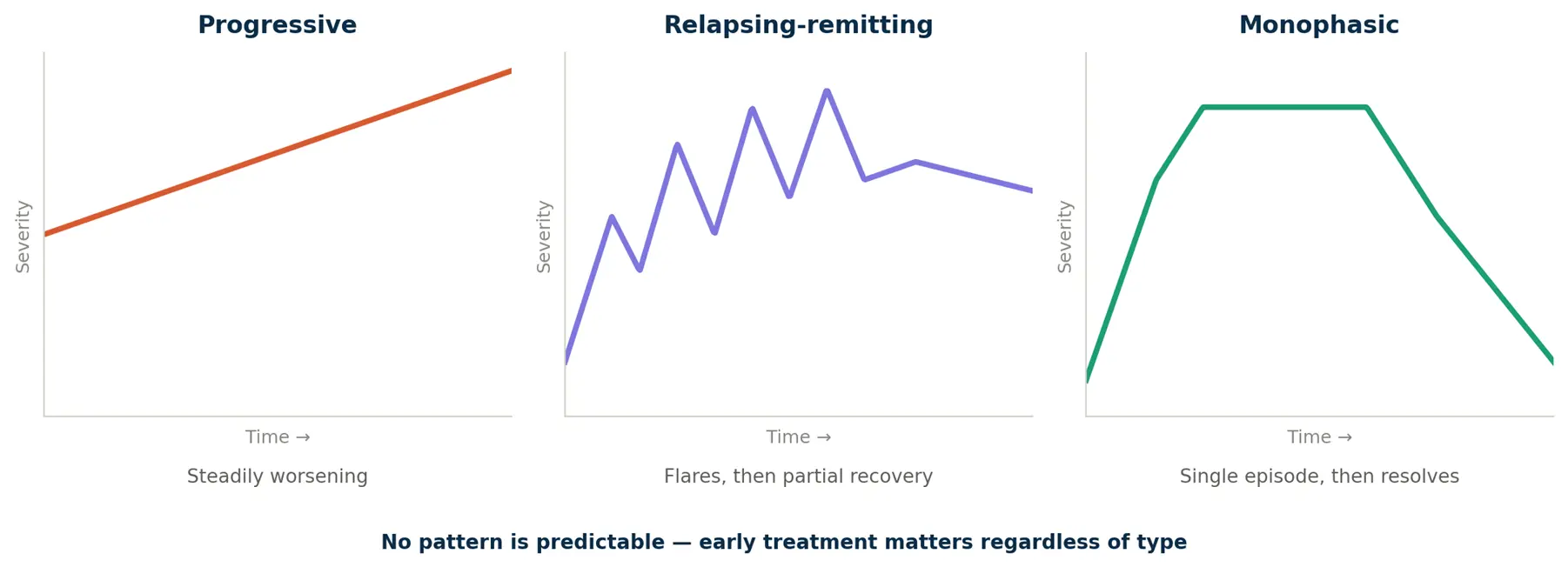
Because no one can predict which pattern a given patient will follow, and because some of the damage can become permanent, acting early really does matter.
Does CIDP Have Stages? How the Disease Evolves
Unlike some cancers, CIDP doesn’t have a formal numbered staging system. But doctors generally talk about severity in terms of how much the disease is affecting daily life:
- Early stage: Mild weakness, tingling, or sensory changes. Most daily activities are still manageable.
- Moderate stage: Weakness becomes more noticeable, balance starts to go, grip strength reduces. Getting through the day takes more effort.
- Advanced stage: Significant weakness or paralysis, loss of reflexes, and a major impact on independence. At this point, quality of life is seriously affected.
The earlier treatment starts, the better the chances of limiting long-term damage. Waiting rarely helps.
CIDP Versus MS: Peripheral Nerves, Not the Brain
They’re related in the sense that both are autoimmune diseases that damage myelin, but they’re not the same condition.
| Feature | CIDP | Multiple Sclerosis |
|---|---|---|
| Nervous system affected | Peripheral (outside brain/spinal cord) | Central (brain and spinal cord) |
| Brain/spinal lesions | Not typical | Present (visible on MRI) |
| Symptom pattern | Usually symmetrical | Often asymmetrical |
| Treatment approach | Immunotherapy, HSCT | DMTs, HSCT |
If there’s any uncertainty about whether your diagnosis is CIDP or MS, getting a thorough neurological evaluation is essential: the distinction matters significantly when it comes to planning treatment.
Why Untreated CIDP Leads to Lasting Nerve Damage
The short answer: things get worse, and some of that damage doesn’t reverse. Untreated CIDP can lead to:
- Permanent numbness and loss of sensation
- Progressive muscle weakness and wasting
- Serious balance problems and a higher risk of falls
- Paralysis of the limbs
- Breathing complications in severe cases
- Permanent disability, as nerve fibres lost to axonal degeneration do not regrow
The immune system won’t stop attacking on its own. Every month without treatment is another month of damage accumulating, which is why getting assessed as early as possible makes such a difference.
What Is the Prognosis for CIDP?
For most patients the CIDP prognosis with treatment is good: the majority respond to first-line therapy such as intravenous immunoglobulin, corticosteroids or plasma exchange, and most continue to walk independently over the long term. The outlook is not uniform. Many patients stay dependent on repeated treatment to hold the ground they have regained, and a smaller group continues to deteriorate despite it. What separates them is not how severe the symptoms feel at diagnosis but the kind of nerve damage the disease has already caused.
CIDP injures the peripheral nerves in two distinct ways. The immune attack strips the myelin sheath, the insulating layer that allows a nerve signal to travel at speed. This is demyelination, and it responds to treatment: remove the inflammation and myelin can be rebuilt. Where inflammation is allowed to continue, the nerve fibre itself begins to degenerate. This is axonal loss, and it is permanent. The muscle that fibre supplied wastes, and no immunotherapy restores it.
That distinction is measurable, and it is the single most useful thing a CIDP patient can understand about their own outlook. In patients followed for between five and twenty-eight years from diagnosis, demyelination scores on nerve conduction studies improved with treatment while axonal scores did not. The finding that axonal loss at diagnosis predicts long-term disability has been replicated across cohorts, and early axonal loss predicts disability decades later. So does the delay between the first symptom and the first treatment.
What the published data show
Against that background, and using the outcome measures set out in the EAN/PNS guideline on CIDP, the published data read as follows.
- Roughly 70 to 80 percent of patients respond to first-line immunomodulatory therapy. In the ICE trial, the largest randomised controlled trial of intravenous immunoglobulin (IVIg) in CIDP, 54 percent of patients responded to IVIg against 21 percent on placebo.
- Response is not the same as recovery. In the prospective International CIDP Outcome Study, 78 percent of newly treated patients improved on at least one outcome measure, yet at one year 48 percent were still on treatment and 36 percent were in remission.
- Most responders become treatment-dependent. Patients who improve on IVIg typically require repeated maintenance infusions, in many cases indefinitely, and symptoms return when infusions are spaced out or withdrawn.
- Residual deficit is common even in patients doing well. In the same cohort, some sensory deficit persisted in 96 percent of patients and neuropathic pain in 25 percent.
- Between 20 and 30 percent of patients do not respond adequately to first-line treatment at all. It is that group for whom transplantation is considered.
| What patients ask | What the published data show |
|---|---|
| Will treatment work? | Roughly 70 to 80 percent respond to first-line therapy. In the ICE trial, 54 percent responded to IVIg against 21 percent on placebo. |
| Will I actually get better? | 78 percent of newly treated patients improved on at least one outcome measure within a year. |
| Will I need treatment forever? | At one year, 48 percent were still on treatment and 36 percent were in remission. Most responders require maintenance IVIg, often indefinitely. |
| Will I be left with symptoms? | Residual deficit is common. Some sensory deficit persisted in 96 percent and neuropathic pain in 25 percent. |
| What if treatment does not work? | 20 to 30 percent do not respond adequately to first-line therapy. This is the group for whom transplantation is considered. |
| What decides my long-term disability? | The axonal loss already present when treatment began, and the delay between the first symptom and the first treatment. |
Does CIDP shorten life expectancy?
CIDP is not, for most patients, a fatal disease. With treatment, life expectancy approaches that of the general population. The burden of CIDP is measured in disability, in dependence on repeated infusions, and in the cumulative side effects of long-term immunosuppression, rather than in mortality. Inadequately treated disease is a different matter: the immune attack does not stop on its own, and what it takes it tends to keep. Independent disease information and patient support are available from the GBS|CIDP Foundation International.
What HSCT changes about the prognosis
Autologous HSCT acts on the part of the prognosis that conventional treatment does not touch, which is the dependence. In the Northwestern University series of 66 patients transplanted for CIDP, every one of whom had failed or become dependent on IVIg or plasma exchange, 83 percent were free of all immune medication five years after a single course of treatment. The proportion able to walk without assistance rose from 33 percent before transplantation to 83 percent at five years. Strength, quality of life and nerve conduction all improved significantly. There were no treatment-related deaths, and overall survival was 97 percent.
What transplantation does not do is regrow axons that have already degenerated. This is the clinical reason prognosis in CIDP is a function of timing, and the reason a patient who is losing ground on maintenance therapy is assessed sooner rather than later. The nerve being protected is the nerve that is still there. The same non-myeloablative protocol is used across our autoimmune programme, including HSCT for multiple sclerosis and HSCT for myasthenia gravis.
Standard CIDP Treatments
Most patients start with one or more of the established first-line therapies:
- Corticosteroids (such as prednisone): Dampen inflammation and slow the immune attack on the nerves
- Intravenous Immunoglobulin (IVIg): Helps regulate the immune response; typically given as regular infusions
- Plasmapheresis (plasma exchange): A procedure that filters damaging antibodies out of the blood
These treatments work well for many people, but they’re not a cure. A significant number of patients need to keep coming back for treatment year after year, and some eventually find that these therapies stop working as well as they once did. For those patients, it’s worth having a serious conversation about HSCT.
 Get HSCT India Brochure Emailed to you
Can HSCT Treat CIDP?
Yes, and for patients who haven’t responded well to conventional treatment, it can be genuinely life-changing.
HSCT doesn’t just put a lid on the immune system for a while. It resets it. The process eliminates the immune cells that have been attacking the myelin sheath and replaces them with healthy stem cells, giving the body a chance to build an immune system that behaves the way it’s supposed to.
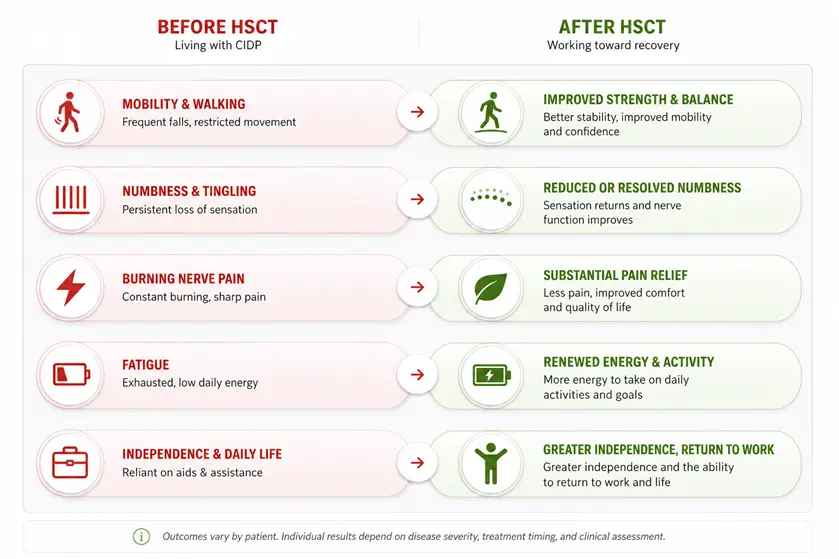
Most patients who go through HSCT for CIDP see meaningful improvement or stabilisation in their symptoms, and many don’t need any further immunotherapy afterwards.
Here is what that improvement commonly looks like across the symptoms patients describe most often before and after treatment:
How Autologous HSCT Stops the Immune Attack on Peripheral Nerves
The treatment happens in four stages, and the whole process takes around 30 days in hospital:
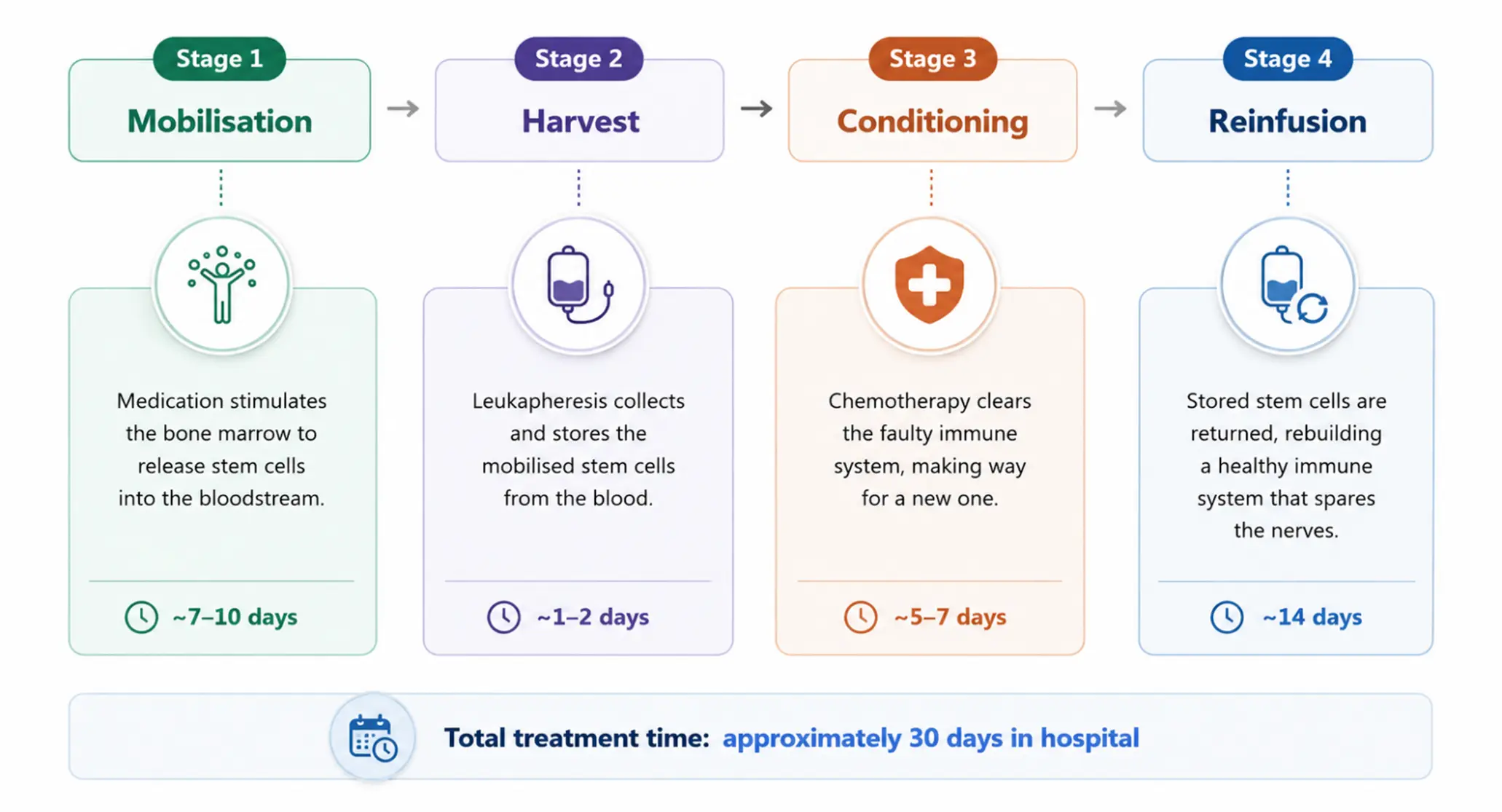
- Mobilisation: Medication is given to prompt the bone marrow to produce extra haematopoietic stem cells and release them into the bloodstream.
- Harvest (Leukapheresis) : The stem cells are collected from the blood using a specialised procedure and stored until they’re needed.
- Conditioning: A targeted chemotherapy regimen is used to clear out the faulty immune system, essentially making room for the new one to take hold.
- Reinfusion : The patient’s own stored stem cells are reinfused. They travel to the bone marrow and get to work building a fresh immune system, one that, crucially, doesn’t recognise the peripheral nerves as a threat.
Can CIDP Be Cured?
Autologous HSCT is the only treatment for CIDP shown to free the large majority of treatment-dependent patients from immune therapy altogether. In the Northwestern University series, the largest published series to date, 83 percent of transplanted patients remained free of every immune therapy five years after a single course of treatment, with improvement in strength, in independent walking and in nerve conduction sustained across that period.
Conventional therapy works on a different principle. Corticosteroids, intravenous immunoglobulin and plasma exchange suppress the immune attack for exactly as long as they are administered. They do not remove the autoreactive immune cells that cause it. That is why most patients who respond to IVIg go on to need maintenance infusions, and why symptoms characteristically return when the interval between infusions is stretched.
Durable remission on conventional treatment does happen. In the prospective International CIDP Outcome Study, around a third of patients were in remission a year after starting treatment, and a proportion of those remain well off treatment for years afterwards. Where first-line therapy is working and continues to work, it should be continued. HSCT is not indicated in well-controlled CIDP.
No CIDP treatment is described as a cure anywhere in the medical literature, and a centre that claims otherwise should be treated with suspicion. A proportion of transplanted patients relapse and resume treatment. Nerve already lost to axonal degeneration does not return, whatever the therapy.
What HSCT offers is the removal of the immune attack that drives the disease rather than its suppression. For a patient tethered to infusions, that is the difference between managing CIDP indefinitely and, in the large majority of transplanted patients, living without treatment for it. Patients who have been through it describe the change in their own words in our patient testimonial videos.
 Request a Call Back
Who Is a Candidate for HSCT?
HSCT isn’t the right fit for every CIDP patient, and we’d never suggest it was. Every case is weighed with care, and patient safety sits at the centre of the decision. The key factors we look at include:
- A confirmed CIDP diagnosis
- Insufficient response to first-line treatments
- How active the disease is and how quickly it’s progressing
- Overall health, including heart, lung, and kidney function
- Age and general fitness
CIDP Transplant Cost in India, and How It Compares Abroad
The all-inclusive HSCT package at HSCT Hospital India is 30,000 US dollars. It covers a 30 day in-hospital admission for the patient and one attendant, in a deluxe private room equipped with triple-level HEPA air filtration, at a JCI-USA accredited hospital.
That figure takes in the full pre-transplant work-up, mobilisation, leukapheresis and cryopreservation, the conditioning regimen and reinfusion, every consultant fee, all investigations, medicines and consumables, transfusion support, physiotherapy, meals and laundry for both patient and attendant, and airport transfers. No further chemotherapy or maintenance immunotherapy is required after discharge.
The comparison that matters in CIDP
In CIDP the meaningful comparison is not against other transplant centres. It is against the cost of staying on treatment. IVIg is among the most expensive chronic therapies in medicine, and it recurs for as long as the infusions continue. Published United States estimates put the cost of IVIg for an average CIDP patient at over 136,000 US dollars per year.
This has been examined formally. In the same cost-effectiveness analysis, autologous HSCT for chronic CIDP was performed at a mean cost of 108,577 US dollars per patient. Because roughly 80 percent of those patients then needed no further immune therapy for up to five years, transplantation was found to be more cost-effective than continued IVIg. At HSCT Hospital India the same procedure is performed for 30,000 US dollars, which is less than a single year of IVIg at the published United States figure.
| Country | Typical cost | Admission |
|---|---|---|
| India (HSCT Hospital India) | 30,000 US dollars | 30 days fully inpatient, patient and attendant, deluxe private room with triple-level HEPA filtration |
| Russia | 40,000 to 45,000 US dollars | 5 to 6 weeks, inpatient |
| Mexico | Approximately 54,500 US dollars | Largely outpatient, with accommodation near the clinic |
| Germany | Approximately 68,000 US dollars | 6 to 7 weeks, inpatient |
| United States | 150,000 to 200,000 US dollars | 6 to 7 weeks. For most CIDP patients, available only within a clinical trial. |
Not included: international airfare, and the management of any complication that extends the admission beyond 30 days. Both are put in writing before you commit to anything. A full breakdown of what the package covers is on our HSCT treatment package and cost page. Click here to get complete details
Frequently Asked Questions About CIDP
What is the prognosis for CIDP?
Most patients with CIDP improve once treatment begins, and with modern immunotherapy the majority continue to walk independently over the long term. Long-term outlook is determined mainly by how much of the nerve damage is demyelination, which is reversible, and how much is axonal loss, which is permanent. Around 70 to 80 percent of patients respond to first-line therapy such as intravenous immunoglobulin, corticosteroids or plasma exchange, but most responders become dependent on repeated maintenance treatment. Between 20 and 30 percent do not respond adequately, and it is that group for whom autologous stem cell transplantation is considered.
Is CIDP curable?
Autologous haematopoietic stem cell transplantation (HSCT) is the only treatment for CIDP shown to free the large majority of treatment-dependent patients from immune therapy altogether. In the largest published series, 83 percent of transplanted patients remained free of all immune therapy five years after a single course of treatment. Corticosteroids, intravenous immunoglobulin and plasma exchange suppress the immune attack only for as long as they are given, which is why most patients who respond to them require indefinite maintenance. No treatment for CIDP is described in the medical literature as a cure, and any centre promising one should be treated with caution.
Can HSCT cure CIDP?
HSCT removes the immune attack that drives CIDP rather than suppressing it. In the Northwestern University series of 66 patients who had failed or become dependent on intravenous immunoglobulin or plasma exchange, 83 percent were free of all immune medication five years after transplantation, and the proportion able to walk without assistance rose from 33 percent before treatment to 83 percent at five years. There were no treatment-related deaths and overall survival was 97 percent. A proportion of patients relapse and resume treatment, and nerve fibres already lost to axonal degeneration do not return.
How much does CIDP treatment cost?
At HSCT Hospital India the all-inclusive autologous HSCT package is 30,000 US dollars, covering a 30 day in-hospital admission for the patient and one attendant in a deluxe private room with triple-level HEPA air filtration at a JCI-USA accredited hospital. The relevant comparison in CIDP is the recurring cost of maintenance therapy: published United States estimates put the cost of intravenous immunoglobulin for an average CIDP patient at over 136,000 US dollars per year, for as long as the infusions continue.
How much does HSCT for CIDP cost in India?
The HSCT package at HSCT Hospital India is 30,000 US dollars, all inclusive. It covers the full pre-transplant evaluation, mobilisation, leukapheresis and cryopreservation, the conditioning regimen, reinfusion, consultant fees, investigations, medicines, consumables, transfusion support, physiotherapy, and food and laundry for both patient and attendant, together with airport transfers, across a 30 day admission. The same procedure typically costs 150,000 to 200,000 US dollars in the United States.
Does CIDP affect life expectancy?
CIDP is not, for most patients, a fatal disease. With treatment, life expectancy approaches that of the general population, and the burden of the condition is measured in disability, in dependence on repeated infusions and in the cumulative side effects of long-term immunosuppression rather than in mortality. Untreated or inadequately treated CIDP causes progressive nerve damage that eventually becomes permanent.
Will I need IVIg for the rest of my life?
Most patients who respond to intravenous immunoglobulin (IVIg) become dependent on it. In the prospective International CIDP Outcome Study, 48 percent of patients were still on treatment one year after starting, and symptoms characteristically return when infusions are spaced out or withdrawn. Autologous HSCT addresses that dependence directly: in the largest published transplant series, 83 percent of patients needed no immune medication at all five years after a single course of treatment.
Does a stem cell transplant work for CIDP?
Yes. A systematic review and meta-analysis of 89 patients across 11 studies found that autologous HSCT achieves marked, sustained clinical improvement in refractory CIDP and allows many patients to come off long-term immunotherapy. In the Northwestern University series, strength, independent walking, quality of life and nerve conduction all improved significantly after transplantation, and 83 percent of patients remained free of immune medication at five years.
What determines long-term disability in CIDP?
Long-term disability in CIDP is determined largely by axonal loss, the degeneration of the nerve fibre itself, which is permanent, as distinct from demyelination, the stripping of the insulating myelin sheath, which is reversible with treatment. In patients followed for between five and twenty-eight years, demyelination measured on nerve conduction studies improved with treatment while axonal loss did not, and the amount of axonal loss present before treatment began predicted disability decades later. The delay between the first symptom and the start of treatment predicted both.
How long does HSCT for CIDP take?
The treatment takes approximately 30 days in hospital and proceeds in four stages: mobilisation, harvest by leukapheresis, conditioning, and reinfusion. At HSCT Hospital India the entire admission, for both the patient and one attendant, is conducted as an inpatient stay in a deluxe private room with triple-level HEPA air filtration. The protocol used requires no further chemotherapy or maintenance immunotherapy after discharge.
Why Choose HSCT Hospital India for Life Changing CIDP Treatment
 HSCT Hospital India is one of the finest private hospitals in India and Accredited by JCIUSA. Most Affordable, 30,000 US $ HSCT package includes complete treatment cost for 30 days inhospital stay in a deluxe private room, Doctors Fee, Tests and Consultations, Medicines, Consumables, Neuro-Physiotherapy and also Food and Laundry for both the patient and the attendant, Airport Transfers etc. Large number of MS patients from Europe, America and Australia already treated successfully. Click here to know more
 Complete 30 day HSCT done in hospital. Private deluxe rooms are very well served for patient and attendant’s comfort and equipped with HEPA Filter with Triple Level Air Filtration. No outside hospital stay avoids risk of infection, 24 x 7 nursing care and best medical attention. Advanced HSCT for MS protocol used does not require any further chemo/ treatment after leaving the hospital. Click here to get complete details
 International and Globally Renowned Accreditations – HSCT Hospital India is accredited by the Joint Commission International, USA, National Accreditation Board for Hospitals and Healthcare Providers (NABH), and National Accreditation Board for Laboratories (NABL) for processes and high-quality patient care.
 Large number of MS patients from Europe, America and Australia have already been treated successfully at HSCT Hospital India. Click here to watch patient testimonial videos
Real Patient– Real Stories