HSCT Guide for Myositis
Medically reviewed by the board of haematologists at HSCT Hospital India, whose transplant physicians hold DM Clinical Haematology qualifications and fellowship training in stem cell transplantation. The programme runs at a JCI-USA, NABH and NABL accredited hospital that has treated more than 1500 patients.
Last reviewed: 21 July 2026. This guide cites peer-reviewed studies, which are linked throughout.
For most people with myositis, medication controls the disease. This guide is written for the smaller group it does not help: patients who flare as soon as steroids are lowered, or whose muscles keep weakening despite one drug after another. For these patients, a stem cell transplant can break the cycle by rebuilding the immune system itself.
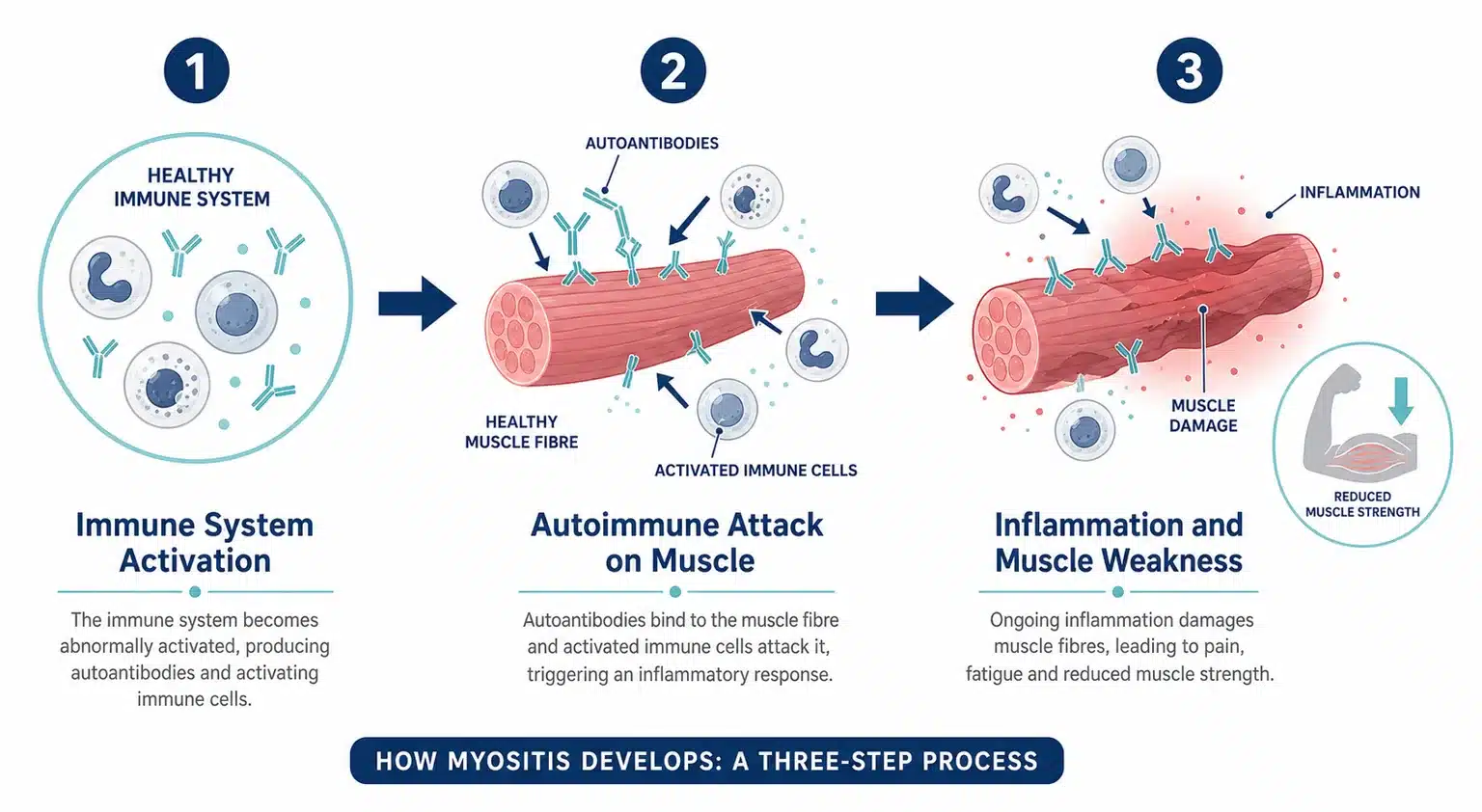
Myositis is the common name for a group of autoimmune conditions called the inflammatory myopathies, in which the immune system attacks the body’s own muscle. The two most common forms are dermatomyositis, which combines muscle inflammation with a distinctive skin rash, and polymyositis, which affects muscle without the rash. Because the disease begins in the immune system rather than in the muscle, the treatments that work are the ones that act on the immune system. A transplant takes this idea to its conclusion: for carefully selected patients, replacing a faulty immune system with a new one grown from their own cells can succeed where years of drugs did not.
What Is Myositis?
In an inflammatory myopathy, the immune system attacks healthy muscle as though it were a threat. White cells and autoantibodies, which are antibodies directed by mistake at the body’s own tissue, collect in and around the muscle and cause inflammation. Left untreated, that inflammation destroys muscle fibres and replaces them with scar. Alongside dermatomyositis and polymyositis are a few less common forms: immune-mediated necrotising myopathy, which is aggressive and raises muscle-enzyme levels very high, and antisynthetase syndrome, which adds inflammation of the lungs and joints to the muscle disease.
One more form, inclusion body myositis, looks similar but is not driven the same way, and that difference changes how it is treated. It is covered later in this guide. The key point here is that a disease driven by the immune system responds to treatments that act on the immune system, and a transplant is the most complete immune reset available. The same autologous transplant is used across our autoimmune programme, including for multiple sclerosis, CIDP, lupus, NMOSD and myasthenia gravis and Sjogren’s syndrome, and you can compare every condition we treat in our HSCT treatment guides.
What Are the Symptoms of Myositis?
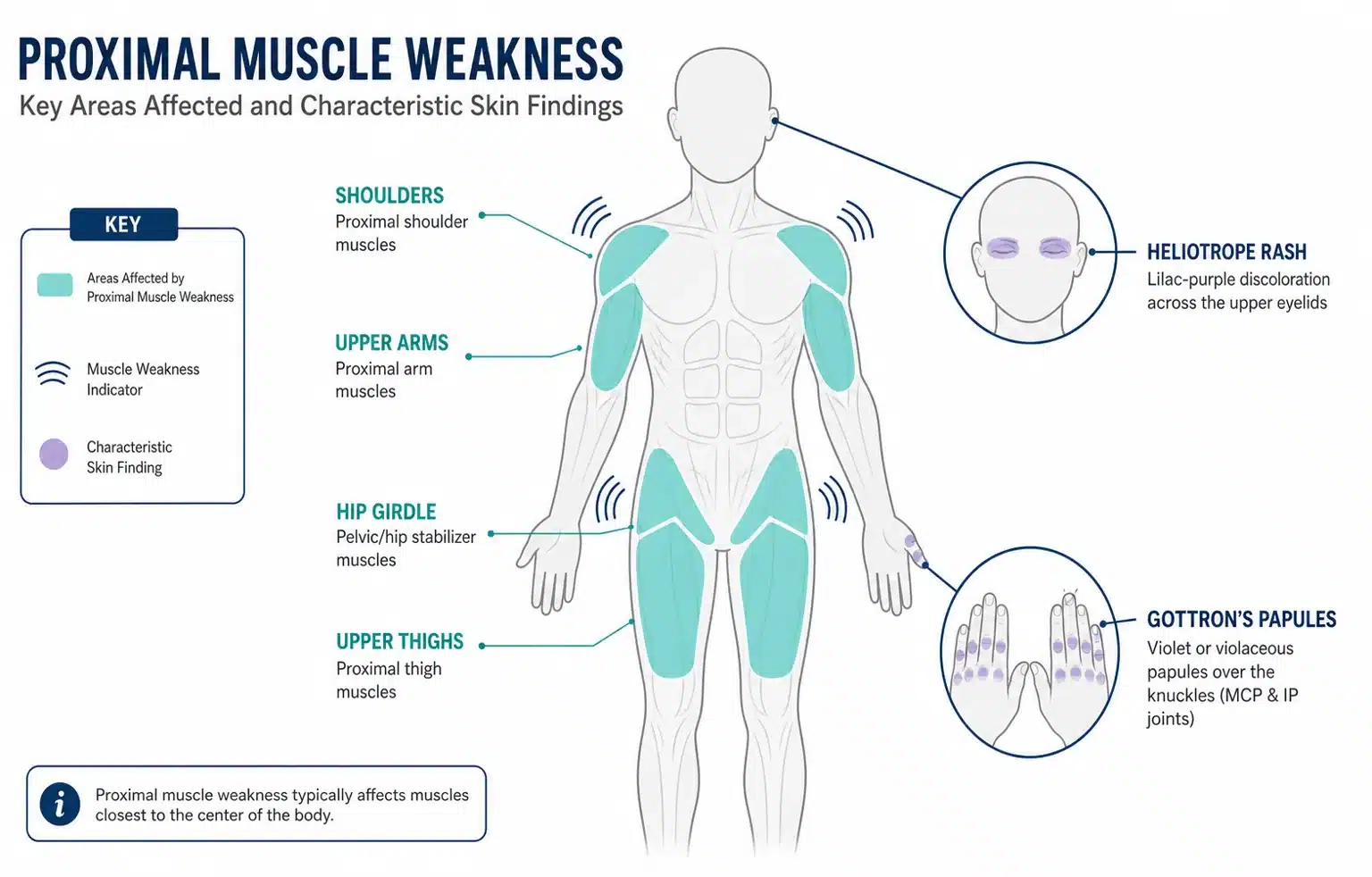
The first thing most patients notice is weakness in the muscles closest to the trunk, the shoulders and hips. Climbing stairs, getting up from a low chair and lifting the arms overhead all become difficult. The weakness comes on over weeks rather than overnight, and it affects both sides of the body equally. In dermatomyositis, the skin often changes before the muscle weakness appears: raised violet patches over the knuckles, a lilac discolouration across the eyelids, and a red rash across the shoulders and upper back. Some patients have trouble swallowing when the throat muscles weaken, and some become breathless when the disease affects the lungs.
How Is Myositis Diagnosed?
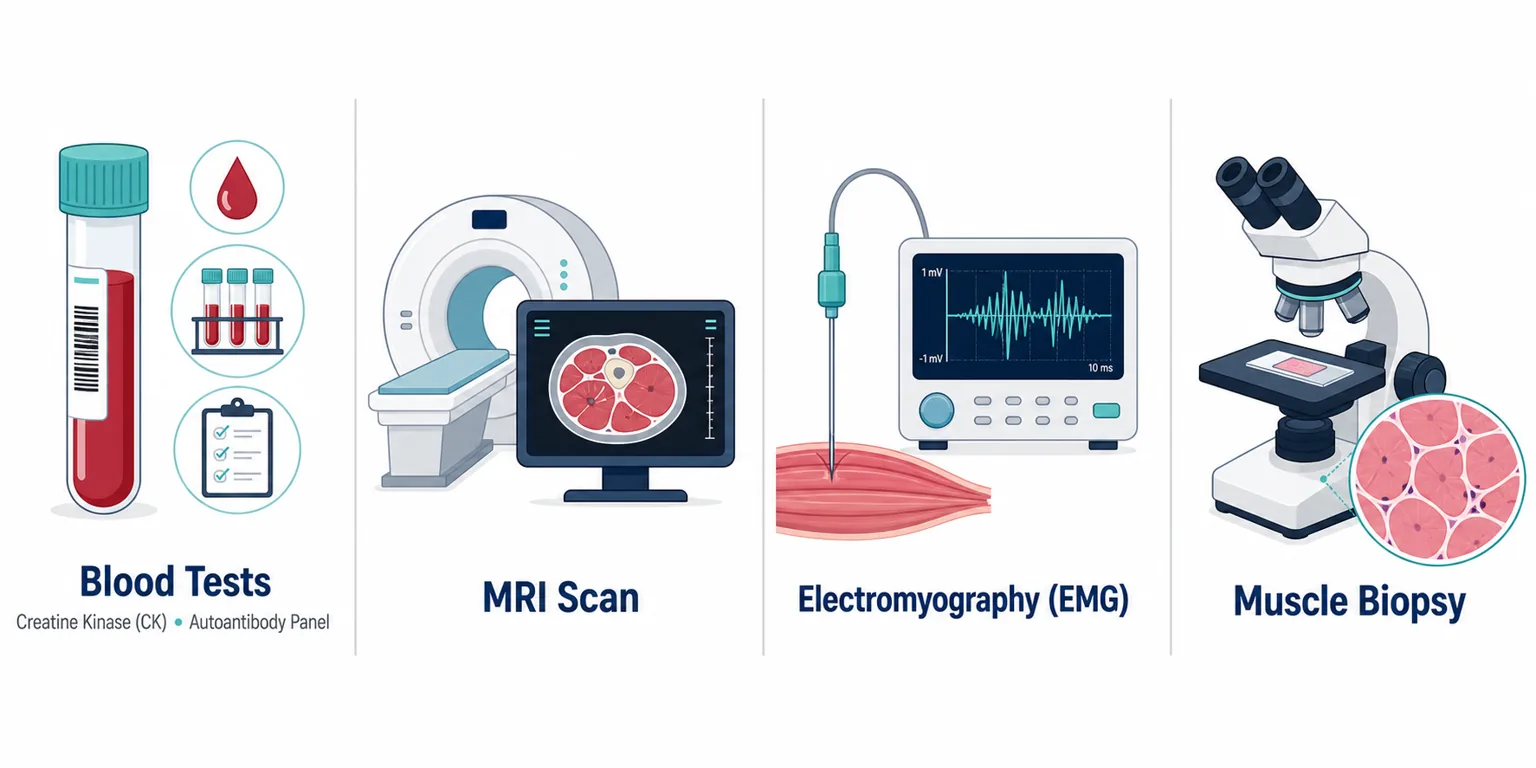
No single test confirms myositis, which is part of why it is often missed for months. The diagnosis is built from several tests together. Blood tests show muscle enzymes, mainly creatine kinase, released from inflamed muscle fibres. An antibody panel is now central to the workup, because the specific autoantibody a patient carries predicts how the disease will behave and which organs it may affect. An MRI scan shows where muscle is actively inflamed and guides the biopsy to the right site. Electromyography, a needle test of the muscle’s electrical activity, shows the pattern typical of inflammation. A muscle biopsy confirms the diagnosis, and in dermatomyositis it shows a characteristic loss of fibres at the edge of each muscle bundle.
The specific autoantibody matters because it predicts how the disease will behave, which organs it may threaten, and how well it is likely to respond to treatment. The most common ones are shown below.
| Autoantibody | What it usually signals | Bearing on treatment |
|---|---|---|
| Anti-Mi-2 | The classic rash, a fairly abrupt start | Tends to answer treatment well |
| Anti-Jo-1 and other antisynthetase | Muscle plus lung inflammation, cracked ‘mechanic’s’ fingers | The lung, not the muscle, drives the urgency |
| Anti-MDA5 | Heavy skin disease, sometimes little weakness | Warns of fast-moving lung disease, treated hard and early |
| Anti-TIF1-gamma | Adult dermatomyositis | Carries a higher cancer link, so screening follows |
| Anti-SRP or anti-HMGCR | Necrotising myopathy, sky-high enzymes | Frequently shrugs off first-line drugs |
Table 1. The myositis autoantibodies a patient is most likely to be told they carry, and what each one means for the road ahead.
What Are the Types of Myositis?
Which form of myositis you have decides whether a transplant can help, because only some forms are driven by an immune attack that treatment can switch off. Dermatomyositis, polymyositis, necrotising myopathy and antisynthetase syndrome all are. Inclusion body myositis is the exception.
It usually begins later in life, weakens the thighs and the grip unevenly on the two sides, and progresses slowly. Unlike the other forms, it does not respond to immune-suppressing drugs, because its muscle loss is a degenerative process as much as an immune one. Resetting the immune system does not change its course, so a transplant is not offered for it, and any programme that offered one would be selling false hope. Everything that follows applies to the immune-driven forms, and this distinction returns later when we look at who actually benefits.
Why Does Myositis Relapse After Treatment?
Standard drug treatment has a built-in limit. Steroids and immunosuppressants control the attack only while you keep taking them, and they do not stop the immune system attacking muscle in the first place. When the dose is lowered, the attack usually returns. This is why many patients spend years on steroids they cannot come off, why each attempt to reduce the dose ends in a flare, and why a little more muscle is lost with each relapse. A transplant is designed to address this directly. Rather than holding the attack down for as long as the drug is taken, it clears out the immune cells driving the disease and allows a new immune system to grow from the patient’s own stem cells, one that has not learned to attack muscle.
What Happens If Myositis Is Left Untreated?
Untreated or undertreated myositis tends to get worse. Continuing inflammation turns into permanent weakness as muscle fibres are lost for good, and beyond the muscle itself, three complications make delay dangerous.
- The lungs. Inflammation and scarring of lung tissue affects roughly a third of patients and is one of the most common causes of death in myositis, most of all in those carrying the MDA5 or antisynthetase antibodies.
- Hidden cancer. Adult dermatomyositis is associated with an undiagnosed cancer in a meaningful minority of patients, mostly in the first few years, which is why cancer screening is part of the initial workup.
- Swallowing and the heart. When the throat muscles weaken, food and fluid can enter the airway, and the heart muscle itself can be affected by the disease.
Older studies put the death rate for dermatomyositis at around one in ten, driven far more by the lung disease and the cancer link than by muscle weakness itself. Treatment can only save muscle and prevent these complications while the disease is still active and reversible, which is the reason to treat refractory disease firmly rather than wait.
How Is Myositis Treated Before HSCT Is Considered?
A transplant is never the first treatment. It is considered only after the standard sequence of drugs has been given a proper trial and has either failed to control the disease or caused side effects the patient cannot tolerate. That sequence is worth understanding, because a transplant is offered for what doctors call refractory disease, meaning disease that is still active after proper treatment.
Treatment starts with high-dose corticosteroids to bring the attack under control quickly. Because no one can stay on high-dose steroids safely, a second drug, usually methotrexate or azathioprine, is added early so the steroid dose can be reduced. Intravenous immunoglobulin, pooled antibody given by drip, is used to settle active disease and has a particular role in dermatomyositis. When these do not hold the disease, treatment moves up to rituximab, which removes the B cells that make the autoantibodies, or to mycophenolate. Cyclophosphamide is reserved for the most severe disease, above all fast-moving lung involvement.
| Rung | Drug | What it is for |
|---|---|---|
| Start | High-dose corticosteroids | Fast control of the attack |
| Spare the steroid | Methotrexate or azathioprine | Lets the steroid dose fall |
| Settle active disease | Intravenous immunoglobulin | Strong role in dermatomyositis |
| Climb | Rituximab or mycophenolate | When the rungs above do not hold |
| Fiercest disease | Cyclophosphamide | Fast-moving lung involvement |
Table 2. The accepted drug sequence for dermatomyositis and polymyositis. A transplant enters the conversation only after this has been worked through without lasting control.
The patients who have worked through this sequence and still relapse every time the dose is reduced are the ones the next section is about.
Email me the costed HSCT plan and set up a call
Can HSCT Treat Myositis? What the Evidence Shows
Autologous stem cell transplantation has brought patients with severe, drug-resistant myositis into lasting remission with no medication at all. In the reports published so far, patients whose dermatomyositis had stopped responding to the usual drugs, children among them, reached full remission after transplant, came off every immunosuppressant, and stayed well for years.
The strength of that evidence deserves a straight account. It comes from case series and from the registries kept by the European transplant societies, not from a large controlled trial. In one long-running series of three children with treatment-resistant juvenile dermatomyositis, every child who was transplanted reached full remission, stopped all medication within a year, and none had relapsed at the last follow-up, which in the longest case was twelve years later, with no deaths from the procedure. Adult reports describe the same durable remission in disease that had exhausted the available drugs. The European best-practice recommendations of 2025 list the inflammatory myopathies among the autoimmune conditions for which an autologous transplant is a reasonable choice in selected refractory patients.
The published studies are careful never to call this a cure, and a clinic that does is overselling it. What a transplant can deliver is remission that holds without drugs, but only for the right patient: someone whose disease is genuinely immune-driven, still active, and has not yet caused permanent muscle damage. Because the numbers are small, careful patient selection and honest counselling are central to doing this well.
| Evidence | What it found |
|---|---|
| Long-running series of three children, treatment-resistant juvenile dermatomyositis | Every child reached full, drug-free remission; none relapsed on follow-up out to 12 years; no procedure-related deaths |
| Adult refractory dermatomyositis reports | Lasting remission after autologous transplant in disease that had exhausted the drugs |
| European best-practice recommendations, 2025 | Inflammatory myopathies listed among autoimmune diseases suited to autologous transplant in selected refractory cases |
Table 3. The published evidence for a transplant in refractory myositis. It is case series and registry data rather than a controlled trial, so patient selection carries the weight. See references.
How Does a Stem Cell Transplant for Myositis Work?
An autologous transplant for myositis is built on the patient’s own haematopoietic stem cells, the marrow cells that give rise to the whole immune system. Autologous means the cells are the patient’s own rather than a donor’s, which is why the graft-versus-host reaction seen after donor transplants does not arise here. The work is done in four stages.
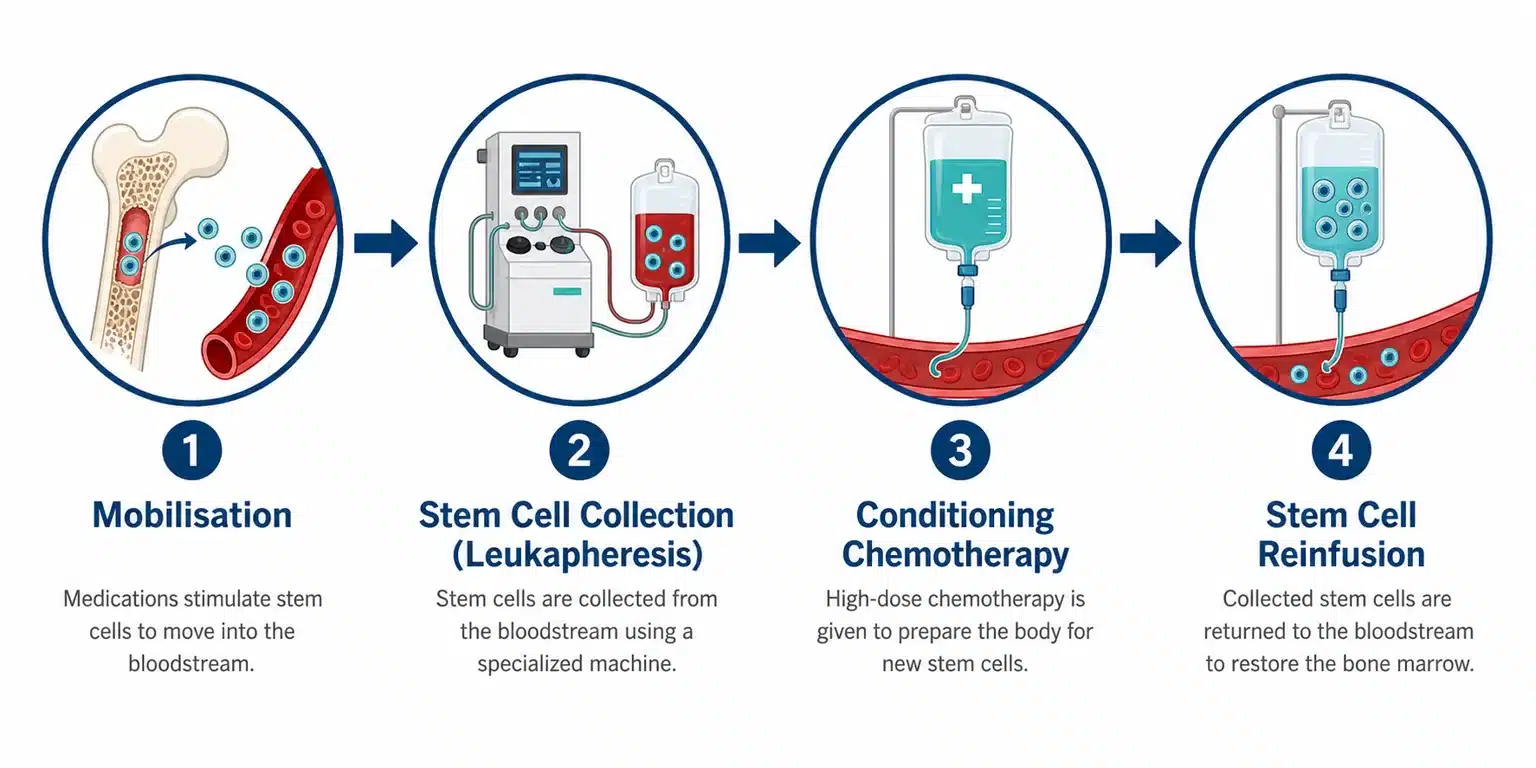
Mobilisation
A dose of chemotherapy together with a growth factor moves the stem cells out of the marrow and into the bloodstream, ready to be collected.
Harvest (Leukapheresis)
Blood is passed through a machine that separates out the CD34-positive stem cells and returns the rest of the blood to the patient. The collected cells are frozen and stored for the next stage.
Conditioning
A short course of immune-clearing treatment, usually cyclophosphamide with antithymocyte globulin, removes the immune cells that have been driving the attack. Our unit uses a non-myeloablative regimen, which resets the immune system without destroying the bone marrow, and has the longest safety record in autoimmune disease. It is based on the non-myeloablative protocol developed by Professor Richard Burt at Northwestern University.
Reinfusion
The patient’s frozen cells are thawed and returned through a drip. Over the next week or two they settle back into the marrow and rebuild a new immune system, one with no memory of attacking muscle. That new immune system is the entire point of the treatment.
What Happens During the 30 Days in Hospital?
The all-inclusive programme runs to a thirty-day hospital stay, the patient and one companion together. The opening days cover admission, the placing of the central line used to collect and return the cells, and mobilisation. Leukapheresis follows once the cells have moved into the blood. Conditioning is then given across several days, and the stored cells go back in.
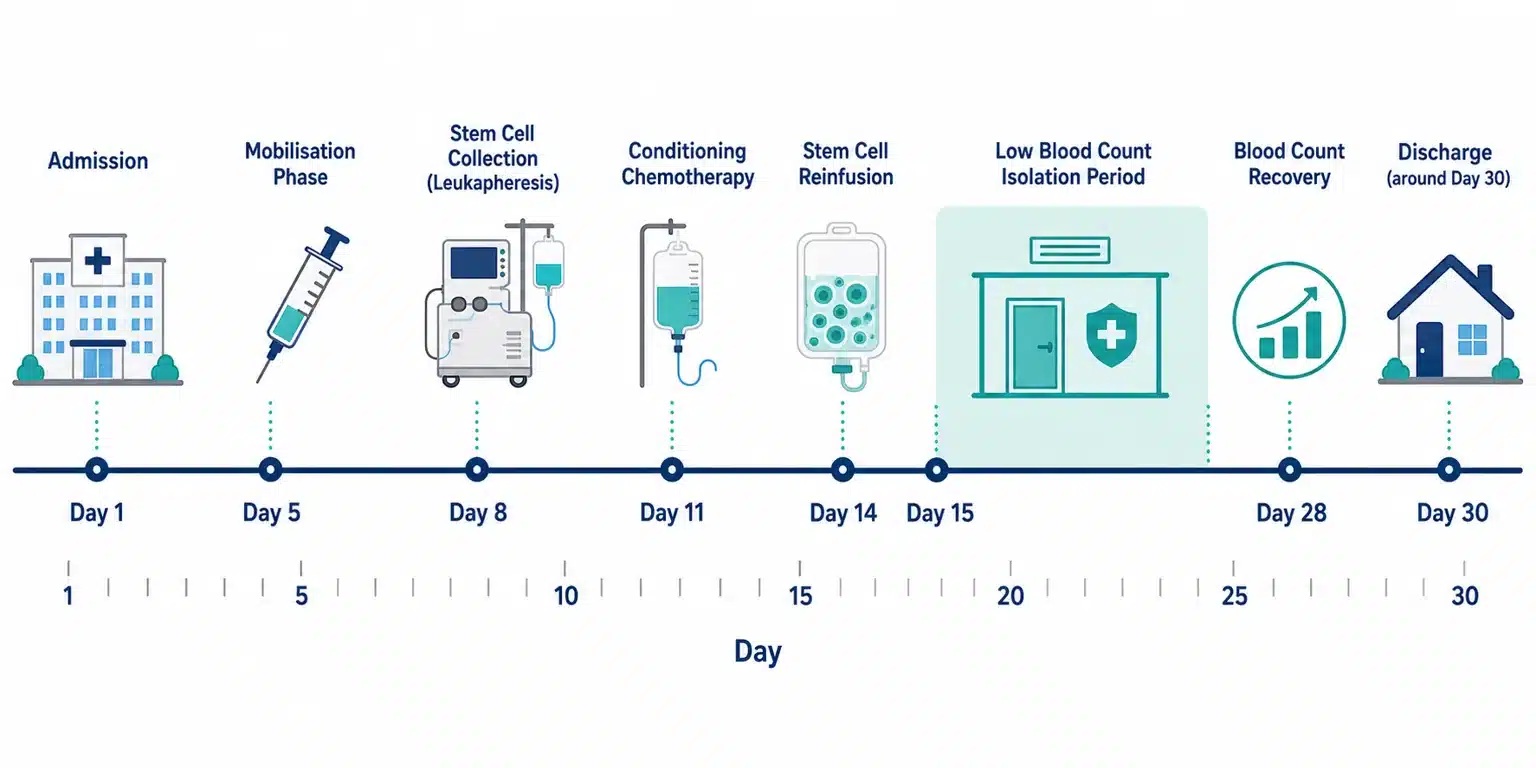
The most demanding period is the week or two after reinfusion, when the old immune system is gone and the new one has not yet grown, so infection is the main risk. The patient spends this time in a deluxe private room with triple-HEPA air filtration, under close monitoring. As the blood counts recover and the graft takes hold, the patient is stepped down, prepared for travel and sent home. A coordination team manages both the medical schedule and the practical side, including the companion’s stay and the logistics, from start to finish.
What Are the Risks of HSCT for Myositis?
A transplant is a serious procedure, and patients deserve the risks stated plainly. Because the cells are the patient’s own, there is no graft-versus-host reaction. The main risk is infection during the period of low blood counts before the new immune system has grown, which is why the filtered isolation and close monitoring exist. The conditioning chemotherapy can cause nausea and temporary hair loss, and it can affect fertility, because the drugs can damage the ovaries or testes, so anyone who may want children is counselled about preserving fertility beforehand. Death from the procedure itself, with today’s non-myeloablative regimens in autoimmune disease, is uncommon but not impossible, which is one reason the treatment is reserved for disease serious enough to justify it. The published myositis series recorded no such deaths, but the numbers are small, and an honest account weighs a serious risk against a serious disease.
HSCT or CAR T Cell Therapy for Myositis: Which Is Better?
CAR T cell therapy has lately produced striking early results across several autoimmune diseases, from systemic sclerosis to Crohn’s disease, and patients are right to ask how it stacks up. Both approaches reset the immune attack, but they sit at very different stages of proof for myositis. A transplant has years of case-series and registry data behind it. CAR T cell therapy in autoimmune myositis has so far been tried in only a handful of patients with short follow-up. It is a genuinely exciting line of work that is still being studied, not yet a settled treatment.
| Autologous transplant | CAR T cell therapy | |
|---|---|---|
| The idea | Grows a new immune system from the patient’s own stem cells | Re-engineers the patient’s T cells to clear the B cells behind the attack |
| Track record in myositis | Case series and registry data over many years | A handful of patients, short follow-up, still investigational |
| Where to get it | Established at experienced units | Mostly within trials and specialist centres |
| Freedom from drugs | Durable drug-free remission reported | Early drug-free remission reported, long-term data awaited |
Table 4. A transplant beside CAR T cell therapy for myositis. For refractory disease today the transplant is the option with the longer record; CAR T is promising and moving fast.
Can Myositis Be Cured?
Of the treatments available, a transplant is the one most likely to hold refractory myositis in remission with no drugs at all. In the published series, patients came off every immunosuppressant and stayed in remission for years, more than ten in the longest case. Doctors stop short of the word cure, and a clinic that uses it should make you cautious. Some patients do relapse, and drugs that had failed before the transplant often begin working again afterwards. For someone who has spent years cycling between flares and failed attempts to taper, lasting remission with no medication is a major change, and for the right candidate it is a realistic goal.
Am I a Candidate for HSCT for Myositis?
Whether a transplant is suitable comes back to the distinction drawn earlier: it acts on active, immune-driven inflammation, so the patients it helps are those whose disease is still active, still immune-mediated, and has not yet caused fixed, permanent damage. An evaluation looks at several things together.
- A confirmed immune-driven myopathy: dermatomyositis, polymyositis, necrotising myopathy or the antisynthetase syndrome. Inclusion body myositis does not qualify, because it does not answer immune treatment.
- Disease that is genuinely refractory, still active after a fair trial of the drug ladder, or drugs that cannot be tolerated.
- Inflammation that can still be switched off, rather than muscle already turned to scar, with enough reserve in the lungs and heart to come through safely.
- No untreated cancer sitting behind the myositis, which is why screening is part of the workup.
The patient with a lot of active disease and muscle still largely intact has the most to gain; the patient with long-standing weakness and little active inflammation has the least. Working out which of these describes you is exactly what a formal evaluation is for, and it is not something a website can decide.
How Much Does HSCT for Myositis Cost?
At HSCT Hospital India the autologous transplant is priced, all in, at thirty thousand US dollars. That price holds a thirty-day stay for patient and companion, the deluxe triple-HEPA room, the transplant itself and the coordination of the whole episode, with nothing added on afterwards. The same treatment in the United States is routinely put at a hundred and fifty to two hundred thousand dollars.
| Where | What an autologous transplant is put at |
|---|---|
| India, HSCT Hospital India, all in | Thirty thousand US dollars, thirty-day stay for patient and companion |
| United States | One hundred and fifty to two hundred thousand US dollars |
| Elsewhere | Set out in our country-by-country cost comparison |
Table 5. What a myositis transplant costs in India against the figure usually quoted in the United States. The full country-by-country breakdown lives on our cost comparison page.
Ask whether your myositis is the kind a transplant can help
Frequently Asked Questions About HSCT for Myositis
Will a transplant cure my myositis?
It is the treatment most likely to hold refractory myositis quiet with no medication, and in the published series patients came off all their drugs and stayed in remission for years. Medicine does not call it a cure, and a centre that does should be treated with caution.
Is my type of myositis one that responds?
The immune-driven forms respond: dermatomyositis, polymyositis, necrotising myopathy and the antisynthetase syndrome. Inclusion body myositis does not, because it is not driven the same way, so a transplant is not offered for it.
Why is inclusion body myositis left out?
Its muscle loss is a wearing-out process as much as an immune one, so suppressing or resetting the immune system does not change its course. Offering a transplant for it would be selling false hope.
Are the cells mine or a donor’s?
Your own. That is what autologous means, and it is why the graft-versus-host reaction that can follow a donor transplant does not happen here.
How dangerous is it?
The main danger is infection in the week or two before the new immune system grows back, which the filtered isolation and monitoring are built around. The conditioning drugs can affect fertility, so that is discussed first. Death from the procedure with modern non-myeloablative regimens is uncommon but not zero.
How long am I in hospital?
The programme covers a thirty-day stay for you and one companion, spanning mobilisation, harvest, conditioning, reinfusion and the first stretch of recovery.
What will it cost?
Thirty thousand US dollars, all in, with nothing added afterwards, against the hundred and fifty to two hundred thousand usually quoted in the United States.
Will I really be able to stop my medication?
That is the aim, and in the published series patients did stop everything. Some relapse and go back on treatment, and drugs that had stopped working before often work again afterwards.
How solid is the evidence?
It is case series and registry data in refractory disease, not a large trial. It points consistently to lasting remission in well-chosen patients, which is exactly why selection and honest counselling matter so much.
References
- Chen J, et al. Long-term follow-up of autologous haematopoietic stem cell transplantation for refractory juvenile dermatomyositis: a case-series study. Pediatric Rheumatology, 2018. link
- Successful autologous peripheral blood stem cell transplantation in severe refractory dermatomyositis. Blood (ASH), 2011. link
- EBMT best-practice recommendations for autologous haematopoietic stem cell transplantation in rheumatic diseases. Bone Marrow Transplantation, 2025. link
- Dermatomyositis. StatPearls, NCBI Bookshelf. link
- EBMT Autoimmune Diseases Working Party guidelines and recommendations. Bone Marrow Transplantation, 2019. link
What Is the Next Step?
No guide can tell you whether a transplant is right for your myositis. That call is made on your own results, the antibody you carry, how much live inflammation is left, the state of your lungs and heart, and the drugs you have already been through, read together. Send us those reports, the biopsy and antibody findings and a note of what you have tried, and we will tell you plainly whether a transplant is worth considering and, if it is, arrange a conversation with our transplant doctors. You can also watch recovery stories from patients we have treated, and patient organisations such as The Myositis Association offer support while you weigh your options.
Why Choose HSCT Hospital India for Life Changing Myositis Treatment

 Complete 30 day HSCT done in hospital. Private deluxe rooms are very well served for patient and attendant comfort and equipped with HEPA Filter with Triple Level Air Filtration. No outside hospital stay avoids risk of infection during the aplastic phase, 24 x 7 nursing care and best medical attention. Advanced HSCT protocol used does not require any further chemo or treatment after leaving the hospital. Click here to get complete details
 International and Globally Renowned Accreditations. HSCT Hospital India is accredited by the Joint Commission International, USA, the National Accreditation Board for Hospitals and Healthcare Providers (NABH), and the National Accreditation Board for Laboratories (NABL) for processes and high quality patient care. Click here to know more

Real Patients,Real Stories
A Finland Patient’s Inspiring Recovery from Multiple Sclerosis after HSCT Treatment at JCI-USA Accredited World Class Hospital in India
Truly inspiring HSCT treatment journey: a man from Finland diagnosed with Primary Progressive

American Cop Flies to India for HSCT: 95% Symptom free, 5 Months after HSCT Treatment at JCI-USA Accredited World Class Hospital in India
Five months after his transplant, about 95 per cent of his symptoms were gone. He was off prednisone, exercising every day, and back at work as a police officer. Dylan: HSCT for Autoimmune Small Fibre Neuropathy Results at a Glance Patient Dylan, South Jersey, United States, aged 28 when he recorded this account Condition Autoimmune
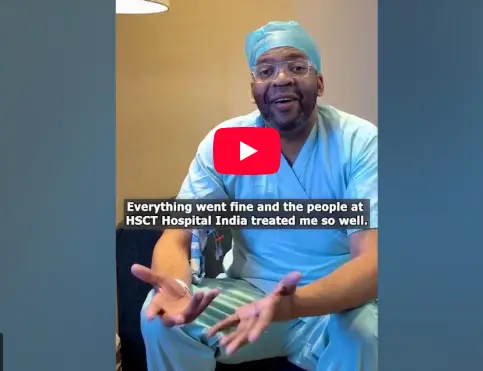
Sergel, 38M from Holland: Multiple Sclerosis Patient shares after HSCT Treatment at JCI-USA Accredited World Class Hospital in India
Watch this Video testimonial: Sergel, 38 years young man from Netherlands suffering from Multiple Sclerosis