HSCT for MS in Australia: What Australian Patients Need to Know
Australians with multiple sclerosis have two realistic routes to HSCT: a funded clinical trial place at home, or self funded treatment overseas at a fixed price.
There are 37,756 Australians living with MS. That number has risen 13.3% in three years and 77% since 2010, and MS now costs Australian society more than $3 billion a year (MS Australia, 2025).
HSCT does exist in Australia. It is offered at three hospitals, and at those hospitals it costs you nothing. The catch is that it is delivered through observational clinical trials, which means a limited number of places and a narrow entry gate. Most Australians who ask about HSCT are told they do not qualify.
HSCT Hospital India has treated more than 1,500 MS patients at a JCI accredited hospital, and assesses every patient individually rather than against a trial protocol. The price is US $30,000, all inclusive, with nothing added afterwards.
1. What is HSCT, and what does it do to multiple sclerosis?
HSCT stands for haematopoietic stem cell transplantation. In multiple sclerosis it is used to stop the immune system attacking myelin, the protective coating around your nerves. The US National Institute of Neurological Disorders and Stroke calls multiple sclerosis an autoimmune disorder, and the myelin it goes after sits in the brain and the spinal cord.
Your own blood forming stem cells are collected and stored. Chemotherapy then clears out the immune cells that have been driving the disease. Your stored cells are returned, and the immune system rebuilds itself without the memory of attacking your nerves.
It is not a drug you take for the rest of your life. It is a single treatment, delivered over roughly a month, and it is the only approach in MS treatment that aims to stop the disease process rather than slow it.
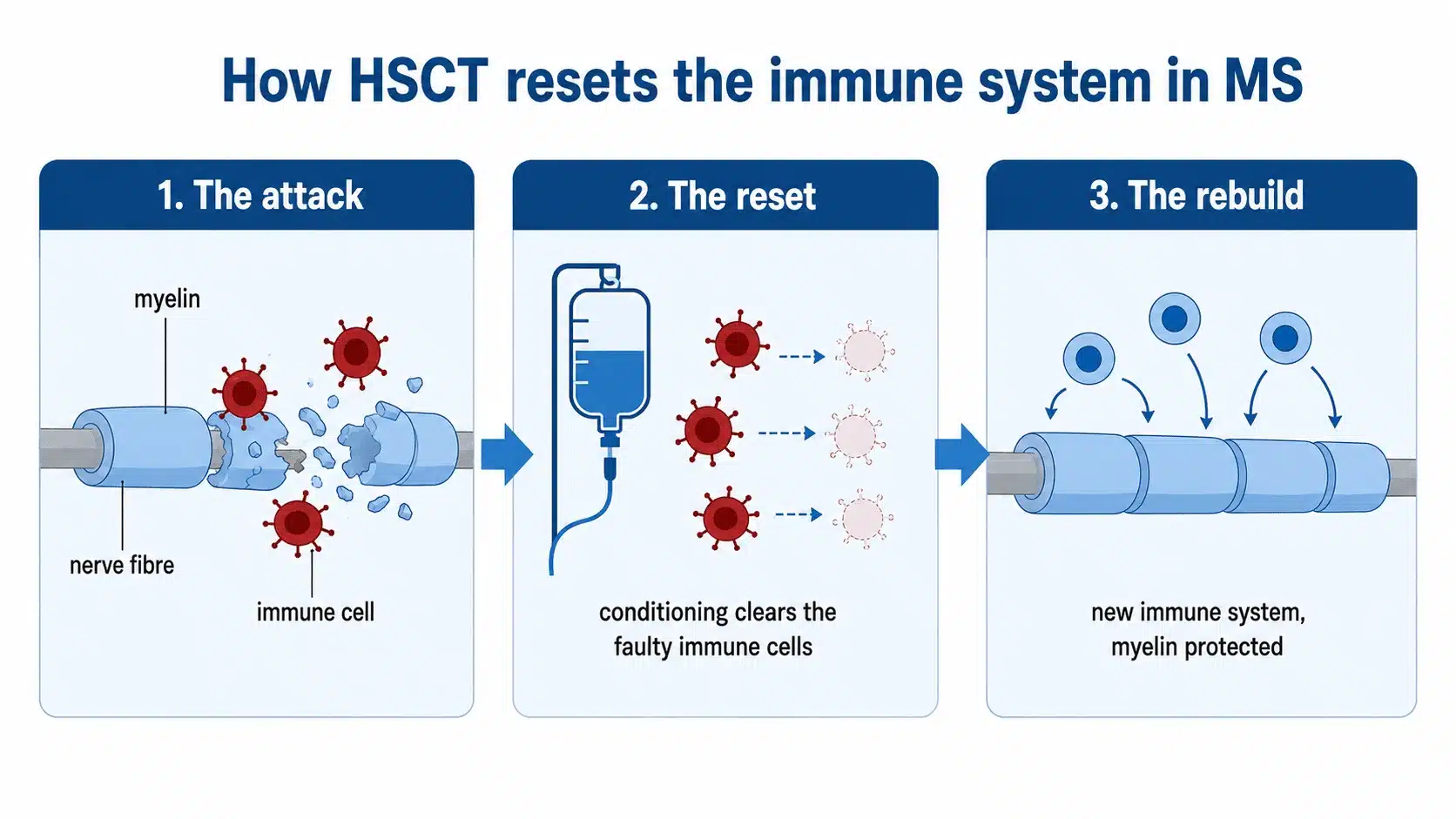
Figure 1. How HSCT resets the immune system that is attacking the nerves in multiple sclerosis.
The distinction that matters to an Australian patient is between HSCT and the drugs your neurologist can already prescribe. Those drugs, which you will hear called disease modifying therapies, reduce how often you relapse. They do not remove the underlying attack, and you take them indefinitely.
HSCT is aimed at the immune cells that cause the damage. Where it works, patients come off MS drugs entirely and stay off them. That is the reason people are willing to fly to another country for it.
The treatment is established rather than experimental. The EBMT Autoimmune Diseases Working Party, the European body that sets transplant practice for autoimmune disease, lists stem cell transplantation for multiple sclerosis as standard of care, and it is used inside the Australian public system. For an Australian patient the open question is access.
 Get Free Expert Opinion Now
2. Does HSCT for MS actually work, and what do the trials show?
Yes, for the right patient, and the evidence is published in the major medical journals rather than in marketing material.
The most quoted study is the MIST trial, a randomised comparison of HSCT against continued MS drug therapy. It is the trial your neurologist will know.
Durability has been measured on a much longer horizon. An international cohort of 281 transplanted MS patients across 25 centres in 13 countries, followed for a median of 6.6 years, recorded overall survival of 93% at five years and freedom from progression in 46% at five years, in a group where 78% had progressive MS (JAMA Neurology 2017). The patients who did best were the younger ones, still relapsing, on fewer previous drugs and less disabled when they were treated. Australian and Canadian follow up now runs to a decade.
What the data does not show is a benefit in every form of MS. The evidence is strongest in relapsing MS with active inflammation, and weakest where the disease has moved into a steady progressive decline without inflammation.
Australia has contributed directly to this evidence base. HSCT Hospital India publishes a summary of the Australian AHSCT trial results, and a fuller comparison in HSCT versus MS drugs.
The questions Australian patients ask most often are answered from the published trials.
| What patients ask | What the published data show |
|---|---|
| Is HSCT better than staying on MS drugs? | In MIST, progression was seen in 3 of the 52 patients randomised to HSCT, and in 34 of the 51 who continued on drug therapy (JAMA 2019). |
| Does the benefit hold over the years? | The Canadian phase 2 trial reported zero relapses and zero new or active lesions on repeat MRI, across follow up that ran for several years (Lancet 2016). See also the page on where patients are 10 years on. |
| Is it safe? | No treatment related deaths were recorded on the lower intensity MIST regimen. One death occurred among the 24 patients given the high intensity Canadian regimen, which is why the gentler conditioning is preferred for most patients and is what HSCT Hospital India uses. |
| Does it work for progressive MS? | MS Australia states that AHSCT “does not halt or reverse progressive forms of the disease”. Active inflammation is what the treatment acts on. |
3. Why is HSCT almost impossible to access in Australia?
HSCT is hard to get in Australia because it is not a standard funded treatment there. It is delivered as research.
MS Australia lists three centres offering it: St Vincent’s Hospital in Sydney, Austin Health in Melbourne and The Alfred in Melbourne. A small number of other centres may consider it case by case.
At those centres the treatment is delivered through observational clinical trials. That has one genuine advantage, which is that it costs the patient nothing. It also has a structural limit: a trial has a fixed number of places and a fixed protocol, and a patient who does not fit the protocol is not offered another place.
The entry gate is narrow by design. Australian hospitals recommend HSCT only where the approved MS therapies are not working or cannot be used. You are expected to have failed treatments first. Younger patients with new MRI lesions and ongoing relapses are the ones most likely to be accepted.
If your MS is progressive rather than relapsing, the Australian answer is no, because the trials recruit on active inflammation.
The trial structure is how a country builds its own evidence base, and it also means that for the large majority of the 37,756 Australians living with MS the practical availability of HSCT at home is zero. MS Australia acknowledges that patients are travelling overseas at considerable personal cost as a result.
What those patients found was a hospital that assesses each person on their own scans, relapse history and current disease activity rather than against a trial protocol. HSCT Hospital India has treated more than 1,500 MS patients on that basis.
4. How does the treatment in India differ from the Australian route?
The transplant itself is the same in India as it is in Australia. What differs is who decides you are eligible, how long you wait, and what you pay.
In Australia the decision is made against a trial protocol. In India it is made by the doctors who will treat you, working from your MRI films, your relapse record and how active the disease is right now.
A trial protocol is a fixed list, written before anyone saw your scans. An individual assessment starts from the scans. Two doctors can read the same MRI and reach different conclusions, because one is asking whether you fit the study and the other is asking whether the treatment will help you.
The medical difference is the strength of the chemotherapy, which doctors call conditioning. Conditioning clears the misdirected immune cells before your own stem cells are given back. A high intensity regimen empties the bone marrow completely. A lower intensity one switches the faulty immune response off and leaves enough marrow to recover quickly. Both reset the immune system, and the lower intensity version carries less risk. It is the regimen on which the MIST trial recorded no treatment related deaths, and it is the one HSCT Hospital India uses.
The other practical difference is timing. A trial place depends on recruitment. An individual assessment depends on your records reaching a doctor. A trial place is also free, while HSCT Hospital India costs US $30,000, all inclusive and fixed before you travel. For most Australians that is the price of being treated at all.

Figure 2. How HSCT for MS is accessed in Australia, compared with HSCT Hospital India.
| Australia | HSCT Hospital India | |
|---|---|---|
| How it is offered | Observational clinical trials at three centres | Standard treatment, assessed individually |
| Who is eligible | Relapsing MS where approved therapies have failed or cannot be used. Not offered for progressive MS | Assessed case by case on your scans, history and current activity |
| Where | St Vincent’s Sydney, Austin Health Melbourne, The Alfred Melbourne | JCI accredited hospital, more than 1,500 MS patients treated |
| What you pay | Nothing, if you are accepted onto a trial | US $30,000, all inclusive, nothing added afterwards |
| The catch | Limited places, narrow entry criteria, no route if you do not fit | You travel, and you self fund |
| Room | Standard hospital allocation | Private room with triple HEPA filtered air for the full stay |
5. What sends Australian patients to HSCT Hospital India?
Australian patients travel to HSCT Hospital India for four reasons: they were declined at home, they did not want to lose more function while they waited, the price is fixed and known before they leave, and the hospital runs this treatment at volume.
The first is simply that they were declined at home, or told the trial was not recruiting, or told their MS was the wrong type. An individual assessment is a different question from a trial protocol, and patients who did not fit one sometimes fit the other.
The second is time. MS does not pause while you wait, and disability you accumulate before treatment does not come back. That is the argument set out in why waiting on HSCT costs you function.
The third is cost certainty. US $30,000 covers the entire treatment. Australians comparing options against Mexico, Russia or the United States can see the full picture in the HSCT cost by country comparison, and against other centres in the guide to the best HSCT hospitals worldwide.
The fourth reason is the one patients tend to mention afterwards rather than beforehand. More than 1,500 MS patients have been treated. The staff are not learning on you.
You can see who would be treating you on the medical doctors team page, and read about the facility itself at HSCT Hospital India.
6. What happens during HSCT for MS, stage by stage?
The treatment runs over about 30 days as an inpatient, and it has four stages.
First your own blood forming stem cells are mobilised and collected from your bloodstream and stored. Then chemotherapy clears out the immune cells driving the disease. Then your stored cells are returned. Then your immune system rebuilds, and you recover.
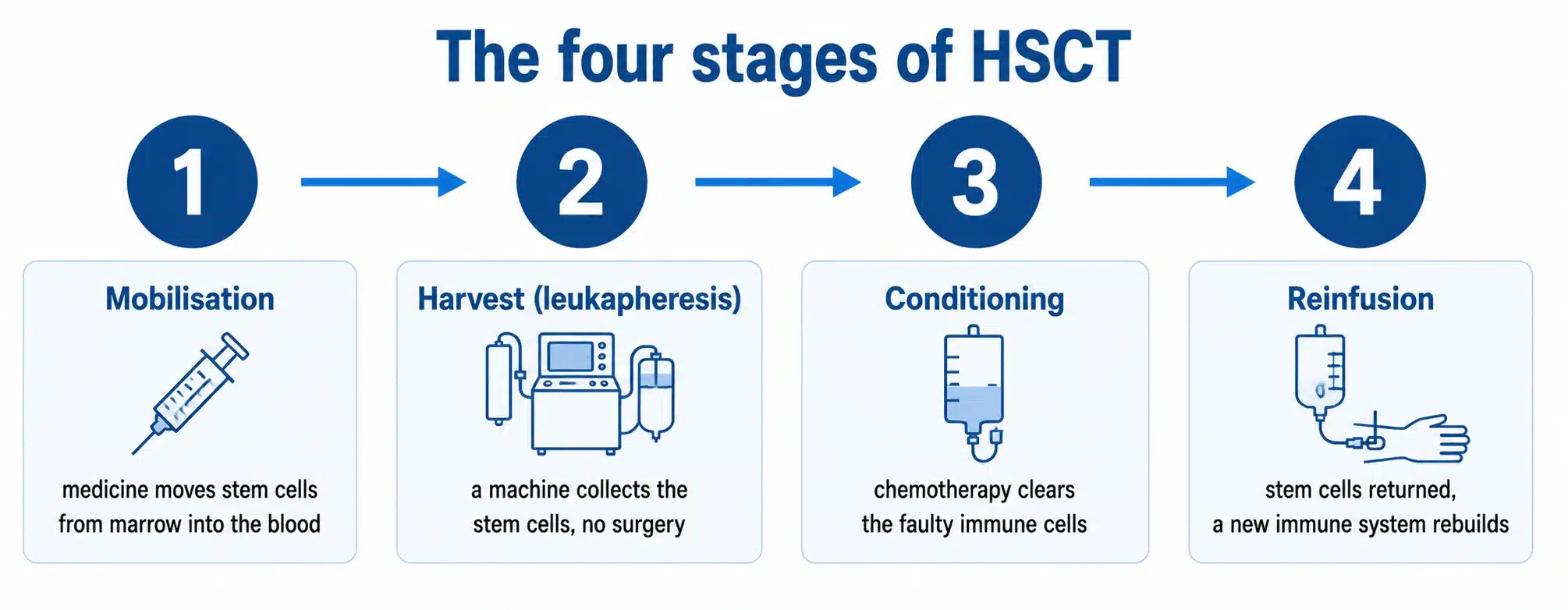
Figure 3. The four stages of HSCT for MS: mobilisation, harvest, conditioning and reinfusion.
The stage patients worry about most is the middle one, when your immune defences are at their lowest. That is why the room matters. At HSCT Hospital India the full stay is in a private room with triple HEPA filtered air, which is the practical protection against infection during that window.
Neuro physiotherapy runs alongside the medical treatment rather than afterwards, and it is included in the package.
You will need an attendant with you. Their food and laundry are included too, which is not a detail most hospitals bother to cover.
The full sequence, day by day, is set out on how it works.
7. How risky is HSCT for MS, and what lowers the risk?
The risk of HSCT for MS is set mainly by two things that HSCT Hospital India controls directly: the strength of the chemotherapy, and the air the patient breathes while the new immune system is coming up. Both are chosen to keep the risk as low as the treatment allows.
The main risk is infection during the weeks when your immune system is rebuilding. There is also hair loss, fatigue, and an effect on fertility that matters a great deal to younger patients.
The single biggest factor in how risky the treatment is turns out to be the intensity of the chemotherapy used. One death occurred among the 24 patients treated on the high intensity Canadian regimen, while the lower intensity MIST regimen recorded none. HSCT Hospital India uses the lower intensity approach.
The second factor is the environment during recovery, which is the reason for the private HEPA filtered room rather than a shared ward.
On fertility, this is worth settling before you travel rather than afterwards. It is covered in fertility preservation before HSCT.

Figure 4. The strength of the chemotherapy is what sets the risk of HSCT for MS.
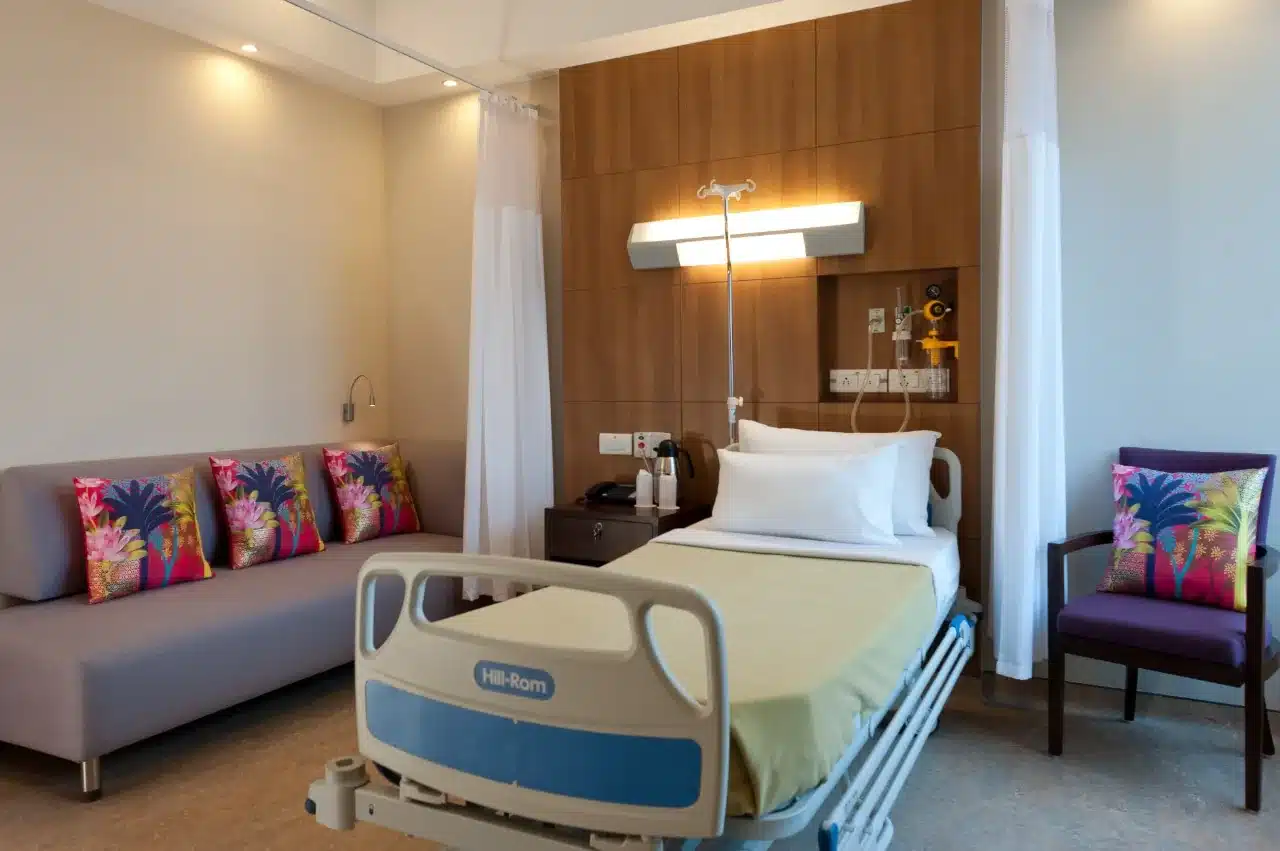
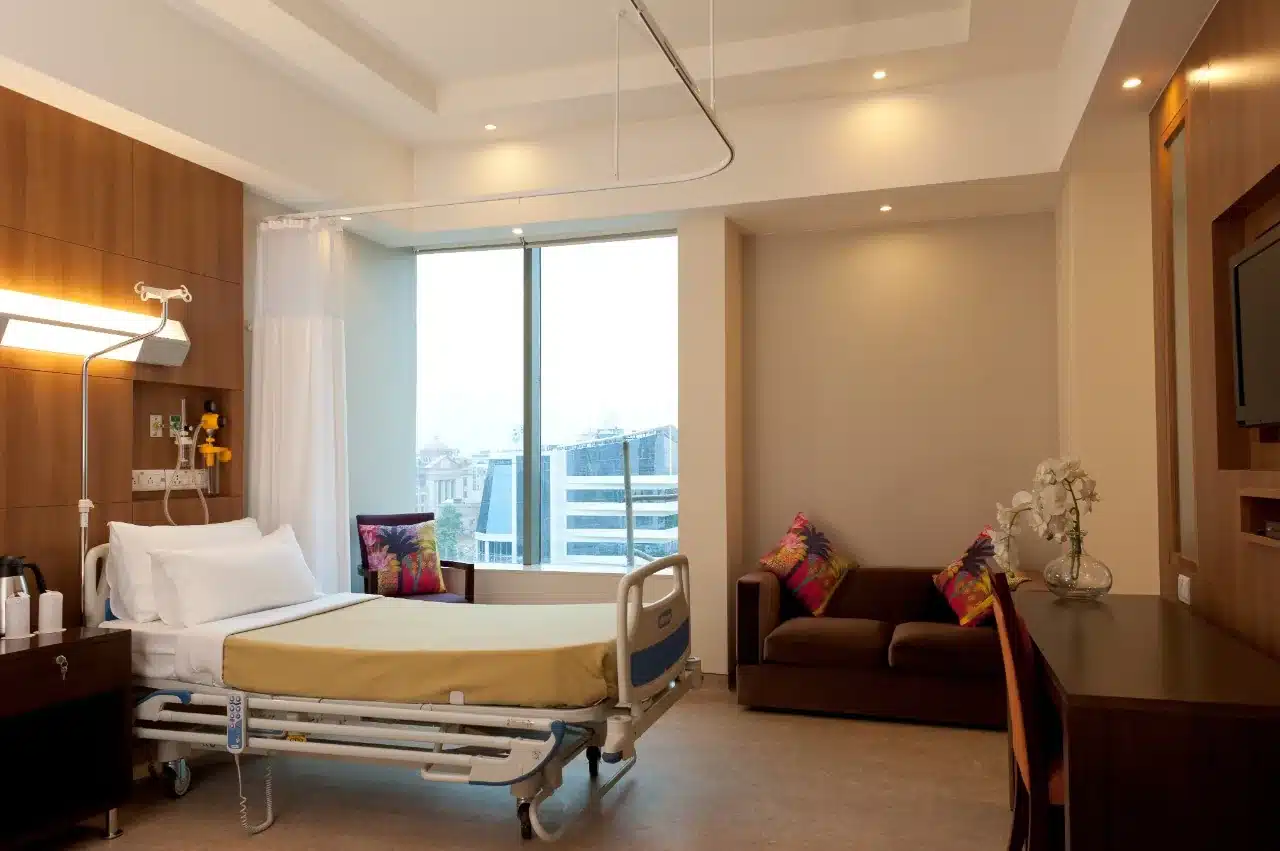
Figure 5. The deluxe private rooms in which Australian patients spend their whole admission at HSCT Hospital India, with a bed for the attendant and triple HEPA filtered air.
8. What can an Australian patient expect after HSCT for MS?
Most Australian patients treated while their MS is still relapsing stop relapsing, stop showing new activity on MRI, and come off their MS drugs. That is what the MIST data describes, and it is the realistic expectation wherever inflammation is still active.
Recovery of function you have already lost is a different and less predictable matter. Some patients regain a great deal. Others stabilise where they are, which for someone who has been declining every year is itself the outcome they came for.

Figure 6. What happened to patients in the MIST randomised trial, JAMA 2019.
Progression is measured on a scale your neurologist uses called the EDSS. Your EDSS score is the most useful number to have before you ask about eligibility, and your neurologist can tell you what it is. It is explained in plain terms on the EDSS disability scale.
The pattern in the follow up data is consistent: the earlier the treatment happens in the course of the disease, the better the result. It is also the reason Australian trial criteria favour younger patients with active inflammation.
No centre can promise a specific personal outcome, which is why HSCT Hospital India reviews the scans before it accepts anyone.
 Get Free Expert Opinion Now
9. Who is a candidate for HSCT, and which MS patients qualify?
The strongest candidates share a profile: relapsing MS, active inflammation showing on MRI, relapses still happening despite treatment, and a disability level that has not yet reached the point where the damage is fixed. That is the profile set out in the EBMT and JACIE transplant guidelines for multiple sclerosis.
Age matters. Younger patients do better, consistently, across every published series (JAMA Neurology 2017). Under 60 is a guide rather than a hard line. Heart, lung and kidney function are checked as well, because the body has to recover from chemotherapy.
Disability level matters just as much. Neurologists score it on the EDSS scale, which runs from 0 for no disability to 10. HSCT Hospital India’s usual range on that scale goes up to 6.5, where walking is still possible with support. Higher up the scale, more of the disability comes from old damage that no immune reset can undo.
Time since diagnosis counts too. Shorter is better, which is why a patient two years in is assessed differently from one twelve years in.
A strong candidate is under 60, relapsing, with fresh MRI activity, relapses despite treatment, still walking, and not many years into the disease. A weaker candidate usually has long standing disease, a quiet MRI, no relapses for years, and disability rising without relapses.
Having failed drug treatments is not a disqualification. It is close to the opposite. Both the Australian criteria and the trial evidence assume that the approved therapies have been tried.
Where the answer is more cautious is long standing progressive MS with no inflammatory activity. HSCT acts on inflammation. Where inflammation has stopped and the decline continues, the treatment has less to act on, and MS Australia says so directly.
HSCT is also used for other autoimmune conditions, and the full list is in the HSCT treatment guides, including CIDP and NMOSD.
Is there an age limit for HSCT at HSCT Hospital India, and how high can my disability score be?
The usual range at HSCT Hospital India is an age of up to about 60 and an EDSS score of 6.5 or below. If walking about 20 metres without a rest takes support on both sides, such as two sticks, your score is usually 6.5. Both figures are a guide, and every case is assessed individually.
Your age is read alongside your fitness for chemotherapy. This is why people in their fifties with active inflammation on their scans are assessed as a matter of routine. A score above 6.5 is also reviewed individually. Because more disability can raise the risk of treatment, your fitness for chemotherapy is checked with particular care at that level. The review then tells you clearly whether the benefit you can expect outweighs that risk.
HSCT Hospital India also assesses patients who have no formal EDSS score. A description of how far you can walk now, and of how that has changed over the last two years, is enough. The HSCT specialists then set your score during the free review, and the EDSS calculator gives you an estimate beforehand.
What does active MS look like on my MRI scan?
Active MS shows up on an MRI as lesions, which are areas of inflammation or damage in the brain or spinal cord. A lesion counts as active when it is new or has grown. It also counts when it lights up after a contrast dye is injected during the scan. A lesion that lights up is inflamed on the day of the scan, and that inflammation is what HSCT stops.
HSCT Hospital India looks for this activity on scans from the last 12 months, and your relapse history is weighed alongside the scans. To see the activity, the HSCT specialists place each scan beside the one before it. That is why they ask for your MRI films, meaning the scan images themselves, as well as the written report. HSCT Hospital India sets out its eligibility criteria, including how progressive MS is assessed, on its HSCT eligibility criteria page.
10. Turned down in Australia, what happens then?
Often yes, because a no in Australia is usually a decision about a trial place rather than a clinical judgment that HSCT cannot help you. This is the most common reason Australians make contact.
A no in Australia usually means one of three things: the trial was not recruiting, you did not match the trial protocol, or your MS was judged progressive rather than relapsing.
The first two are administrative rather than medical. A trial place is a finite resource. Not fitting a protocol is not the same as not being treatable, and an individual assessment can reach a different conclusion on the same scans.
The third is medical, and HSCT Hospital India gives the same answer as MS Australia. If your MS is progressive with no inflammatory activity, HSCT has less to offer, and the assessment will say so.
Which of the three you were given is often not spelled out. What the decision turned on is the clue. Places, recruitment, criteria or waiting lists point to an administrative no. Progressive MS, or inflammation no longer showing on your scans, points to a clinical one.
A second opinion is a review of documents, not another round of testing. The HSCT doctors read your most recent MRI films and report, your relapse history with dates, which drugs you took and why they stopped, your current medication, your EDSS score and any letter setting out the Australian decision.
What decides it is your actual records. Send those and an HSCT case manager will come back with an answer. That answer normally arrives within a few days of your MRI films, relapse history and drug record reaching the HSCT specialists. A yes arrives with a written plan, a fixed cost of US $30,000, a date, and an invitation letter for the medical visa. The review itself costs nothing.
If your case is not accepted, the answer names the reason and whether anything could change it. If your scans show no current inflammation, a new MRI in six or twelve months can lead to a different decision. This is because MS activity rises and falls over time. The concern may instead be a heart, kidney or other test result that affects your fitness for chemotherapy. That finding is then named so your own doctors in Australia can work on it.
11. What does the treatment cost an Australian patient?
US $30,000, all inclusive, for the complete treatment and up to 30 days as an inpatient. There is no second invoice at the end.
Cost is the reason most Australians start looking abroad, so here is the breakdown line by line rather than a headline number.

Figure 7. Every item covered by the US $30,000 all inclusive package at HSCT Hospital India.
Four things sit outside the price. Your flights and the India medical visa fee are two of these things, and you pay both directly. Your HSCT case manager helps you with the visa application. A private nurse attendant, needed only if you travel without an attendant of your own, costs US $1,500 for the 30 days. A stay beyond 30 days, needed only in rare cases, is charged separately.
| Item | Included in the US $30,000 |
|---|---|
| All pre treatment testing and workup | Yes |
| MRI scans | Yes |
| The complete HSCT procedure, all four stages | Yes |
| Hospital stay, up to 30 days, private room with triple HEPA filtered air | Yes |
| All doctors’ fees | Yes |
| All tests and consultations during the stay | Yes |
| All medicines and consumables | Yes |
| Neuro physiotherapy | Yes |
| Food and laundry for the patient | Yes |
| Food and laundry for your attendant | Yes |
| Airport pick up and drop back | Yes |
| International flights from Australia | No, you arrange these |
| India medical visa fee | No, you pay this directly, and your HSCT case manager helps with the application |
| Private nurse attendant, if you travel without an attendant of your own | No, US $1,500 for 30 days |
| Stay beyond 30 days, in the rare cases it is needed | No, charged separately |
Set that against the Australian position. A trial place is free, and it is also finite, protocol bound and closed to most people who ask. No other publicly funded route exists. For most of the 37,756 Australians living with MS, the alternative to travelling is no transplant at all. MS Australia puts the yearly cost of the disease at A$42,688 for a person with no disability and A$135,780 for a person with severe disability.
HSCT Hospital India has no trial quota and no long waiting list. Every patient is assessed on their own scans and history, the price is fixed at US $30,000 before anyone travels, and nothing is added afterwards.
Once you are home, your own neurologist or GP in Australia takes over your follow up. That doctor runs the blood tests that check your blood cells are recovering. The doctor works from the discharge summary and aftercare manual you bring home, which record your treatment and guide your care. Sending updates to HSCT Hospital India afterwards costs nothing. There is no follow up chemotherapy to pay for either.
A full country by country comparison is on the HSCT cost by country page, and the package itself is detailed on the HSCT treatment package.
12. What does HSCT actually change for someone with MS?
HSCT stops the immune attack that drives multiple sclerosis, and in the patients where it works the change is complete rather than partial. Relapses stop. New lesions stop appearing on MRI. Disease modifying drugs are discontinued and not restarted.
In the MIST randomised trial that meant 49 of 52 transplanted patients showed no disease progression, against 17 of 51 who stayed on their drugs. Most patients in that trial also improved on the disability scale rather than merely holding steady, which is something no MS drug has been shown to do.
For an Australian who has spent years cycling through therapies and watching the scans get worse each time, that is the outcome being bought: the disease process stops rather than slows.
Function already lost is a separate question. Nerve damage that happened before treatment does not reverse on its own, although rehabilitation and the neuro physiotherapy included in the package recover more of it than most patients expect, particularly in the first year.
The follow up data now runs past a decade and it holds. A minority of patients do see activity return later, and HSCT is best described as a durable stop rather than a guaranteed permanent one.
13. Flying from Australia to Delhi and home again
It starts before you fly. You send your recent MRI, your relapse history, your current medication and your EDSS score, and an HSCT case manager reviews them and tells you whether you are a candidate.
If the answer is yes, you get a date, a written cost that does not change, and a visa letter.

Figure 8. The five steps from an enquiry in Australia to treatment at HSCT Hospital India.
Flights from Sydney, Melbourne, Brisbane or Perth to Delhi are direct or one stop. You are met at the airport, and that transfer is part of the package rather than something you organise on arrival jet lagged.
You are then an inpatient for up to 30 days with your attendant, in a private HEPA filtered room. Most Australian patients plan for around five weeks in country in total.
The 30 days have a shape. Tests and workup first, then the medicine that moves stem cells into the blood, then the harvest, done through a drip line rather than surgery. Conditioning chemotherapy follows, then your own cells go back in. Then come the quiet weeks, when counts are low and daily bloods track the new immune system coming up.
Pack for a hospital room, not a holiday: MRI films and reports, a medication list, loose clothes, chargers, a power adapter, and something to fill long quiet days. One attendant stays in the room throughout, so choose someone who can take five weeks off. Their food and laundry are covered, and a private nurse attendant can be arranged instead for US $1,500 for the 30 days.
Follow up afterwards happens with your own neurologist in Australia, and MS Australia is right to stress that this matters. Arrange it before you travel, not after you land back home, and take your discharge summary and test results with you.
14. Real patients, real stories
Marjorie flew from Australia to HSCT Hospital India for her transplant, and she has written up the whole experience in her own words.
You can read her account as Marjorie from Australia. Thepatient testimonials include patients from the United Kingdom, the Netherlands, Norway, the United States and Canada, and the Canadian experience is set out in detail on HSCT for MS in Canada. The American position is set out on HSCT for MS in the USA.
These are the patients’ own words, recorded after they came home.
15. Australian patient questions, answered
Can an Australian get HSCT without leaving the country?
HSCT for MS is available in Australia at three centres, St Vincent’s Hospital in Sydney, Austin Health in Melbourne and The Alfred in Melbourne, and a small number of other centres may consider it case by case. It is delivered through observational clinical trials rather than as standard funded treatment.
That means it costs nothing if you are accepted, but places are limited and the entry criteria are narrow. Most Australians who enquire are found ineligible.
Does Medicare cover HSCT for MS?
At the Australian centres offering it, treatment through the observational trials should be at no cost to you, so the question of Medicare cover does not arise in the usual way.
Medicare does not fund HSCT performed overseas. Australians treated at HSCT Hospital India self fund the US $30,000 package.
Can HSCT help progressive MS?
The evidence is much weaker in progressive MS. MS Australia states that AHSCT does not halt or reverse progressive forms of the disease.
HSCT acts on inflammation. Where there is still inflammatory activity showing on MRI, the treatment has something to act on. Where there is not, it has less to offer. An individual review of your scans is the only way to know which applies to you.
Does treatment in India carry more risk than treatment at home?
The main determinant of safety is the intensity of the chemotherapy used, not the country. HSCT Hospital India uses the lower intensity regimen, which is the same approach used in the MIST trial that recorded no treatment related deaths.
The hospital is JCI accredited and has treated more than 1,500 MS patients. The full 30 day stay is in a private room with triple HEPA filtered air, which is the practical protection during the weeks when infection risk is highest.
How long is the wait?
In Australia the wait depends on whether a trial is recruiting and whether you match its protocol, and for many patients there is no wait because there is no place.
At HSCT Hospital India the timeline depends on how quickly your records reach the doctors. Once you are assessed and accepted you are given a date.
What is the total cost, and what is not included?
US $30,000, all inclusive, at HSCT Hospital India. That covers all pre testing, MRI, the complete procedure, up to 30 days as an inpatient in a private HEPA filtered room, all doctors’ fees, all tests and consultations, all medicines and consumables, neuro physiotherapy, and food and laundry for both you and your attendant, plus airport transfers.
Flights and the India medical visa fee are not included. A private nurse attendant, if you travel without an attendant of your own, is US $1,500 for the 30 days. A stay beyond 30 days, needed only in rare cases, is charged separately.
Will MS come back after HSCT?
For most patients treated at the right point in the disease it does not come back. In the MIST randomised trial 49 of 52 transplanted patients showed no disease progression, relapses stopped, MRI activity stopped, and MS drugs were discontinued and not restarted.
Follow up data now runs past a decade, and a minority of patients do see activity return later. The patients who hold the result longest are the ones treated while their MS was still relapsing rather than after years of steady decline.
What do I need to send to find out if I qualify?
Your most recent MRI, your relapse history, the MS medication you are on now and have been on before, and your EDSS score if you know it.
An HSCT case manager reviews those and comes back with an answer, including a no where that is the right answer.
How many MS patients has HSCT Hospital India treated?
More than 1,500 MS patients have been treated at HSCT Hospital India, at a JCI accredited hospital.
That volume is the reason the process is routine for the staff, and it is a fair question to ask of any centre you are considering.
What about follow up when I get back to Australia?
Follow up with your own neurologist in Australia is important and MS Australia is right to emphasise it. HSCT is a serious procedure that needs monitoring in the weeks afterwards and over the longer term.
Arrange that follow up before you travel rather than after you return. Your discharge summary and all treatment records go home with you.
What if the approved MS treatments have not worked for me?
That is the situation HSCT is aimed at, and it is close to a requirement rather than a disqualification. Both the Australian trial criteria and the published evidence assume the approved therapies have been tried first.
If your MS is still relapsing and still showing activity on MRI despite treatment, you are the patient the data is about.
16. What is the next step?
If you are in Australia and you want to know whether HSCT is realistic for you, the next step is not a phone call about brochures. It is a review of your actual records.
Send your most recent MRI, your relapse history, your current and previous MS medication, and your EDSS score if you have it.
An HSCT case manager reviews them and comes back with an answer and, if you are a candidate, a date and a written cost that does not move.
There is no charge for the opinion, and if the answer is that HSCT is not right for your form of MS, you will be told that.
17. Why choose HSCT Hospital India
Australians who have travelled for treatment name the same things.
- More than 1,500 MS patients treated. This is what the hospital does, at volume, rather than occasionally.
- JCI accredited. The same international hospital accreditation standard used to assess hospitals worldwide.
- US $30,000, all inclusive. Pre testing, MRI, the full procedure, 30 days inpatient, doctors’ fees, medicines, physiotherapy, food and laundry for you and your attendant, and airport transfers. No second invoice.
- Private room with triple HEPA filtered air. For the entire stay, not just the critical days.
- The lower intensity protocol. The approach that recorded no treatment related deaths in the MIST trial.
- Assessed individually. Your scans and your history, not a trial protocol with a fixed number of places.
- Your attendant is looked after too. Food and laundry for the person travelling with you is part of the package.
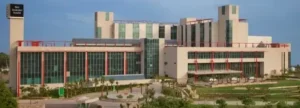 37,756 Australians live with MS. HSCT Hospital India carries JCI-USA accreditation alongside NABH and NABL, and its transplant unit sits on the same floor as intensive care. Accreditation is an audited standard for infection control. See the JCI-USA accredited transplant unit
 Australian patients are admitted to a deluxe private room with triple HEPA filtered air and stay there for the whole month, with one attendant beside them. For someone travelling with a partner, that second bed sits inside the US $30,000 price rather than being billed on top of it. See what the all-inclusive package covers


Real Patients,Real Stories
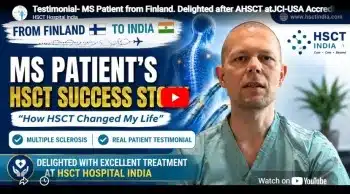
A Finland Patient’s Inspiring Recovery from Multiple Sclerosis after HSCT Treatment at JCI-USA Accredited World Class Hospital in India
Jukka from Finland, who has primary progressive MS, completed the full 30 day HSCT programme at HSCT Hospital India.

American Cop Flies to India for HSCT: 95% Symptom free, 5 Months after HSCT Treatment at JCI-USA Accredited World Class Hospital in India
Dylan, a US police officer with small fibre neuropathy, had about 95 per cent of his symptoms gone five months after HSCT.
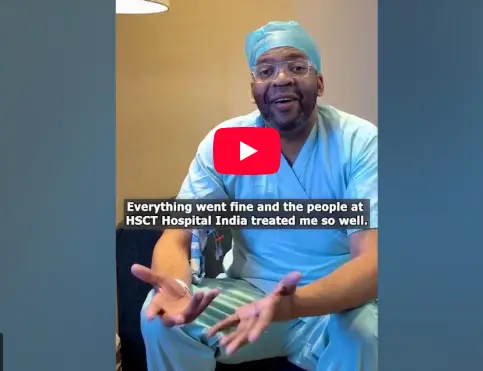
Sergel, 38M from Holland: Multiple Sclerosis Patient shares after HSCT Treatment at JCI-USA Accredited World Class Hospital in India
Watch this Video testimonial: Sergel, 38 years young man from Netherlands suffering from Multiple Sclerosis
The material above is general medical information rather than medical advice, and no individual outcome is promised. Whether HSCT suits an Australian patient is decided by a formal assessment of that patient’s MRI films, relapse record and present disease activity, carried out by the HSCT doctors at the hospital.