HSCT for Progressive MS: Primary and Secondary Progressive
Medically reviewed by the board of haematologists at HSCT Hospital India, whose transplant physicians hold DM Clinical Haematology qualifications and fellowship training in stem cell transplantation. The programme runs at a JCI-USA, NABH and NABL accredited hospital that has treated more than 1500 patients.
Last reviewed: 23 September 2026.
Progressive multiple sclerosis is the form of MS in which disability builds up steadily over time, rather than in attacks that come and go. It affects people in two ways. In primary progressive MS, often shortened to PPMS, disability builds from the start. In secondary progressive MS, or SPMS, it follows years of relapsing remitting MS, the form in which attacks are followed by periods of recovery.
HSCT, short for autologous haematopoietic stem cell transplantation, is a treatment that clears the faulty immune system with chemotherapy and rebuilds it from the patient’s own stem cells. In progressive MS, its value depends on whether the disease is still driven by active inflammation. Because of this, a progressive diagnosis on its own does not decide whether HSCT is suitable.
HSCT Hospital India assesses both primary and secondary progressive MS case by case, and the deciding question is inflammatory activity on a recent MRI. The hospital has treated more than 1,500 MS patients from over 30 countries since 2016, in a JCI-USA accredited hospital that also holds NABH and NABL accreditation. Patients with progressive MS from the United States, the United Kingdom and Finland have recorded their own accounts of treatment there.
What is progressive MS, and how is it different from relapsing MS?
MS damages myelin, the protective covering around the nerves in your brain and spinal cord. In relapsing remitting MS, this damage comes mainly from waves of inflammation, and each wave is felt as a relapse. In progressive MS, a second process adds to the inflammation. Nerve fibres that have lost their myelin tend to wear out slowly, and disability builds even when no new attack is felt.
The two progressive forms reach the same place by different routes. Primary progressive MS usually shows itself in the legs first, as walking becomes slower and less steady over months and years. Secondary progressive MS begins as relapsing MS, and the pattern changes: recovery after each relapse usually becomes less complete, and then disability keeps building between attacks.
How do doctors tell active progressive MS from progressive MS without activity?
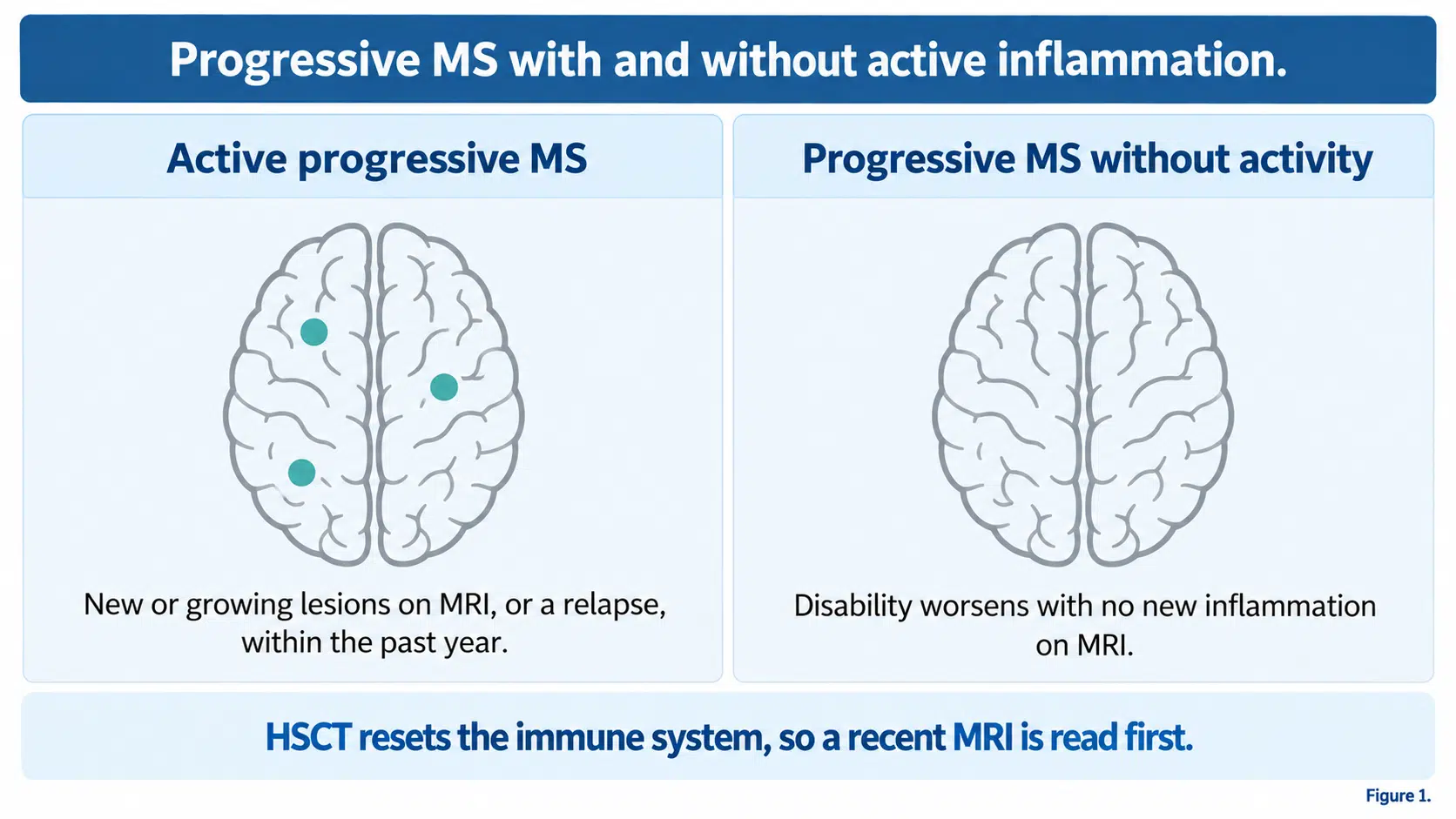
Doctors describe progressive MS as active or not active. Active means your MRI shows new or growing lesions, which are areas of inflammation, or that you have had a relapse, usually within the past year. Not active means your disability is increasing while the MRI shows no new inflammation.
The MRI answers this question more reliably than symptoms alone. Some lesions light up after a contrast dye is given during the scan, because they are inflamed at that moment, and doctors call these enhancing lesions. Others are new or larger than on the scan before. HSCT Hospital India looks for either sign on scans taken within the last 12 months.
This is why the doctors ask for the MRI films themselves rather than only the written reports. They compare your scans side by side to see whether anything has changed. The same diagnosis can describe two quite different diseases, and this comparison decides which treatments can work.
Can HSCT help my progressive MS?
HSCT can help progressive MS that still shows active inflammation. HSCT works on the immune system, so it acts on the inflammatory part of MS. When new lesions keep appearing on your MRI, the immune attack is usually still running, and HSCT is aimed at exactly that attack. When the MRI shows no new inflammation, there is much less for HSCT to stop.
For you, this means the label on your diagnosis matters less than your scans. A person with PPMS whose recent MRI shows enhancing lesions can be a stronger candidate than a person with relapsing MS whose disease has been quiet for years. This is why HSCT Hospital India asks for your MRI before anything else.
The aim of HSCT in progressive MS is to stop the immune attack that is still adding damage. The conditioning chemotherapy halts inflammatory activity, and it does not repair nerve damage that has already happened. Some patients regain function, as the patients below describe in their own words.
What treatments are there for progressive MS?
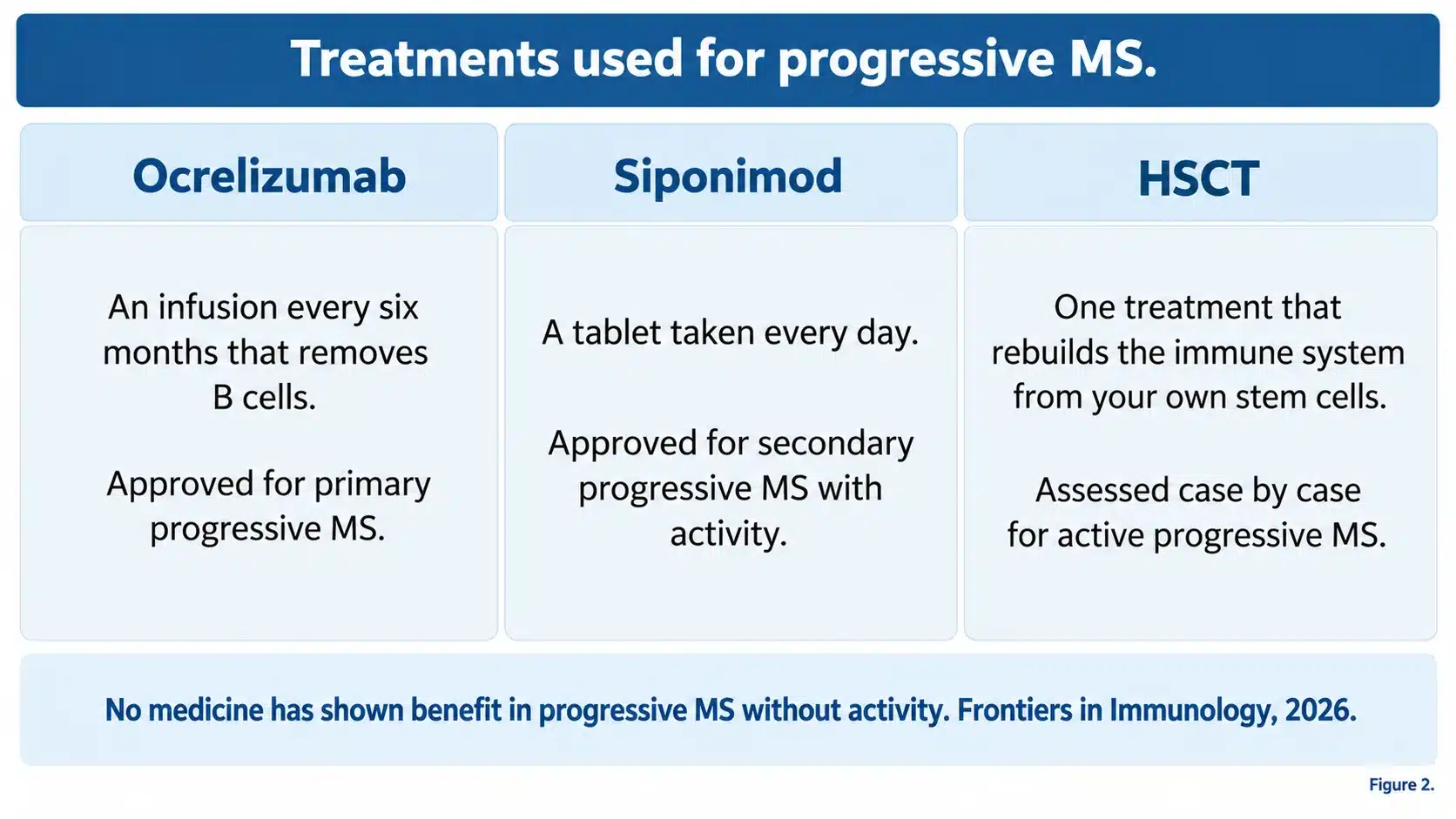
Progressive MS has fewer treatment choices than relapsing MS. Two medicines are approved for it, and each is used for a different form. Ocrelizumab is an infusion given every six months that removes B cells, a type of white blood cell involved in MS inflammation, and it is approved for primary progressive MS. Siponimod is a tablet taken every day, and it is approved for secondary progressive MS that is still active.
A 2026 review in Frontiers in Immunology describes both medicines as having modest benefit. The same review notes that no effective treatment yet exists for progressive MS without activity. HSCT works differently from both, because it is a single treatment rather than an ongoing one. It clears the immune cells driving the inflammation and lets your own stem cells rebuild the immune system.
Many patients with progressive MS come to HSCT after trying these medicines. David, whose story is below, had taken three MS medicines before he travelled to India, and his MS had continued to progress on the last of them.
| Question | Ocrelizumab | Siponimod | HSCT at HSCT Hospital India |
|---|---|---|---|
| How is it given? | It is given as an infusion into a vein. | It is taken as a tablet by mouth. | It is given during one hospital stay of up to 30 days. |
| How often? | It is repeated every six months. | It is taken every day. | It is given once. |
| Which progressive MS is it for? | It is approved for primary progressive MS. | It is approved for secondary progressive MS that is still active. | It is assessed for primary and secondary progressive MS that still shows inflammation. |
| What does it act on? | It removes B cells. | It keeps certain immune cells from reaching the brain and spinal cord. | It clears the immune cells driving MS and rebuilds the immune system from your own stem cells. |
What do patients with progressive MS say about HSCT at HSCT Hospital India?
Three patients with primary progressive MS have recorded their own accounts of treatment at HSCT Hospital India. Their words are given here as they said them, and each result is the patient’s own account.
David travelled from California. He had lived with primary progressive MS since 2011 and had started using a cane before he came.
“I treated it with different drugs, from Copaxone to Tysabri and lastly Ocrevus.” David, United States
“I was not able to lift my left leg without helping it, so that is something I can point to, in the amount of time I have been here and gone through the program.” David, United States
“Just so you know, the program is not easy, and it will be tough on your body and your mind. But living with MS is also.” David, United States
“I doubted initially if a caregiver was necessary, but now, after going through the 30 day program, I now know a caregiver is absolutely necessary.” David, United States
His full account is on the page about David from the United States. Gary travelled from the United Kingdom. His MS is primary progressive and his EDSS was 6.5, at the top of the range HSCT Hospital India assesses.
“I came here at a scale of 6.5, and hopefully that will reduce, because I now have feeling back in my foot after only three weeks.” Gary, United Kingdom
“He can now move his feet up and down. No more fizziness. A lot of the symptoms of MS have gone that he had, and this is after only like three weeks.” Linda, Gary’s partner and attendant
“Staff have been first class.” Linda, Gary’s partner and attendant
His full account is on the page about Gary from the United Kingdom. Jukka came from Finland with primary progressive MS, and he describes the care he received day by day.
“Every single step they are checking every single thing about me. My blood work is being done every single day since I got here.” Jukka, Finland
“The staff here, the doctors for example, they see me every single day at least twice. And if I have something to ask them, I can ask them.” Jukka, Finland
“I feel safe here. And I’ve been treated with the utmost care here.” Jukka, Finland
His full account is on the page about Jukka from Finland.
Progressive MS raises questions that depend on your own scans and your own history, and they are often easier to answer out loud. Book a free call and an HSCT Case Manager will ring you at an hour you choose.
 Request a Call Back
How does HSCT Hospital India decide whether HSCT is right for my progressive MS?
Your case is read by haematology and neurology together, on your own records. The doctors look first at your recent MRI for signs of active inflammation. They then look at your EDSS score, the scale from 0 to 10 that doctors use to measure MS disability, and at your age and general fitness for chemotherapy.
The hospital accepts patients for assessment up to about 60 years old, with an EDSS of 6.5 or below. An EDSS of 6.5 means walking with two sticks or a similar aid. A score or an age outside that range is reviewed individually rather than refused outright, and a refusal in another country is treated as background, not as a decision.
The doctors normally give their opinion within a few days of receiving your records, at no cost and with no obligation. The doctors tell you which of three outcomes applies: accepted after review, assessed individually, or unlikely to benefit from HSCT. They give you their reasoning either way. Every criterion, set against those of other centres, is listed on the page about who is eligible for HSCT.
Your records do most of the work in the review. The MRI films matter most, ideally from the last 12 months, because the doctors compare scans side by side to see whether new lesions have appeared. They also need your disease history, meaning when your MS began and how it has changed since, and the record of every MS medicine you have taken and why you stopped it.
Your latest EDSS score helps if you have one. If you do not, the EDSS calculator shows where you sit on the scale.
Send your diagnosis, your MRI films from the last 12 months and the MS medicines you have taken through the enquiry form. The HSCT specialist doctors at HSCT Hospital India read every case without charge, and an HSCT Case Manager replies to you by email.
How do other health systems treat progressive MS for HSCT?
Criteria for HSCT differ from one health system to the next, and progressive MS is where they differ most. The NHS in England funds HSCT for relapsing MS, with an EDSS of 6.0 or below and recent relapses or new MRI activity despite high efficacy treatment. Progressive MS falls outside that policy.
European guidance allows HSCT for progressive MS that still shows active inflammation, and prefers it to be given inside a clinical trial. One private centre in London accepts primary progressive MS when the spinal fluid shows oligoclonal bands, which are markers of inflammation inside the nervous system, with an EDSS of up to 6.5.
HSCT Hospital India assesses primary and secondary progressive MS directly, up to about 60 years of age and an EDSS of 6.5. The deciding question is inflammatory activity on your recent MRI rather than the name of your diagnosis. This is why a patient outside one health system’s policy can still be assessed in India.
Why do patients with progressive MS choose HSCT Hospital India?
Where a health system decides by the name of the diagnosis, progressive MS is often ruled out before the scans are considered. HSCT Hospital India reads the scans first, for both primary and secondary progressive MS, and decides on the inflammation it finds.
The programme is built for patients whose walking and balance are already affected. Every patient stays as an in-patient for the whole treatment, in a deluxe private room with Triple HEPA air filtration, with nurses on hand 24 hours a day. Your attendant stays in the room with you, which David found he needed. Neuro-physiotherapy, exercise planned by a physiotherapist to rebuild strength, balance and movement, is part of every stay.
You know the full price before you book a flight. One all-inclusive payment of US $30,000 covers the whole programme, and there is no long waiting list. Your HSCT Case Manager helps you apply for the Indian medical visa, and airport pick-up is included, so the travel is planned before you leave home.
Families looking into HSCT for progressive MS can request the HSCT Hospital India brochure by email. It sets out the treatment, the 30 day stay and the items included in the price.
What happens to me during HSCT at HSCT Hospital India?
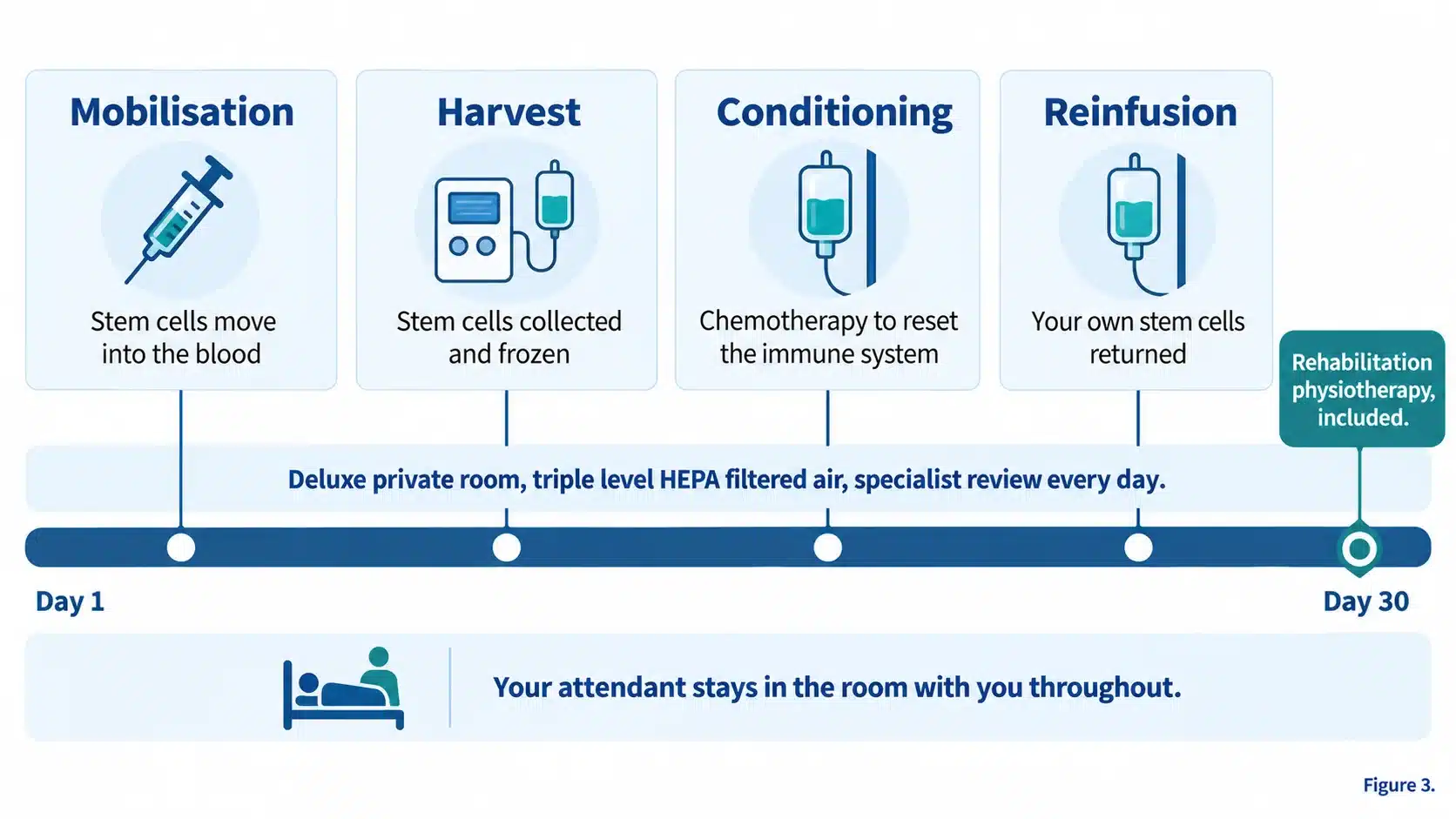
Your treatment is one in-patient stay of up to 30 days, and your attendant can stay with you throughout. It follows the non-myeloablative protocol developed by Dr Richard Burt, which uses cyclophosphamide with ATG, short for anti-thymocyte globulin. Non-myeloablative means the chemotherapy weakens your bone marrow but does not wipe it out, so your blood counts come back more quickly.
On arrival you have a full medical evaluation. Your stem cells are then moved from your bone marrow into your blood with medicines, in a stage called mobilisation. A machine collects them from your blood over several hours in a process called leukapheresis, and they are counted and frozen. Conditioning chemotherapy then clears the immune cells driving your MS, and your stem cells are returned through a drip in a stage called reinfusion.
“First of all you have a treatment to flush out the stem cells from your bone marrow into your bloodstream. Then they harvest the stem cells over about six hours. You then have a day of rest. Then you have four days of chemotherapy, which can be rough.” Linda, describing Gary’s treatment
The days after your cells are returned are when infection is most likely, and doctors call this the aplastic phase. You are kept in your HEPA filtered room throughout, and a fever is caught and treated at once. A fever, chills or a rash can appear while the ATG infusion runs, and the nursing team treats these reactions straight away.
How is travel to HSCT Hospital India arranged with progressive MS?
Travel is planned with you before you leave home, because walking and fatigue limit what a patient with progressive MS can manage. Your HSCT Case Manager helps you apply for the Indian medical visa and explains what to bring. Airport pick-up in New Delhi is included in the price, so you are met when you land and taken to the hospital.
Your attendant travels with you and stays in your room for the whole treatment. David came with his mother, and Gary came with his partner Linda. David said in his video that he had doubted it at first and found an attendant absolutely necessary.
On arrival you have a detailed medical evaluation, and your treatment begins after it. From then on the HSCT specialist doctors see you every day, and Jukka describes them at his bedside at least twice a day.
What does recovery look like after HSCT at HSCT Hospital India?
Recovery starts in hospital and continues for months at home. Neuro-physiotherapy begins during your stay, which matters for progressive MS because walking and balance are often the main concerns. There is no more chemotherapy after you go home.
Your blood counts are checked twice a month for the first two months, and then once a month until they return to normal. Most patients are back to their normal activities within 2 to 4 months, and full recovery from the transplant usually takes 3 to 12 months. You go home with a discharge summary to share with your own GP or neurologist.
Physiotherapy continues to matter after you go home. The rebuilt immune system stops the inflammation, and the exercise helps your body use the function it still has. The hospital asks for updates on your progress, so your HSCT specialists can follow your recovery and answer questions as they come up.
What does the research on HSCT for progressive MS show?
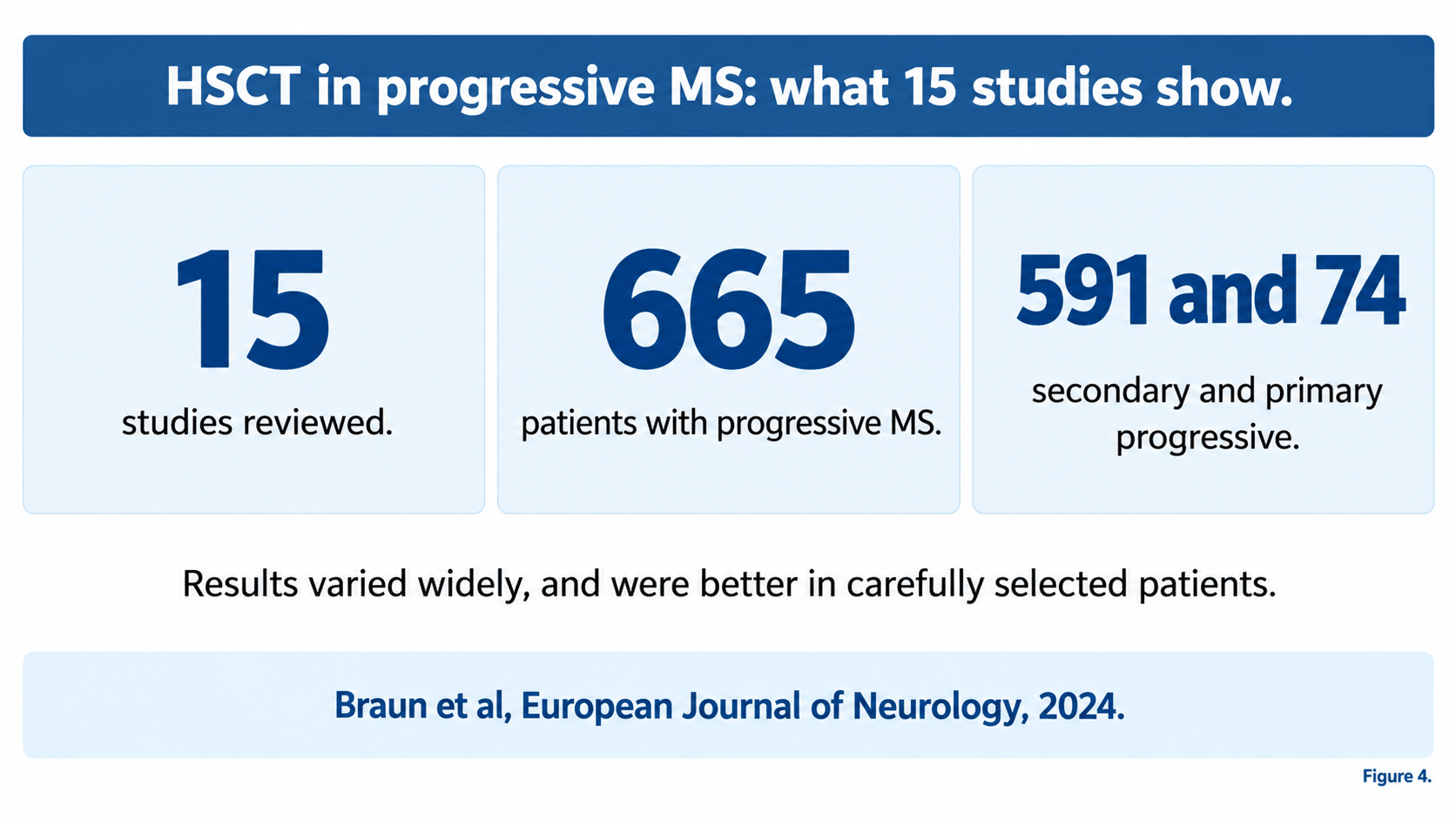
The largest review of HSCT in progressive MS was published in the European Journal of Neurology in 2024. Its authors, Braun and colleagues, gathered 15 studies covering 665 patients with progressive MS. Of these, 591 had secondary progressive MS and 74 had primary progressive MS.
The results varied widely from one study to the next. The authors concluded that HSCT does not halt progression across progressive MS as a whole, and that outcomes were better in carefully selected patients. A 2025 study of 1,114 patients in the European registry agreed, showing that the form of MS a patient had shaped the result more than anything else. Both findings point to the same step, which is a careful reading of your own scans before treatment.
What are the risks of HSCT with progressive MS, and how does HSCT Hospital India manage them?
In the 2024 review, patients with progressive MS started treatment with more disability than patients with relapsing MS. Across the review, deaths related to treatment averaged 1.9 per cent across 10 studies, which was 10 of 528 patients. The main risk is infection while the immune system is rebuilding.
HSCT Hospital India manages this risk in three ways. Your fitness for chemotherapy is checked before any treatment is offered. Your whole stay is in a HEPA filtered room, where an HSCT specialist reviews you every day. The protocol is non-myeloablative, so your blood counts usually recover quickly.
How much does HSCT for progressive MS cost at HSCT Hospital India?
HSCT for progressive MS at HSCT Hospital India costs US $30,000, all-inclusive, the same price as for every form of MS. That single figure pays for the tests and MRI before treatment, the transplant itself and a hospital stay of up to 30 days. Doctors’ fees, consultations, medicines, consumables and neuro-physiotherapy are inside it too. So are meals and laundry for you and your attendant, and the airport transfers at both ends.
The full comparison of HSCT prices across countries is on the page about HSCT cost by country.
Answers to Frequently Asked Questions (FAQs) about HSCT for progressive MS
Is primary progressive MS excluded from HSCT at HSCT Hospital India?
No, it is not excluded. Primary progressive MS is assessed case by case, and a recent MRI showing active inflammation leads to a full review.
Can HSCT help secondary progressive MS?
HSCT can help secondary progressive MS that still shows active inflammation. The doctors read your recent MRI to see whether new or growing lesions are present.
What if my progressive MS shows no activity on MRI?
The benefit of HSCT is much smaller when the MRI shows no new inflammation. The HSCT specialist doctors will explain what your own scans show when they review your case.
Will HSCT repair the damage progressive MS has already done?
HSCT stops the immune attack, and it does not repair nerve damage that has already happened. Some patients regain function after treatment, and physiotherapy helps you use the function you have.
Is there an age limit for HSCT for progressive MS?
Patients up to about 60 years old are assessed at HSCT Hospital India. Fitness for chemotherapy is checked for every patient before treatment is offered.
Is an EDSS of 6.5 too high for HSCT?
No, a score of 6.5 falls inside the range HSCT Hospital India reviews. Gary came for treatment at an EDSS of 6.5, and higher scores are reviewed individually.
I was refused HSCT in my own country. Can I still be assessed?
Yes, a refusal elsewhere is treated as background rather than as a decision. The HSCT specialist doctors read your own scans and history and give their own opinion.
Do I need to bring someone with me?
Yes, an attendant stays in your room with you for the whole treatment. Meals and laundry for your companion cost nothing extra.
How long will I stay in India for HSCT?
The treatment takes place in one hospital stay of up to 30 days. Most patients are back to their normal activities within 2 to 4 months of going home.
How quickly will I hear back after I send my records?
You normally hear back within a few days of the records arriving. The review is free and you are under no obligation.
Do I need MRI films or just the reports?
The doctors ask for the MRI films themselves, ideally from the last 12 months. They compare scans side by side to see whether new lesions have appeared.
Does the NHS offer HSCT for progressive MS?
The NHS in England funds HSCT for relapsing MS, so progressive MS falls outside its policy. HSCT Hospital India assesses both primary and secondary progressive MS on your own scans.
Is CAR T cell therapy an option for progressive MS?
CAR T for progressive MS is given only inside clinical trials. The differences between the two treatments are explained on the page about CAR T cell therapy or HSCT for MS.
The HSCT specialist doctors at HSCT Hospital India can tell you whether your progressive MS shows the activity HSCT works on. Send your MRI films through the enquiry form, and an HSCT Case Manager replies to you by email without charge.
References
- Braun B, Fischbach F, Pfeffer LK, et al. Exploring the therapeutic potential of autologous haematopoietic stem cell transplantation in progressive multiple sclerosis: a systematic review. European Journal of Neurology. 2024. PMID 39104136.
- Greco R, Saccardi R, Ponzano M, et al. BEAM/ATG or cyclophosphamide/ATG as conditioning regimen in autologous haemopoietic stem cell transplantation for multiple sclerosis. Bone Marrow Transplantation. 2025. PMID 41023426.
- Efficacy and safety of mesenchymal stem cell transplantation for progressive multiple sclerosis: a systematic review and meta-analysis. Frontiers in Immunology. 2026. PMID 42558431.
Read next
- HSCT or Ocrevus for MS: how the two treatments compare
- How long does it take to recover after HSCT for MS?
- Who is eligible for HSCT at HSCT Hospital India?
- CAR T cell therapy or HSCT for MS
- Which HSCT protocol is best for MS?
- HSCT for multiple sclerosis
Real Patients, Real Stories
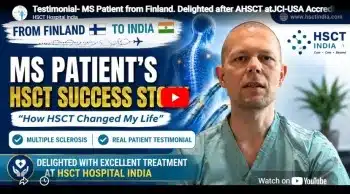
A Finland Patient’s Inspiring Recovery from Multiple Sclerosis after HSCT Treatment at JCI-USA Accredited World Class Hospital in India
Jukka from Finland, who has primary progressive MS, completed the full 30 day HSCT programme at HSCT Hospital India.

American Cop Flies to India for HSCT: 95% Symptom free, 5 Months after HSCT Treatment at JCI-USA Accredited World Class Hospital in India
Dylan, a US police officer with small fibre neuropathy, had about 95 per cent of his symptoms gone five months after HSCT.
Sergel, 38M from Holland: Multiple Sclerosis Patient shares after HSCT Treatment at JCI-USA Accredited World Class Hospital in India
Watch this Video testimonial: Sergel, 38 years young man from Netherlands suffering from Multiple Sclerosis