HSCT for MS in the Netherlands: Access, Criteria and Cost
Who this page is for. Dutch patients with multiple sclerosis who have looked at the transplant route at home and found the door narrower than the policy suggests. HSCT is covered by the basisverzekering. Thirteen people have received it. HSCT Hospital India gives an eligibility opinion at no cost, and it is given by a haematologist who has read the file.

Covered by the basisverzekering since December 2022, and given to thirteen people
Zorginstituut Nederland placed autologous stem cell transplantation for very active relapsing remitting MS into the basic insurance package on 13 December 2022. The estimate attached to that decision was ten to twenty patients a year.
The Zorginstituut’s own evaluation records what happened instead. Two patients were treated in 2023. Ten in 2024. One in 2025. Thirteen in total against a forecast that should have produced between twenty five and fifty over the same stretch. Seven of those thirteen did not fully satisfy the published criteria and were treated on the basis of severe breakthrough disease.
More than 36,000 people in the Netherlands live with multiple sclerosis, a prevalence of 210.4 per 100,000 measured against 2019 data. Thirteen transplants have been performed since the treatment entered the package.
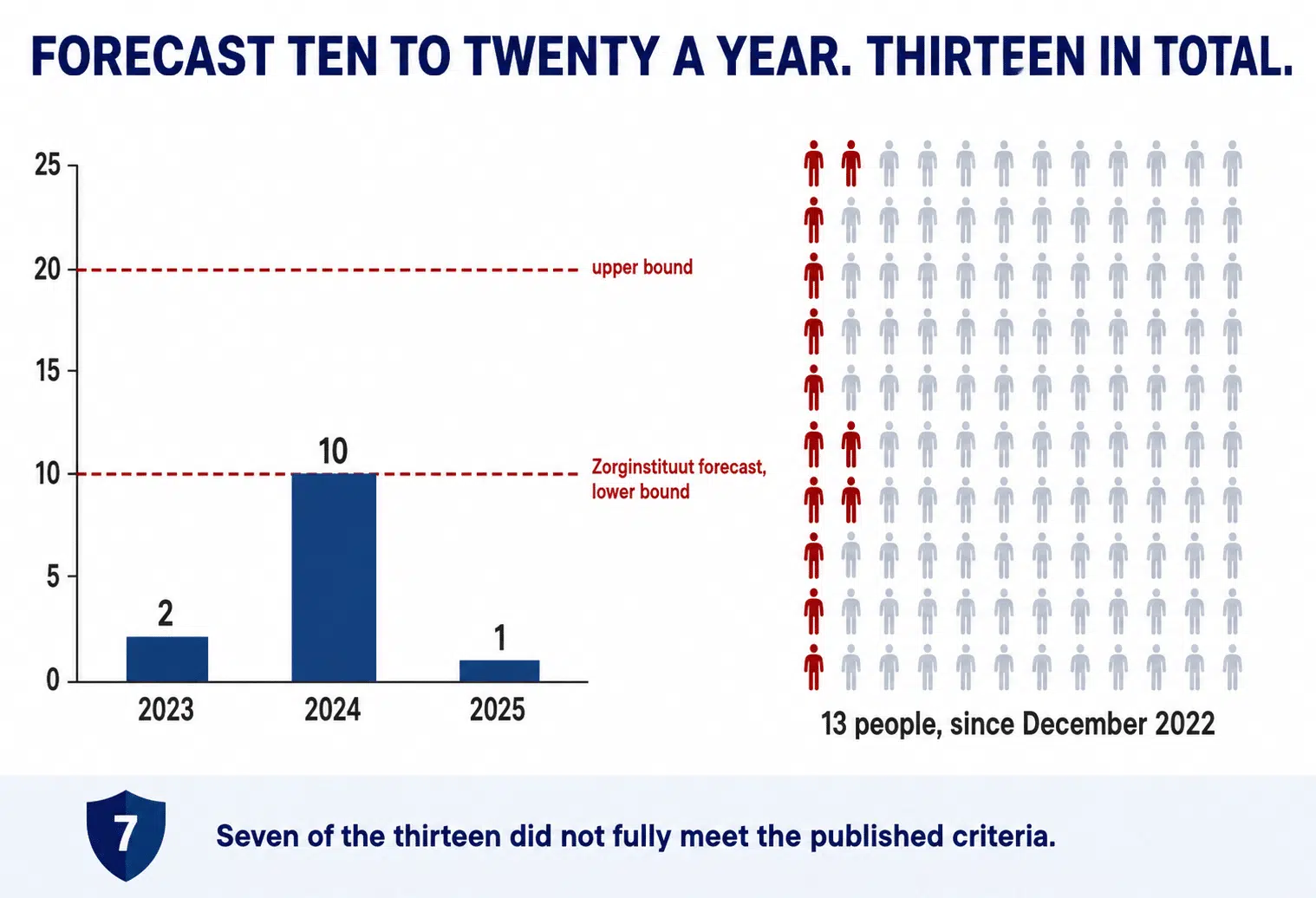
Figure 10. Forecast ten to twenty a year. Thirteen in total.
The gap between the policy and the practice is the whole subject of this page. Nothing here argues that the Dutch decision was wrong. It was the right decision and it puts the Netherlands ahead of most of Europe, including Germany, where funding is decided patient by patient. The question a Dutch patient is left with is narrower and more practical: what happens when the answer at home is no, or when it is taking longer than the disease is.
Three gates stand between a Dutch patient and a transplant
The route runs through three separate assessments and each one can end it.
The first is the patient’s own neurologist, who has to be persuaded that the case is worth referring at all. The second is one of seven regional MS centres, which gives a second opinion on whether the disease meets the threshold. The third is the landelijke indicatiecommissie, a national indication committee of twelve neurologists, two haematologists and one radiologist, which makes the final call.
A refusal at any of those three gates is a refusal, and no appeal route is published alongside the criteria. The committee assesses against the written standard.

Figure 9. Three assessments, and each one can end it.
Already been through the committee? Send the refusal letter with the MRI images and the disease history. A haematologist will tell you whether the reason given was a criteria question or a clinical one, and what that means for treatment abroad. Ask for a free eligibility opinion.
What the April 2026 revision changed, and what it tightened
On 16 April 2026 the criteria were eased at the request of the neurology association’s MS working group and with the approval of Zorginstituut Nederland. Three restrictions were loosened and one new one was added.

Figure 11. Three restrictions loosened, one tightened.
| Before April 2026 | After April 2026 |
|---|---|
| Disability had to sit above an EDSS of 3. | That floor is gone. A patient with a low score and aggressive disease is no longer excluded for being too well. |
| Disease duration had to be under ten years. | The ten year limit no longer applies to anyone diagnosed before the age of 45. |
| Activity had to include a clinical relapse. | New lesions on MRI now count on their own, without a relapse alongside them. |
| Breakthrough on any high efficacy drug counted. | Breakthrough on cladribine no longer qualifies. An anti-CD20 drug has to be tried first. |
The age band of 18 to 55 was not changed. Neither was the requirement for at least six months on a high efficacy disease modifying drug, nor the upper disability limit below an EDSS of 6.5.
Who the Dutch criteria still leave outside

Figure 3. Covered as standard care, decided centrally, and narrow at the point of entry.
Four groups fall outside the Dutch standard even after the revision, and they account for most of the enquiries that reach HSCT Hospital India from the Netherlands.
Patients over 55. The Dutch ceiling is firm at 55 and a patient of 57 with demonstrable inflammation is outside it regardless of how the disease is behaving. HSCT Hospital India assesses to around 60, and the deciding factor is organ function and inflammatory activity rather than the date on a passport.
Patients who have passed an EDSS of 6.5. The Dutch upper limit sits below 6.5, which is the point at which a patient needs support on both sides to walk twenty metres. Above that line the Dutch route closes. HSCT Hospital India assesses the file rather than the score, and a haematologist reads the MRI and the organ function before any answer is given.
Patients with progressive disease. The Dutch criteria are written for very active relapsing remitting MS. Progressive MS is not automatically excluded from assessment in India. The deciding question is whether inflammation is still visible on the MRI, and that is a question for the haematologist reading the scan rather than one to decide at home.
Patients whose most recent breakthrough was on cladribine. That route closed in April 2026 and now requires an anti-CD20 drug to be tried and to fail first, which adds months to a disease that is already moving. Assessment in India reads the inflammatory activity the MRI shows rather than a required sequence of drugs.
The Dutch trial has not reported, and will not until late 2026
Amsterdam UMC at the VUmc location is the Dutch enrolling centre in RAM-MS, a randomised trial comparing autologous transplantation against alemtuzumab, cladribine or ocrelizumab in relapsing remitting MS. The sponsor is Haukeland University Hospital in Bergen, and the other centres are in Norway, Sweden and Denmark.
The trial began enrolling on 21 March 2018 and finished recruiting during 2024 with 96 participants against a target of 100. The primary endpoint is the proportion of patients with no evidence of disease activity at two years, with a five year extension planned. Recruitment is closed and no results have been published. Primary completion is estimated for 21 November 2026.
A separate Dutch study, MS-ACT, is running at VUmc with 24 participants and a five year follow up. It is observational. It follows patients who have already been selected for treatment and it is not a route to being treated.
For a Dutch patient this matters in one practical way. The trial is not open, so there is no enrolment option to wait for, and the results that might widen the criteria further are still at least a year away.
Published results for HSCT in MS

Figure 4. Disability progression in the two arms of MIST, transplant against continued drug therapy.
The randomised evidence sits in MIST, published in JAMA in 2019. One hundred and ten patients with relapsing remitting MS took part, recruited across four sites on three continents, every one of them having relapsed at least twice in the preceding year despite being on a disease modifying drug. Disability progressed in three of the fifty five transplanted patients and in thirty four of the fifty five who stayed on drugs. Nobody died. Average disability fell over the first year in the transplant group and rose in the drug group.
One caveat belongs with those numbers and it is the authors’ own. Median follow up was two years. Only twenty three patients were assessed annually out to five. MIST is described by the people who ran it as preliminary.
The longer view comes from a meta-analysis of fifteen studies and 764 patients published in Neurology in 2017. Freedom from any measurable disease activity was 83 per cent at two years and 67 per cent at five. Pooled treatment related mortality across two decades was 2.1 per cent, and it was significantly higher in the older studies, in cohorts with fewer relapsing remitting patients, and where baseline disability was higher.
The largest recent real world dataset comes from Britain, reported in JNNP in 2026, and covers 364 patients treated across fourteen centres between 2002 and 2023. At two and five years, freedom from relapse was 94.6 per cent and 88.6 per cent. Freedom from progression was 83.5 per cent and 62.4 per cent. Measured disability had improved in 24.2 per cent by year two and in 20.4 per cent by year five. Relapsing remitting patients did significantly better than progressive ones on both measures.
What the evidence supports is a treatment that stops the inflammatory process in most carefully selected patients, given once, without maintenance medication afterwards.
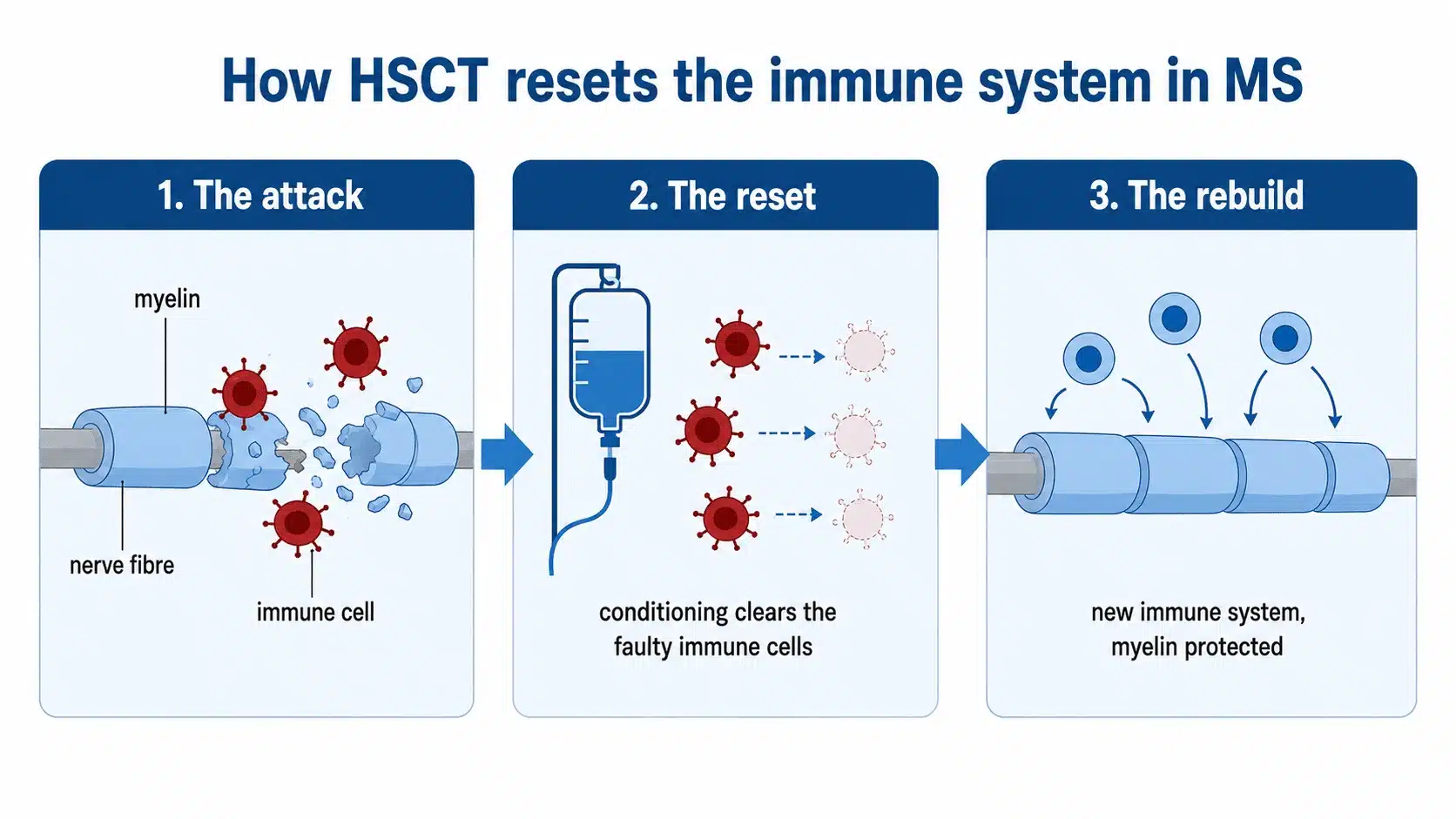
Figure 1. What the transplant acts on: the immune attack, the clearing, and the rebuild.
Chemotherapy dose is what separates one transplant programme from another

Figure 5. Conditioning strength, and what it does to the balance between depth of reset and complication rate.
The strength of the conditioning chemotherapy is the main reason risk differs between transplant centres.
Heavier regimens empty the bone marrow along with the immune system. They produce a deeper reset and they carry a higher complication rate, which is why programmes using them apply tighter limits on age and disability. Lower intensity conditioning, the term for which is non-myeloablative, holds the immune system down without emptying the marrow. Recovery is quicker as a result, and it opens the treatment to patients a heavier programme would turn away.
The conditioning strength used at HSCT Hospital India is the lower intensity one, the same dose level behind the MIST results. A Dutch patient comparing centres should ask any programme which regimen it uses before comparing anything else, because the published mortality figures move with it.
Where the risk sits, and how it is managed
There is one dangerous window and it is short. Between the conditioning chemotherapy and the point where the returned stem cells rebuild a working immune system, roughly ten to fourteen days, the patient has very little defence against infection. That window is what the filtered air, the single room and the daily blood counts exist to manage.
The measured figures: no deaths among the 55 transplanted in MIST; 1.4 per cent across the 364 patient British series, in a cohort with a median EDSS of 6.0 and 38 per cent progressive disease; 2.1 per cent pooled across 764 patients over two decades. The trend across those three is downward, and the meta-analysis identifies why: later era, more relapsing remitting patients, lower disability at the point of treatment.
Beyond the admission there are effects to raise before travelling rather than after. Hair goes and comes back. Tiredness is severe for the first few weeks and eases across the months after that. Fertility can be affected, so preservation is a conversation to have before an admission date is fixed, not after. A minority develop thyroid autoimmunity later, which is why thyroid function stays on the monitoring schedule for years.
The shape of a thirty day admission
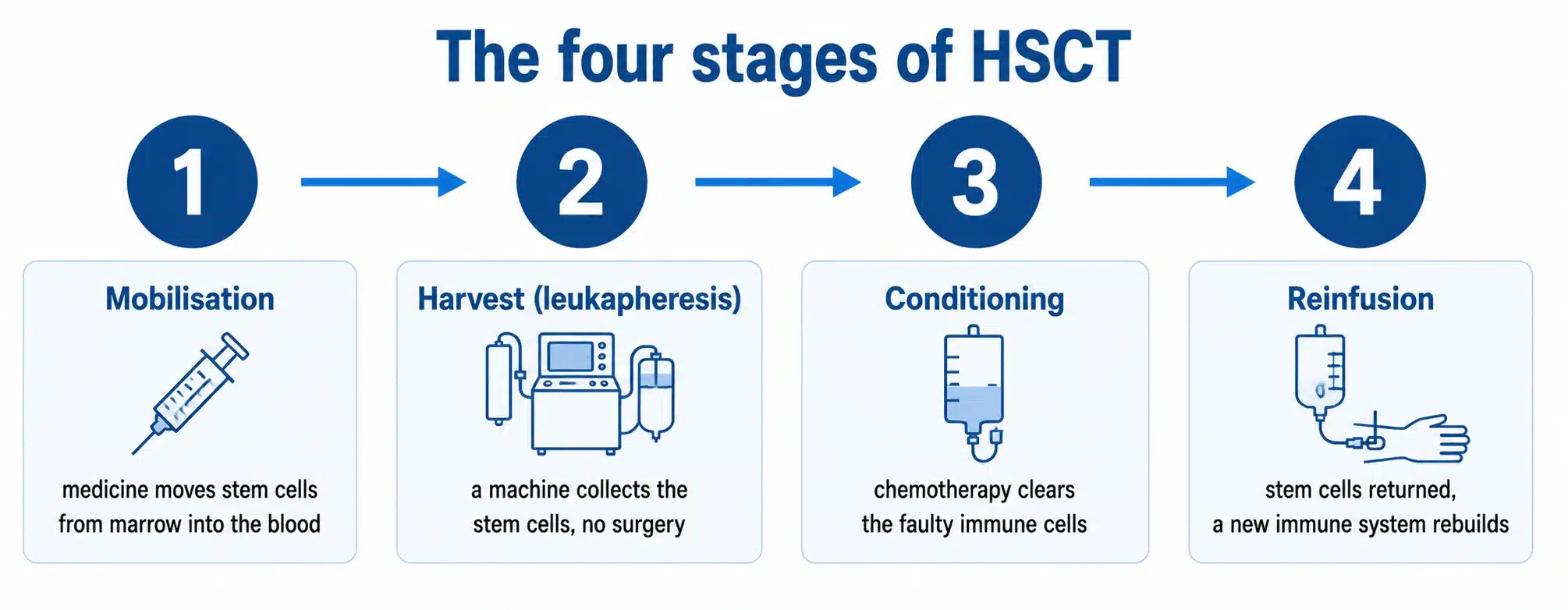
Figure 7. From the first growth factor injection to a rebuilt immune system, inside one admission.
Everything happens inside one admission, in four stages. Mobilisation uses growth factor injections so that stem cells leave the marrow and circulate where they can be collected, and an ache through the hips and lower back at that stage is expected. Harvest, or leukapheresis, runs the blood through a separator that keeps the stem cells and gives back the rest. It feels closer to a long blood donation than to an operation. Conditioning is the chemotherapy that clears the misdirected immune cells. Reinfusion puts the thawed cells back through a line, and over the next two weeks the marrow starts building a new immune system.
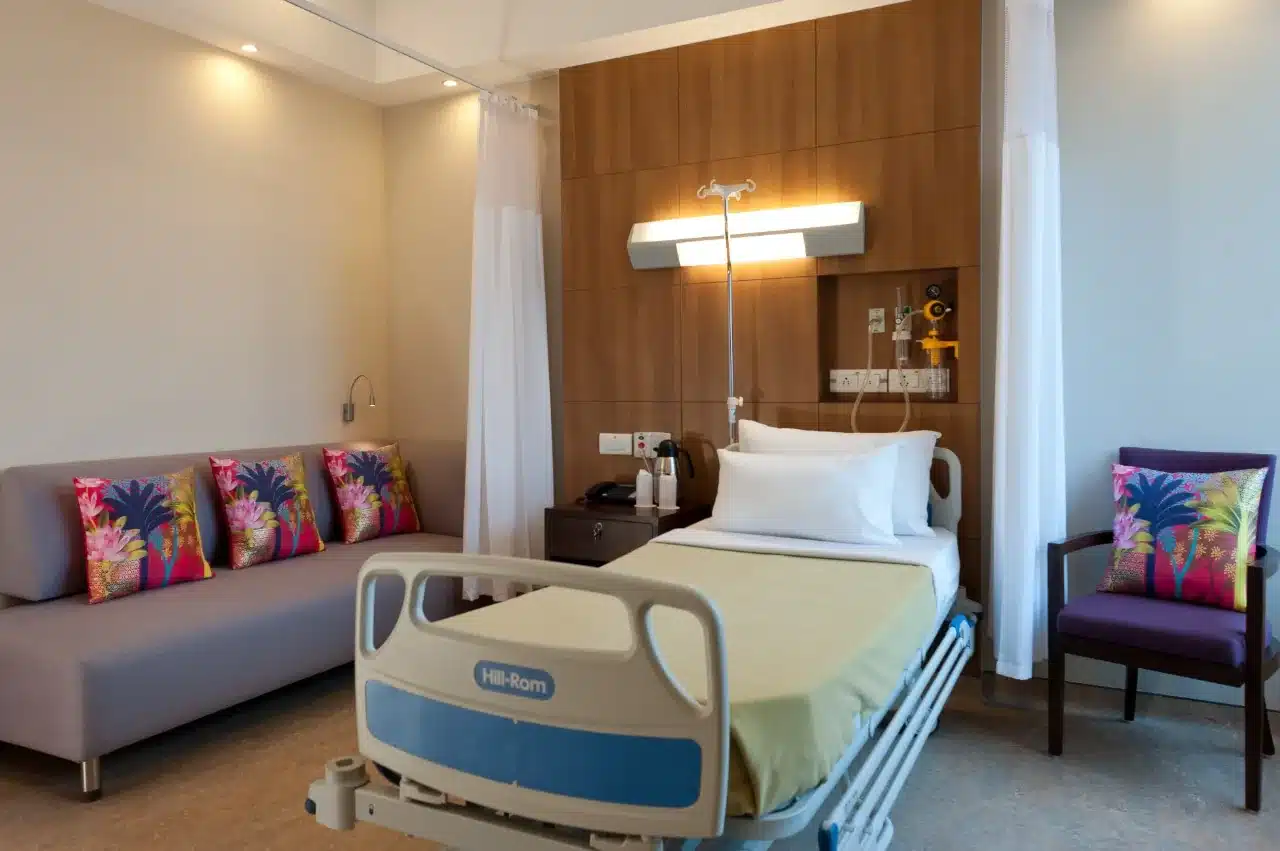
Figure 6. A single room on filtered air, with a bed for the companion who stays the month.
The patient occupies a single room for the full month with a bed for one companion alongside. Air passes three filtration stages before it reaches the room, and critical care is one floor away. The companion staying in the room rather than visiting is a clinical decision, not a comfort one, because it removes the traffic that a shared ward brings during the vulnerable fortnight.
Aftercare in the Netherlands, planned before you travel
A transplant is not finished when the patient lands at Schiphol. The first twelve months carry a monitoring schedule, and it runs at home rather than in Delhi, which makes the handover the part of the process most worth getting right before you travel.
Every patient leaves HSCT Hospital India with the complete clinical file a Dutch neurologist and haematologist need, written in English: which conditioning was given and at what strength, how many cells were harvested and reinfused, the count charts across the whole admission, anything that went wrong and what was done about it, the medication on discharge, the vaccination course and the follow up timetable.
The specialists who performed the transplant remain contactable by your own doctors, and the HSCT case manager stays the family’s single named contact rather than a switchboard.
Year one runs to a fixed timetable: bloods at set intervals, a scan somewhere between six and twelve months to confirm nothing new is appearing, a full revaccination course because childhood protection does not survive conditioning, and physiotherapy to turn a quiet immune system into recovered movement.
One thing to plan for. A Dutch neurologist is entitled to decline to supervise follow up of treatment given abroad. The practical answer is to raise it before travelling rather than after, take the discharge file to the appointment rather than describing it, and involve the neurologist in the decision from the beginning. Where a neurologist still declines, a haematologist rather than a neurologist can hold the monitoring schedule, since most of the first year is blood work.
Want the aftercare schedule before you decide anything? Ask for the monitoring plan and the discharge file template, and take them to your own neurologist. Request the treatment information pack.
What it costs, and what your insurer does and does not do

Figure 8. Inside the fixed price, and outside it.
Through the Dutch route the treatment is free at the point of use beyond the mandatory own risk, which stands at 385 euro. That applies to the thirteen people who have been through the committee.
Outside that route, a Dutch patient is comparing self funded options rather than comparing against the Dutch price, because there is no Dutch price to compare against.
| Route | What a Dutch patient pays |
|---|---|
| Netherlands, through the national committee | The 385 euro own risk, and only after the committee says yes. |
| HSCT Hospital India | 30,000 US dollars, quoted before travel, covering a thirty day inpatient stay for two people. |
| United States, privately | Roughly 150,000 to 200,000 US dollars. |
The Indian price does not include international flights, the e-visa, travel insurance, a private nurse attendant for anyone travelling alone, or nights beyond the thirtieth. Nothing is added afterwards that was not quoted before departure.
On insurance, three things are worth stating plainly and one is worth checking yourself. India sits outside the EU and the EEA and is not a treaty country, so the S2 prior authorisation route that applies to planned care within Europe does not apply here at all. The basisverzekering does provide worldwide cover, but reimbursement outside those areas is capped at the tariff considered normal in the Netherlands. And whether an insurer pays anything toward a treatment that is now available domestically depends on the polisvoorwaarden of that specific policy, so the answer comes from the insurer in writing before a date is fixed.
What does stay covered in the Netherlands is the care around the admission: the MRI scans and consultations beforehand, contact with your own neurologist, and the checks, blood work and follow up imaging after you return, all under the same own risk.
Getting there from the Netherlands
Direct flights run to Delhi from Schiphol and the flight takes around eight and a half hours. The Indian e-visa for medical treatment is applied for online and the hospital supplies the invitation letter that goes with it. Patients are collected on arrival.
One point that catches people out: a standard Dutch travel insurance policy excludes planned medical treatment abroad. It is not a substitute for the arrangements around the admission and it should not be relied on as one.
For thirty days in a single room, bring loose comfortable clothing, a laptop or tablet with a Dutch keyboard, any regular medication in its original packaging with the prescription, and a copy of the MRI images on physical media as well as in the cloud. The companion should plan for the full month rather than for part of it.
Questions Dutch patients ask most
Is HSCT for MS reimbursed in the Netherlands?
Yes, since 13 December 2022, for a strictly defined group with very active relapsing remitting MS. It is delivered at Amsterdam UMC and Sint Antonius Nieuwegein and every case is decided by a national indication committee. Thirteen patients have been treated since the reimbursement decision, against a forecast of ten to twenty a year.
Why were only thirteen people treated?
Zorginstituut Nederland’s own evaluation records the shortfall without resolving it. The criteria are narrow, the route runs through three separate assessments, and seven of the thirteen who were treated did not fully meet the published criteria in the first place. The criteria were widened in April 2026, partly in response.
I am over 55. Is there any Dutch route?
Not through the national criteria, which set the ceiling at 55 and did not change it in April 2026. HSCT Hospital India assesses patients to around 60, and the decision rests on inflammatory activity and organ function rather than age alone.
My neurologist will not refer me. What now?
Send the MRI images, the disease history and the list of drugs already tried directly. A haematologist reads it and tells you where you stand, including when the answer is no and why. It costs nothing and commits you to nothing.
Will my zorgverzekeraar pay for treatment in India?
The S2 route for planned care in Europe does not extend to India. Worldwide cover exists under the basic insurance but is capped at the normal Dutch tariff, and whether anything is payable toward a treatment now available domestically depends on your specific policy conditions. Ask your insurer in writing before you commit to a date.
Can I have HSCT with progressive MS?
The Dutch criteria are written for relapsing remitting disease. Assessment in India is not closed to progressive MS, and the deciding question is whether inflammation is still visible on a recent MRI. Where the scan is quiet, a transplant has nothing to act on and the answer will be no.
Does a stem cell transplant cure MS?
HSCT stops the inflammatory process that drives relapses and new lesions, and it is given once, without maintenance medication afterwards. Damage already done to myelin and axons is not repaired by it. Function that active inflammation was suppressing can return, and roughly one patient in five in the British series had measurably less disability five years later.
What happens if I relapse after the transplant?
It is uncommon and it is not the end of the road. Drugs that had stopped controlling the disease beforehand frequently start working again, because the immune system they are now acting on is a rebuilt one.
How quickly can an admission be arranged?
The assessment comes back within days of the file arriving. Where the answer is yes, an admission date is usually confirmed within weeks rather than months.
Is treatment in India as safe as in the Netherlands?
Safety is decided by the conditioning regimen, the number of cases the unit handles and the isolation arrangements during the low count fortnight. HSCT Hospital India uses the lower intensity non-myeloablative regimen, the same dose level behind the MIST results, in an internationally accredited unit that has looked after upwards of 1,500 patients from abroad since 2016, in single rooms on three stage filtered air with critical care one floor away. Those are the three answers that decide it, and any centre should give them in writing.
Why Dutch families choose HSCT Hospital India
Four things, one for each question Dutch patients ask most.
There is no committee. A haematologist and a neurologist read the file together and the decision comes back in days with the reasoning set out, rather than after three sequential assessments.
There is no age ceiling of 55. Assessment runs to around 60 and turns on what the MRI and the organ function show.
There is no queue. Thirteen Dutch transplants in two and a half years against a forecast of ten to twenty a year is what the published evaluation records. An admission date here is normally weeks away, which counts when the disease is the thing that is moving.
There is one price, known before you book. Thirty thousand US dollars covers the thirty day admission for the patient and one companion, and nothing arrives afterwards that was not on the quote.
 The hospital carries JCI-USA, NABH and NABL accreditation. The bone marrow transplant unit has its own intensive care on the same floor. Under JCI-USA accreditation, infection control is audited to an international standard.Look inside the transplant unit
 Each patient stays in a private room for the full month, and the attendant sleeps in the same room. Each room has three stage HEPA air filtering. Filtered air lowers the infection risk across the fortnight when immune defence is at its lowest.See what the thirty day package includes


You can read recovery stories from patients we have treated, see the country by country cost comparison, read how the treatment works in the multiple sclerosis guide, or score yourself on the EDSS calculator before you send anything. Dutch speakers can read the same material in Dutch on the stamceltransplantatie bij MS page.
Ready to find out where you stand? Send the MRI images, the disease history and the drugs already tried. The opinion is free and it comes back with the reasoning. Speak to the HSCT doctors.
Sources
- Zorginstituut Nederland. Standpunt stamceltransplantatie bij zeer actieve RRMS, 13 December 2022, and the subsequent evaluation of that standpunt.
- Nederlandse Vereniging voor Neurologie. aHSCT bij MS, describing the landelijke indicatiecommissie and the referral route.
- MS Vereniging Nederland. Lichte verruiming regels voor stamceltransplantatie bij MS, 16 April 2026.
- Lemmens CMC, Vanhommerig JW, Knottnerus BJ, Uitdehaag BMJ, Mostert JP, de Jong BA. Prevalence and incidence of multiple sclerosis in the Netherlands. Multiple Sclerosis and Related Disorders, 2025.
- Burt RK, Balabanov R, Burman J, Sharrack B, Snowden JA, Oliveira MC, et al. Effect of nonmyeloablative hematopoietic stem cell transplantation vs continued disease-modifying therapy on disease progression in patients with relapsing-remitting multiple sclerosis. JAMA, 2019.
- Sormani MP, Muraro PA, Schiavetti I, Signori A, Laroni A, Saccardi R, Mancardi GL. Autologous hematopoietic stem cell transplantation in multiple sclerosis: a meta-analysis. Neurology, 2017.
- Muraro PA, Kazmi M, De Matteis E, Brittain G, Mariottini A, Nicholas R, et al. Autologous haematopoietic stem cell transplantation for multiple sclerosis: a UK multicentre cohort. Journal of Neurology, Neurosurgery and Psychiatry, 2026.
- Muraro PA, Pasquini M, Atkins HL, Bowen JD, Farge D, Fassas A, et al. Long-term outcomes after autologous hematopoietic stem cell transplantation for multiple sclerosis. JAMA Neurology, 2017.
- RAM-MS trial record, NCT03477500, ClinicalTrials.gov, and the Neuro-SysMed trial page.
Real Patients, Real Stories
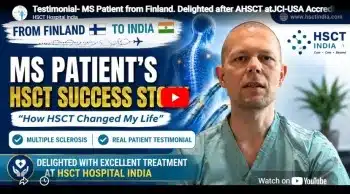
A Finland Patient’s Inspiring Recovery from Multiple Sclerosis after HSCT Treatment at JCI-USA Accredited World Class Hospital in India
Jukka from Finland, who has primary progressive MS, completed the full 30 day HSCT programme at HSCT Hospital India.

American Cop Flies to India for HSCT: 95% Symptom free, 5 Months after HSCT Treatment at JCI-USA Accredited World Class Hospital in India
Dylan, a US police officer with small fibre neuropathy, had about 95 per cent of his symptoms gone five months after HSCT.
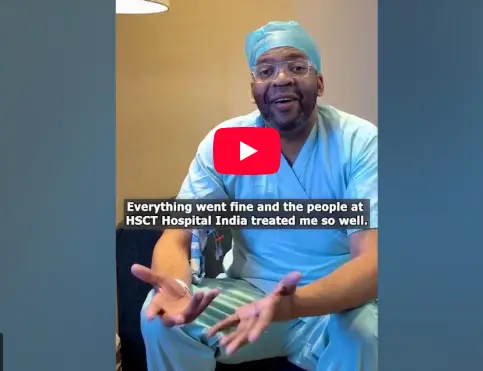
Sergel, 38M from Holland: Multiple Sclerosis Patient shares after HSCT Treatment at JCI-USA Accredited World Class Hospital in India
Watch this Video testimonial: Sergel, 38 years young man from Netherlands suffering from Multiple Sclerosis