CAR T Cell Therapy for MS or HSCT: How They Compare in 2026
Medically reviewed by the board of haematologists at HSCT Hospital India, whose transplant physicians hold DM Clinical Haematology qualifications and fellowship training in stem cell transplantation. The programme runs at a JCI-USA, NABH and NABL accredited hospital that has treated more than 1500 patients.
Last reviewed: 23 September 2026.
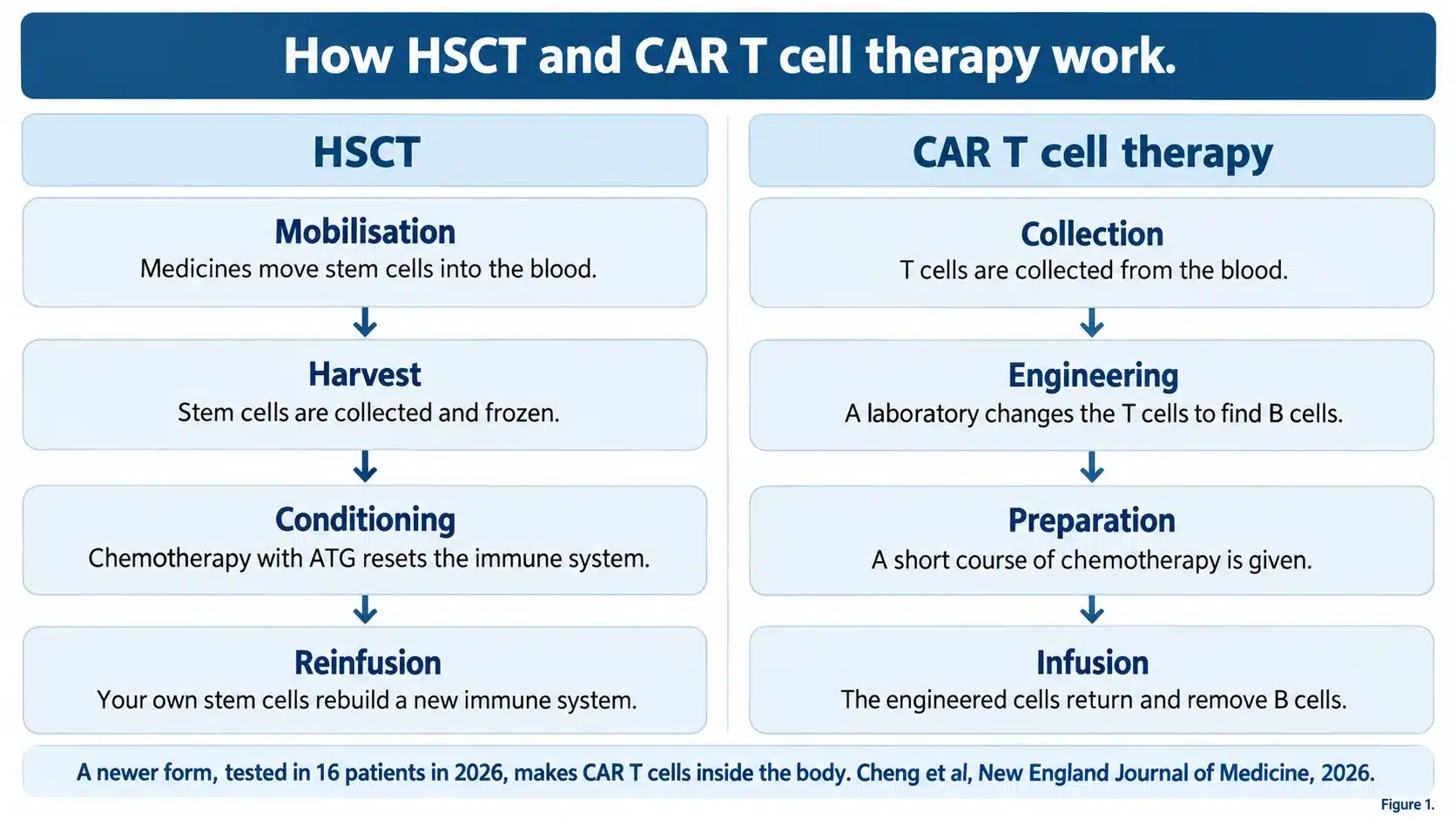
CAR T cell therapy is an experimental treatment that changes a patient’s own immune cells in a laboratory. The changed cells find and remove the B cells involved in multiple sclerosis. It has been approved for some blood cancers since 2017, and trials in MS began only recently. HSCT, short for autologous haematopoietic stem cell transplantation, works in a different way. It clears the faulty immune system with chemotherapy and then rebuilds it from the patient’s own stem cells.
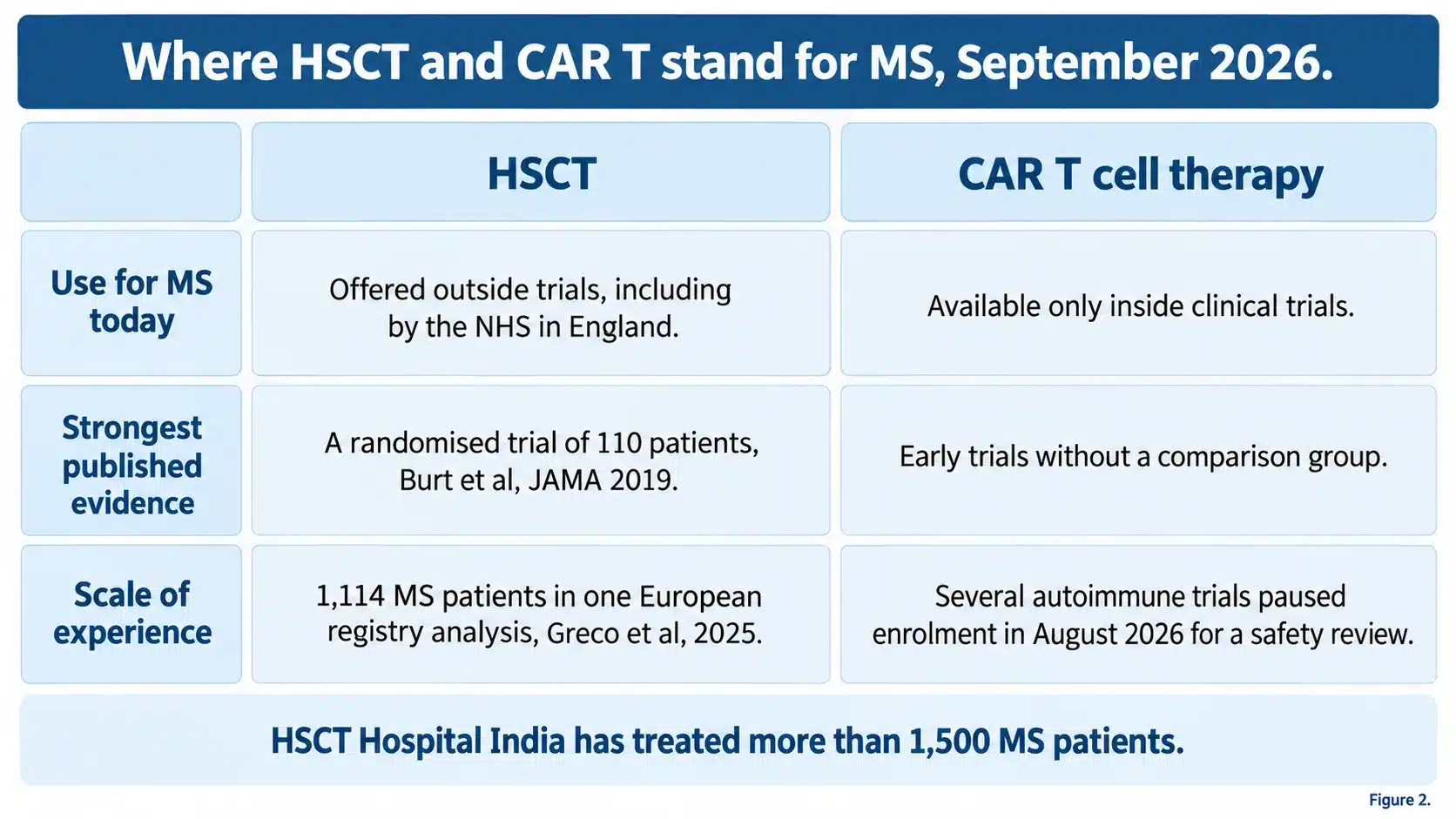
Both treatments act on the immune cells that drive MS, and both start by collecting cells from the patient’s blood. The main difference today is access. CAR T for MS is given only inside clinical trials, while HSCT is offered outside trials in several countries, including by the NHS in England.
HSCT Hospital India has treated more than 1,500 MS patients from over 30 countries since 2016, using the non-myeloablative protocol developed by Dr Richard Burt. Treatment takes place in a JCI-USA accredited hospital that also holds NABH and NABL accreditation, for one all-inclusive price of US $30,000, and there is no long waiting list.
What is CAR T cell therapy, and how is it different from HSCT?
CAR T stands for chimeric antigen receptor T cell. A T cell is a white blood cell that normally finds and destroys infected or abnormal cells. In CAR T therapy, your T cells are collected from your blood. A laboratory then adds a new receptor to them, which is a protein on the cell surface that recognises one chosen target.
In most of the MS trials, that target is a protein called CD19, which sits on B cells. B cells are another type of white blood cell, and they help drive the inflammation that damages myelin, the protective covering around your nerves. Before the engineered cells go back in, you usually receive a short course of chemotherapy to make room for them. Once they are infused, the CAR T cells typically multiply and remove B cells throughout the body.
HSCT acts on the whole immune system rather than on one cell type. At HSCT Hospital India, chemotherapy with ATG, short for anti-thymocyte globulin, clears both the T cells and the B cells that attack myelin. Your own stem cells then rebuild the immune system over the following weeks, which is why doctors describe HSCT as a “reset”.
This difference in reach shapes what each treatment is for. CAR T aims one engineered cell at one target, while HSCT removes the immune cells driving MS and lets the whole system grow back from your own stem cells. HSCT has been given for MS for many years and has been tested against the regular MS medicines in a randomised trial, while CAR T for MS is at the stage of first trials.
How do HSCT and CAR T compare for MS, side by side?
Most patients weigh the two treatments on the same handful of questions. Each answer below reflects what is published as of September 2026.
| Question | HSCT at HSCT Hospital India | CAR T cell therapy for MS |
|---|---|---|
| Can I have it now? | Yes, HSCT is given outside trials, and there is no long waiting list at HSCT Hospital India. | It is available only if a clinical trial accepts you, and some trials paused enrolment in August 2026. |
| What does it act on? | It clears the T cells and B cells driving MS and rebuilds the immune system from your own stem cells. | It removes B cells using your own T cells, engineered to find them. |
| What is the strongest evidence? | A randomised trial of 110 patients compared HSCT with the regular MS medicines and was published in 2019. | The trials so far are small and have no comparison group. |
| How long is the treatment? | It is one hospital stay of up to 30 days. | The length depends on the trial and on how long the cells take to make. |
| What does it cost? | It costs US $30,000, all-inclusive, at HSCT Hospital India. | There is no public price for MS, because it is given only in trials. |
| Who decides if it suits me? | The HSCT specialist doctors at HSCT Hospital India review your case without charge. | Each trial sets its own entry rules and chooses its own patients. |
Is CAR T cell therapy available for my MS today?
CAR T for MS is available only inside a clinical trial. It is still being tested, so the only way to receive it is to be accepted into a study. Each study usually takes a small number of patients and sets strict entry rules. In September 2026, the US Food and Drug Administration cleared a trial of a CAR T therapy called C-CAR168 for progressive MS. Its first stage will treat between 6 and 24 people.
HSCT is available in a different way, because it is already part of routine care in several countries. The NHS in England funds it for relapsing MS under a policy published in 2024. HSCT Hospital India assesses patients from over 30 countries and usually gives its opinion on a case within days.
What have the CAR T trials in MS found so far?
The early results are encouraging, and they come from small groups of patients. In 2026, the New England Journal of Medicine reported a trial of a new form of CAR T in 16 people with MS and related nerve conditions. This form is given as a single infusion that makes the CAR T cells inside the body, without the laboratory step. Patients with MS reported less tiredness and better movement and thinking, and markers of nerve injury went down.
That trial had no comparison group. This means its results cannot yet be weighed against standard MS treatment. Longer follow-up is also needed to judge how long the benefit lasts and how safe it is. Other programmes are at a similar stage. The Breakfree-2 programme presented early data in 2026 on six patients with relapsing MS and nine with progressive MS. A study at Tongji Hospital treated five people with progressive MS using a CAR T aimed at a different target, called BCMA, and reported a favourable safety profile.
Why were some CAR T trials in MS paused in 2026?
In August 2026, two companies paused CAR T trials in autoimmune disease, and MS was among the conditions affected. Novartis paused eight trials of its therapy, rapcabtagene autoleucel, on 24 August after three patients died. The cause was a rare and severe inflammatory reaction that doctors call immune effector cell associated haemophagocytic syndrome. In this reaction, the activated immune system inflames the body’s own organs.
Bristol Myers Squibb then paused enrolment in its own programme, called zola-cel, after milder inflammatory reactions that went away. No deaths were reported in that programme. Both companies are reviewing their data, and these reviews will decide when the paused trials reopen.
What should I ask before joining a CAR T trial for MS?
A trial can be a good choice, and it helps to know what you are signing up for. The first question is which phase the trial is in. Phase 1 trials usually test safety and dose in a small group, while later phases test how well a treatment works, often against a comparison group.
The second question is what happens after the infusion. Ask how long you will be followed, how often you must travel back, and who pays for that travel and your stay. The third question is what happens if the trial is paused, as several were in August 2026, and whether your place is kept.
It also helps to ask whether you can have HSCT later if the trial does not help you. The answer depends on your own case, and the HSCT specialist doctors at HSCT Hospital India can talk it through with you when they review your records.
Why do patients choose HSCT Hospital India for their HSCT?
Patients who choose HSCT over waiting for CAR T then choose where to have it, and HSCT Hospital India gives them a programme built around MS. The hospital has treated more than 1,500 MS patients from over 30 countries since 2016. It is accredited by JCI-USA, an international accreditation for hospital quality and patient safety, and also holds NABH and NABL accreditation. Its protocol is the non-myeloablative regimen developed by Dr Richard Burt, the same regimen tested in the MIST trial.
The stay is designed around the weeks when you are most vulnerable. Every patient stays as an in-patient for the whole treatment, in a deluxe private room with Triple HEPA air filtration, which removes germs from the air you breathe. Your attendant stays in the room with you, and nurses are on hand 24 hours a day. During your stay you also have neuro-physiotherapy, which is exercise a physiotherapist plans to rebuild your strength and balance.
The price is set out in full before you travel. One all-inclusive payment of US $30,000 covers the whole programme, including your attendant’s food and laundry and your airport pick-up and drop-back. Your HSCT Case Manager helps you apply for the Indian medical visa and guides you from your first enquiry to your flight home.
For patients comparing HSCT with CAR T, the HSCT Hospital India brochure is sent by email on request. It describes the 30 day HSCT programme and everything the one price covers.
What do patients say about their HSCT at HSCT Hospital India?
Patients from the United States and the United Kingdom have described their treatment at HSCT Hospital India on video. Their words appear exactly as spoken, and the results they describe are their own.
Kathryn travelled from the United States after living with MS for 30 years. Her friend Corrinne came with her as her attendant.
“I have had nothing but great service and great doctors and great nurses here. They are very concerned about not only my health needs but my personal needs.” Kathryn, United States
“On a daily basis I receive physical therapy that I have never had before, which has helped me to improve immensely, to the point that I am getting to go home real soon.” Kathryn, United States
“She can feel things that she could not feel before. Her mind is better, and her overall attitude and body is just better.” Corrinne, Kathryn’s attendant
Her full account is on the page about Kathryn from the United States. Margaret came from Scotland, where she had been diagnosed in 2013 and had received no treatment for her MS.
“Seven hours after I had the stem cells reinfused, I could move my legs, the legs I have not been able to move for years. I actually managed to move them.” Margaret, United Kingdom
“That is the thing here, everything, they really take care of everything. They look at the whole picture. It is not just about the HSCT.” Margaret, United Kingdom
“I would just wish I had done it sooner. It is what everybody says.” Margaret, United Kingdom
Her full account is on the page about Margaret from the United Kingdom. David from the United States, who has primary progressive MS, explains on his page why he chose India over programmes closer to home.
Who does HSCT at HSCT Hospital India help most?
HSCT helps most when MS is still driven by active inflammation. That means relapses, or new and growing lesions on an MRI taken within the last 12 months. It suits patients whose MS has kept moving despite the regular MS medicines, because it acts directly on the immune cells driving the disease.
The hospital reviews patients aged up to about 60 whose EDSS is 6.5 or lower. At 6.5, a person usually needs two sticks or a similar aid to walk. All three courses of MS are assessed: relapsing remitting, secondary progressive and primary progressive. For each one, the deciding question is the same, which is whether your scans still show inflammation.
A score above 6.5 or an age above 60 does not end the conversation. Those cases are reviewed individually, and the doctors explain what they see in your own scans. If another country has said no, the hospital still reads your case afresh, because every health system draws its own lines.
How is HSCT given to me at HSCT Hospital India, and how long does it take?
You stay at HSCT Hospital India for up to 30 days as an in-patient, with your attendant beside you in the same room. On arrival you have a full medical evaluation, and the treatment then moves through four stages. Each stage prepares for the next.
The first stage is called mobilisation. You are given a growth factor with a short course of chemotherapy, and together they push stem cells from your bone marrow out into your bloodstream. Your bone marrow is the soft tissue inside your bones where blood cells are made.
Next comes the harvest, known to doctors as leukapheresis. A machine collects the stem cells from your blood over several hours, a little like giving blood, and returns the rest of your blood to you. The collected cells are counted and frozen until they are needed, so the chemotherapy that follows is never rushed.
The third stage is conditioning, when cyclophosphamide and ATG clear the immune cells that drive your MS. While the ATG runs in, some patients develop a fever, chills or a rash. These reactions are expected, and the nurses treat them as they happen. If you feel sick, you are given anti-nausea treatment.
The fourth stage is reinfusion. Your frozen stem cells are thawed and returned to you through a drip, and over the following days they usually start to rebuild your immune system.
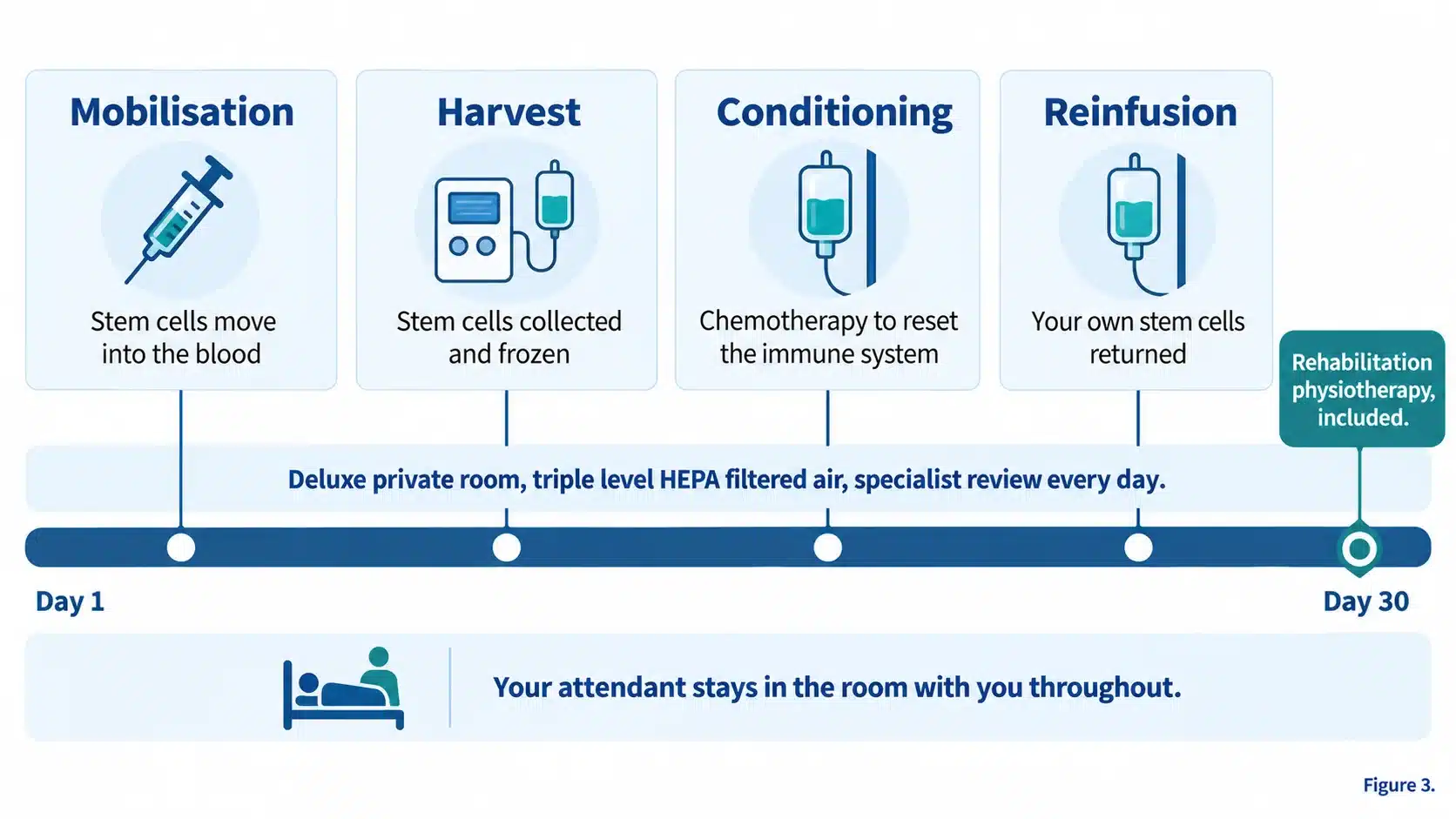
The days after reinfusion are when your immunity is at its lowest. This stretch is known as the aplastic phase, and it is why every patient at HSCT Hospital India stays in hospital from the first day to the last. You stay in a deluxe private room with Triple HEPA air filtration and nurses 24 hours a day, so a fever is caught and treated at once. In the European registry, a large record of patients treated at many hospitals, patients on this protocol had their infection-fighting white blood cells back about 10 days after reinfusion.
Every step from your first enquiry to your flight home is explained on the page about the HSCT treatment process at HSCT Hospital India.
What does the research on HSCT for MS show?
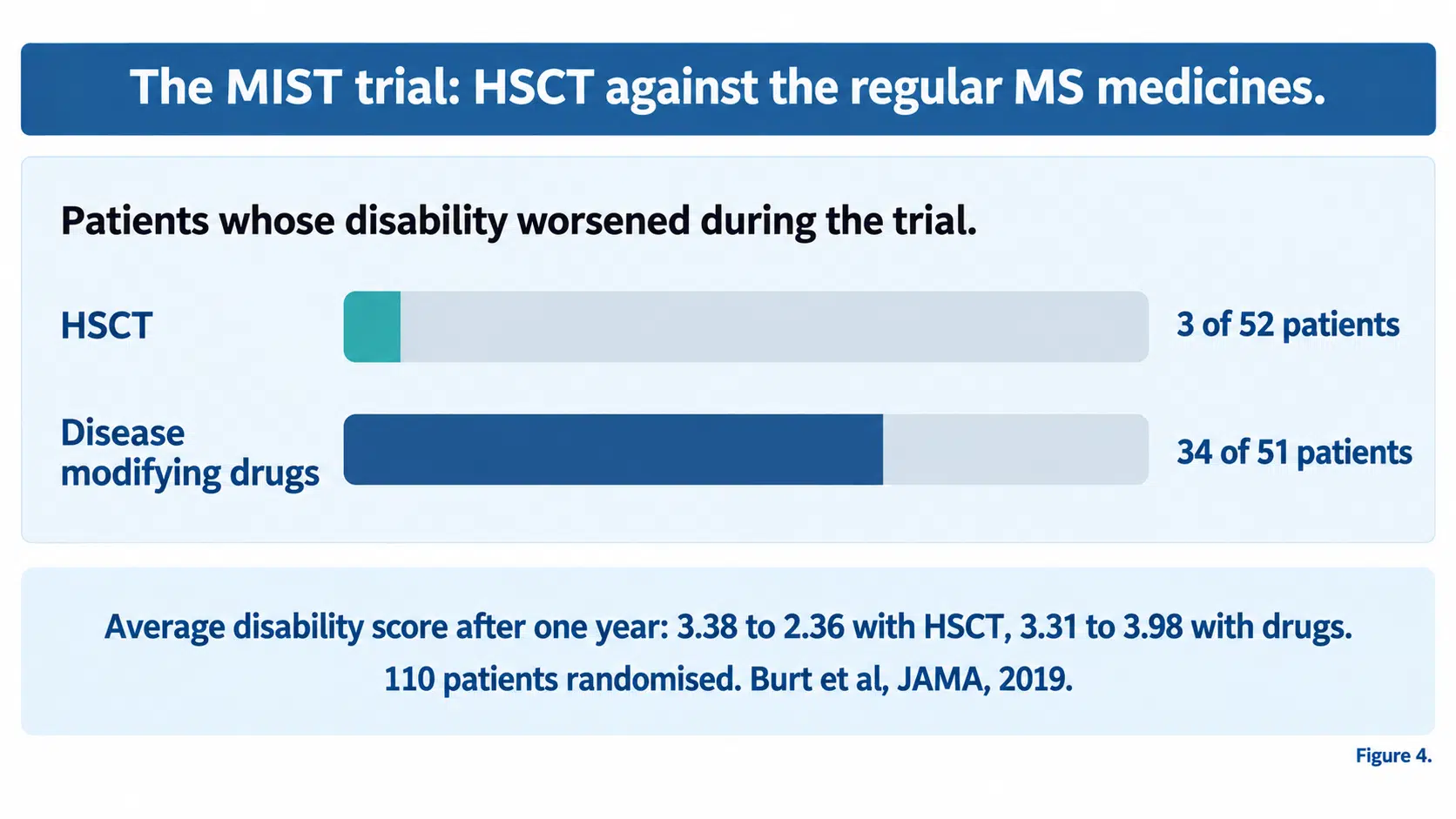
The strongest evidence for HSCT in MS comes from a randomised trial, in which patients are assigned to one treatment or another by chance. The MIST trial results appeared in 2019, in the Journal of the American Medical Association. It assigned 110 patients with relapsing MS either to HSCT or to disease modifying drugs, the regular medicines used to control MS. Among patients who had HSCT, 3 of 52 saw their disability get worse, against 34 of 51 of those who stayed on drugs.
The disability score moved in opposite directions for the two groups. EDSS, the scale doctors use to measure MS disability from 0 to 10, fell on average from 3.38 to 2.36 one year after HSCT. On drugs, it rose from 3.31 to 3.98 over the same year. The trial used cyclophosphamide with ATG, which is the protocol HSCT Hospital India uses.
Registry data points the same way. A 2025 study of 1,114 MS patients in the European registry found that this protocol gave results very similar to the other main protocol. The same study found that the type of MS made the biggest difference to the result, which is why your own scans are read before anything else.
Use the enquiry form to share your diagnosis, your most recent MRI report and the list of MS medicines you have already taken. Specialist doctors at HSCT Hospital India review it without charge. Their answer reaches you by email from an HSCT Case Manager.
What happens after I go home from HSCT Hospital India?
Your recovery continues at home, and HSCT Hospital India stays involved. No more chemotherapy is needed once you leave. You go home with a discharge summary, a full record of your treatment that you share with your own GP or neurologist.
For the first two months your blood counts are tested twice a month, then monthly until they are back to normal. Depending on those counts, most patients resume their usual activities after 2 to 4 months, and the full recovery usually takes 3 to 12 months. Many patients return to work gradually, starting with half days.
The hospital asks for updates on your progress after you go home. Your HSCT specialists use these updates to follow your progress and help with any question you have.
What are the risks of HSCT, and how does HSCT Hospital India manage them?
The main risk of HSCT is infection during the aplastic phase, when your white blood cells are low. In the 2025 European registry study, 1.0 per cent of patients on cyclophosphamide with ATG died within 100 days of treatment. This is the protocol used at HSCT Hospital India.
Because infection is the main risk, the whole stay is built around preventing it. Every patient is an in-patient in a Triple HEPA filtered room, and an HSCT specialist reviews you every day. The non-myeloablative protocol weakens your bone marrow without wiping it out, so your blood counts usually recover quickly. Every case is reviewed by the HSCT specialist doctors before treatment is offered, and your fitness for chemotherapy is part of that review.
How much do HSCT at HSCT Hospital India and CAR T cell therapy cost?
HSCT at HSCT Hospital India costs US $30,000, all-inclusive. The package covers pre-testing, MRI, the full HSCT treatment and up to 30 days in hospital. It also covers doctors’ fees, tests and consultations, medicines and consumables, neuro-physiotherapy, food and laundry for both the patient and the attendant, and airport pick-up and drop-back.
CAR T for MS has no public price, because it is given only in trials. For blood cancers, where CAR T is an approved treatment, it costs hundreds of thousands of dollars. Prices for HSCT in other countries are compared on the page about HSCT cost by country.
How do I find out whether HSCT at HSCT Hospital India is right for my MS?
The first step is to send your records through the enquiry form. The HSCT specialist doctors at HSCT Hospital India, in haematology and neurology, read your case together. They look at your recent MRI, your disease history and the MS medicines you have tried.
You usually receive the doctors’ opinion a few days after your records reach them, free and with no obligation to go ahead. Their answer is one of three: accepted after review, a closer individual look because one criterion sits outside the usual range, or unlikely to benefit from HSCT. They give you their reasoning either way. The criteria they use are set out on the page about who is eligible for HSCT.
Most of the review rests on the records you send. The doctors want the MRI images themselves, not just the radiologist’s report, so they can set one scan beside another and see whether new lesions have formed. The most useful scans are from the last 12 months.
They also need the history of your MS from diagnosis, and a list of each MS medicine you have taken and the reason it stopped. A recent EDSS score is useful, and if you do not have one, the EDSS calculator gives you an estimate.
Many patients have practical questions about flights, the medical visa and who travels with them. An HSCT Case Manager will call you at a time that suits you, at no cost.
 Request a Call Back
Should I have HSCT now or wait for CAR T cell therapy?
The answer depends mainly on how active your MS is today. HSCT usually works best while MS is still active, which means relapses or new lesions on your MRI. Lesions are areas of inflammation or damage that show up on the scan. The European registry study found that the type of MS was the biggest factor in the result of HSCT.
CAR T for MS is still in early trials, so waiting for it means waiting for a trial place and for the safety reviews to finish. HSCT is available now, with evidence from a randomised trial and many years of use in MS. The HSCT specialist doctors at HSCT Hospital India can read your MRI and your treatment history and tell you whether HSCT is suitable for you now.
Send your latest MRI report and your treatment history through the enquiry form. The HSCT specialist doctors at HSCT Hospital India will tell you without charge whether HSCT is suitable for your MS now. An HSCT Case Manager replies to you by email.
Answers to Frequently Asked Questions (FAQs) about CAR T cell therapy and HSCT for MS
Is CAR T cell therapy better than HSCT for MS?
No study has compared the two treatments yet. HSCT has evidence from a randomised trial in MS, while CAR T has early results from small groups of patients without a comparison group.
Is CAR T cell therapy approved for MS?
CAR T for MS is still being tested in clinical trials. It is approved only for some blood cancers, so patients with MS can receive it only by joining a study.
Does CAR T cell therapy for MS need chemotherapy?
The standard form does. A short course of chemotherapy is usually given before the engineered cells are infused, to make room for them in the body.
Why were CAR T trials for MS paused?
Novartis paused eight trials in August 2026 after three patients died from a severe inflammatory reaction. Bristol Myers Squibb paused enrolment in its own programme after milder reactions that went away.
Can I have CAR T cell therapy for MS at HSCT Hospital India?
HSCT Hospital India treats MS with HSCT. CAR T for MS is given only inside clinical trials, and the HSCT specialist doctors can review whether HSCT is suitable for you now.
How long does HSCT take at HSCT Hospital India?
You are treated during a single hospital stay of up to 30 days. Back home, most patients resume their normal activities within 2 to 4 months.
How much does HSCT cost at HSCT Hospital India?
HSCT at HSCT Hospital India costs US $30,000, all-inclusive. The price covers the treatment, up to 30 days in hospital, your attendant’s food and laundry, and airport pick-up and drop-back.
Can someone come with me to India?
Yes, one attendant can stay in your room for the whole of your treatment. Their food and laundry are included in the price.
How long does the free review of my records take?
The doctors usually reply with their opinion a few days after your records arrive. There is no charge and no obligation.
Can HSCT help progressive MS?
HSCT Hospital India assesses progressive MS case by case. What decides it is whether a recent MRI still shows inflammatory activity, and the page about HSCT for progressive MS explains more.
The HSCT specialist doctors at HSCT Hospital India review every case without charge. Send your diagnosis and your latest MRI report through the enquiry form, and an HSCT Case Manager replies to you by email.
References
- Burt RK, Balabanov R, Burman J, et al. Effect of nonmyeloablative hematopoietic stem cell transplantation vs continued disease-modifying therapy on disease progression in patients with relapsing-remitting multiple sclerosis. JAMA. 2019;321(2):165-174.
- Greco R, Saccardi R, Ponzano M, et al. BEAM/ATG or cyclophosphamide/ATG as conditioning regimen in autologous haemopoietic stem cell transplantation for multiple sclerosis: a retrospective analysis of the EBMT autoimmune diseases working party. Bone Marrow Transplantation. 2025. PMID 41023426.
- Cheng YH, et al. Lentiviral in vivo CD19 CAR T-cell therapy in neurologic autoimmune disorders. New England Journal of Medicine. 2026;395(9):926-929.
- Anti-BCMA CAR-T therapy in patients with progressive multiple sclerosis. Cell. 2025.
- Novartis and Bristol Myers Squibb pause autoimmune CAR-T trials. BioPharma Dive, 31 August 2026.
- FDA gives go-ahead for trial testing cell therapy for progressive MS. Multiple Sclerosis News Today, 15 September 2026.