How Long Does It Take to Recover After HSCT for MS?
Medically reviewed by the board of haematologists at HSCT Hospital India, whose transplant physicians hold DM Clinical Haematology qualifications and fellowship training in stem cell transplantation. The programme runs at a JCI-USA, NABH and NABL accredited hospital that has treated more than 1500 patients.
Last reviewed: 24 September 2026.
Recovery after HSCT for multiple sclerosis happens in two places, first in hospital and then at home. HSCT, short for autologous haematopoietic stem cell transplantation, uses chemotherapy to clear the immune cells that attack the nerves in MS. The immune system is then rebuilt from the patient’s own stem cells, and that rebuilding takes months.
At HSCT Hospital India, the first part of recovery takes place during one in-patient stay of up to 30 days. The second part happens at home, guided by an Aftercare Manual and regular blood tests. HSCT Hospital India has treated more than 1,500 MS patients from over 30 countries since 2016. Its hospital holds JCI-USA accreditation, together with NABH and NABL.
How long does it take to recover after HSCT for MS?
Within 2 to 4 months of HSCT, most patients are back to their usual activities. A full recovery from the transplant itself usually comes somewhere between 3 and 12 months. HSCT recovery time depends mainly on your blood counts, which show how far your bone marrow and immune system have rebuilt. The MS Society in the UK describes a similar picture, with most people recovering over two to six months.
Your fitness before treatment matters too, and so does how physical your daily life is. Recovery from the chemotherapy is also separate from any change in your MS symptoms. The two follow different timetables, and research has measured each of them.
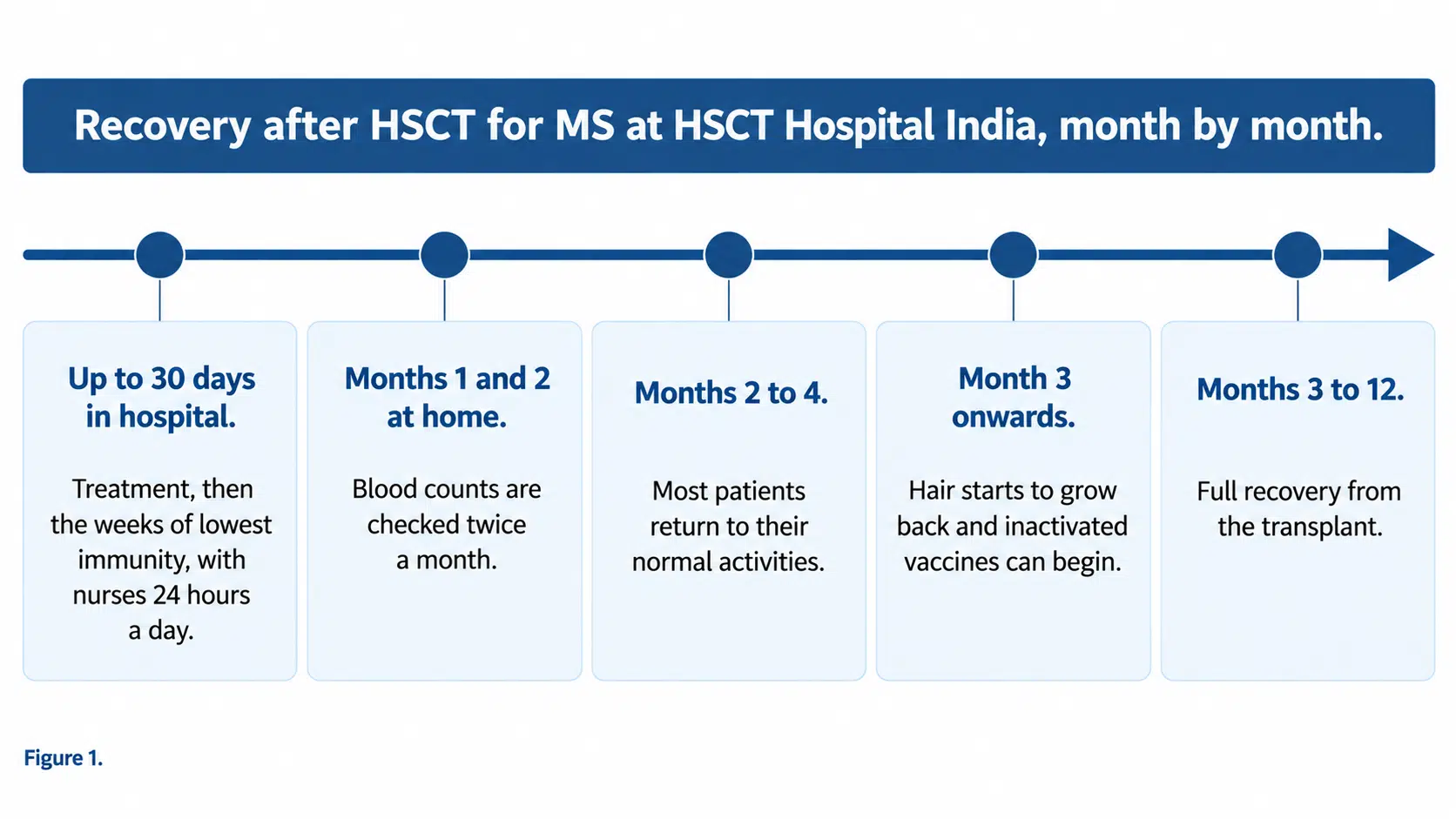
Each stage of recovery has its own focus, and HSCT Hospital India plans its care around each one.
| When | What usually happens to you | What HSCT Hospital India does |
|---|---|---|
| Up to 30 days in hospital | Your stem cells are collected, the chemotherapy is given and your cells are returned to you. Your immunity is at its lowest in the days that follow. | You stay in a Triple HEPA room with nurses on duty 24 hours a day, and neuro-physiotherapy begins during the stay. |
| Months 1 and 2 | Tiredness is common while your blood counts are still rebuilding. | Your blood counts are checked twice a month, and the results are shared with the hospital. |
| Months 2 to 4 | Most patients return to their normal activities in this period. | The blood count checks continue once a month until your counts are normal. |
| Month 3 onwards | Your hair starts to grow back, and essential inactivated vaccines can begin. | The Aftercare Manual sets out what you can restart and when. |
| Months 3 to 12 | Full recovery from the transplant usually comes within this period. | Your updates continue, so your HSCT specialists can follow your recovery. |
Table 1. Recovery after HSCT for MS at HSCT Hospital India, stage by stage. Timings from the hospital’s own answers to patients.
What happens to my body while I recover in hospital at HSCT Hospital India?
The hardest part of recovery comes early, inside the 30 day stay. After conditioning, which is the chemotherapy that clears the faulty immune cells, your white blood cells fall to their lowest level. This stretch is known as the aplastic phase, and infection risk peaks during it.
For this reason every patient at HSCT Hospital India stays in hospital for the whole treatment, with no outpatient stage. Your room is a deluxe private room with triple level HEPA air filtration, which uses fine filters to take germs out of the air. Nurses monitor you around the clock, so a fever is noticed and treated straight away.
The conditioning at HSCT Hospital India uses cyclophosphamide with ATG, short for anti-thymocyte globulin, in the non-myeloablative protocol developed by Dr Richard Burt. Non-myeloablative means your bone marrow is weakened rather than destroyed. Because of this, your blood counts come back sooner than they would after a stronger regimen.
Feeling weak for a while after the chemotherapy is expected. Marion, who travelled from the Netherlands with her brother Johannis as his attendant, described the change she saw in him.
"Before a treatment he could not walk, only some metres with the walker. And after treatment, first he was weak because of the chemo, but after that he can walk better, and he is a little bit less stiff."
Marion, Johannis’s sister and attendant
Strength is rebuilt with neuro-physiotherapy, which is exercise guided by a physiotherapist to improve strength, balance and movement. At HSCT Hospital India it begins during your stay and is included in the HSCT treatment package. Because you are an in-patient throughout, sessions can take place every day.
Kathryn from the United States, who had lived with MS for 30 years when she came for treatment, had physiotherapy daily during her stay.
"On a daily basis I receive physical therapy that I have never had before, which has helped me to improve immensely, to the point that I am getting to go home real soon."
Kathryn, MS patient from the United States
Questions about recovery often depend on your own health and your life at home, and they are easier to talk through. An HSCT Case Manager can phone you at a time you choose, free of charge.
 Request a Call Back
What will I feel in the first weeks at home after HSCT?
Going home is not the end of the time it takes to recover after HSCT, because your new immune system is still rebuilding. In the first weeks, tiredness is the feeling most patients notice. It usually eases as your blood counts rise, and there is no more chemotherapy after you leave hospital.
Hair loss is part of these weeks too. You lose about a third of your hair during treatment, and it usually starts to grow back about 3 months after HSCT. Cutting the hair short before treatment is a common choice, because the head is shaved once the hair begins to fall.
Food on the flight home and in the first months follows the Aftercare Manual. It lists cooked food as the safe choice, and it rules out raw vegetables, raw eggs, raw meat, raw fish, raw seafood and salads. Raw food can carry germs that a rebuilding immune system copes with poorly, and canned food, thick skinned fruit and packaged juices are fine for the flight.
How do I lower my risk of infection at home after HSCT?
The main risk at home is infection, and a few simple rules lower it. Close contact is avoided with anyone who has a cough or a cold. The same applies to children who have recently had the oral polio vaccine, which contains a weakened live virus. Pets can stay at home as long as they are well immunised.
Close contact with a pet is avoided for 3 months, and cleaning up after it waits for 6 months. Travel abroad is kept to a minimum for the first 3 months, and places where medical care is far away are avoided. You can live alone after returning home, as long as medical help is close by. A mask and hand sanitiser are used on the flight and in public places for the first month after treatment.
When can I go back to work, drink alcohol or garden after HSCT?
As you recover after HSCT, everyday activities return one at a time, and your blood counts set most of the timing. Work comes back once your platelet count is above 100,000. Platelets are the blood cells that help blood to clot, and their count is one of the clearest signs of how far your bone marrow has recovered.
Returning in stages works best for most patients, with half days or half weeks at first. The timing also depends on your stamina and on how physical your job is.

Alcohol is avoided completely for the first 3 months, and after that it is taken only in moderation. Gardening waits for at least 3 months, until your blood counts have recovered, because soil carries germs that your immune system is not yet ready for. Dental surgery waits for 6 months after the transplant.
Anyone who smokes stops completely before the transplant, and does not start again. For women who hope to have a child, pregnancy is safe after 1 year. Fertility planning happens before treatment, and HSCT Hospital India explains the options in its guide to fertility preservation before HSCT.
The timings for everyday life after HSCT at HSCT Hospital India come from its Aftercare Manual and its answers to patients.
| Activity | When it usually comes back | Why the wait matters |
|---|---|---|
| Work | Work returns once your platelet count is above 100,000, often with half days at first. | Platelets help your blood to clot, and a count above 100,000 shows your bone marrow has largely recovered. |
| Alcohol | Alcohol is avoided for the first 3 months, and then taken only in moderation. | Your blood counts and your immune system are still recovering from the chemotherapy in these months. |
| Gardening | Gardening waits for at least 3 months, until your blood counts have recovered. | Soil carries germs that a rebuilding immune system is not ready to meet. |
| Travel abroad | Travel is kept to a minimum for the first 3 months. | Staying close to good medical care keeps any infection easy to treat. |
| Dental surgery | Dental surgery waits for 6 months after the transplant. | Surgery in the mouth can let germs into the blood while immunity is still low. |
| Pregnancy | Pregnancy is safe after 1 year. | Waiting a year gives your body time to recover fully from the chemotherapy. |
Table 2. When everyday activities usually return after HSCT, from the HSCT Hospital India Aftercare Manual.
Research shows how work returns over the longer term. A 2024 study from Norway by Kvistad and colleagues was published in the Multiple Sclerosis Journal. It followed 29 patients with aggressive relapsing MS for an average of almost six years after HSCT. Before treatment, 1 of the 29 was working full time. That number rose to 10 at two years and to 15 at five years. Over the same period, 24 of the 29 had no further relapse and 26 had no worsening of disability.
How does HSCT Hospital India follow my recovery after I fly home?
Your care continues after you leave India, through your own doctors and through regular updates to the hospital. Before you leave, you receive a Discharge Summary and an Aftercare Manual. The Discharge Summary records your treatment for your own GP or neurologist, and the Aftercare Manual guides your daily life at home.
Airport drop-back is part of the package, so the trip home is arranged for you. Once you are home, your blood counts are checked twice a month for the first two months. After that they are checked once a month until they return to normal, and the results are shared with HSCT Hospital India.

The hospital asks for these updates for two reasons. Your HSCT specialists can then see how you are doing and help with questions along the way. The results are also reported to national and international HSCT databases, which track how patients do after treatment.
Having your case looked at by the transplant doctors at HSCT Hospital India costs nothing. Send your diagnosis, your recent MRI films and a list of the MS medicines you have taken through the enquiry form, and an HSCT Case Manager replies by email.
How does my immune system rebuild after HSCT?
Your new immune system grows back in a set order, and each stage explains part of how you feel. Neutrophils come back first, usually within the first two weeks after your cells are returned. Neutrophils are the white blood cells that fight infection first, and their return, which doctors call engraftment, is confirmed on a blood count before you go home.
Energy then returns gradually over the first three months. During these months medicines to prevent infection continue, and crowds and known sources of infection are avoided. Your T cells, the immune cells that directed the damage to your nerves, recover in number at around six months.
The balance between the different kinds of T cell moves back towards normal by about one year. This timing comes from a review for the European Society for Blood and Marrow Transplantation by Cencioni and colleagues, published in Frontiers in Immunology in 2021. B cells, which make antibodies, usually return within the first year.
The thymus, a small gland in the chest that trains new T cells, becomes active again after the first year. A study of HSCT for lupus by Alexander and colleagues, published in Blood in 2009, followed this closely. By three years, the number of newly made T cells had doubled against healthy people. These new cells come from your own stem cells, which is the reason HSCT is described as a reset of the immune system. HSCT Hospital India explains what the treatment does to each part of the immune system in its guide to chemotherapy for MS.
| Part of the immune system | When it usually returns | What it means for you |
|---|---|---|
| Neutrophils, the first infection fighters | They return within about two weeks of your cells going back in. | Their return is confirmed on a blood count before you leave hospital. |
| T cells, which drove the damage in MS | Their numbers recover at around six months. | Medicines to prevent infection continue while they rebuild. |
| The balance of T cell types | It moves back towards normal by about one year. | Your immune system behaves more and more like a normal one. |
| B cells, which make antibodies | They usually return within the first year. | Vaccines begin to work better as B cells recover. |
| New T cells from the thymus | The thymus becomes active again after the first year. | Fresh immune cells made from your own stem cells replace the old ones. |
Table 3. How the immune system rebuilds after HSCT, from the EBMT review by Cencioni and colleagues and the study by Alexander and colleagues.
When can I have vaccinations after HSCT?
HSCT weakens the protection your earlier vaccinations gave you, so vaccines are restarted on a set schedule. The timing comes from European guidelines on vaccination after stem cell transplant, known as ECIL 7. They were published by Cordonnier and colleagues in the Lancet Infectious Diseases in 2019.
Essential inactivated vaccines can begin from 3 months after HSCT. An inactivated vaccine contains no live germ, so it is safe while your immune system is still rebuilding. Live vaccines, which contain a weakened living germ, are considered at 24 months, if you are no longer taking medicine that suppresses the immune system.

Your body responds less strongly to vaccines in the first months, and the response comes close to normal two to three years after HSCT. Your own doctor gives the vaccinations near your home.
When will I notice changes in my MS after HSCT at HSCT Hospital India?
Changes in MS symptoms follow a different timetable from recovery after chemotherapy. A study from Vilnius University in Lithuania measured both. Published in Scientific Reports in 2022 by Giedraitiene and colleagues, it followed 18 patients with highly active relapsing MS for two years after HSCT.
Those patients were treated with cyclophosphamide and ATG, the same combination used at HSCT Hospital India. Their physical functioning, energy and pain had improved by the first check at 3 months, and the improvement lasted to two years. Disability, measured on the EDSS, the 0 to 10 scale doctors use for MS, had improved at 3 months in 14 of the 18 patients.
Fatigue improved more slowly. This is the heavy tiredness that is part of MS itself, and it was clearly better at 12 months. The study was small, with 18 patients followed at one centre.
Some patients describe changes before they leave hospital. Hege from Norway, who has had MS since 2007, spoke about hers while she was still in hospital.
"My sight is much better. I can read on my cell phone without my glasses. And my walking has improved very much, and I feel stronger, and my balance is much better since I started for three, four days ago. And my brain is better. My thoughts are going faster."
Hege, MS patient from Norway
For other patients the work continues at home, and physiotherapy carries it forward. Margaret from Scotland, whose legs had been locked in spasm for a long time, explained what her physiotherapist had told her.
"Unfortunately my legs are going to need a little bit more help, since they were locked in spasm for so long. But that is fine, because being with the physiotherapist here we know that my legs can stretch and they will stretch."
Margaret, recorded at HSCT Hospital India
More patients describe their treatment and recovery in their own words on the HSCT Hospital India patient reviews page.
Who can have HSCT at HSCT Hospital India, and does my disability change how I recover?
HSCT Hospital India assesses every form of MS, both relapsing and progressive, and each case is reviewed on the patient’s own records. Patients are assessed up to about 60 years of age, and with an EDSS score up to 6.5, which means walking with two sticks or a similar aid. Where a patient’s age or score falls outside that range, the HSCT specialist doctors still look at the case individually.
Your starting point shapes how quickly you recover after HSCT. In the Norwegian study, the patients who still showed MS activity after treatment had started with higher disability scores. This is one reason the doctors look closely at your EDSS and your recent MRI before treatment is offered.
You can work out an estimate of your own score with the EDSS calculator. The full criteria are set out on the page about HSCT eligibility at HSCT Hospital India. Patients with progressive MS can read how their form of MS is assessed in the guide to HSCT for progressive MS. The complete guide to HSCT for multiple sclerosis covers every stage of treatment.
How does my attendant help my recovery at HSCT Hospital India?
Every patient at HSCT Hospital India comes with an attendant, a family member or friend who stays for the whole treatment. The attendant is admitted with you to your Triple HEPA room, and their food and laundry are included in the price. Most physical care is given by the hospital staff, so the attendant’s main role is company and support.
That support matters during the long days in hospital, when tiredness and being far from home can weigh on a patient. An attendant is someone to talk to if you feel lonely, anxious or homesick. They also help during travel, which is why the attendant must be able to help you on and off transport and to the toilet at airports.
Patients who have no one to travel with are not turned away. HSCT Hospital India can arrange a full time private nurse to act as the attendant, for an extra US $1,500 for the hospital stay. Johannis came with his sister Marion, and Gary came with his partner Linda, who described what she saw from beside him.
"He can now move his feet up and down. No more fizziness. A lot of the symptoms of MS have gone that he had, and this is after only like three weeks."
Linda, Gary’s partner and attendant
Why do patients choose HSCT Hospital India for their treatment and recovery?
Patients choose HSCT Hospital India because the whole treatment takes place in hospital, including the weeks when infection is most likely. Every patient is an in-patient for the whole stay of up to 30 days, in a deluxe private room with triple level HEPA air filtration. The patient and an attendant are accommodated together, and there is no long waiting list.
The hospital holds JCI-USA accreditation alongside NABH and NABL. It follows the Dr Richard Burt non-myeloablative protocol, and it has treated more than 1,500 MS patients from over 30 countries since 2016. Cases are reviewed without charge, and an HSCT Case Manager answers your questions before, during and after treatment.
You can read who HSCT Hospital India accepts for HSCT, and how its protocol compares with those used in Mexico and Russia.
How much does HSCT cost at HSCT Hospital India, and what does it include?
The price of HSCT for MS at HSCT Hospital India is US $30,000, all-inclusive. Included are the pre-treatment tests and MRI, the complete HSCT and as many as 30 days on the ward. The price also takes in all doctors’ fees, tests, consultations, medicines, consumables and neuro-physiotherapy. Food and laundry for patient and attendant are covered, as is the drive to and from the airport.
There is no outside hotel stay to pay for, because the whole treatment is given as an in-patient. You leave with your Discharge Summary and Aftercare Manual, which guide your recovery at home. Prices in other countries are compared on the page about HSCT cost by country.
The HSCT Hospital India brochure is emailed free to any patient who asks. It sets out the treatment, the stay of up to 30 days and all that the single price includes.
Answers to Frequently Asked Questions (FAQs) about recovery after HSCT
How long will I stay in hospital for HSCT at HSCT Hospital India?
You stay in hospital for up to 30 days, as an in-patient for the whole treatment. The weeks when your immunity is lowest pass inside a Triple HEPA room, with nurses on duty 24 hours a day.
When can I fly home after HSCT?
You fly home at the end of your hospital stay of up to 30 days. Airport drop-back is included in the price, and cooked or packaged food is the safest choice for the flight.
How long will I feel tired after HSCT?
Tiredness is common in the first weeks at home and eases as your blood counts rise. In a 2022 study of 18 patients, the fatigue that comes with MS itself was clearly better by 12 months.
When will my hair grow back after HSCT?
Your hair usually starts to grow back about 3 months after HSCT. Most patients lose about a third of their hair during treatment.
When can I go back to work after HSCT?
You can go back to work once your platelet count is above 100,000. Most patients start with half days or half weeks, and the timing also depends on how physical your job is.
Will I need more chemotherapy after I go home?
No, you will not need more chemotherapy. The chemotherapy is given only during your hospital stay, and recovery at home focuses on rest, blood tests and physiotherapy.
Can I live alone after HSCT?
Yes, you can live alone after returning home, as long as medical help is close by.
When can I travel abroad again after HSCT?
Travel abroad is kept to a minimum for the first 3 months after HSCT, and places where medical care is far away are avoided.
When is it safe to get pregnant after HSCT?
Pregnancy is safe 1 year after HSCT. Fertility preservation, if you want it, is planned before treatment begins.
When can I have vaccinations after HSCT?
Essential inactivated vaccines can begin from 3 months after HSCT. Live vaccines are considered at 24 months if you are no longer on medicine that suppresses the immune system.
Will my own doctor know how to look after me after HSCT?
Yes, your own GP or neurologist receives your Discharge Summary, which records your treatment. Your blood count results are also shared with HSCT Hospital India, so your HSCT specialists can follow your recovery.
Recovery looks different for every patient, and the HSCT specialist doctors at HSCT Hospital India can explain what it would mean in your own case. Your records go in through the enquiry form, and an HSCT Case Manager answers by email at no cost.
References
- Giedraitiene N, Gasciauskaite G, Kaubrys G. Impact of autologous HSCT on the quality of life and fatigue in patients with relapsing multiple sclerosis. Scientific Reports. 2022. PMID 36100664.
- Kvistad CE, Lehmann AK, Kvistad SAS, et al. Autologous hematopoietic stem cell transplantation for multiple sclerosis: long-term follow-up data from Norway. Multiple Sclerosis Journal. 2024. PMID 38345003.
- Cencioni MT, Genchi A, Brittain G, et al. Immune reconstitution following autologous hematopoietic stem cell transplantation for multiple sclerosis: a review on behalf of the EBMT Autoimmune Diseases Working Party. Frontiers in Immunology. 2021. PMID 35178046.
- Alexander T, Thiel A, Rosen O, et al. Depletion of autoreactive immunologic memory followed by autologous hematopoietic stem cell transplantation in patients with refractory SLE induces long-term remission through de novo generation of a juvenile and tolerant immune system. Blood. 2009. PMID 18824594.
- Cordonnier C, Einarsdottir S, Cesaro S, et al. Vaccination of haemopoietic stem cell transplant recipients: guidelines of the 2017 European Conference on Infections in Leukaemia (ECIL 7). Lancet Infectious Diseases. 2019. PMID 30744963.
Read next
- Can MS come back after HSCT?
- HSCT or Ocrevus for MS: how the two treatments compare
- What are the side effects of HSCT for MS?
- Who is eligible for HSCT at HSCT Hospital India?
- Which HSCT protocol is best for MS?
- HSCT for progressive MS
- CAR T cell therapy or HSCT for MS
- HSCT for MS: what the published evidence shows
- HSCT cost by country
Real Patients, Real Stories
A Finland Patient’s Inspiring Recovery from Multiple Sclerosis after HSCT Treatment at JCI-USA Accredited World Class Hospital in India
Jukka from Finland, who has primary progressive MS, completed the full 30 day HSCT programme at HSCT Hospital India.

American Cop Flies to India for HSCT: 95% Symptom free, 5 Months after HSCT Treatment at JCI-USA Accredited World Class Hospital in India
Dylan, a US police officer with small fibre neuropathy, had about 95 per cent of his symptoms gone five months after HSCT.
Sergel, 38M from Holland: Multiple Sclerosis Patient shares after HSCT Treatment at JCI-USA Accredited World Class Hospital in India
Watch this Video testimonial: Sergel, 38 years young man from Netherlands suffering from Multiple Sclerosis