Multiple Sclerosis Treatment in India: What HSCT Costs, Who Is Accepted and What the Thirty Days Involve
Medically reviewed by the board of haematologists at HSCT Hospital India, whose transplant physicians hold DM Clinical Haematology qualifications and fellowship training in stem cell transplantation. The programme runs at a JCI-USA, NABH and NABL accredited hospital that has treated more than 1500 patients.
Last reviewed: 19 August 2026.
1. What multiple sclerosis treatment in India involves
Multiple sclerosis treatment in India, at HSCT Hospital India, is an autologous haematopoietic stem cell transplant delivered inside one admission of about thirty days. Autologous means the stem cells are the patient’s own. They are collected before chemotherapy and returned afterwards. No donor is involved, which removes the tissue matching and the wait for a match.
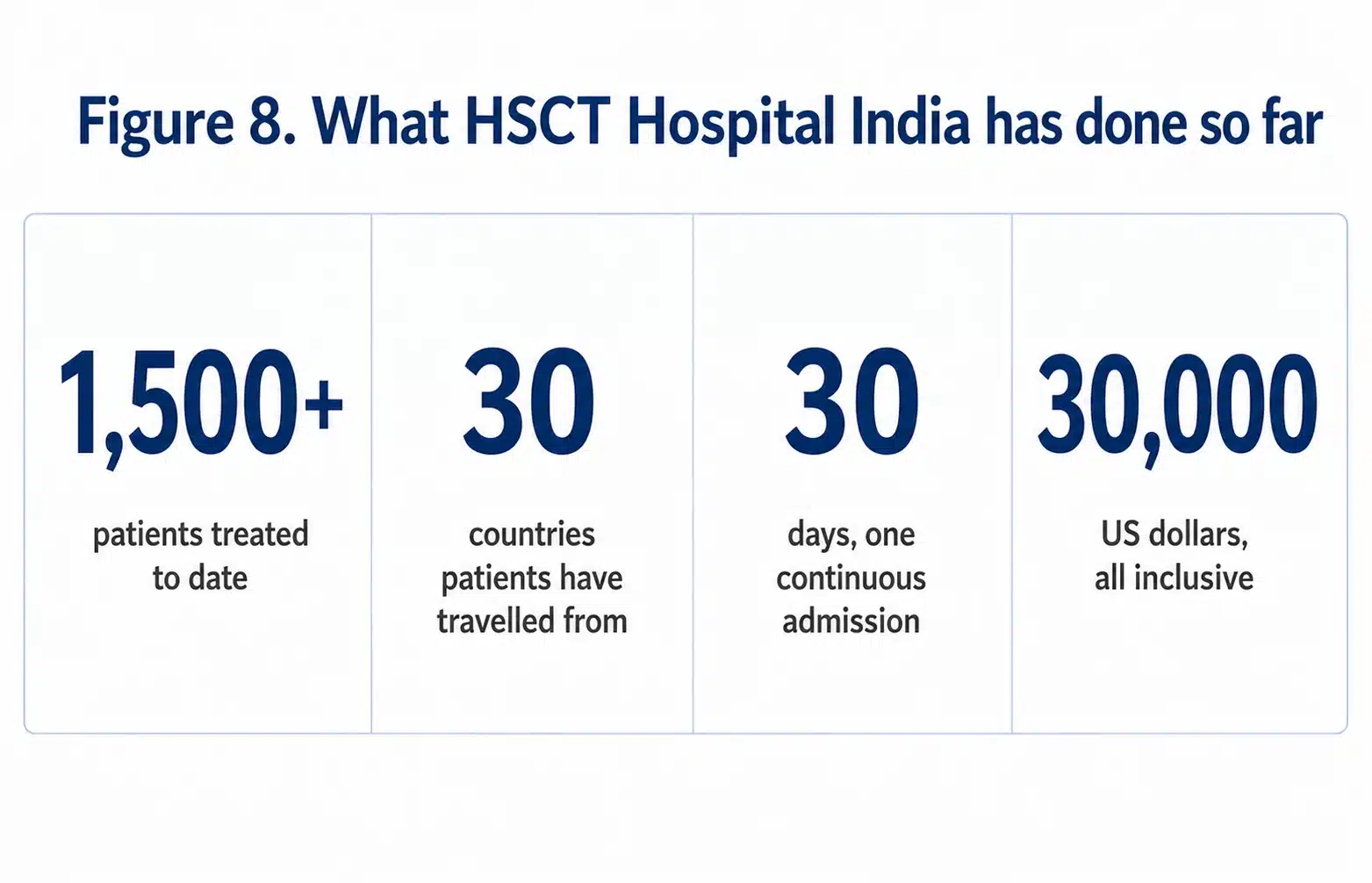
Treatment is priced at 30,000 US dollars, fixed before anything is booked. It covers the patient and one attendant for the whole admission.
The admission is built around 30 days, and some patients stay longer if blood counts take longer to recover. Gudrun R and Linda each stayed five weeks. More than 1,500 patients have been treated to date, drawn from 30 countries. Accreditation is JCI-USA, held with NABH and NABL.
2. Which conditions HSCT Hospital India treats
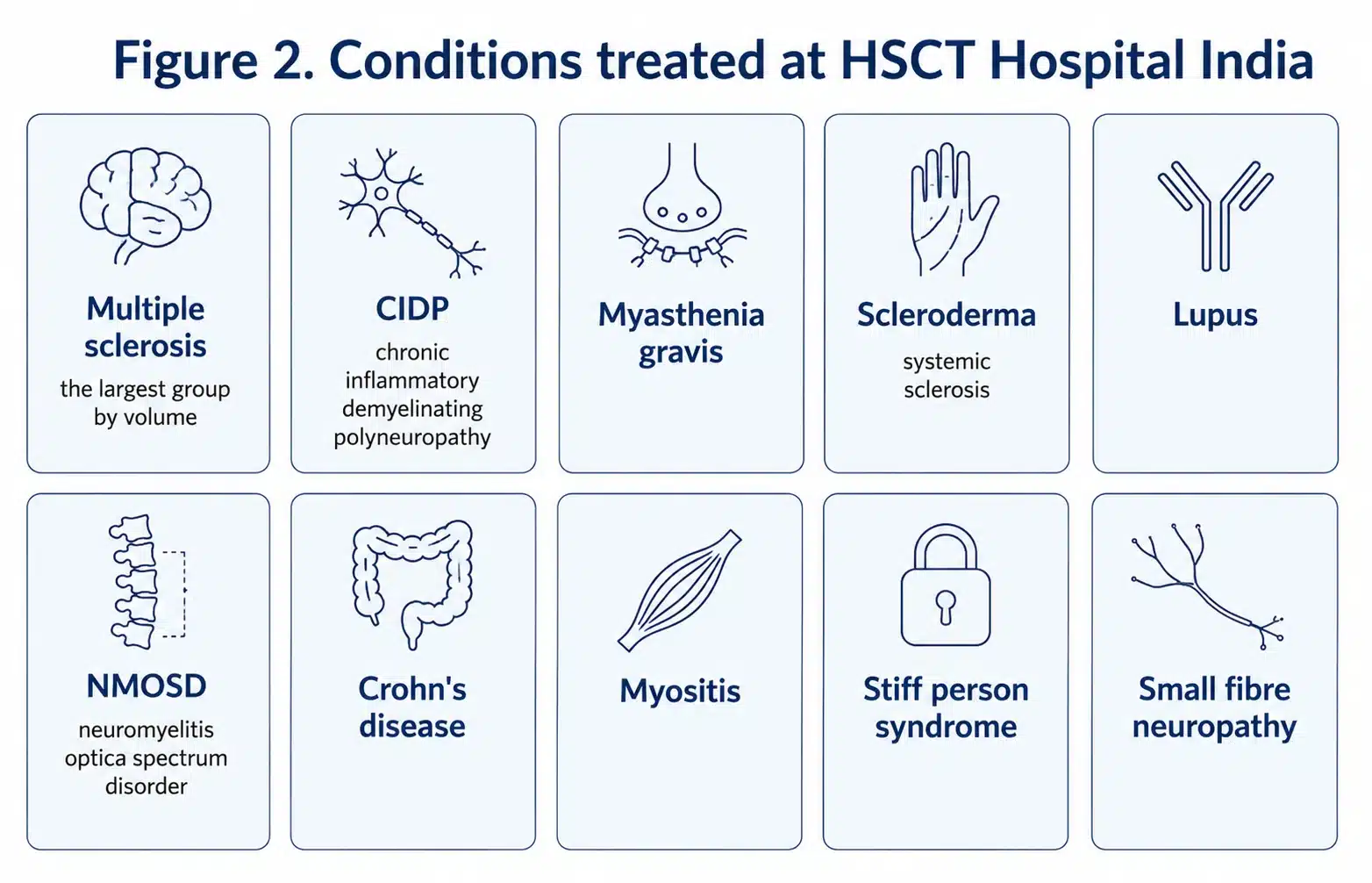
Multiple sclerosis is the largest group by volume. It is not the only one. The same transplant is used across a range of autoimmune conditions in which the immune system attacks the patient’s own tissue.
- Multiple sclerosis, relapsing remitting and progressive disease that still shows inflammatory activity
- CIDP, chronic inflammatory demyelinating polyneuropathy
- Myasthenia gravis
- Scleroderma, also called systemic sclerosis
- Lupus
- NMOSD, neuromyelitis optica spectrum disorder
- Crohn’s disease
- Myositis
- Stiff person syndrome
- Small fibre neuropathy
Each condition is assessed on its own markers. A CIDP case is read against nerve conduction studies and treatment response. An MS case is read against scan activity and disability. The transplant itself runs the same four stages whichever condition brought the patient in, which is why the whole condition guide index shares one protocol.
3. How a transplant switches off an autoimmune disease
In multiple sclerosis the immune system attacks myelin, the fatty sheath that lets an electrical signal travel cleanly along a nerve fibre. Damaged myelin slows or blocks that signal. The weakness, the blurred vision, the numbness and the fatigue all follow from it.
Disease modifying drugs suppress MS activity only while a patient stays on them. When the drug is stopped, relapses and new lesions usually return. That is why these therapies run for life.
A transplant works on the immune system itself. Stem cells are collected and stored. Conditioning chemotherapy clears the circulating immune cells that carry the learned attack on myelin. The stored cells go back in and the immune system rebuilds from them. What grows back does not carry the same learned response, which is how a single admission can hold disease activity down for years without a drug afterwards. It does not hold in every patient. The published figures giving how often and for how long are in the next section. The mechanism is set out in full at what HSCT is.
4. What the published evidence shows
A meta-analysis by Sormani and colleagues, published in Neurology in 2017, pooled transplant outcomes across centres and reported no evidence of disease activity in 83 per cent of patients at 2 years and 67 per cent at 5 years.
The strongest evidence is randomised. The MIST trial, reported in JAMA in 2019, allocated 110 people with relapsing remitting multiple sclerosis either to a transplant or to a change of drug, usually to something more potent than they had been taking. Over the follow up, 3 of 52 transplanted patients progressed against 34 of 51 on drugs, out of 110 randomised in total. Average disability improved in the transplant group over the first year, from 3.38 to 2.36 on the EDSS scale, and worsened in the drug group from 3.31 to 3.98.
Intensity is where the trade off sits. A Canadian phase 2 study in The Lancet in 2016 used a far heavier conditioning regimen, saw no relapses at all across years of follow up, and lost one patient to the treatment. That result is why HSCT Hospital India uses the lower intensity protocol: the heavier regimen bought stronger disease control at a cost in safety that the evidence has since moved away from.
No evidence of disease activity measures the disease stopping. It does not measure function returning. In MIST the transplanted group improved on average, which is a stronger result than stopping alone, and that trial recruited patients with relapsing disease that had broken through a drug. Results from a group selected that way do not transfer automatically to a patient with long standing progressive disease and no inflammation on the scan.
Registry data from the EBMT Autoimmune Diseases Working Party records transplant related mortality in multiple sclerosis falling to 0.2 per cent as regimens moved toward lower intensity and patient selection tightened. Patients often ask about how centres worldwide compare on exactly this point.
5. Why the conditioning is non-myeloablative
Myeloablative conditioning destroys the bone marrow completely, and it is used where the disease being treated is a marrow cancer. Non-myeloablative conditioning suppresses the immune system heavily and leaves the marrow compartment intact. HSCT Hospital India uses the second.
Autoimmune disease does not need the higher intensity. The target is the immune cells carrying the learned attack, not the marrow. The lower intensity regimen shortens and shallows the period when blood counts are at their lowest, and that period is where infection risk sits.
The regimen used at HSCT Hospital India is the lower intensity protocol designed by Professor Richard Burt, the same protocol tested in the MIST randomised trial.
6. Who is accepted, and how eligibility is decided
Eligibility follows the consensus criteria agreed by ECTRIMS and the EBMT, published as recommendations from ECTRIMS and the EBMT in 2025. Those recommendations set out a corridor rather than a fixed pass mark, and they say so in their own text: a usual age below 45 with biologically fit older patients considered individually, and a disability ceiling that higher scores may still pass. The specific thresholds HSCT Hospital India works to are listed on the multiple sclerosis guide, and the assessment reads them together rather than one at a time.
The assessment weighs these together:
- Whether a current MRI still shows active inflammation
- How long the disease has run, and how it has behaved over that time
- The disability level reached, expressed on the EDSS scale
- Which treatments have been tried, and what happened on each
- Age, read alongside general fitness for chemotherapy
- Heart, lung, liver and kidney function, each tested because conditioning places demand on all of them
The current scan carries the most weight. Active inflammation on a recent MRI is the finding that moves a case forward, and it counts for more than the label attached to the diagnosis.
HSCT Hospital India assesses a wider range than the ECTRIMS and EBMT corridor, whose usual age is below 45. Its usual range is up to about 60 years of age with a disability score of 6.5 or below. That score comes from the Expanded Disability Status Scale, usually shortened to EDSS, which neurologists use to grade MS disability from 0 to 10. An EDSS of 6.5 describes someone who needs a stick, crutch or brace on each side to walk about 20 metres without resting. HSCT Hospital India reads both figures as a guide rather than as fixed lines.
Age is weighed against fitness for chemotherapy. Patients in their fifties with active inflammation are therefore assessed routinely. A score above 6.5 is reviewed individually as well. Because advanced disability can raise the risk of the procedure, fitness for chemotherapy is checked with particular care at that level.
A patient without a recorded score can still apply. A description of current walking distance, and of how it has changed over the last two years, is enough. The score is then set during the free review.
On an MRI, a lesion is an area of inflammation or damage in the brain or spinal cord. Active inflammation shows as a new lesion, a lesion that has grown, or a lesion that brightens after a contrast dye is injected.
HSCT Hospital India looks for this activity on a scan taken within the last 12 months. Relapse history is weighed alongside the scan.
Comparing each scan with the one before shows that activity. For this reason the HSCT specialists ask for the scan images and not only the written report. The eligibility criteria, including previous drugs and progressive disease, are set out on the HSCT eligibility criteria page.
7. How previous treatments are read
HSCT Hospital India records how each previous drug ended, not only which drug it was. A drug taken correctly that did not hold the disease is recorded as treatment failure. A drug stopped because of side effects, cost, monitoring burden or supply problems is recorded as intolerance. Both leave the disease active and they read differently on an assessment.
There is no agreed international definition of refractory disease, which is why two centres can look at the same file and reach different answers. HSCT Hospital India works from what the record actually shows: which drugs were started, for how long each was taken, whether relapses or new lesions appeared while the patient was on them, and why each one stopped.
That is the reason the treatment history is asked for in that shape rather than as a list of names. A patient who relapsed twice on a high efficacy drug taken faithfully for two years presents a different case from a patient who stopped the same drug after six weeks. Sending the dates and the reasons alongside the drug names removes a round of questions and often moves the answer forward by a week.
8. Is progressive MS ruled out?
No. Progressive disease is assessed case by case, whether it is secondary or primary. The deciding question is whether a current scan still shows active inflammation.
A patient with primary progressive disease and visible inflammation on a recent scan may be accepted. A patient with relapsing disease that has been quiet for years, whose disability is now fixed rather than inflammatory, may not be. The ECTRIMS and EBMT recommendations say the same thing: progressive phenotypes can be included provided there is clinical and radiological evidence of inflammatory activity. The multiple sclerosis treatment guide sets out the same position.
9. When a patient has already been refused at home
Many enquiries arrive from patients whose own health system has declined to fund or perform a transplant. A refusal in one country is usually a decision against that country’s funding rules or its capacity, not a clinical statement that the treatment cannot work for that person.
The pattern differs by country. Britain funds HSCT on the NHS in England and the picture changes at the border, which the UK page sets out. American patients reach it inside a clinical trial at a small number of academic centres, covered on the USA page. Australia routes most patients through a trial place, covered on the Australia page. Ireland has no domestic programme, covered on the Ireland page, and Canada, Germany, the Netherlands and Mexico each run their own arrangement.
HSCT Hospital India reads the scans and the records and reaches its own view, measured against the ECTRIMS and EBMT corridor rather than against any one country’s funding threshold. That view normally reaches the patient within a few days of the scans and records arriving. That view costs nothing. A patient who is accepted receives the treatment plan and the all inclusive price of 30,000 US dollars, and admission usually follows within weeks.
Sometimes that view matches the one reached at home, and a patient who is not accepted is given the reason. Where the scans show no current inflammation, a repeat MRI at six or twelve months can change the answer. This is because disease activity rises and falls over time.
The concern may instead be fitness for chemotherapy, where a heart or kidney test has raised a question. That finding is then named so the patient’s doctors at home can work on it.
10. What happens across the thirty days
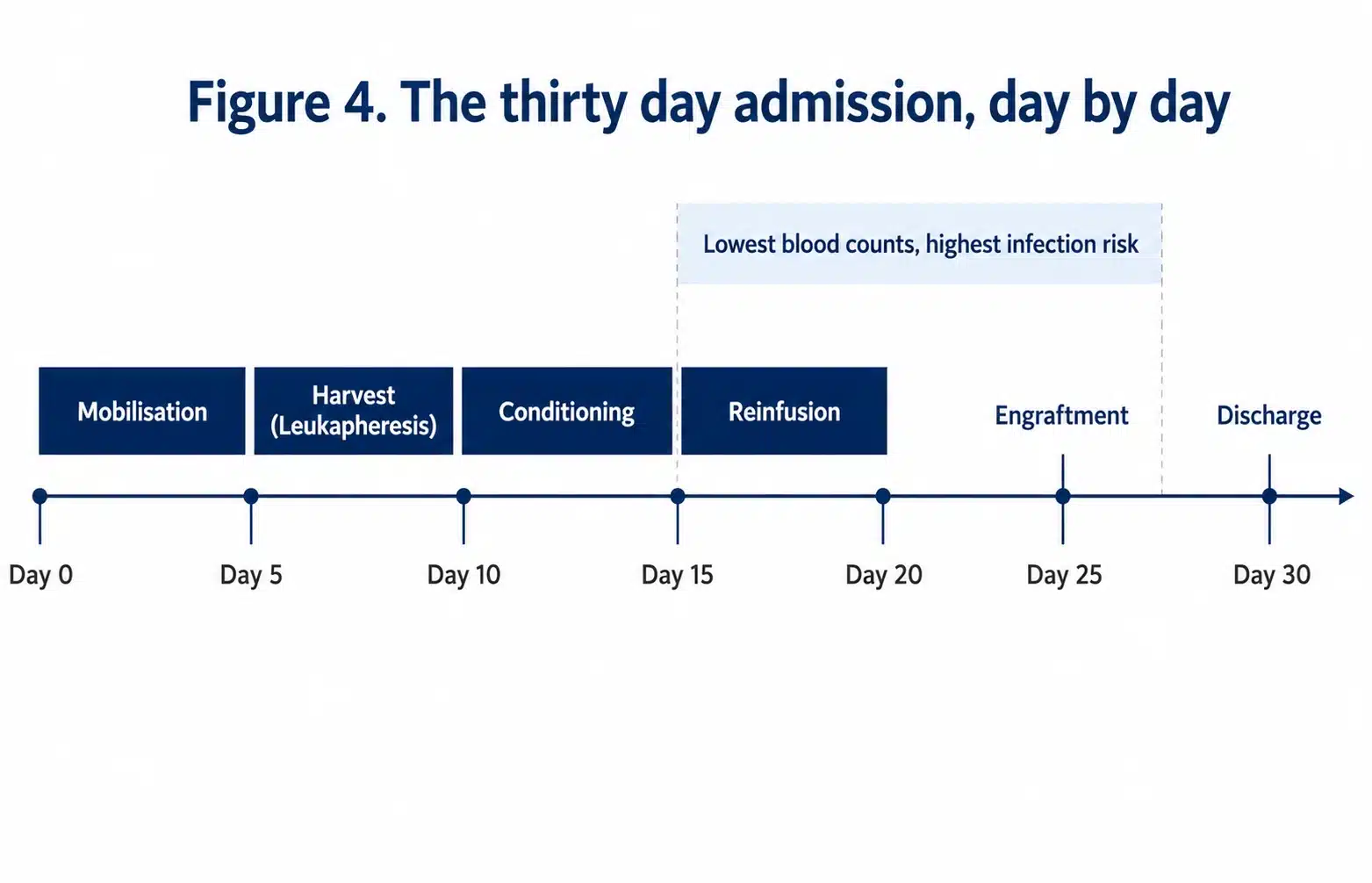
The whole treatment runs inside one continuous admission. There is no second visit and no follow up chemotherapy.
The opening days repeat the assessment on site, with fresh bloods, imaging and organ function testing. A decision reached on records posted from abroad is confirmed in person before conditioning starts. Mobilisation follows, then harvest, then conditioning, then reinfusion. The patient stays on the ward through the low count window until the new immune system engrafts and counts climb. Discharge follows once the haematologists are satisfied with those counts. Neuro physiotherapy starts as soon as the patient is able.
11. The four stages of the transplant
| Stage | What happens |
|---|---|
| Mobilisation | Medicines draw stem cells out of the marrow into circulating blood, where they can be collected. |
| Harvest (Leukapheresis) | A cell separator draws off the blood layer carrying the stem cells and returns the rest. The CD34-positive cells are processed, cryopreserved and stored. |
| Conditioning | Non-myeloablative chemotherapy clears the circulating immune cells carrying the autoimmune attack. |
| Reinfusion | The stored cells go back through a drip, travel to the marrow and rebuild the immune system. |
Reinfusion takes under an hour. The stretch that requires a hospital ward is the period afterwards, while counts are low and the rebuilt immune system establishes itself. Engraftment is the point at which the new marrow starts producing cells again, and it is what the daily blood counts are watching for.
12. What 30,000 US dollars covers, and what sits outside it
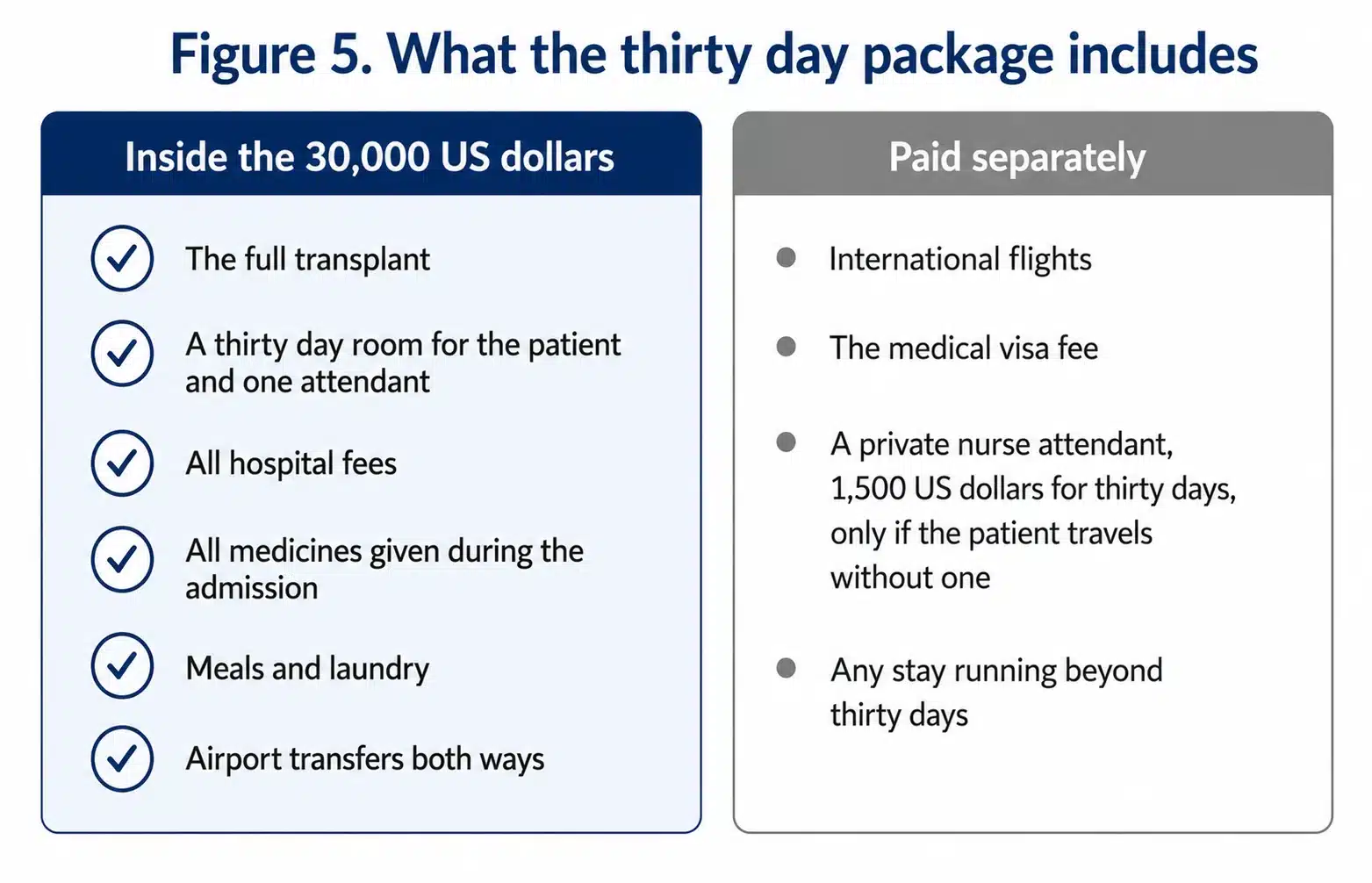
Inside the price sit the full transplant, the thirty day room for the patient and one attendant, every hospital fee, every medicine given during the admission, meals, laundry and airport transfers at both ends.
Outside it sit international flights, the medical visa fee, a private nurse attendant at 1,500 US dollars for the thirty days if the patient travels without one, and any stay running beyond thirty days. The line by line inclusions are set out on the HSCT treatment package page.
Waiting times are measured in weeks. Because the graft is autologous there is no donor to find, and the donor search is what creates most transplant waiting lists.
13. What the same treatment costs elsewhere
| Country and centre | Cost | What the figure covers |
|---|---|---|
| India, HSCT Hospital India | 30,000 | All inclusive, thirty days, patient and one attendant, fully inpatient |
| Russia, Pirogov Centre, Moscow | 40,000 to 45,000 | Five to six weeks, inpatient |
| Mexico, Clinica Ruiz, Puebla | 59,500 | Treatment and lodging across about four weeks, largely outpatient, caregiver, scans and flights billed separately |
| United States, private | 150,000 to 200,000 | The procedure, usually quoted before travel and accommodation |
Germany and Italy both run programmes priced between the Mexican and the American figures. Every centre, with what each one folds into its quoted price and what it bills separately, is listed on the HSCT cost by country page. Two centres can quote the same number and include quite different things, so the inclusions decide the comparison.
14. Inpatient in India, outpatient in Mexico
The Mexican programme at Clinica Ruiz is largely outpatient. Patients are treated by day and return to a hotel or apartment at night. HSCT Hospital India is fully inpatient for all 30 days.
For a patient flying in from another continent this changes three things. Accommodation for the treatment weeks moves inside the price rather than sitting on top of it. Blood counts are read on the ward rather than at scheduled visits, so a falling count is seen the hour it happens rather than the following morning. And when the counts reach their lowest point, the patient is already inside a HEPA filtered room rather than travelling to one.
The outpatient model has real advantages for a patient living locally, who can reach their own hospital and their own neurologist if a count falls. A patient who has flown in from another continent has neither within reach. The full comparison between the two programmes sits on the Mexico page.
15. What continuing drug treatment costs over the same period
The 30,000 US dollars is paid once. Disease modifying therapy is paid every year for as long as it is taken.
In the United States the yearly bill for disease modifying therapy falls between 80,000 and 100,000 US dollars for one patient, and it arrives again every year the drug continues. In CIDP the gap is wider still, because published United States estimates place intravenous immunoglobulin above 136,000 US dollars a year for an average patient, a figure reported by Burt and colleagues in Frontiers in Neurology in 2021.
Set against a one off 30,000 US dollars, the transplant costs less than a single year of either.
16. What the total comes to once flights and an attendant are added
At HSCT Hospital India a patient adds two things to the 30,000 US dollars: international flights and the medical visa fee. Everything else for both people, across all 30 days, is already inside the price.
Elsewhere the additions are larger. An outpatient programme leaves the patient paying for accommodation across the treatment weeks. A caregiver service billed separately is a further line. A five or six week stay costs more in accommodation than a four week one. Each of these is published by the centre concerned and each sits outside its quoted figure.
At HSCT Hospital India the room, the meals, the laundry and the airport transfers for both people sit inside the 30,000 US dollars. What a patient adds is the airfare and the visa fee.
17. What the risks are, and how they are managed
The period of highest risk lasts about 10 days. It starts when conditioning finishes and ends when the rebuilt immune system engrafts, and infection is the risk throughout it.
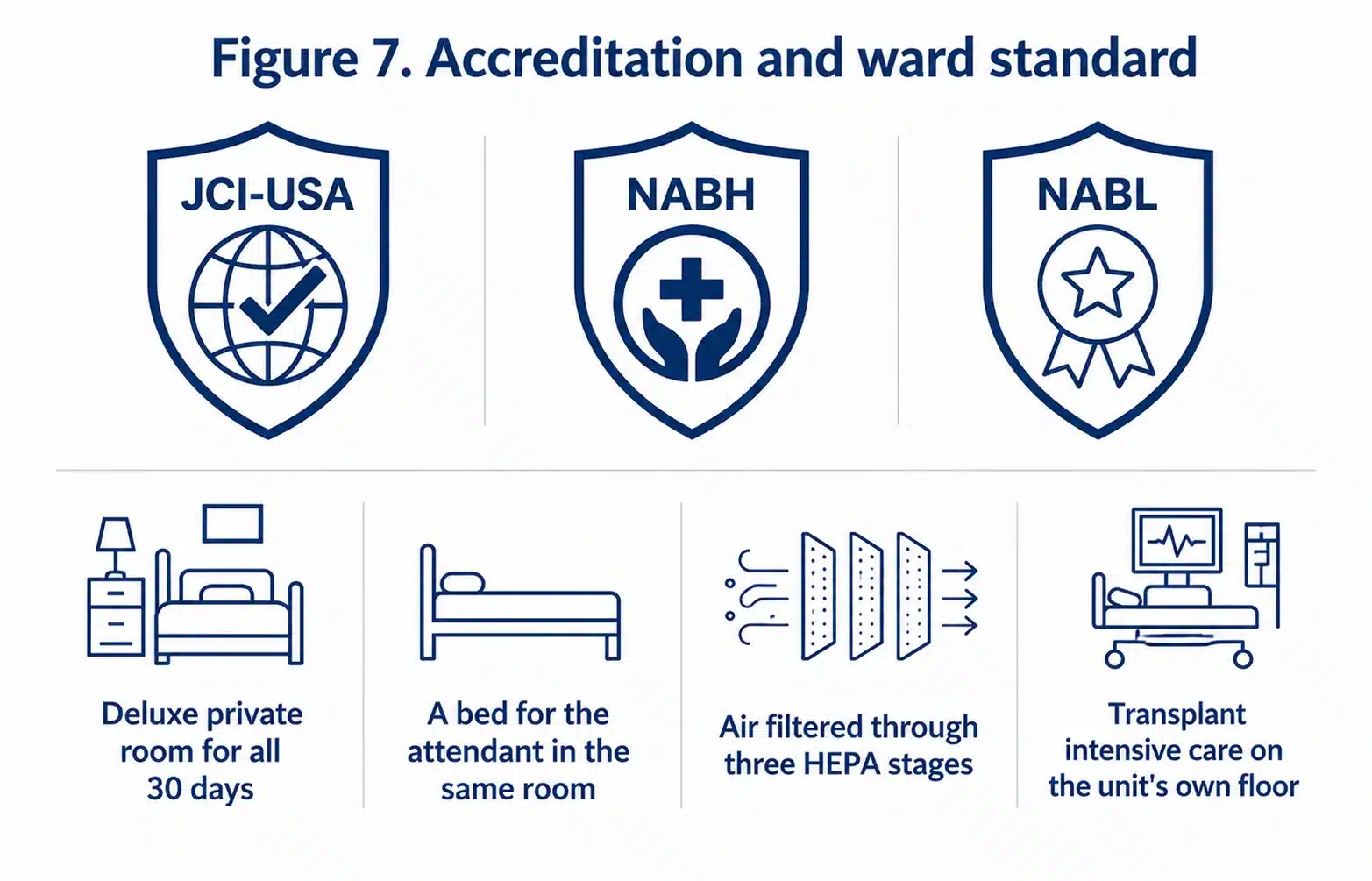
The ward is built around that window. Rooms are deluxe and single occupancy for all 30 days, and the attendant sleeps in the same room rather than visiting. Incoming air is filtered at three HEPA stages before it reaches the bedside. Bloods are drawn and read every day, so a falling count is caught within hours. Antimicrobial cover is given preventively rather than in response to a fever. Critical care for transplant patients sits on the unit’s own floor, which means an escalation never involves wheeling a patient with no immune system through a general hospital corridor.
Beyond infection, the common effects are temporary hair loss, nausea during conditioning, and fatigue that can last months rather than weeks. Patients are frequently surprised that reinfusion itself is uneventful and that the demanding stretch is the fortnight afterwards. Fertility is affected and is covered in its own section below.
Patient selection is the other half. Organ function testing before conditioning exists so that patients whose heart, lung, liver or kidney function will not tolerate the regimen are identified before treatment starts rather than during it.
18. Fertility, and what to arrange before conditioning
Conditioning chemotherapy is gonadotoxic, which means it can damage the ovaries or the testes and reduce fertility. The degree varies with the drugs used, the dose and the patient’s age, and lower intensity regimens carry less risk than the high intensity ones, but the risk is real and it is discussed before treatment rather than after.
Preservation is possible and it has to happen first. Sperm banking is straightforward and quick. Egg or embryo freezing takes longer, usually a stimulation cycle of about two weeks, and has to be scheduled before conditioning begins. A patient who wants either should raise it at the first conversation, because it changes the treatment date rather than fitting around it.
Patients who have already completed their families often do not need fertility preservation. Younger patients, and patients who have not decided, are the ones for whom this changes the sequence of events. Either way it is a decision the patient makes with time to think, not one taken in the week before admission.
19. Travel, the medical visa, and who comes with the patient
Patients travelling to India for treatment apply for a medical visa rather than a tourist visa. The hospital issues the invitation letter the application requires once a treatment date is agreed, and the HSCT case manager works through the rest of the paperwork with the family.
One attendant travels with the patient and is covered inside the price for the full thirty days, room and meals included. That attendant applies for a medical attendant visa, granted alongside the patient’s own. Airport transfers are arranged, so nobody lands in an unfamiliar country and has to find their own way to a hospital.
Delhi is served directly from most major international hubs, so many patients need only a single flight. The hospital sits in the National Capital Region just outside Delhi, and is described in detail at HSCT Hospital India.
20. What to prepare before flying
The assessment needs three things. A recent MRI supplied as images rather than as a written report alone, because the doctors read the scans themselves. The current neurology letters. A list of every disease modifying therapy tried, with the dates and what happened on each.
Preparation for the stay is simpler than most patients expect, because the room, the meals and the laundry are covered. Comfortable clothing for a month indoors, any personal medication with its prescription, and a way of staying in touch with family cover most of it.
Dental checks are worth completing at home first. An active dental infection is a problem to resolve before conditioning rather than during the low count window.
21. Follow up once the patient is home
The patient flies home once counts have recovered and the discharge is signed. There is no second admission waiting at the other end.
Follow up sits with the patient’s own neurologist, working from the discharge summary and treatment record the hospital supplies. The hospital stays reachable for questions from that neurologist. Patients are given a schedule of repeat scans and blood work so disease activity is tracked over the years that follow.
Immune reconstitution runs on a longer clock than the admission. Counts recover inside the thirty days, but the fuller rebuilding of immune memory continues for months, which is why vaccination schedules are commonly revisited during the first year home.
22. What patients report in the first year
The change patients describe most often is that disease activity stops. Relapses cease and new lesions stop appearing on follow up scans. That is the outcome the published multi-centre figures measure, and those figures come from transplant centres worldwide rather than from any single hospital.
Recovery of function is a separate question from halting the disease, and it varies. Myelin already lost does not reliably return, and patients arriving with long standing fixed disability are told so before they travel rather than after. Fatigue tends to improve across the first several months. Bladder symptoms and spasticity often follow. Patients whose disability came mostly from recent inflammatory activity generally describe more change than those whose disability accumulated slowly across many years.
Recovery is rarely a straight line. Many patients describe a dip in energy in the weeks after returning home, while the immune system is still rebuilding, then steady improvement through the rest of the year.
23. Patients who travelled to India, and what changed
Gudrun R, United Kingdom, relapsing remitting multiple sclerosis diagnosed on 22 October 2007. She arrived pushing a rollator. Five weeks after she arrived she was walking with a stick, and taking short walks without it. In her own words: “Every single day after the stem cell transplant I have achieved one thing. One thing every day.” Her full account is at Gudrun’s story.
Marjorie, Australia, secondary progressive multiple sclerosis. She travelled in July 2017 and was transplanted on 1 August 2017. Writing a year afterwards she said: “I have no regrets, my EDSS was 6.5 before transplant and although it has only improved slightly, I am able to walk without any aid other than my stick, which I was not able to do before HSCT.” Her account is at Marjorie’s story.
Evert, Canada, myasthenia gravis. By the time he recorded his account he rated his own hand strength and calf strength as very good, and he had no difficulty breathing and needed no oxygen. He was careful about what came next: “Not sure yet where this is all going to end up, but the prognosis looks very good that my myasthenia gravis will go into total remission.” His account is at Evert’s story.
Linda, Netherlands, multiple sclerosis diagnosed in 2007. She told the Dutch press after treatment that her left leg now travels straight forward, with no swing and no trick to get it there. Her account is at Linda’s story, and the full set is indexed at patient testimonials.
24. Questions patients outside India ask most
How much does multiple sclerosis treatment in India cost?
HSCT Hospital India charges 30,000 US dollars, with nothing added afterwards. That buys the transplant itself, a thirty day inpatient stay covering the patient and one attendant, all hospital fees, all medicines given during the admission, meals, laundry and transfers to and from the airport. Flights and the medical visa fee are the two items a patient pays separately.
How long does a patient stay in India?
About thirty days, in one continuous admission. There is no second visit and no follow up chemotherapy, so patients fly home once counts have recovered and the discharge is signed.
Is progressive multiple sclerosis accepted at HSCT Hospital India?
Progressive disease is assessed case by case, whether secondary or primary. The deciding question is whether a current scan still shows active inflammation, rather than which label the diagnosis carries.
What does HSCT Hospital India need in order to give an answer?
A recent MRI supplied as images, the current neurology reports, and a summary of which treatments have been tried and how the patient responded to each. The HSCT specialists read those together and the HSCT case manager returns an opinion free of charge.
Is there a waiting list for HSCT in India?
Waiting times at HSCT Hospital India are measured in weeks. Because the graft is autologous the stem cells come from the patient, so there is no donor to find, and the donor search is what creates most transplant waiting lists.
Can a family member travel with the patient to India?
Yes. One attendant is covered inside the 30,000 US dollar price for the full thirty days, room and meals included, and applies for a medical attendant visa issued alongside the patient’s own.
Which visa does a patient need to travel to India for treatment?
A medical visa rather than a tourist visa. HSCT Hospital India issues the invitation letter the application requires once a treatment date is agreed.
Who looks after the patient once they are back home?
The patient’s own neurologist, working from the discharge summary and treatment record HSCT Hospital India supplies. The hospital stays reachable for questions from that neurologist afterwards.
Which conditions besides multiple sclerosis are treated in India?
HSCT Hospital India treats CIDP, myasthenia gravis, scleroderma, lupus, NMOSD, Crohn’s disease, myositis, stiff person syndrome and small fibre neuropathy. Each is assessed against its own criteria.
How does the price in India compare with treatment elsewhere?
Published costs run from 40,000 to 45,000 US dollars in Russia and 59,500 in Mexico for treatment and lodging, rising to 150,000 to 200,000 privately in the United States. The German figure is published in euros at about 50,000. The India figure of 30,000 US dollars covers thirty days and two people.
Does a transplant cure multiple sclerosis?
HSCT aims to stop the disease progressing, and the published evidence describes long stretches without disease activity in a large share of patients. Damage already done to myelin is a separate question from preventing new damage, and outcomes differ between patients, which is why every case is assessed individually before a date is offered.
25. What happens after an enquiry
An HSCT case manager replies personally, usually within a day. They ask for the recent MRI, the neurology letters and the treatment history, and pass the file to the doctors. Acceptance requires haematology and neurology to have both read it and agreed, so no patient is admitted on one specialty’s opinion.
The opinion that comes back says whether the patient looks suitable and, if so, what a realistic date looks like. No cost and no obligation attach to it, and a patient who decides against travelling owes nothing.
Why choose HSCT Hospital India
Accreditation here runs to JCI-USA, held alongside NABH and NABL. What that accreditation actually buys a transplant patient is an infection control regime measured against an international benchmark rather than a local one, which is the standard that matters most during the ten days when immune defence is lowest. Look inside the transplant unit.
Every patient gets a deluxe private room for the full month, with a bed for the attendant in the same room rather than in a hotel across the city. The air supply passes three separate HEPA stages before it reaches the bedside. Intensive care for the bone marrow transplant unit sits on that unit’s own floor, so an escalation does not involve moving a neutropenic patient across a hospital. Read the package line by line.
The protocol is the lower intensity regimen developed by Professor Richard Burt, the same one carried into the MIST randomised trial. Every file is read jointly by haematology and neurology before an acceptance is issued, so nobody is admitted on a haematology opinion alone. More than 1,500 international patients have been treated to date, drawn from 30 countries. Watch what patients say about their treatment.
Real Patients, Real Stories
A Finland Patient’s Inspiring Recovery from Multiple Sclerosis after HSCT Treatment at JCI-USA Accredited World Class Hospital in India
Jukka from Finland, who has primary progressive MS, completed the full 30 day HSCT programme at HSCT Hospital India.

American Cop Flies to India for HSCT: 95% Symptom free, 5 Months after HSCT Treatment at JCI-USA Accredited World Class Hospital in India
Dylan, a US police officer with small fibre neuropathy, had about 95 per cent of his symptoms gone five months after HSCT.
Sergel, 38M from Holland: Multiple Sclerosis Patient shares after HSCT Treatment at JCI-USA Accredited World Class Hospital in India
Watch this Video testimonial: Sergel, 38 years young man from Netherlands suffering from Multiple Sclerosis