What Are the Side Effects of HSCT for MS, and How Are They Managed?
Medically reviewed by the board of haematologists at HSCT Hospital India, whose transplant physicians hold DM Clinical Haematology qualifications and fellowship training in stem cell transplantation. The programme runs at a JCI-USA, NABH and NABL accredited hospital that has treated more than 1500 patients.
Last reviewed: 29 September 2026. This guide cites peer-reviewed studies, which are listed at the end.
The side effects of HSCT for multiple sclerosis come mainly from the chemotherapy that clears the immune cells behind the disease. Most of them appear during the hospital stay, while doctors and nurses are with the patient every day. They ease as the blood counts recover over the following weeks. A smaller number of effects can appear months later, and these are found with routine blood tests and check ups.
HSCT is short for autologous haematopoietic stem cell transplantation. Autologous means the stem cells come from your own body, so there is no donor and no risk of your body rejecting the cells. This is why the side effects of HSCT for MS differ from those of a donor transplant for leukaemia. Graft versus host disease, in which donor cells attack the patient, cannot happen when the cells are your own.
HSCT Hospital India has treated more than 1,500 MS patients from over 30 countries since 2016. It uses cyclophosphamide with ATG, the non-myeloablative protocol developed by Dr Richard Burt, in a JCI-USA accredited hospital that also holds NABH and NABL accreditation. The whole programme costs one all-inclusive price of US $30,000 for up to 30 days, and the medicines used to treat side effects during the stay are part of that price.
What side effects can I expect at each stage of HSCT?
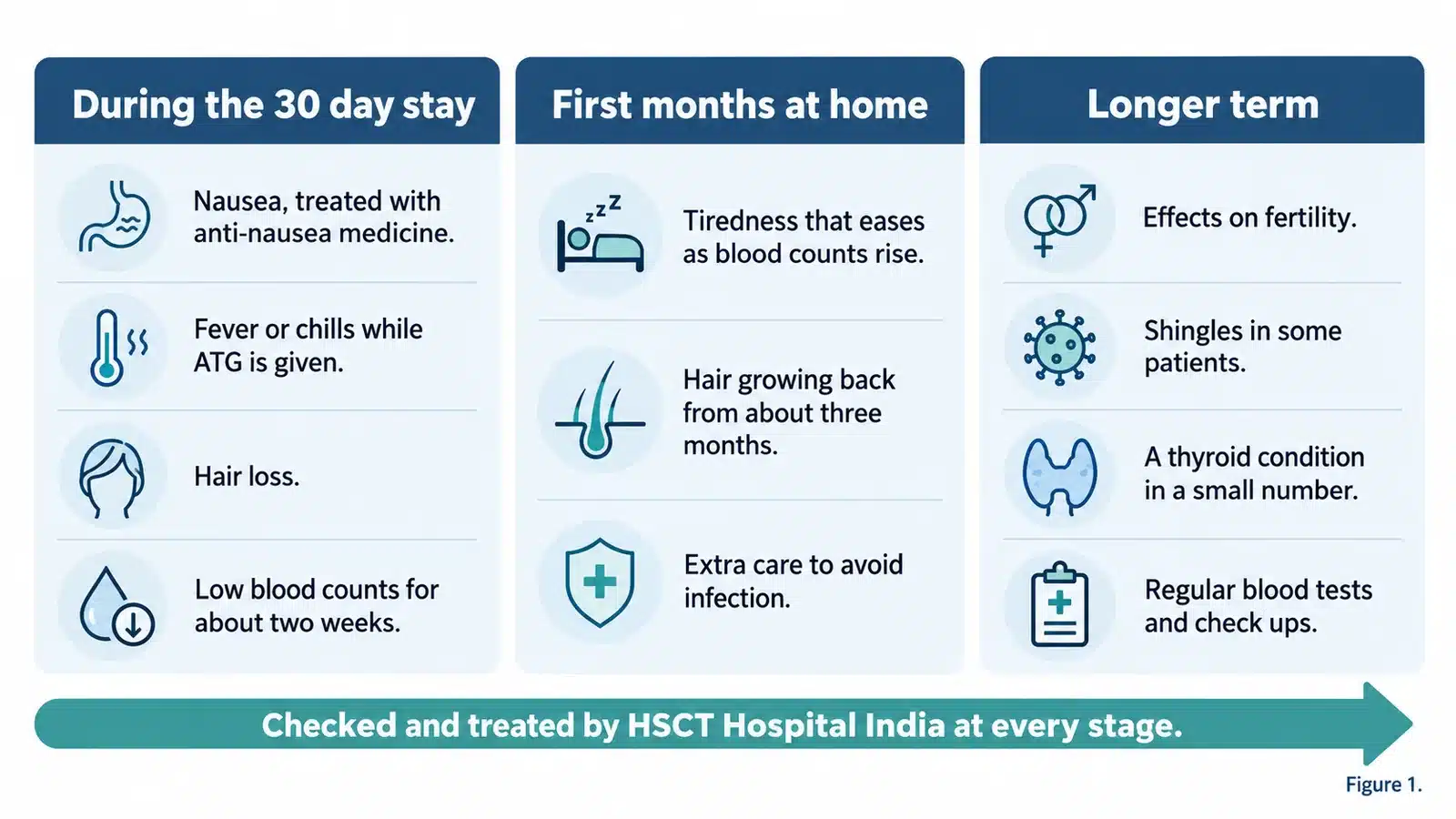
The side effects of HSCT follow the order of the treatment, so it helps to know which ones belong to which weeks. During the 30 day stay, you can expect nausea, tiredness, hair loss and a stretch of about two weeks when your blood counts are low. These are the effects your HSCT specialists plan for before treatment starts.
After you go home, tiredness continues for a while as your blood counts rebuild. Your hair usually starts to grow back from about the third month. A few effects can appear later still, such as shingles, a change in how your thyroid gland works, or a change in your periods.
| When | What you may notice | What is done about it |
|---|---|---|
| During the 30 day stay | You may feel sick, lose your hair and have a fever or chills while ATG is given. | Anti-nausea medicine is given before and during chemotherapy, and nurses treat each reaction as it happens. |
| The low count weeks in hospital | Your white blood cells and platelets are low, so infection and bruising are more likely. | You stay in a private room with Triple HEPA air filtration, with nurses present day and night. |
| The first months at home | Tiredness is common, and you are more likely to catch infections than before. | Your blood counts are checked twice a month at first, and medicines to prevent infection continue. |
| The following years | A small number of patients develop shingles, a thyroid condition or a change in fertility. | Each of these is found with routine tests or check ups and treated by your own doctor. |
Which part of HSCT causes which side effect?
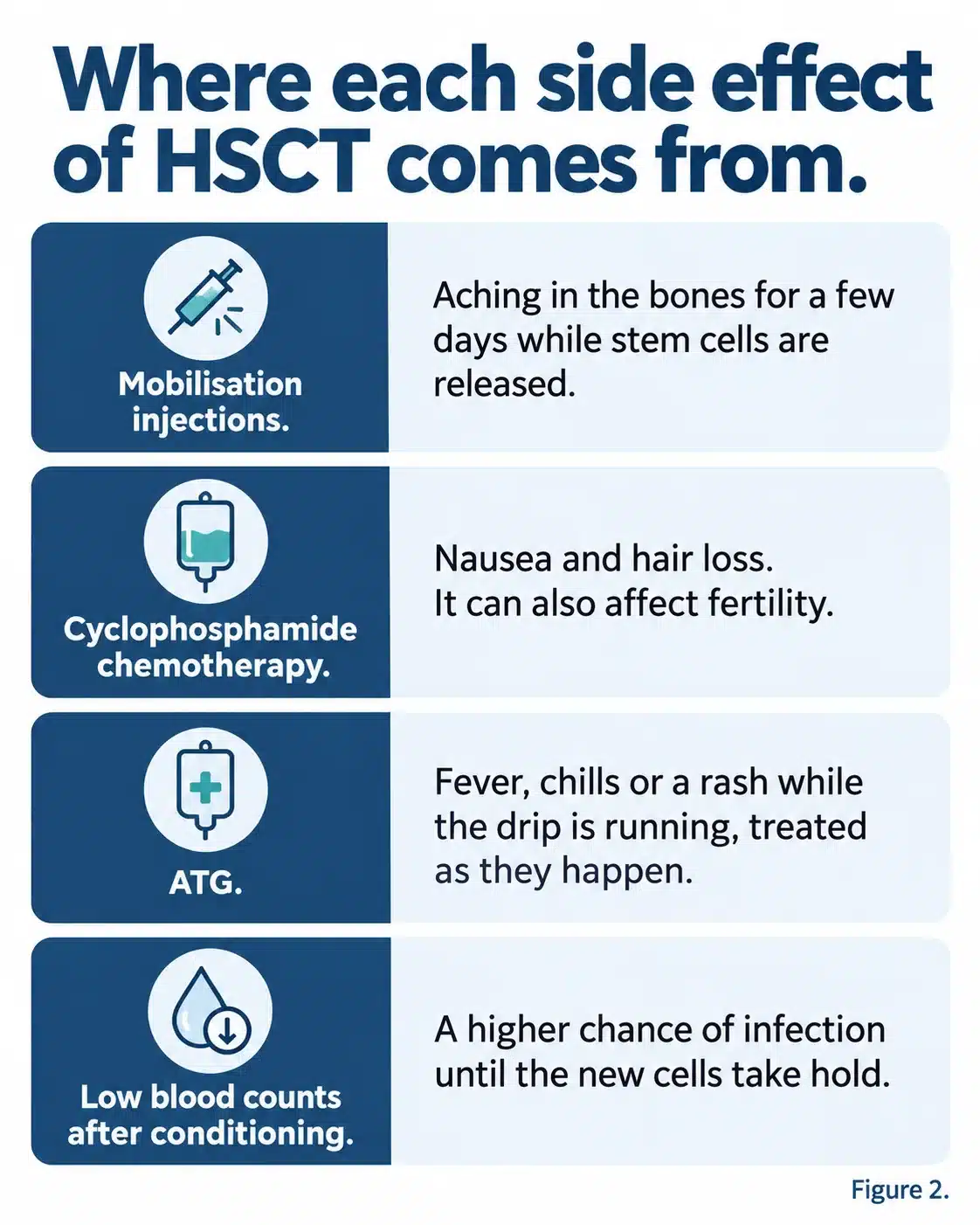
HSCT at HSCT Hospital India has four stages: mobilisation, collection of the stem cells, conditioning and reinfusion. Each stage uses different medicines, and each medicine brings its own side effects. Knowing where a symptom comes from also tells you how long it is likely to last.
What does mobilisation feel like?
Mobilisation brings stem cells out of your bone marrow, the soft tissue inside your bones that makes blood. It uses a growth factor, which is a medicine that makes the marrow produce more stem cells, together with a short course of chemotherapy. While the marrow is working harder, some patients feel an ache in their bones, often in the back or hips. This ache usually lasts a few days and settles once the stem cells have been collected.
What does the stem cell collection feel like?
The stem cells are collected by leukapheresis, in which a machine draws your blood, keeps the stem cells and returns the rest to you. It feels much like a long blood donation. The cells are counted and frozen straight away, so the chemotherapy that follows does not have to be rushed.
What side effects come from cyclophosphamide?
Conditioning is the main chemotherapy, and it is the stage that causes most of the side effects people associate with HSCT. Cyclophosphamide, the chemotherapy medicine used at HSCT Hospital India, can make you feel sick, so anti-nausea medicine is given before and during each dose. It also causes hair loss, which is temporary.
Cyclophosphamide can also affect fertility in both women and men. This is why fertility is discussed with you before conditioning begins.
What side effects come from ATG?
ATG, short for anti-thymocyte globulin, is an antibody that removes the T cells driving your MS. It is not chemotherapy, and its side effects are different. While the ATG drip runs, some patients get a fever, shivering or a skin rash. The nurses expect these reactions and treat each one when it appears.
What happens after my stem cells are returned?
Reinfusion returns your thawed stem cells through a drip, which usually causes no side effects of its own. In the days before the new cells start working, your blood counts are at their lowest. This is when infection is most likely, and it is the reason every patient stays in hospital through this period.
What happens to my blood counts, and why is infection the main risk?
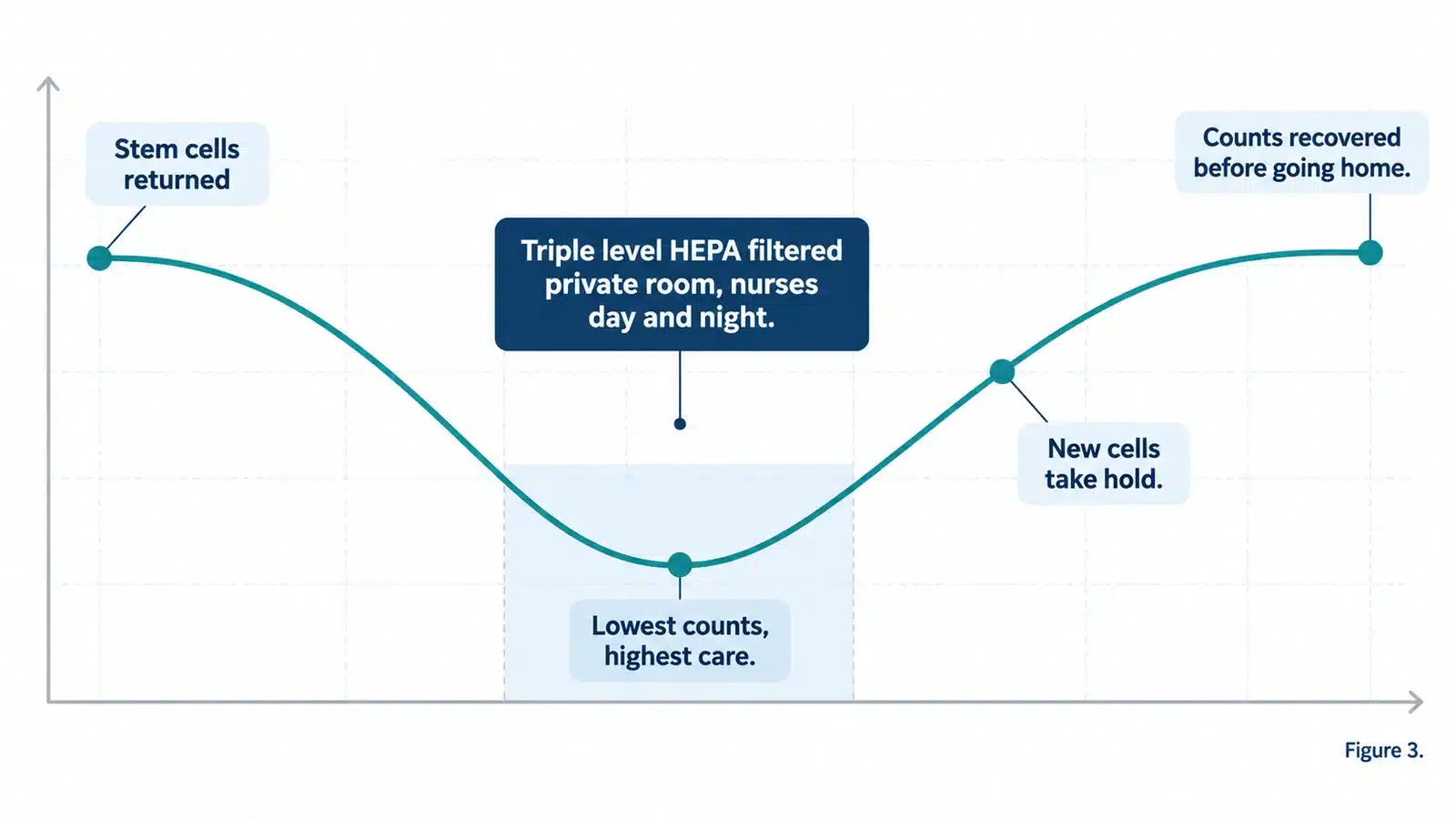
Conditioning lowers all three types of blood cell for a short time. White blood cells fight infection, platelets help your blood to clot, and red blood cells carry oxygen. When they are low, you are more likely to catch an infection, you bruise more easily and you can feel breathless or very tired.
Doctors call this low stretch the aplastic phase. On cyclophosphamide with ATG, the European registry recorded infection-fighting white blood cells coming back about 10 days after the stem cells were returned. Because the protocol is non-myeloablative, it weakens your bone marrow without destroying it, so your counts are able to recover quickly.
HSCT Hospital India builds the whole stay around these days. You are an in-patient in a deluxe private room with Triple HEPA air filtration, which lowers the number of germs around you while your white cells are low. Nurses are on the ward day and night, so any fever is treated as soon as it starts. An HSCT specialist reviews you every day. In the third and fourth weeks your counts recover, and you are prepared to go home.
How serious are the risks of HSCT at HSCT Hospital India?
The most serious risk of HSCT is an infection during the low count weeks that the body cannot fight off. The largest published series on the protocol used at HSCT Hospital India comes from Northwestern University in Chicago, where Dr Richard Burt developed it. Among 507 patients treated there between 2003 and 2019, one died from the treatment, which is 0.19 per cent. Five years after HSCT, 98.8 per cent of patients were alive.
Other large studies report similar figures. In the MIST trial, which randomly allocated 110 people with relapsing MS, no patient died. None of the patients who had HSCT had a life-threatening event such as a heart attack or sepsis, a severe reaction to infection. In the 2025 European registry study, 1.0 per cent of patients on cyclophosphamide with ATG died within 100 days of treatment.
The risk is not the same for everyone. In a United Kingdom series of 364 patients treated between 2002 and 2023, every death from the treatment was in a patient with advanced disability before HSCT. For this reason the HSCT specialist doctors at HSCT Hospital India review your disability, your general health and your fitness for chemotherapy before treatment is offered.
Send your diagnosis, your latest MRI report and your other health conditions through the enquiry form. The HSCT specialist doctors at HSCT Hospital India review every case without charge, and an HSCT Case Manager replies to you by email.
What side effects might I notice in the first months at home?
Tiredness is the effect most patients notice after they fly home. It is common in the first two months, while your blood counts are still rebuilding, and it eases as they rise. Most patients return to their normal activities after 2 to 4 months.
Your immune system also takes time to rebuild, so you are more likely to catch infections than before HSCT. Medicines to prevent infection continue after you go home, and a blood test checks your counts twice a month in the first two months. After that, one test a month follows until your counts are normal, and HSCT Hospital India receives each result.
Your hair usually starts to grow back from about the third month. Essential inactivated vaccines can also begin from around this time, following the schedule in your Aftercare Manual. The timing of each stage is set out on the page about recovery time after HSCT for MS.
Can HSCT cause shingles or other infections later on?
Shingles is the most common later side effect of HSCT for MS. Shingles is a painful rash caused by the chickenpox virus, which stays in the body after childhood and can become active again when immunity is low. In a study of 48 Swedish patients, 15 per cent had shingles after HSCT.
Other infections are also more common in the first years. A Swedish national study followed 139 patients after HSCT and compared them with patients on other MS medicines. Infections needing hospital or specialist care, six months or more after treatment, were recorded at about 11 per 100 patients a year after HSCT. The figure was about 5 per 100 on the other medicines.
Two things lower this risk after you go home. Medicines to prevent infection continue for the months your immune system needs to rebuild, and vaccinations restart on the schedule in your Aftercare Manual. Your blood counts are also checked regularly, so a problem is found early and your own doctor can treat it.
HSCT Hospital India emails its brochure to any patient who asks for it. The brochure covers the treatment, the 30 day stay, the follow up at home and everything the one price includes.
Can HSCT affect my thyroid or cause another autoimmune condition?
A small number of patients develop a new autoimmune condition in the years after HSCT, most often in the thyroid gland. The thyroid is a gland in the neck that controls how fast the body uses energy. It can become underactive, which causes tiredness and weight gain, or overactive, which causes a fast heartbeat and weight loss.
In the Northwestern series of 507 patients, 3.5 per cent developed an underactive thyroid and 3.3 per cent an overactive thyroid after HSCT. Immune thrombocytopenia, a condition in which the immune system lowers the platelet count, affected between 0 and 2.8 per cent of patients on regimens without alemtuzumab. Both conditions are found with a simple blood test and are treated with medicine.
The medicine used in conditioning makes a difference to this risk. A 2021 review led by Dr Burt notes that alemtuzumab, used in some conditioning regimens, raises the chance of a new autoimmune condition. HSCT Hospital India uses cyclophosphamide with ATG and does not use alemtuzumab in conditioning.
Will HSCT affect my fertility or my periods?
Cyclophosphamide can affect the ovaries and the testes, so HSCT can reduce fertility. In women, the first sign is usually that periods stop for a time after treatment. In an Italian study of 43 women with MS, 70 per cent had their periods return, after an average of about seven months. Younger women were more likely to have their periods return.
For some women, the change lasts longer. In a Norwegian study, 10 of the women treated, 43 per cent, had no periods for more than a year, with symptoms of an early menopause. Because age makes a difference, fertility preservation is discussed with you before treatment begins.
Fertility preservation means storing eggs or sperm before chemotherapy, so they can be used later. The options and their timing are explained in the article on fertility preservation before HSCT.
How does HSCT Hospital India manage side effects during the 30 day stay?
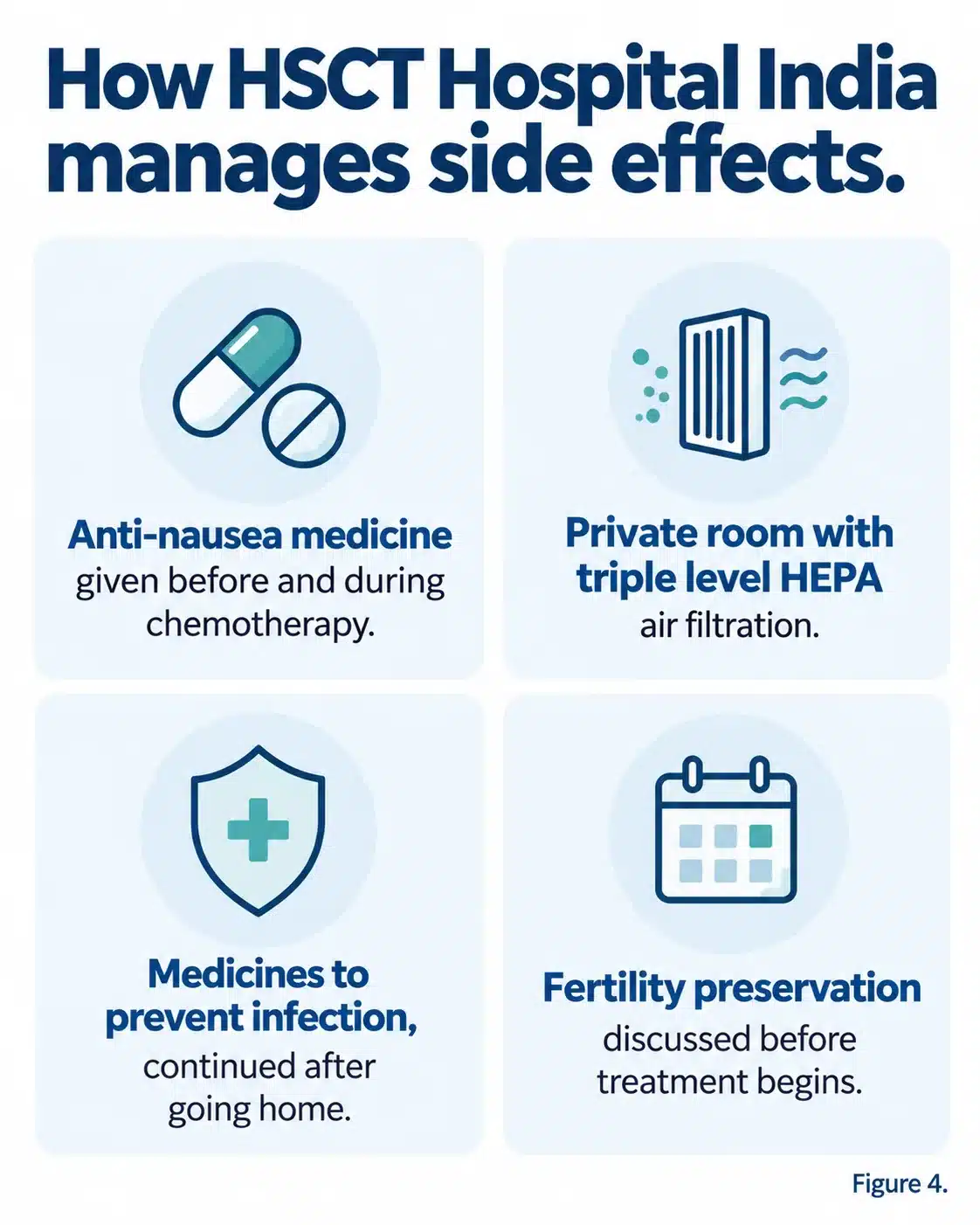
Side effects are managed at HSCT Hospital India from the first day, starting with a full medical evaluation before any treatment. This evaluation includes pre-testing and an MRI, and it checks your fitness for chemotherapy. It is part of the one price, and treatment starts only after the HSCT specialists have reviewed the results.
During the stay, each side effect has a planned response. Anti-nausea medicine is given before and during chemotherapy. Reactions to ATG are treated by the nurses as they happen, and medicines to prevent infection are given during the stay and continue after you go home. Your attendant stays in the room with you, and neuro-physiotherapy, meaning exercise sessions planned for your strength and balance, runs through the stay.
You fly home with a Discharge Summary and an Aftercare Manual, which your own doctor or neurologist can read. The Aftercare Manual sets out your medicines, your blood tests and what you can restart and when. Every step from your first enquiry to your flight home is on the page about how HSCT works at HSCT Hospital India.
Why do patients choose HSCT Hospital India for their HSCT?
Patients who have weighed the side effects of HSCT then choose where to have it. HSCT Hospital India has treated more than 1,500 MS patients from over 30 countries since 2016. Its hospital holds JCI-USA accreditation, an international standard for hospital quality and patient safety, together with NABH and NABL accreditation.
The price is agreed before you travel, and there is no long waiting list. One all-inclusive payment of US $30,000 covers pre-testing, MRI, the full HSCT treatment and up to 30 days in hospital. It also covers doctors’ fees, tests and consultations, medicines and consumables, neuro-physiotherapy, food and laundry for both the patient and the attendant, and airport pick-up and drop-back.
Patients from the United States, the United Kingdom and Europe describe their treatment on video on the patient stories page. Who can have HSCT is set out on the page about HSCT eligibility at HSCT Hospital India.
Many patients have practical questions about side effects, flights, the medical visa and who travels with them. An HSCT Case Manager will call you at a time that suits you, at no cost.
 Request a Call Back
Answers to Frequently Asked Questions (FAQs) about the side effects of HSCT for MS
Is HSCT for MS safe?
HSCT is a serious treatment, and its safety has improved as centres have gained experience. On the protocol used at HSCT Hospital India, the Northwestern series of 507 patients recorded one death from the treatment, and 98.8 per cent of patients were alive after five years.
Will I lose all my hair after HSCT?
Hair loss is expected with cyclophosphamide, and it is temporary. Hair usually starts to grow back from about three months after treatment.
Why do my bones ache during mobilisation?
The growth factor makes your bone marrow produce more stem cells, and this can cause an ache in the bones, often in the back or hips. It usually lasts a few days and settles once the stem cells are collected.
How long do the side effects of HSCT last?
Most side effects happen during the 30 day stay and ease as your blood counts recover. Tiredness can last for the first two months at home, and most patients return to normal activities after 2 to 4 months.
Can I get shingles after HSCT?
Shingles is the most common later side effect, and it affected 15 per cent of patients in a Swedish study. Medicines to prevent infection and the vaccination schedule in your Aftercare Manual lower this risk.
Does HSCT cause thyroid problems?
A small number of patients develop a thyroid condition after HSCT. In a series of 507 patients, 3.5 per cent developed an underactive thyroid and 3.3 per cent an overactive one, and both are treated with medicine.
Can HSCT cause early menopause?
It can, especially in older women. In an Italian study, 70 per cent of women had their periods return after HSCT, and younger women were more likely to recover them.
Is HSCT painful?
Most of HSCT is given through a drip. The effect patients notice most is the ache in the bones during mobilisation, which usually lasts a few days, and nausea during chemotherapy is treated with anti-nausea medicine.
This page was medically reviewed on 29 September 2026 against the published research listed below.
References
- Burt RK, Han X, Quigley K, et al. Real-world application of autologous hematopoietic stem cell transplantation in 507 patients with multiple sclerosis. Journal of Neurology. 2022;269(5):2513-2526. PMID 34633525.
- Burt RK, Balabanov R, Burman J, et al. Effect of nonmyeloablative hematopoietic stem cell transplantation vs continued disease-modifying therapy on disease progression in patients with relapsing-remitting multiple sclerosis: a randomized clinical trial. JAMA. 2019;321(2):165-174. PMID 30644983.
- Kazmi M, Muraro PA, Mehra V, et al. Autologous haematopoietic stem cell transplantation for multiple sclerosis in the UK: a 20-year retrospective analysis of activity and haematological outcomes. British Journal of Haematology. 2025;207(3):977-991. PMID 40500866.
- Greco R, Saccardi R, Ponzano M, et al. BEAM/ATG or cyclophosphamide/ATG as conditioning regimen in autologous haemopoietic stem cell transplantation for multiple sclerosis. Bone Marrow Transplantation. 2025. PMID 41023426.
- Burman J, Iacobaeus E, Svenningsson A, et al. Autologous haematopoietic stem cell transplantation for aggressive multiple sclerosis: the Swedish experience. Journal of Neurology, Neurosurgery and Psychiatry. 2014;85(10):1116-1121. PMID 24554104.
- Alping P, Burman J, Lycke J, Frisell T, Piehl F. Safety of alemtuzumab and autologous hematopoietic stem cell transplantation compared to noninduction therapies for multiple sclerosis. Neurology. 2021;96(11):e1574-e1584. PMID 33514645.
- Burt RK, Muraro PA, Farge D, et al. New autoimmune diseases after autologous hematopoietic stem cell transplantation for multiple sclerosis. Bone Marrow Transplantation. 2021;56(7):1509-1517. PMID 33911200.
- Massarotti C, Sbragia E, Boffa G, et al. Menstrual cycle resumption and female fertility after autologous hematopoietic stem cell transplantation for multiple sclerosis. Multiple Sclerosis Journal. 2021;27(13):2103-2107. PMID 33709839.
- Kvistad SAS, Lehmann AK, Trovik LH, et al. Safety and efficacy of autologous hematopoietic stem cell transplantation for multiple sclerosis in Norway. Multiple Sclerosis Journal. 2020;26(14):1889-1897. PMID 31833798.
Read next
- How long does it take to recover after HSCT for MS?
- Chemotherapy for MS: what HSCT does to the immune system
- Which HSCT protocol is best for MS?
- Who is eligible for HSCT at HSCT Hospital India?
- CAR T cell therapy for MS or HSCT: how they compare
- HSCT for multiple sclerosis
Why Choose HSCT Hospital India for Life Changing Multiple Sclerosis Treatment

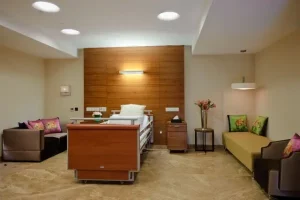 Complete 30 day HSCT done in hospital. Private deluxe rooms are very well served for patient and attendant comfort and equipped with HEPA Filter with Triple Level Air Filtration. No outside hospital stay avoids risk of infection during the aplastic phase, 24 x 7 nursing care and best medical attention. Advanced HSCT protocol used does not require any further chemo or treatment after leaving the hospital. Click here to get complete details
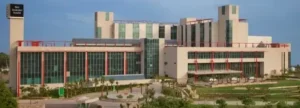 International and Globally Renowned Accreditations. HSCT Hospital India is accredited by the Joint Commission International, USA, the National Accreditation Board for Hospitals and Healthcare Providers (NABH), and the National Accreditation Board for Laboratories (NABL) for processes and high quality patient care. Click here to know more