HSCT for MS in Mexico: Cost, Protocol and How India Compares
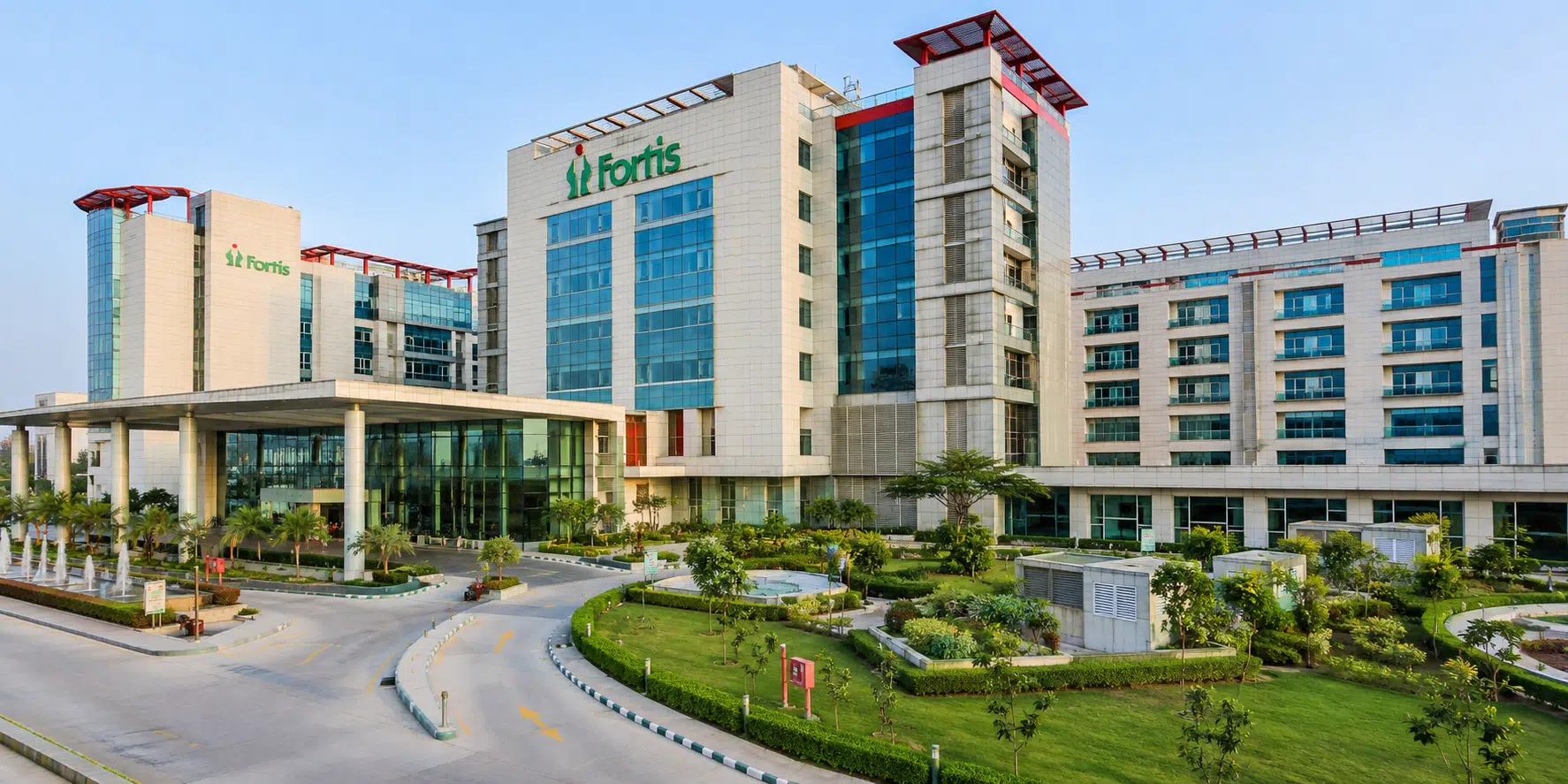
HSCT for MS in Mexico is the best known route for patients who cannot get a stem cell transplant at home. Autologous haematopoietic stem cell transplant, usually shortened to HSCT or AHSCT, is a one-time procedure that resets the immune system using a patient’s own blood stem cells, and the programme in Puebla has treated thousands of people with multiple sclerosis over three decades.
Patients who look into it closely tend to arrive at the same two questions. The first is what the treatment actually costs once the caregiver, the scans, the hotel and the flights are added to the quoted figure. The second is whether the outpatient method used in Mexico is the same treatment described in the trials they have been reading.
HSCT Hospital India answers both differently. The whole treatment is US $30,000 all-inclusive for a 30-day stay covering the patient and one attendant, in a JCI-USA accredited hospital, and it is delivered as an inpatient admission using the non-myeloablative protocol developed by Professor Richard Burt, a regimen that resets the immune system without destroying the bone marrow and is the one used in the randomised trial most patients have read about.
This guide sets out what Mexico charges and what that figure covers, how the two protocols differ in the published literature, and how a patient who has already been quoted in Mexico can be assessed for HSCT in India.
What is HSCT, and why is it used for multiple sclerosis?
HSCT treats multiple sclerosis by removing the immune system that is attacking the patient rather than by suppressing it month after month. In multiple sclerosis the immune system attacks myelin, the insulating sheath around nerve fibres in the brain, optic nerves and spinal cord, and a nerve stripped of myelin conducts its signal slowly, unreliably or not at all.
The immune cells responsible are the patient’s own, which is what makes a transplant a rational treatment rather than an experimental one. Blood stem cells are collected from the patient before treatment, chemotherapy clears out the misdirected immune system, and the stored cells are returned so that a new immune system grows in its place. Nothing comes from a donor, so there is no rejection and no graft-versus-host disease.
The full clinical picture is set out in the guide to HSCT for multiple sclerosis. The same procedure is used at HSCT Hospital India for other autoimmune conditions, including HSCT for CIDP, HSCT for NMOSD, HSCT for myasthenia gravis and HSCT for stiff person syndrome.
The distinction that decides who benefits is between inflammation and degeneration. Relapses and new lesions on an MRI scan are inflammation, and that is what a transplant acts on. Disability that arrives slowly without relapses is nerve degeneration, and no immune treatment reverses it. This is why recent disease activity makes a patient more suitable for HSCT rather than less.

Figure 1. How the immune system strips myelin from nerve fibres in multiple sclerosis.
Is HSCT for MS proven to work?
The strongest evidence comes from a randomised trial that compared transplantation directly against continued drug therapy. In the MIST trial, 110 patients with relapsing remitting multiple sclerosis were randomised either to a non-myeloablative transplant or to staying on disease-modifying drugs. Disease progressed in 3 of 52 transplanted patients and in 34 of 51 of those who stayed on drugs, relapse in the first year occurred in 2 per cent of the transplant group against 69 per cent of the drug group, and there were no deaths in either arm.
Average disability improved after transplant, falling on the EDSS scale from 3.38 to 2.36, while it worsened on drugs from 3.31 to 3.98. No disease-modifying drug has produced a fall in average disability in a randomised trial.
The results have held outside trial conditions. A German real-world series of 109 patients published in 2026 reported that 82.8 per cent had no relapse, no new MRI activity and no progression of disability two years after transplant, taking no MS medication at all, with the highest rates in relapsing remitting disease. A review of more than three decades of transplant data published the same year reported disease-worsening-free survival above 70 per cent at ten years.
In 2025 ECTRIMS and the European Society for Blood and Marrow Transplantation published joint recommendations placing transplantation formally in the treatment pathway, stating that HSCT after the failure of a high-efficacy disease-modifying therapy in aggressive relapsing multiple sclerosis is a generally accepted indication.

Figure 2. MIST randomised trial, disease progressed in 3 of 52 transplanted patients against 34 of 51 who stayed on standard MS drugs.
Why do so many MS patients look at Mexico for HSCT?
Mexico became the default destination for a straightforward reason: it accepted patients that public systems in the United States, Canada, the United Kingdom and Australia were turning away, and it did so at a fraction of the private cost in the United States, where the procedure runs to roughly US $150,000 to $200,000.
The rationing is at its tightest in a small number of countries, and the position facing HSCT for MS in Canada, HSCT for MS in Australia, HSCT for MS in Ireland, HSCT for MS in the UK and HSCT for MS in the USA are set out separately, as is the wider picture of HSCT hospitals and centres worldwide.
The programme in Puebla has genuine scale and a genuine publication record. Its team has reported on 286 consecutive multiple sclerosis patients in Acta Haematologica in 2017 and on much larger series since, and its published safety record is good, with no transplant-related deaths reported in that series and a mortality figure of 0.2 per cent stated on the programme’s own website.
None of that is in dispute, and a patient comparing options should weigh it properly. The questions worth asking are about what the quoted price covers and about how the treatment itself is delivered, because both differ from what most patients assume when they read the trial results.
How much does HSCT for MS cost in Mexico?
The Mexican programme does not publish a total price on its own website. The figure reported publicly is US $54,000, described in press coverage of a patient travelling for treatment as covering the procedure and not including travel expenses.
What the programme’s own site does publish is a set of separate charges that sit on top of that figure. A caregiver for the 28-day service is listed at US $3,000. An MRI scan is listed at approximately US $750. An extra meal package for an additional caregiver is listed at US $1,250. Airfare is stated as not included. Only ground transportation is included, and accommodation is arranged through a separate lodging and transportation company, with patients arriving outside designated dates told they will need to book a hotel room themselves.
A patient budgeting realistically therefore needs to add a caregiver, scans, hotel accommodation for roughly a month and international flights for two people to the quoted procedure price before comparing it with anything else. A country-by-country breakdown of HSCT cost in Mexico, Russia and the USA shows where each destination sits.
What is not in the Mexico price?
The items below are drawn from the programme’s own published information and from public reporting of the quoted cost. They are listed here because the single most common mistake a patient makes when comparing destinations is comparing a procedure price against a package price.
| Item | Status in the Mexico programme | Status in the India package |
|---|---|---|
| The procedure | Included in the reported US $54,000 | Included in US $30,000 |
| Caregiver or attendant | US $3,000 for the 28 day service, listed separately | Included. One attendant is admitted and stays in the room for 30 days |
| MRI scan | Approximately US $750, listed separately | Included in the pre-transplant work-up |
| Meals | 3 meals a day for one patient and one caregiver. An extra caregiver meal package is US $1,250 | Included for patient and attendant for the full stay |
| Accommodation | Arranged through a separate lodging and transportation company. Patients arriving outside designated dates book their own hotel | Included. Deluxe private room with triple-level HEPA filtration for 30 nights |
| Airfare | Stated as not included | Not included |
| Ground transport | Included | Included. Airport transfers on arrival and departure |
| Published total price | Not published on the programme’s own website | US $30,000, published |
Table 1. Sources: the Mexican programme’s own treatment information and FAQ pages, read 28 July 2026, and public reporting of the US $54,000 procedure figure. Every line is what each programme itself states.
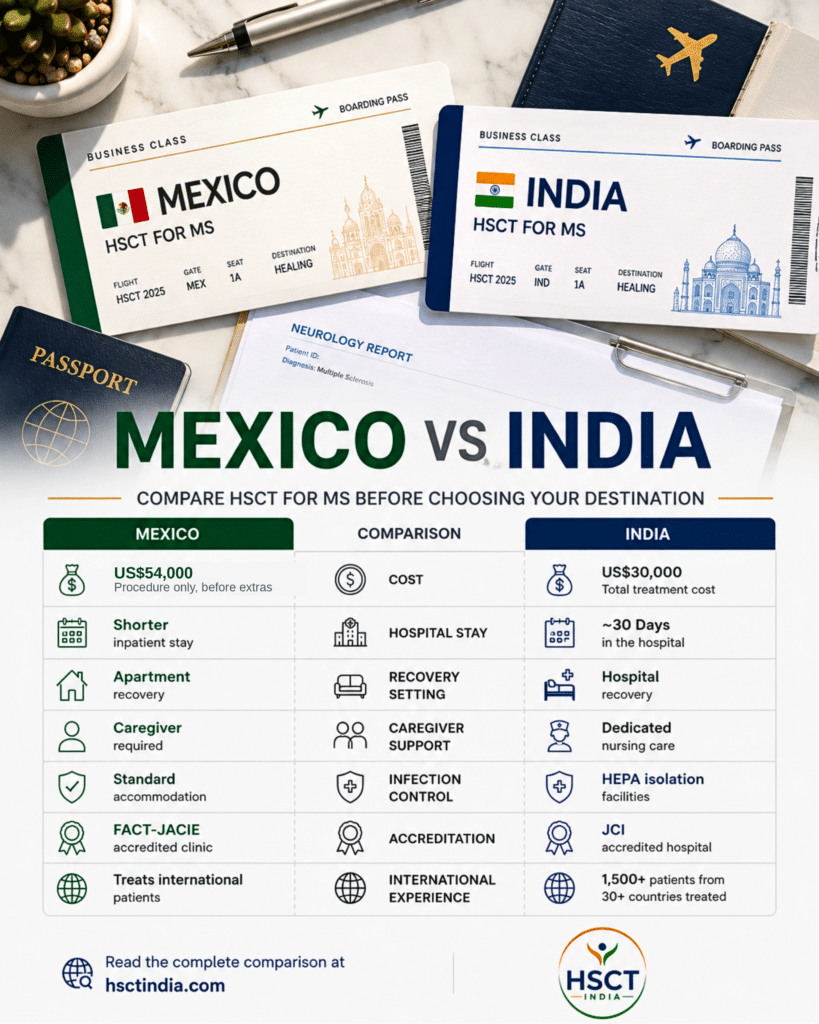
Figure 3. HSCT for MS in Mexico compared with India across cost, hospital stay, recovery setting, infection control and accreditation.
How does the Mexican protocol differ from the one used in India?
The two programmes use different conditioning regimens and different settings, and the difference is documented in the published literature rather than being a matter of opinion.
The Mexican method, described by its own investigators in Acta Haematologica in 2017, conditions patients with cyclophosphamide and rituximab, uses peripheral blood stem cells that are not cryopreserved, and is conducted fully on an outpatient basis, with only 8 of 286 patients in that series needing to be admitted to hospital during the procedure. The programme states plainly that this is deliberate, on the reasoning that neutropenia developing in a hospital carries more infection risk than neutropenia managed outside one.
HSCT Hospital India uses the non-myeloablative regimen developed by Professor Richard Burt, which combines cyclophosphamide with anti-thymocyte globulin, cryopreserves the collected stem cells, and admits the patient for 30 days in a deluxe private room with triple-level HEPA air filtration, with one attendant staying in the room throughout.
The 2025 ECTRIMS and EBMT recommendations place transplantation formally in the treatment pathway for multiple sclerosis. The European registry analysis published in Bone Marrow Transplantation in 2025 names the two conditioning regimens in most use: cyclophosphamide with anti-thymocyte globulin, and BEAM with anti-thymocyte globulin. Anti-thymocyte globulin is what depletes the T cells that drive the attack on myelin. A regimen built on cyclophosphamide with rituximab targets B cells and is not one of those two. The protocols used in India, Mexico and Russia are compared side by side on the page which HSCT protocol is best for MS.

Figure 4. The Mexican outpatient protocol compared with the inpatient non-myeloablative protocol used in India.
| Mexico, as published by its own investigators | HSCT Hospital India | |
|---|---|---|
| Conditioning drugs | Cyclophosphamide and rituximab | Cyclophosphamide and anti-thymocyte globulin |
| Named in the 2025 ECTRIMS and EBMT recommendations | No. The named regimens are cyclophosphamide with ATG and BEAM with ATG | Yes, cyclophosphamide with ATG |
| What it depletes | B cells | T cells and B cells |
| Stem cells | Not cryopreserved | Cryopreserved |
| Setting | Fully outpatient by design. 8 of 286 patients in the published series were admitted | Inpatient for 30 days |
| Room during the aplastic phase | Outside hospital, by stated policy | Deluxe private room, triple-level HEPA filtration, ICU on the same floor |
| Attendant | Hired separately at US $3,000 | Admitted with the patient, same room, included |
Table 2. Protocol comparison. Mexico column from Ruiz-Arguelles GJ, et al. Acta Haematologica 2017;137(4):214-219, PMID 28514773, and the programme’s own published FAQ. Recommendation column from Muraro PA, et al. Nature Reviews Neurology 2025;21(3):140-158.
Is the outpatient method as effective? What the published results show
Both programmes have published disability outcomes on the same scale, which allows a direct comparison without either side needing to characterise the other.
The Mexican series of 286 patients reported mean EDSS improving from 5.2 to 4.9 after transplant, an average change of 0.3 of a point, with the best results in relapsing remitting and primary progressive disease. The MIST randomised trial of the non-myeloablative regimen with anti-thymocyte globulin reported mean EDSS improving from 3.38 to 2.36 in the first year, an average change of just over one full point, against a control group that worsened.
Two things follow from those numbers and both matter to a patient choosing. The Mexican programme is treating a more disabled population on average, a mean EDSS of 5.2 against 3.38, which makes improvement harder to achieve in any protocol. And the larger improvement was recorded with the regimen that includes anti-thymocyte globulin, in a hospital setting, in a randomised comparison rather than a single-arm series.
A patient who has been quoted in Mexico and wants a second view on which regimen suits their scans and relapse history can send records for a free expert opinion before committing to either.
| Study | Design | Patients | Mean EDSS before | Mean EDSS after | Change |
|---|---|---|---|---|---|
| Ruiz-Arguelles GJ, et al. Acta Haematologica 2017 | Single-arm series, outpatient, cyclophosphamide and rituximab | 286 | 5.2 | 4.9 | 0.3 improvement |
| Burt RK, et al. MIST trial, JAMA 2019 | Randomised against continued drug therapy, inpatient, cyclophosphamide and ATG | 110 | 3.38 | 2.36 | 1.02 improvement |
| Same trial, control arm | Continued disease-modifying therapy | 3.31 | 3.98 | 0.67 worsening |
Table 3. Published disability outcomes on the same scale. The Mexican series treated a more disabled population on average, which makes improvement harder to achieve in any protocol.
 Get HSCT India Brochure Emailed to you
How does a stem cell transplant for MS work?
The treatment runs in four stages and takes 30 days in hospital in India for the patient and one attendant, and how HSCT works step by step is set out in full separately.
Mobilisation comes first. Blood stem cells normally sit inside the bone marrow, and cyclophosphamide followed by a growth factor called G-CSF is given over several days to push them out into the circulating blood where they can be collected. Most patients feel a deep ache in the pelvis and long bones during this stage, which is the marrow responding.
Harvest, or leukapheresis, comes next. Blood is drawn through a line, passed through a machine that separates out the stem cells, and returned to the patient, who stays awake throughout. It takes a few hours across one or two days, and the collected cells are then frozen and stored until they are needed.
Conditioning is the treatment itself. Chemotherapy with anti-thymocyte globulin destroys the immune system that has been attacking myelin, including the cells that carry the memory of that attack. This is the stage that determines the result, and it is the stage where the two protocols differ most.
Reinfusion returns the stored cells through a drip, after which they travel back to the marrow and begin producing blood cells again. For roughly seven to ten days afterwards the patient has almost no immune defence, which is the period the HEPA-filtered private room exists for, and engraftment is the point at which the new marrow starts producing white cells again and the admission turns the corner.

Figure 5. The four stages of a stem cell transplant, mobilisation, harvest by leukapheresis, conditioning, reinfusion and rebuild.
What are the risks of HSCT, and how are they lowered?
The main risk of any stem cell transplant is infection during the week or so when the patient has no immune defence. The second risk that matters to younger patients is infertility, because the conditioning chemotherapy is toxic to the ovaries and testes, and that decision cannot be revisited afterwards. Fertility preservation is discussed and arranged before treatment begins for any patient who wants it.
Other effects are common but temporary: nausea, mouth soreness, appetite loss, fatigue and hair loss, all of which are treated and all of which resolve. A reaction to anti-thymocyte globulin occurs in many patients, is anticipated, and is managed with premedication and slow infusion.
At HSCT Hospital India the infection risk is managed by admitting the patient for the whole period into a deluxe private room with triple-level HEPA air filtration, with daily blood counts, preventive antibiotics, antifungals and antivirals, transfusion support and an intensive care unit on the same floor, and the transplant unit and the hospital are described in detail separately. The MIST randomised trial recorded no deaths across all 110 patients in both arms combined.
What results can a patient expect after HSCT for MS?
Most patients with active relapsing disease stop relapsing. In the 2026 German series, 82.8 per cent had no relapse, no new MRI activity and no progression of disability two years afterwards while taking no MS medication.
Improvement, as opposed to stabilisation, is common but not universal. It comes from inflammation being removed and from partial repair of fibres that were damaged but not lost, and it accumulates over the first year rather than appearing at discharge. Function lost to nerve fibres that have already died does not return, which is why the published predictors all favour treating earlier.
Patients with progressive disease and no active inflammation see the smallest benefit, and are told so at assessment rather than after arrival.
Which MS patients are candidates for HSCT?
The strongest candidates are patients with active inflammatory relapsing multiple sclerosis who are still having relapses or showing new lesions on MRI despite disease-modifying drugs, who are usually under about 60, and whose disability still sits within a treatable range on the EDSS scale.
Active inflammation is the signal the transplant can act on, so recent relapses or fresh MRI activity are what make a patient suitable rather than what rule them out. Patients whose disease keeps breaking through high-efficacy or second-line therapy fall squarely into this group, because the conventional options have effectively been exhausted.
Progressive multiple sclerosis that advances steadily without relapses or new lesions responds less well, because the disability there is driven by nerve degeneration rather than the active inflammation HSCT switches off. Shorter time since diagnosis improves the odds even in progressive disease, which is why a patient two years into a progressive course is assessed differently from one twelve years in.
Age and general health are weighed alongside disease activity, since the procedure asks the body to recover from chemotherapy, and heart, lung and kidney function are reviewed as part of deciding whether the treatment is safe for a particular patient.
Am I too old for stem cell therapy for MS, and is there a disability limit?
HSCT Hospital India works to a usual range of up to about 60 years of age and an EDSS score of 6.5 or below. The EDSS, or Expanded Disability Status Scale, is the scale neurologists use to grade MS disability from 0 to 10. A patient at 6.5 needs constant support on both sides, such as two sticks, to walk about 20 metres without resting.
Both figures are a guide rather than a fixed line. Age is read alongside fitness for chemotherapy. This is why patients in their fifties with active inflammation are assessed routinely.
Scores above 6.5 are reviewed individually too. Because more disability can raise the risk of treatment, the fitness checks for chemotherapy are more thorough at that level.
A patient without a recorded score can still apply. The score is then set during the free review from a description of current walking distance.
On an MRI, MS shows up as lesions, which are areas of inflammation or damage in the brain or spinal cord. An active lesion is new or has grown since the last scan. It may also brighten after a contrast dye is injected, which means it is inflamed that day.
HSCT Hospital India looks for this activity on scans from the previous 12 months, and relapse history is weighed alongside the scans. Each scan has to be compared with the one before. For this reason the HSCT specialists ask for the scan films, meaning the images themselves, and not only the written report. The HSCT eligibility criteria at HSCT Hospital India set out the criteria weighed, including age, previous drugs and progressive MS.
 Request a Call Back
Can HSCT Hospital India treat me if I have already been quoted in Mexico?
Yes, and a patient in that position usually already has most of what an assessment needs. A quote from another programme normally means recent MRI films, a relapse history and a treatment history have already been assembled, and those are the documents the transplant physicians in India review.
The assessment costs nothing and is done individually rather than against a fixed list, and it produces a straight answer about whether transplantation is likely to change the course of the disease, including when the answer is that it is not. The HSCT medical team reviews haematology and neurology together before any case is accepted.
Patients who have been quoted elsewhere most often ask for two things to be checked: whether their scans show enough active inflammation for the treatment to work, and whether the regimen they have been offered matches the one used in the trials they have read. Both are answered during the assessment.
The answer from that assessment normally arrives within a few days of the films and records being received. If the patient is accepted, the answer includes the treatment plan and the fixed all inclusive price of US $30,000. Admission usually follows within weeks.
A patient who is not accepted is given the reason in that answer. Where the scans show no current inflammation, a repeat MRI in six or twelve months can change the decision. This is because MS activity rises and falls over time.
The concern may instead be a heart, kidney or other test result that affects fitness for chemotherapy. That finding is then named for the patient’s own doctors to work on.
How much does HSCT for MS cost in India?
The all-inclusive HSCT package at HSCT Hospital India is US $30,000. It covers a 30-day admission for the patient and one attendant in a deluxe private room with triple-level HEPA air filtration at a JCI-USA accredited hospital, and it is a package cost rather than a deposit or a starting figure.
The figure takes in the full pre-transplant work-up including MRI, cardiac and pulmonary testing and the complete laboratory panel, mobilisation, leukapheresis and cryopreservation, the conditioning regimen and reinfusion, every consultant fee, all investigations during the stay, all medicines and consumables, transfusion support, physiotherapy, meals and laundry for both patient and attendant, airport transfers, and a dedicated HSCT case manager from first enquiry through to discharge and follow-up. What each destination charges, and what those figures actually cover, is set against India in how the cost of HSCT compares by country.
What sits outside it is international flights, visa fees, accommodation before admission or after discharge, and treatment for an unrelated pre-existing condition. No maintenance chemotherapy and no ongoing immunotherapy is required after discharge, so there is no recurring drug cost afterwards.

Figure 6. Cost of HSCT for MS compared, the Mexico procedure price plus its add-ons against 30,000 US dollars all-inclusive in India.
| Included in the US $30,000 | Detail |
|---|---|
| Full pre-transplant work-up | MRI, cardiac and pulmonary function testing, infection screening, dental clearance, complete laboratory panel, neurological and EDSS assessment |
| Mobilisation | Cyclophosphamide and G-CSF with daily monitoring |
| Harvest | Leukapheresis, CD34 cell counting and cryopreservation |
| Conditioning | The full non-myeloablative protocol with anti-thymocyte globulin |
| Reinfusion | Thawing and return of the stored stem cells |
| 30 nights accommodation | Deluxe private room with triple-level HEPA filtration, patient and one attendant |
| All consultant fees | Transplant physician, neurologist, intensivist and every specialist consultation |
| All investigations | Daily blood counts, cultures, imaging and repeat testing during the stay |
| All medicines and consumables | Chemotherapy, anti-thymocyte globulin, antibiotics, antifungals, antivirals, anti-emetics, growth factors, lines and dressings |
| Transfusion support | Blood products as required during the aplastic phase |
| Physiotherapy | Assessment and daily sessions during the admission |
| Meals and laundry | For patient and attendant, whole stay |
| Airport transfers | Arrival and departure |
| Case management | A named HSCT case manager from first enquiry to follow-up |
Table 4. The US $30,000 all-inclusive package, line by line. Not included: international flights, visa fees, accommodation before admission or after discharge, and treatment for an unrelated pre-existing condition.
Is HSCT a cure for MS?
HSCT is the only treatment for multiple sclerosis that produces sustained freedom from disease activity with no ongoing medication, and in the 2026 German series more than four in five patients were free of relapses, MRI activity and progression two years afterwards on no MS drug at all.
No treatment for multiple sclerosis is described in the medical literature as a cure, and any programme promising one should be treated with caution. Nerve fibres that have already died are not restored by any treatment that exists.
A proportion of patients do relapse afterwards, more often those with progressive disease and little active inflammation at the time of treatment. Drugs that had stopped working before the transplant frequently start working again after it, and the patient resumes from a lower level of disability than they would otherwise have reached.
What is the journey to India like?
A patient sends their MRI films and reports, relapse history and current medication list, and receives a written assessment and a treatment plan without charge. If the answer is yes, a medical visa invitation letter is issued and dates are agreed, and the waiting period is measured in weeks rather than the months or years typical of publicly funded programmes.
Airport transfers are arranged on arrival and departure. The patient and one attendant are admitted together and stay in the same room for the full 30 days, so no separate hotel is needed for the admission period and no separate caregiver has to be hired. Meals and laundry for both are part of the package. English is spoken throughout the hospital.
A named HSCT case manager handles coordination from the first enquiry to discharge and follow-up, and remains the point of contact after the patient returns home.

Figure 7. The 30 day journey for an international patient, from records review and travel through reinfusion to discharge.
Real patients, real stories
The patients below were treated at HSCT Hospital India with the same protocol described above, some for multiple sclerosis and some for related autoimmune conditions. Each outcome is that patient’s own and is not a prediction of anyone else’s.
Recorded accounts include Janet from Canada, a PPMS patient from Finland, an American patient treated in India and a patient from the Netherlands, alongside the wider library of patient testimonials.
What is the next step?
Nothing in this guide can tell a patient whether HSCT is right for them. That is answered by reviewing the MRI films, the relapse history, the treatment history and organ function together, which is what the free assessment does.
A patient comparing India with Mexico should send the same records to both and compare two things side by side: the total figure including caregiver, scans, accommodation and flights, and the conditioning regimen each programme proposes. Those two answers usually settle the decision.
Frequently asked questions about HSCT for MS in Mexico and India
What is the published price for HSCT in Mexico?
The figure reported publicly for the Mexican programme is US $54,000 for the procedure, not including travel expenses. The programme’s own website does not publish a total price but does list separate charges on top, including US $3,000 for a caregiver for the 28-day service, approximately US $750 for an MRI scan and US $1,250 for an extra meal package for an additional caregiver. Airfare is not included and accommodation is arranged separately through a third-party lodging company.
Is HSCT in Mexico cheaper than HSCT in India?
No. The Mexican procedure price reported publicly is US $54,000 before a caregiver, scans, roughly a month of hotel accommodation and international flights for two people are added. The package at HSCT Hospital India is US $30,000 covering the whole treatment, a 30-day room for the patient and one attendant, all fees, all medicines, meals, laundry and airport transfers.
What is the difference between the Mexican protocol and the Indian one?
The Mexican method conditions patients with cyclophosphamide and rituximab, does not freeze the collected stem cells, and is conducted on an outpatient basis. HSCT Hospital India uses the non-myeloablative regimen developed by Professor Richard Burt, combining cyclophosphamide with anti-thymocyte globulin, freezes the collected cells, and admits the patient for 30 days in a HEPA-filtered private room. The 2025 ECTRIMS and EBMT recommendations name cyclophosphamide with anti-thymocyte globulin and BEAM with anti-thymocyte globulin as the recommended regimens.
Is outpatient HSCT safe?
The Mexican programme reports good safety results for its outpatient method, including no transplant-related deaths in a published series of 286 multiple sclerosis patients and a mortality figure of 0.2 per cent stated on its website. The trade-off is not primarily safety but setting: during the week when a patient has no immune defence, an inpatient admission in a room with triple-level HEPA air filtration and an intensive care unit on the same floor manages a serious infection differently from an apartment or hotel.
Which protocol produced better disability results?
In the published data, the regimen including anti-thymocyte globulin. The Mexican series of 286 patients reported mean EDSS improving from 5.2 to 4.9. The MIST randomised trial of the non-myeloablative regimen with anti-thymocyte globulin reported mean EDSS improving from 3.38 to 2.36 in the first year against a control group that worsened. The Mexican series treated a more disabled group on average, which makes improvement harder in any protocol.
How long does HSCT take in India?
Thirty days in hospital for the patient and one attendant, covering the work-up, mobilisation, harvest, conditioning, reinfusion and engraftment. The immune system continues rebuilding for roughly twelve to twenty-four months after discharge, and most patients see their function improve across that first year rather than at discharge.
Does the India price include a caregiver or attendant?
Yes. One attendant is admitted with the patient and stays in the same room for the whole 30 days, with meals and laundry included for both. There is no separate caregiver fee and no separate hotel booking for the admission period.
Can a patient with progressive MS be treated?
Sometimes. Progressive multiple sclerosis with continuing relapses or new lesions on MRI responds considerably better than progressive disease with no inflammatory activity, and a shorter time since diagnosis improves the odds. Progressive disease with no active inflammation is not an indication for transplantation, and a patient in that position is told so at assessment.
What documents are needed for an assessment?
An assessment needs the most recent MRI films of brain and spine, not only the written reports. These are ideally taken within the last 12 months with gadolinium, the contrast dye. A summary of relapses, the list of disease-modifying drugs already tried and the most recent neurology letter are also needed. A patient who has already been quoted by another programme usually has all of this assembled.
Is HSCT Hospital India accredited?
The hospital holds JCI-USA accreditation and also NABH and NABL accreditation, with a dedicated bone marrow transplant unit and an intensive care unit on the same floor. Accreditation matters for transplantation specifically because it is an audited standard for infection control, which is the factor that governs the riskiest week of the treatment.
How soon can treatment start?
The waiting period is measured in weeks. Timing matters in multiple sclerosis because every published predictor of a good outcome decays with time: younger age, shorter disease duration, active inflammation still present and disability not yet fixed.
Is a stem cell transplant the same as the stem cell therapy sold by clinics?
No. HSCT replaces the immune system using the patient’s own blood stem cells and has randomised trial evidence in multiple sclerosis. The mesenchymal and umbilical stem cell infusions sold by many clinics do not replace the immune system, are given as an outpatient infusion in an afternoon, and have no comparable evidence in multiple sclerosis.
Why choose HSCT Hospital India
 A JCI-USA accredited hospital, also holding NABH and NABL, with a dedicated bone marrow transplant unit and an intensive care unit on the same floor. Accreditation matters in transplantation because it is an audited standard for infection control. See the JCI-USA accredited transplant unit
 Every patient stays in a deluxe private room with triple-level HEPA air filtration for the full 30 days, with one attendant in the same room. During the week when a patient has no immune defence, the air in that room is part of the treatment. See what the all-inclusive package covers


Real Patients,Real Stories
A Finland Patient’s Inspiring Recovery from Multiple Sclerosis after HSCT Treatment at JCI-USA Accredited World Class Hospital in India
Truly inspiring HSCT treatment journey: a man from Finland diagnosed with Primary Progressive

American Cop Flies to India for HSCT: 95% Symptom free, 5 Months after HSCT Treatment at JCI-USA Accredited World Class Hospital in India
Five months after his transplant, about 95 per cent of his symptoms were gone. He was off prednisone, exercising every day, and back at work as a police officer. Dylan: HSCT for Autoimmune Small Fibre Neuropathy Results at a Glance Patient Dylan, South Jersey, United States, aged 28 when he recorded this account Condition Autoimmune
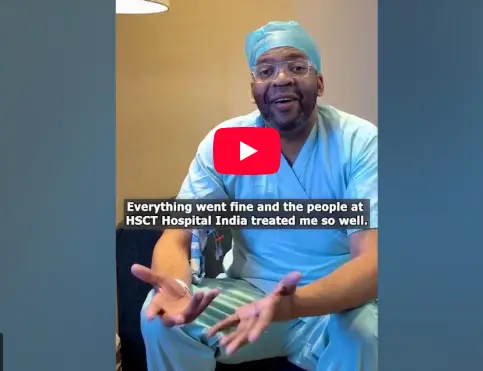
Sergel, 38M from Holland: Multiple Sclerosis Patient shares after HSCT Treatment at JCI-USA Accredited World Class Hospital in India
Watch this Video testimonial: Sergel, 38 years young man from Netherlands suffering from Multiple Sclerosis