HSCT Eligibility Criteria: Who HSCT Hospital India Accepts
Last reviewed: 2 September 2026. This page cites published criteria and peer reviewed studies, which are linked throughout. Eligibility at HSCT Hospital India is determined by haematology and neurology jointly, on the patient’s own records.
On this page
- Who HSCT Hospital India accepts
- EDSS scores of 6.0 and 6.5
- Age limits and fitness for chemotherapy
- Relapsing, secondary progressive and primary progressive disease
- Active inflammation and how it is identified
- How long the disease has been active
- Comparison of published eligibility criteria
- Conditions assessed other than multiple sclerosis
- Patients previously declined in another country
- Records required for assessment
- Assessment timeline and cost
- Where transplantation offers limited benefit
- Risks assessed before admission
- When HSCT Hospital India declines a case
- What treatment involves once a patient is accepted
- Frequently asked questions about eligibility
Who HSCT Hospital India accepts
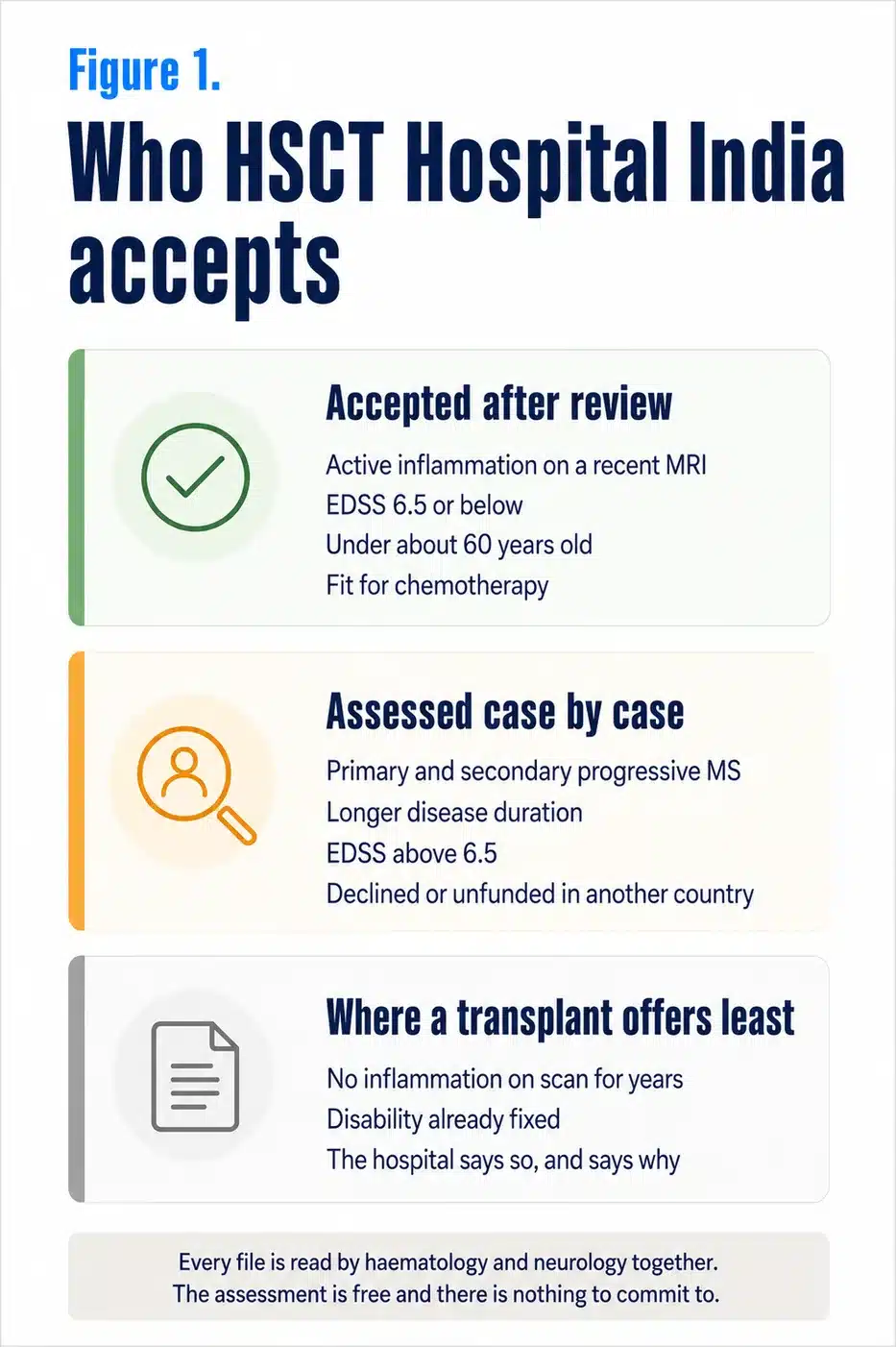
HSCT Hospital India assesses patients up to approximately 60 years of age, with a score of 6.5 or below on the Expanded Disability Status Scale, diagnosed with relapsing remitting, secondary progressive or primary progressive multiple sclerosis. The Expanded Disability Status Scale, abbreviated to EDSS, is the standard measure of disability in multiple sclerosis and runs from 0 to 10. Eligibility is determined primarily by the presence of active inflammation on recent imaging.
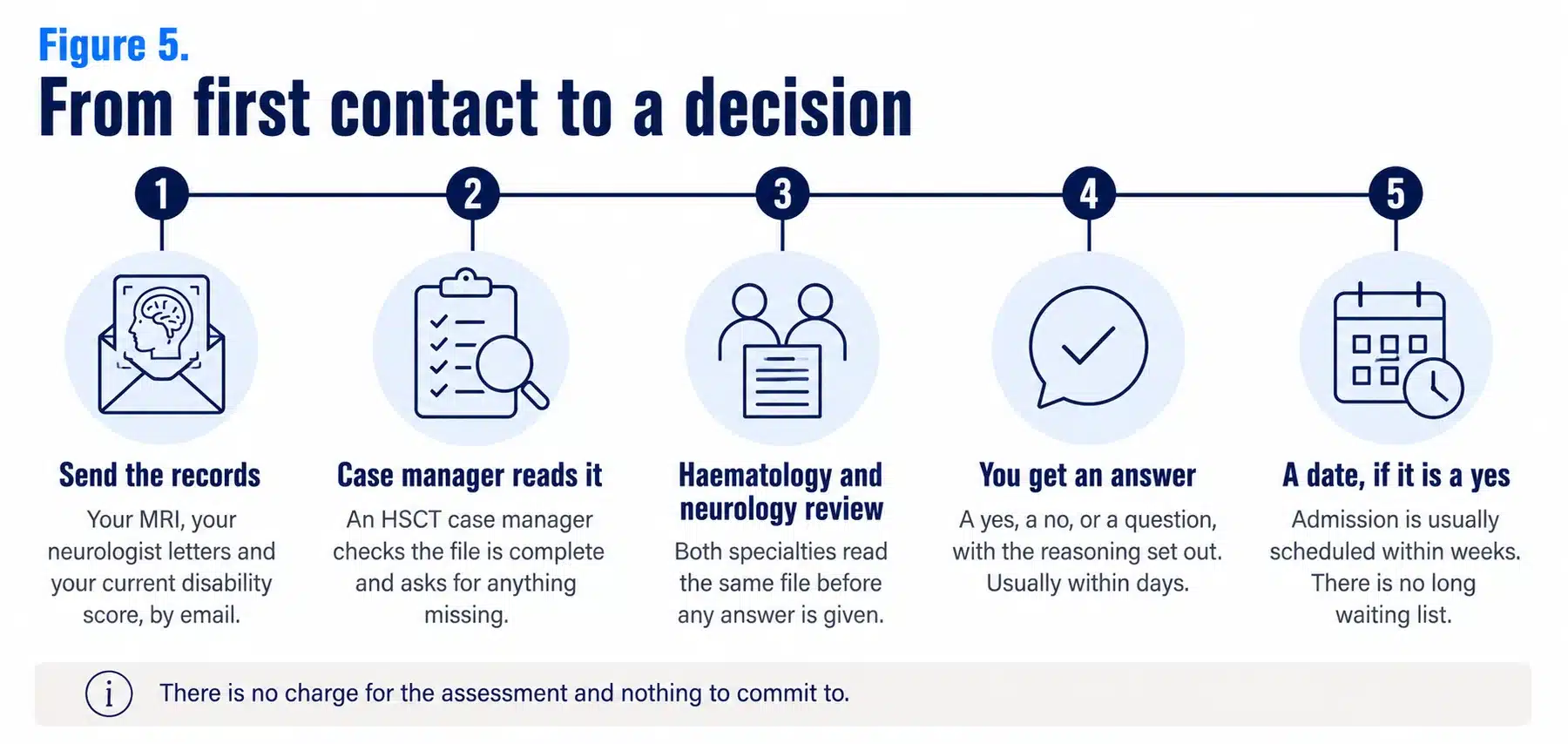
Each file is reviewed jointly by haematology and neurology. Both specialties must agree before a patient is accepted. There is no charge for the assessment and no obligation to proceed. An opinion is normally issued within a few days of the records being received.
Assessment produces one of three outcomes: acceptance following review, individual assessment where one criterion falls outside the usual range, or a determination that transplantation is unlikely to alter the course of the disease. The hospital states which outcome applies and provides the clinical reasoning.
EDSS scores of 6.0 and 6.5
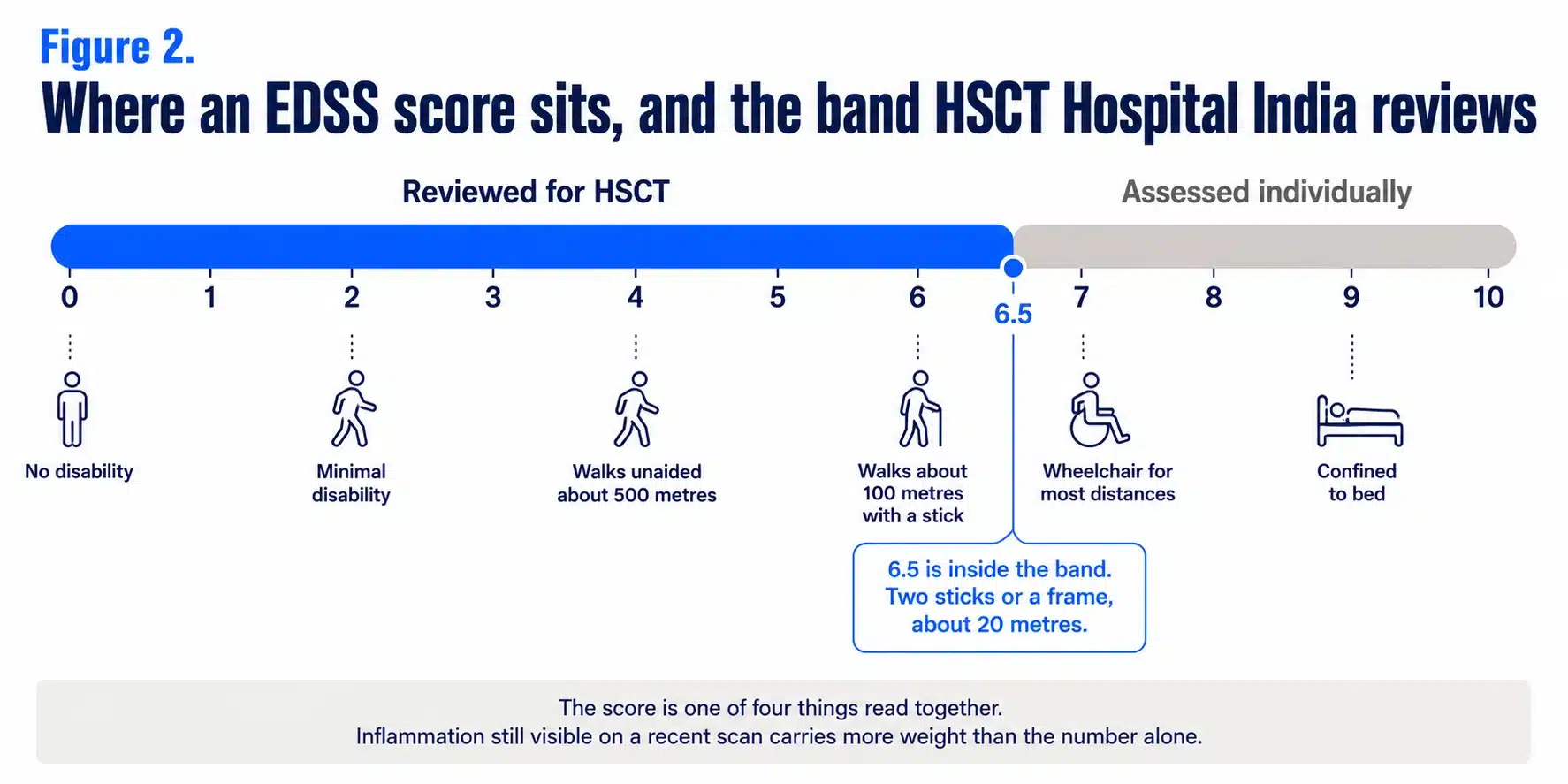
An EDSS of 6.5 is within the range HSCT Hospital India assesses. A score of 6.0 describes a patient who walks approximately 100 metres without resting using support on one side. A score of 6.5 describes a patient who walks approximately 20 metres without resting using support on both sides. The scale is set out in full on the EDSS page.
This upper limit is consistent with published criteria. The London MS-AHSCT Collaborative Group criteria applied in the United Kingdom set the same limit of 6.5, in a document dated December 2015 and published by AIMS Charity. The German national recommendation permits 6.5 under its extended criteria. The MS Society states a threshold of 5.5 for National Health Service funding in England.
Scores above 6.5 are reviewed individually, and established disability raises the risk of the procedure. In the United Kingdom series of 364 patients treated between 2002 and 2023, all five treatment related deaths occurred in patients with advanced disability at the time of treatment, at a median EDSS of 6.5. Fitness for conditioning chemotherapy is therefore assessed alongside the score, and the hospital states where the risk outweighs the benefit that can be expected.
Patients who have not been formally scored may still request an assessment. A description of current walking distance and of changes over the preceding two years is sufficient. The score is determined during the review.
Age limits and fitness for chemotherapy
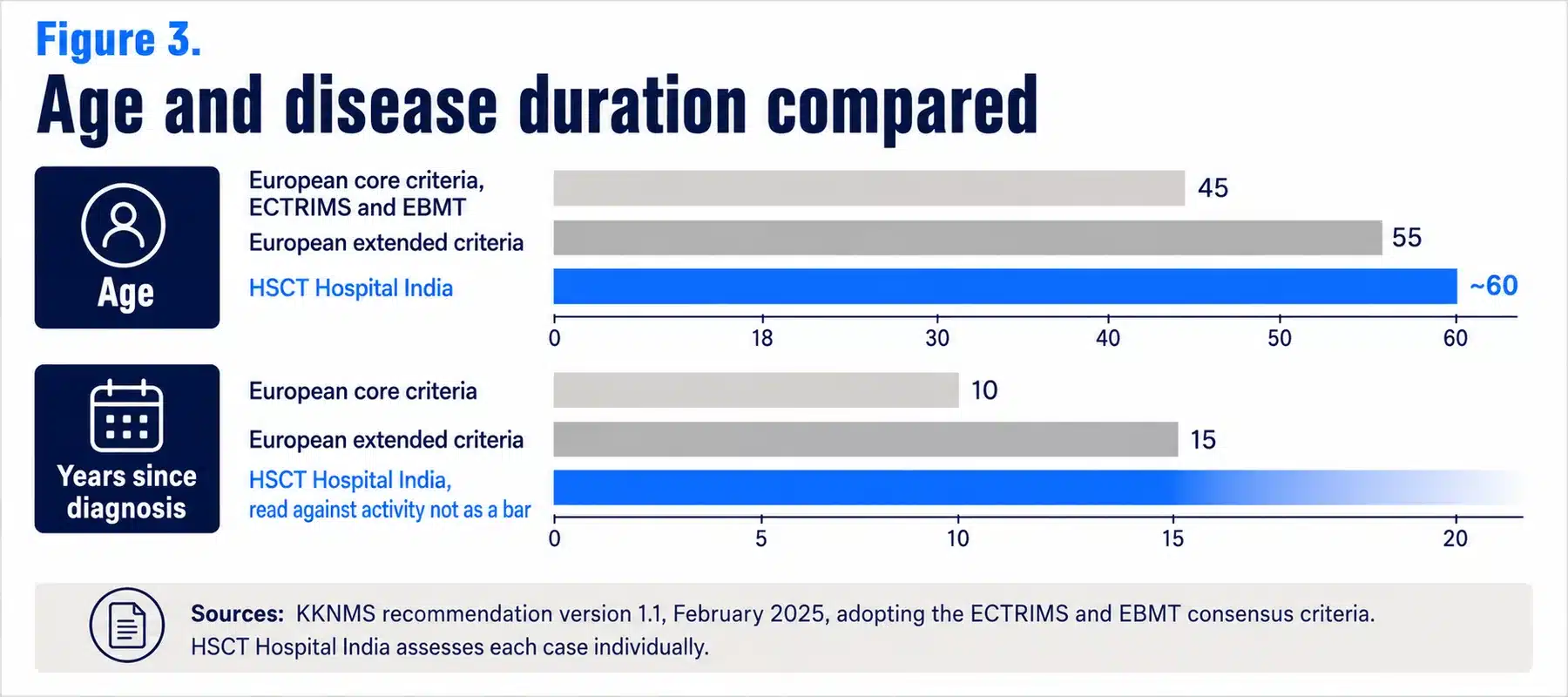
HSCT Hospital India assesses patients up to approximately 60 years of age. Age is considered together with general fitness for chemotherapy rather than applied as a fixed limit. The published basis for considering age is reduced regenerative capacity of the nervous system, ageing of the immune system, and the higher rate of organ comorbidity in older patients.
Published criteria are narrower. The consensus criteria developed by ECTRIMS, the European Committee for Treatment and Research in Multiple Sclerosis, with the EBMT, the European Society for Blood and Marrow Transplantation, specify 18 to 45 years. The German recommendation that adopts them, KKNMS version 1.1 of February 2025, extends this to 55 years in its wider corridor. The London criteria specify 18 to 65 years.
Patients in their fifties with documented inflammatory activity are assessed routinely at HSCT Hospital India.
Relapsing, secondary progressive and primary progressive disease
All three disease courses are assessed. Imaging evidence of inflammation is weighed ahead of the diagnostic classification.
Primary progressive disease with new or enhancing lesions on recent imaging proceeds to full review. Relapsing disease with no new imaging activity over several years, and disability that has become fixed, indicates limited residual inflammation for transplantation to address.
Most published evidence derives from relapsing remitting populations. The MIST randomised controlled trial, published in JAMA in 2019, randomised 110 patients to transplantation or to a change of disease modifying therapy. Disease progression occurred in 3 patients in the transplantation group and in 34 patients in the group that changed therapy, with 55 patients randomised to each arm. MIST enrolled patients aged 18 to 55, with an EDSS of 2.0 to 6.0, and relapsing remitting disease only. Outcomes for patients outside those bounds are not established by randomised evidence and are assessed individually.
Active inflammation and how it is identified
Active inflammation is identified on MRI as new lesions not present on previous imaging, as lesions that have enlarged, or as lesions that enhance following administration of contrast. An enhancing lesion is inflamed at the time of the scan.
Published criteria set a threshold. Both the German recommendation and the London criteria require at least one enhancing lesion of 3 mm or more, or at least one new or enlarged lesion on T2 imaging, within the preceding 12 months. Clinical relapse activity is assessed alongside imaging rather than in place of it. HSCT Hospital India applies the same 12 month window when it asks for a recent scan.
Films are requested rather than reports because assessment requires direct comparison between sequential scans. A radiology report is prepared for a clinician already familiar with the case and does not generally permit that comparison.
How long the disease has been active
Disease duration is assessed in relation to current inflammatory activity. The European criteria specify 10 years in their core corridor and 15 years in the wider one, measured from the first definite manifestation of the disease rather than from the date of diagnosis. The London criteria specify 15 years from diagnosis.
The clinical basis for these limits is that inflammatory activity generally declines over time while accumulated nerve fibre damage persists. Continuing imaging activity at 15 years presents a stronger indication than radiologically stable disease at five years.
Comparison of published eligibility criteria
Published thresholds differ between routes.
| Route | Age | EDSS | Years of disease | Disease course |
|---|---|---|---|---|
| German recommendation, KKNMS version 1.1, core corridor, adopting the ECTRIMS and EBMT age and duration limits | 18 to 45 | 3.0 to 6.0 | 10 or fewer | Relapsing remitting, or secondary progressive with progression in the preceding 5 years |
| German recommendation, wider corridor | 46 to 55 | Up to 6.5 | Up to 15 | Adds primary progressive disease |
| London MS-AHSCT Collaborative Group, published by AIMS Charity, document dated December 2015 | 18 to 65 | 0 to 6.5 | 15 or fewer | Relapsing remitting after failure of a high efficacy therapy, secondary progressive with new MRI activity, or primary progressive with oligoclonal bands in the cerebrospinal fluid |
| MS Society, stated threshold for NHS funding in England | Not stated | 5.5 or below | Not stated | Not stated |
| NHS Wales, Welsh Health Specialised Services Committee policy CP247, November 2024 | 18 and over | 6.0 or below | Not stated | Relapsing multiple sclerosis only, with documented relapse or new imaging activity during adequate high efficacy therapy. Primary and secondary progressive disease excluded |
| HSCT Hospital India | To approximately 60 | 6.5 or below, higher scores reviewed individually | Assessed against imaging activity in the preceding 12 months | All three courses assessed |
Every route in the table also requires documented imaging activity within the preceding 12 months, and the relapsing routes require failure of at least one high efficacy disease modifying therapy. Age, disability and duration are three rows of a longer assessment rather than the whole of it.
A patient aged 52 with an EDSS of 6.5 falls outside the European core corridor, inside the wider German corridor, inside the London criteria, and outside the MS Society threshold for National Health Service funding. Imaging activity and prior therapy would still be assessed in each of those routes. The same patient is assessed routinely at HSCT Hospital India.
Primary progressive disease sits inside the wider German corridor, and inside the London criteria where oligoclonal bands are present in the cerebrospinal fluid. At HSCT Hospital India it is assessed on imaging.
Conditions assessed other than multiple sclerosis
HSCT Hospital India assesses ten further conditions: CIDP, NMOSD, myasthenia gravis, stiff person syndrome, myositis, scleroderma, lupus, Sjogren’s syndrome, Crohn’s disease and small fibre neuropathy. Each has its own criteria, and the multiple sclerosis thresholds do not apply.
Conditioning is selected for each indication. More than 1,500 patients have been treated at HSCT Hospital India across these conditions.
Patients previously declined in another country
A previous refusal is treated as background information rather than as a determination. Eligibility criteria and funded capacity differ between health systems, and a determination made in one system does not carry across to another. The United Kingdom funds the procedure in England and in Wales, as at September 2026. The Welsh Health Specialised Services Committee commissions it under policy CP247 of November 2024, with treatment at Sheffield Teaching Hospitals and at the Clatterbridge Cancer Centre in Liverpool. That policy specifies relapsing multiple sclerosis, an age of 18 or over, an EDSS of 6.0 or below, and documented relapse or new magnetic resonance imaging activity within the preceding 12 months during adequate treatment with a high efficacy disease modifying therapy.
HSCT Hospital India reviews the primary records and issues an independent determination with the reasoning stated.
Records required for assessment
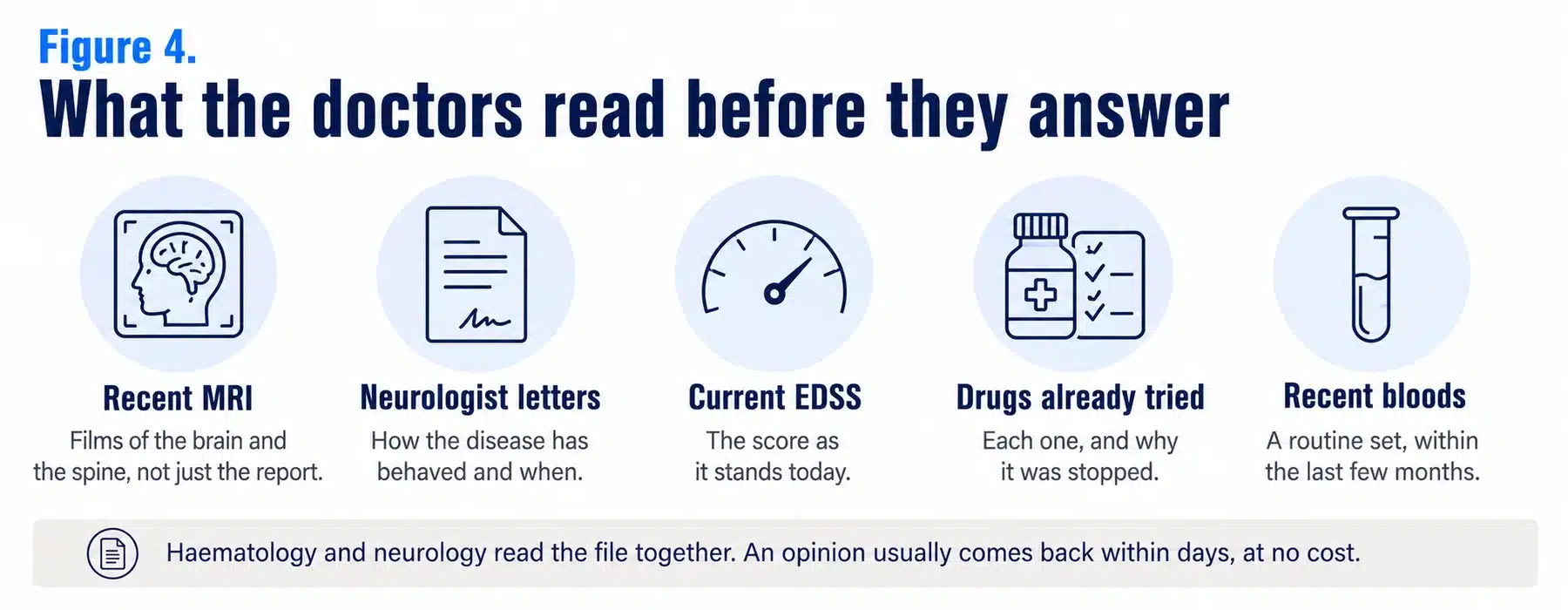
Five items are required. Recent MRI films of the brain and spine, rather than the radiology report alone. Neurology correspondence documenting the course of the disease. The current EDSS score where one has been recorded. A complete record of disease modifying therapies used, with the reason each was discontinued. A recent set of blood investigations.
Treatment history is assessed closely. Disease that has progressed despite a high efficacy disease modifying therapy, meaning one of the stronger drugs used to suppress inflammation, demonstrates continuing inflammatory activity under adequate suppression, which is a recognised indication for transplantation.
Haematology and neurology review the same file. Acceptance requires the agreement of both.
Assessment timeline and cost
An opinion is normally issued within a few days of the imaging, the disease history and the therapy record being received. The assessment is provided at no cost and carries no obligation. Records are held by HSCT Hospital India for the purpose of the assessment only, and the site’s privacy policy sets out how they are handled.
Where a patient is accepted, admission is normally scheduled within weeks. The procedure uses the patient’s own blood forming stem cells, so donor identification and tissue matching are not required.
Treatment consists of a single admission of approximately 30 days. The price is 30,000 US dollars and covers the patient and one attendant for that admission. It does not include international flights, the medical visa fee, a private nurse attendant, or any stay extending beyond thirty days. Full costs are set out on the multiple sclerosis treatment in India page.
Where transplantation offers limited benefit
Long standing progressive disease with radiologically stable imaging and established fixed disability represents the group least likely to benefit. Conditioning chemotherapy, the drug regimen given to suppress the immune system before the stem cells are returned, arrests inflammatory activity. It does not repair existing nerve damage, although confirmed improvement in disability was recorded in about a fifth of patients in the United Kingdom series. Where no inflammatory activity has been documented for several years, there is limited disease activity for the procedure to arrest.
HSCT Hospital India states this outcome where it applies and provides the clinical reasoning.
Risks assessed before admission
Three risks are assessed and discussed with every patient before admission.
Treatment related mortality. A meta analysis of 764 patients treated between 1995 and 2016 reported 2.1 per cent, which is approximately sixteen deaths. The United Kingdom series of 364 patients treated between 2002 and 2023 reported five deaths, 1.4 per cent, and all five were in patients with advanced disability at the time of treatment. Reported mortality has fallen in more recent European registry data.
Later disease. Across published series, secondary cancer has been reported in approximately 3 per cent of patients and secondary autoimmune disease in approximately 5 per cent.
Fertility. Conditioning chemotherapy is gonadotoxic, meaning it can damage the ovaries or the testes. The risk rises with age and with the cumulative dose of cyclophosphamide. Fertility preservation is discussed before admission with any patient who requests it.
When HSCT Hospital India declines a case
The hospital states the clinical reason. A determination based on absence of inflammatory activity indicates different next steps from one based on fitness for chemotherapy.
Where inflammatory activity is the issue, repeat imaging at six or twelve months may produce a different determination, since disease activity varies over time. Where fitness is the issue, the specific finding is identified so that the patient’s own clinicians can address it. Where the condition is outside those the hospital treats, that is stated directly.
A determination by HSCT Hospital India is not a second opinion on the diagnosis and does not replace the treating neurologist. It addresses one question: whether transplantation at this hospital would alter the course of this disease.
What treatment involves once a patient is accepted
Treatment proceeds in four stages within a single admission: Mobilisation, Harvest (Leukapheresis), Conditioning and Reinfusion. Leukapheresis is the process by which stem cells are collected from the blood. HSCT Hospital India uses the lower intensity, non-myeloablative conditioning regimen used in the MIST trial, meaning a regimen that suppresses the bone marrow without destroying it.
Full details of the 30 day admission are set out on the multiple sclerosis treatment in India page.
Frequently asked questions about eligibility
Is an EDSS score of 6.5 too high for HSCT?
No. An EDSS of 6.5 is within the range HSCT Hospital India assesses. It describes a patient walking approximately 20 metres without resting using support on both sides. The London MS-AHSCT criteria applied in the United Kingdom set the same limit, and the German recommendation permits 6.5 in its wider corridor. The determining factor is whether imaging from the preceding 12 months shows active inflammation.
What happens above an EDSS of 6.5?
The file is reviewed individually. Established disability raises the risk of the procedure. In the United Kingdom series of 364 patients, all five treatment related deaths occurred in patients with advanced disability at the time of treatment. Fitness for conditioning chemotherapy is assessed alongside the score, and the hospital states where the risk outweighs the benefit that can be expected.
Is there an age limit for HSCT?
Assessment extends to approximately 60 years of age, considered together with fitness for chemotherapy. The ECTRIMS and EBMT consensus criteria specify 45 years, and the German recommendation extends this to 55 in its wider corridor. The London criteria specify 65. Patients in their fifties with documented imaging activity are assessed routinely.
Is primary progressive multiple sclerosis excluded?
No. Relapsing remitting, secondary progressive and primary progressive disease are all assessed. Primary progressive disease also sits inside the wider German corridor, and inside the London criteria where oligoclonal bands are present in the cerebrospinal fluid. Imaging determines the outcome rather than the diagnostic classification.
Can a patient refused HSCT by their neurologist still be assessed?
Yes. Criteria and funded capacity differ between health systems, and a determination made in one system does not carry across to another. HSCT Hospital India reviews the primary records and issues an independent determination.
Can a patient declined by another HSCT centre be assessed?
Yes, and the file is assessed in the same way. Each programme applies its own protocol and its own limits, and the reasons are not always documented for the patient. A file declined elsewhere is assessed here on imaging, relapse history and treatment history.
Can a patient without an EDSS score be assessed?
Yes. A description of current walking distance and of changes over the preceding two years is sufficient. The score is determined during the review.
What are the long term risks of HSCT?
Across published series, secondary cancer has been reported in approximately 3 per cent of patients and secondary autoimmune disease in approximately 5 per cent. Conditioning chemotherapy may also reduce fertility, and that risk rises with age and with the cumulative dose of cyclophosphamide. All three are discussed before admission.
How long does an assessment take, and what does it cost?
An opinion is normally issued within a few days of the imaging, the disease history and the therapy record being received. There is no charge and no obligation. Where a patient is accepted, admission is normally scheduled within weeks.
Which conditions other than multiple sclerosis are assessed?
CIDP, NMOSD, myasthenia gravis, stiff person syndrome, myositis, scleroderma, lupus, Sjogren’s syndrome, Crohn’s disease and small fibre neuropathy. Each is assessed against its own criteria.
What records does HSCT Hospital India require?
Recent MRI films of the brain and spine rather than the report alone, neurology correspondence, the current EDSS score where recorded, a complete record of disease modifying therapies with the reason each was discontinued, and a recent set of blood investigations. Haematology and neurology review the file jointly before acceptance.
Request a free eligibility opinion
HSCT Hospital India reviews the records listed above and issues a written determination with the reasoning set out. The assessment is free and carries no obligation. Records are used for the assessment only and are handled under the site’s privacy policy.
Related reading: Multiple sclerosis treatment in India, HSCT cost by country, the EDSS scale explained, what the procedure involves, HSCT across autoimmune disease.