Which HSCT Protocol Is Best for MS? The Regimens Compared
Every HSCT programme uses a protocol, the combination of medicines given to clear the faulty immune cells before a patient’s own stem cells are returned. Doctors call this step conditioning. The protocol is one of the main differences between HSCT hospitals, and it is often the first thing patients ask about when they compare them.
HSCT Hospital India uses the non-myeloablative protocol developed by Dr Richard Burt. It combines two medicines, cyclophosphamide and anti-thymocyte globulin, usually shortened to ATG. It is one of the two protocols used most often for multiple sclerosis in Europe. When a 2025 study compared those two in 1,114 patients, it found no clear difference in safety or results.
HSCT Hospital India has used this protocol since 2016 and has treated more than 1,500 MS patients from over 30 countries. Treatment takes place in a JCI-USA accredited hospital that also holds NABH and NABL accreditation.
Which HSCT protocol will I receive at HSCT Hospital India?
You’ll receive cyclophosphamide with ATG. This is the protocol tested in the MIST trial, which compared HSCT with the regular MS medicines. The trial was published in the Journal of the American Medical Association in 2019.
Each of the two medicines has its own job. Cyclophosphamide is a chemotherapy medicine that clears the immune cells driving your MS. ATG is an antibody medicine that removes T cells, the white blood cells that attack the covering of your nerves.
The protocol is non-myeloablative. This means the chemotherapy weakens your bone marrow, where your blood cells are made, but does not wipe it out. Because of this, your blood counts usually recover quickly. In the European registry, patients on this protocol got their infection-fighting white blood cells back a median of 10 days after their stem cells were returned.
The protocol sits inside a programme that is the same for every patient.
| What you receive | At HSCT Hospital India |
|---|---|
| Protocol | You receive cyclophosphamide with ATG, a non-myeloablative protocol. |
| Stem cells | Your own stem cells are collected, counted and frozen before the chemotherapy starts. |
| Hospital stay | You stay as an in-patient for up to 30 days, and there is no long waiting list. |
| Room | You stay in a deluxe private room with Triple HEPA air filtration and 24 hour nursing. |
| Attendant | Your attendant stays in your room with you, and their food and laundry are included. |
| Rehabilitation | You receive neuro-physiotherapy during your stay. |
| Experience | HSCT Hospital India has treated more than 1,500 MS patients from over 30 countries. |
| Accreditation | The hospital is accredited by JCI-USA, NABH and NABL. |
| Price | The package costs US $30,000 and is all-inclusive. |
| Before you travel | HSCT specialist doctors review your case without charge. |
Which HSCT protocols are used most often for MS?
Two protocols are used more than any others for MS: cyclophosphamide with ATG, and BEAM with ATG. We know this from the European Society for Blood and Marrow Transplantation, known as the EBMT. Transplant centres across Europe record every patient they treat in the EBMT registry. In 2025, the EBMT reported which protocols appear most often in it.
Each protocol has its own chemotherapy, but both use the same antibody medicine.
| Protocol | Medicines in it | Does it include ATG? |
|---|---|---|
| Cyclophosphamide with ATG | It combines one chemotherapy medicine, cyclophosphamide, with ATG. | Yes, it does. |
| BEAM with ATG | It combines four chemotherapy medicines, carmustine, etoposide, cytarabine and melphalan, with ATG. | Yes, it does. |
Both protocols include ATG. This makes ATG a standard part of HSCT for MS in the European centres that treat the most patients.
Is one of the two HSCT protocols better than the other for MS?
No clear difference has been found. The EBMT compared the two protocols directly, using the records of 1,114 MS patients, and published the results in 2025.
The researchers looked at how quickly patients recovered and whether their MS stayed inactive over the following five years. On both measures, the two protocols gave very similar results.
| What was measured | BEAM with ATG | Cyclophosphamide with ATG |
|---|---|---|
| How long the infection-fighting white blood cells took to come back | It took a median of 11 days. | It took a median of 10 days. |
| Whether the MS stayed inactive over five years, meaning no attacks, no new MRI lesions and no worsening disability | The result was very similar to the other protocol. | The result was very similar to the other protocol. |
The researchers then allowed for differences between the two groups, such as the type of MS and the level of disability. The results still came out about the same. What did make a difference was the type of MS itself. Patients with relapsing remitting MS, where attacks come and go, did better than patients with progressive MS, whichever protocol they received.
For you, this means the choice of protocol is less important than a careful assessment of your own MS. That assessment is the first step at HSCT Hospital India.
Send your diagnosis, your current EDSS score and the medicines you have tried through the enquiry form. The HSCT specialist doctors at HSCT Hospital India review every case without charge, and an HSCT Case Manager replies to you by email.
Why is ATG part of my HSCT, and how is it given to me?
In MS, T cells attack the myelin, the protective covering around your nerves. ATG removes these T cells from your blood. Once they are cleared, your immune system rebuilds itself from your own stem cells. This is why HSCT is often described as a “reset” of the immune system.
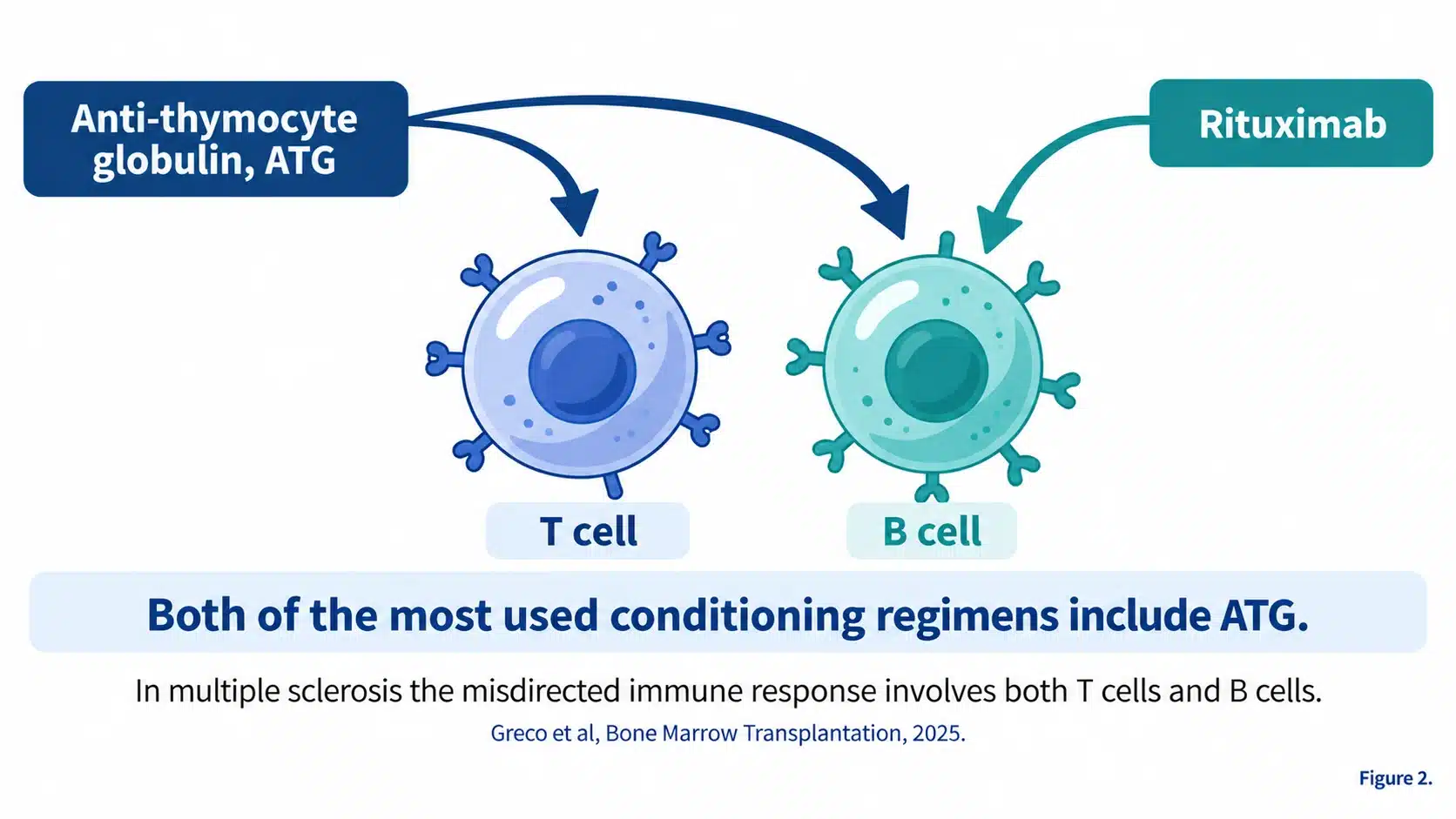
Rituximab, which some clinics use instead, works differently. It removes B cells, another type of white blood cell, but leaves T cells in place. The clinic in Mexico combines rituximab with cyclophosphamide. Neither of the two protocols used most often in Europe includes it.
ATG is given through a drip during the conditioning stage of your stay. Some patients get a fever, chills or a rash while it goes in, and these reactions are expected and treated as they happen. To ease side effects, you’ll also receive methylprednisolone, a steroid medicine, at 2 mg for every kg of your body weight during chemotherapy.
Throughout this stage, HSCT specialists, hospital doctors and nurses watch you around the clock. If you feel sick, you’ll be given anti-nausea treatment, and any pain is treated.
What does cyclophosphamide do, and has it been tested in a trial?
Cyclophosphamide is the chemotherapy medicine in the protocol. It clears the immune cells that cause MS attacks, and it works together with ATG to give your immune system a clean start.
Yes, it has been tested in a randomised trial. The MIST trial, published in 2019, included 110 people with relapsing remitting MS. Every one of them had had at least two MS attacks in the previous year while taking their regular medicine. Their EDSS disability scores were between 2.0 and 6.0.
Half of the patients, 55 people, received HSCT with cyclophosphamide and ATG. The other 55 were switched to a different disease modifying drug, one of the regular medicines used to control MS. The doses were 200 mg of cyclophosphamide and 6 mg of ATG for every kg of body weight.
The difference between the two groups was large. The MS got worse in 3 of 52 patients who had HSCT, compared with 34 of 51 patients who stayed on regular medicines. In the first year, average disability on the EDSS scale improved from 3.38 to 2.36 after HSCT. In the group on regular medicines, it worsened from 3.31 to 3.98.
Will cyclophosphamide affect my fertility or my hair?
It can affect both, and HSCT Hospital India discusses this with you before treatment begins. Around one in three patients become infertile after high-dose cyclophosphamide. Young women can have their eggs collected and frozen before treatment, and the page on fertility preservation before HSCT explains how.
You’ll lose about a third of your hair, and it usually starts to grow back around three months after HSCT. Many patients cut their hair short before they arrive.
Who can have this protocol is explained on the page about HSCT eligibility criteria at HSCT Hospital India. What each medicine does inside the immune system is explained in the article on chemotherapy for MS and HSCT.
What is BEAM, and does it give a better result than cyclophosphamide?
BEAM is a combination of four chemotherapy medicines. Its name comes from their initials: BiCNU, which is carmustine, etoposide, Ara-C, which is cytarabine, and melphalan. Like the protocol at HSCT Hospital India, BEAM is given together with ATG.
BEAM uses more chemotherapy medicines, but that did not translate into a clearly better result. In the EBMT comparison of 1,114 patients, BEAM with ATG and cyclophosphamide with ATG showed very similar safety and very similar results over five years.
Which HSCT protocols do the clinics in Mexico and Russia use?
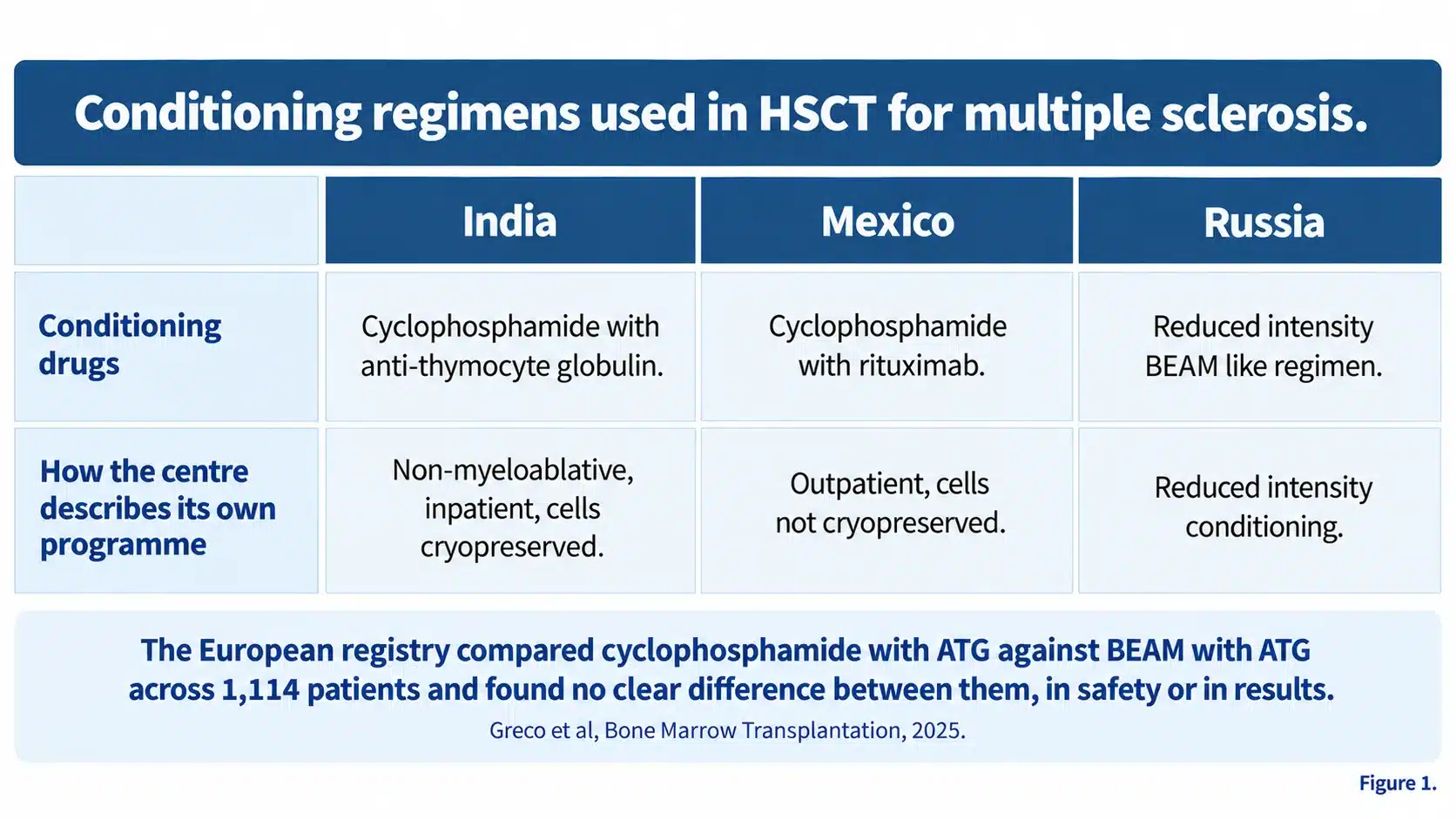
Mexico and Russia are the two other destinations patients most often compare with India, and both use a different protocol. The clinic in Puebla, Mexico, uses cyclophosphamide with rituximab. A transplant centre in Moscow, Russia, describes its protocol as reduced intensity, and its 2015 paper describes it as similar to BEAM.
Each programme’s own published research shows how its treatment is delivered.
| Centre | Protocol and how it is given | Where it is described |
|---|---|---|
| HSCT Hospital India | The hospital uses cyclophosphamide with ATG. Patients stay as in-patients for up to 30 days, and every patient’s stem cells are frozen. | This is Dr Richard Burt’s non-myeloablative protocol, tested in the MIST trial published by Burt RK and colleagues in JAMA in 2019. |
| The clinic in Puebla, Mexico | The clinic uses cyclophosphamide with rituximab. Its paper describes treatment as outpatient, with stem cells that are not frozen. | Lavoignet-Cisneros M and colleagues describe 586 patients with MS or CIDP treated between July 2021 and March 2025, in Transfusion and Apheresis Science in 2026. |
| The centre in Moscow, Russia | The centre describes a reduced intensity protocol, which its 2015 paper calls similar to BEAM. | Shevchenko JL and colleagues describe 95 patients in Experimental Hematology in 2012 and 99 patients in Annals of Hematology in 2015. |
Price is usually the next question. The page on HSCT cost by country compares India, Mexico, Russia and the USA. The Mexican programme is explained in more detail on the page about HSCT for MS in Mexico.
Are my stem cells frozen before they are given back to me?
Yes. At HSCT Hospital India, every patient’s stem cells are frozen after they are collected, a process doctors call cryopreservation. Your cells are counted and checked first, then stored under monitored conditions until your chemotherapy is complete.
Frozen stem cells keep safely in storage. This means your conditioning does not have to be rushed to fit a deadline, and your cells are returned once the chemotherapy is complete.
What happens to me during the 30 days at HSCT Hospital India?
You’ll stay in hospital for the whole treatment, usually about 30 days, and your attendant stays in the room with you. HSCT Hospital India treats every patient as an in-patient because the second week, after conditioning, is when your immune system is at its lowest. Doctors call this the aplastic phase, and it is the time when an infection is most likely.
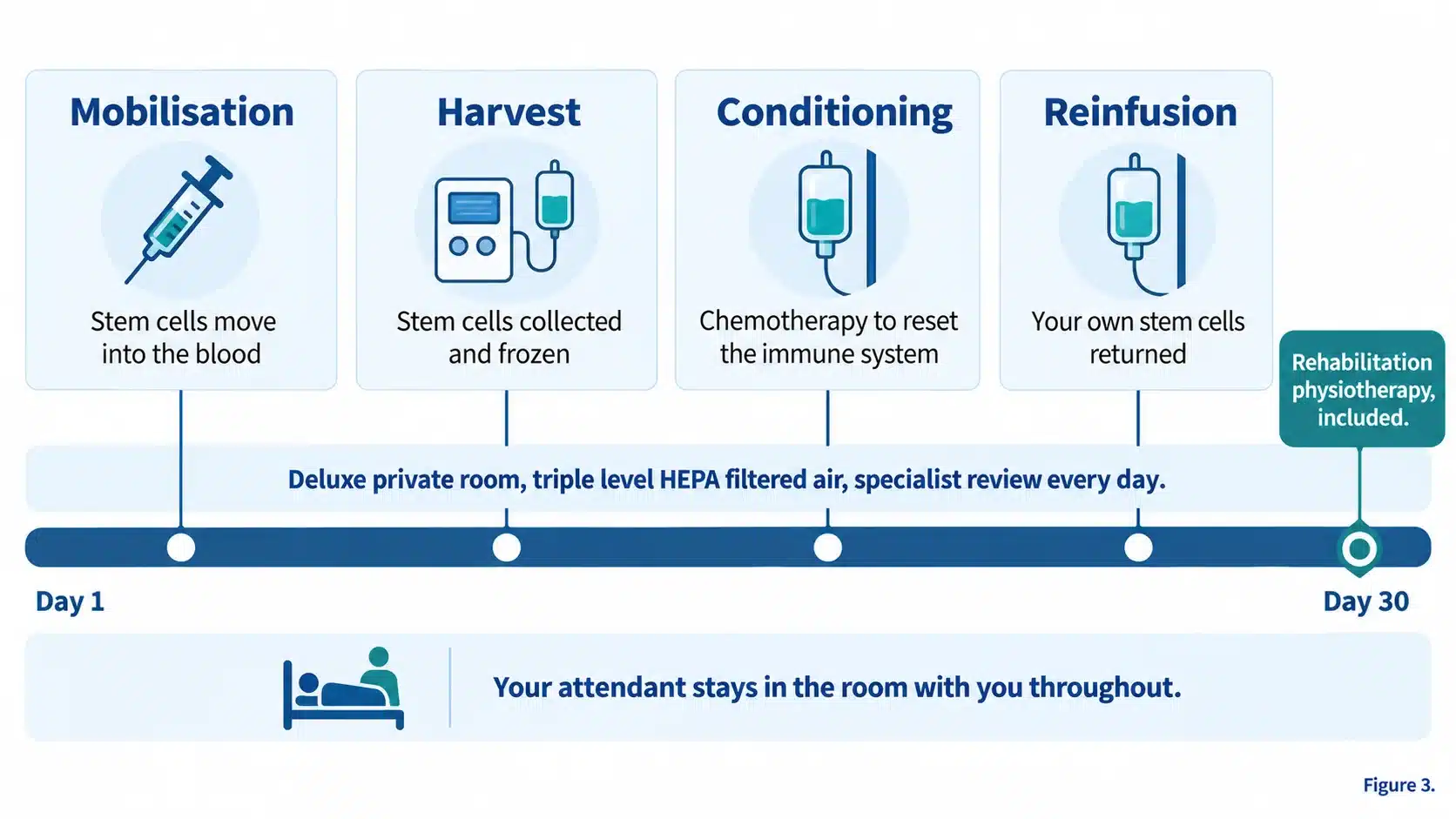
Your treatment moves through four stages.
Mobilisation: You receive a short course of chemotherapy and a growth factor, a medicine that moves stem cells out of your bone marrow and into your bloodstream.
Harvest (Leukapheresis): Your stem cells are collected from your blood by a machine, a little like giving blood, and then frozen.
Conditioning: You receive cyclophosphamide and ATG, which clear the immune cells that cause your MS.
Reinfusion: Your own stem cells are returned through a drip, and over the following days they settle in your bone marrow and start making new blood cells.
During the aplastic phase, you stay in your private room with Triple HEPA air filtration. Nurses are with you 24 hours a day, so any fever is caught and treated straight away. In the third and fourth weeks, your blood counts recover and you are prepared to go home. Neuro-physiotherapy continues through the whole stay.
Before you leave, you receive a Discharge Summary and an Aftercare Manual to share with your GP or neurologist. There is no further chemotherapy after you go home. Most patients return to normal activities after 2 to 4 months, depending on their blood counts. Full recovery usually takes 3 to 12 months.
The package is US $30,000, all-inclusive. It covers pre-testing, MRI, the full HSCT treatment, up to 30 days in hospital, doctors’ fees, tests and consultations, medicines and consumables, neuro-physiotherapy, food and laundry for both the patient and the attendant, and airport pick-up and drop-back. Every step from applying to going home is set out on the page about how HSCT at HSCT Hospital India works.
What decides how well HSCT works for my MS?
The type of MS you have has the biggest influence on your result. The EBMT study of 1,114 patients found this, and it holds whichever of the two main protocols is used.
HSCT works best while MS is still driven by active inflammation. A 2025 EBMT review in the Multiple Sclerosis Journal describes HSCT as a standard treatment for relapsing remitting MS that keeps coming back despite the regular medicines. The same review recommends considering HSCT early when MS shows signs of getting worse quickly. It also includes people with aggressive MS whose disability is building fast, even before they have tried other medicines.
Progressive MS, where disability builds steadily, is also accepted at HSCT Hospital India. Relapsing remitting, secondary progressive and primary progressive MS are all assessed. The question that decides suitability is whether your MS still shows active inflammation, such as recent attacks or new lesions on your MRI.
HSCT stops the immune attack, but it cannot regrow nerve fibres that have already been lost. This is why results vary from patient to patient, and why the review of your case comes first. HSCT specialist doctors review your records before you travel, and a team of specialists confirms that HSCT is suitable after a full medical evaluation when you arrive.
What should I ask a hospital before I choose where to have HSCT?
Asking every hospital the same questions makes the answers easy to compare. These are the eight questions patients find most useful, with the answers from HSCT Hospital India.
| Question to ask | The answer at HSCT Hospital India |
|---|---|
| Which protocol do you use? | We use cyclophosphamide with ATG, a non-myeloablative protocol. |
| Will I be an in-patient or an outpatient? | You stay as an in-patient for up to 30 days, including the low-immunity phase. |
| Will my stem cells be frozen? | Yes, your stem cells are frozen after they are collected. |
| What does the price include? | The US $30,000 price includes treatment, tests, medicines, the room, neuro-physiotherapy, food and laundry for you and your attendant, and airport transfers. |
| How many MS patients have you treated? | We have treated more than 1,500 MS patients from over 30 countries. |
| Which accreditations does the hospital hold? | The hospital holds JCI-USA, NABH and NABL accreditation. |
| Who decides whether I am suitable? | HSCT specialist doctors review your case without charge, and a team of specialists confirms suitability when you arrive. |
| How long will I wait for treatment? | There is no long waiting list. |
Can I hear from patients who chose HSCT Hospital India?
Yes. Many patients record their experience on video before they go home, and two of their stories follow.
David Ellis travelled from California with primary progressive MS. He says that HSCT programmes exist much closer to his home. In the video, he explains in his own words why he chose to come to India instead. He arrived using a cane, and he names lifting his left leg without help as something he could not do before.
His full story is on the page David Ellis, primary progressive MS, United States.
Dean travelled from the United Kingdom with stiff person syndrome. His wife Mandy describes him arriving in a wheelchair, and his clinician describes him walking without support and climbing stairs after HSCT.
His full story is on the page Dean, stiff person syndrome, United Kingdom. More patient videos are on the HSCT patient testimonials page.
Answers to Frequently Asked Questions (FAQs) about HSCT protocols for MS
Which HSCT protocol is best for MS?
No single protocol has been shown to be clearly better. The EBMT compared the two protocols used most often, cyclophosphamide with ATG and BEAM with ATG, in 1,114 patients. The side effects and results were very similar. HSCT Hospital India uses cyclophosphamide with ATG, the lower intensity protocol developed by Dr Richard Burt.
Is ATG a standard part of HSCT for MS?
Yes. ATG is part of both of the protocols used most often for MS in the European transplant registry. It removes the T cells that drive the attack on your nerves, which is why it is part of conditioning.
What is the difference between myeloablative and non-myeloablative HSCT?
Myeloablative chemotherapy wipes out the bone marrow completely, so the patient depends on the returned stem cells to make blood again. Non-myeloablative chemotherapy weakens the bone marrow without wiping it out, which makes it a lower intensity treatment. HSCT Hospital India performs non-myeloablative HSCT.
Is HSCT for MS a clinical trial at HSCT Hospital India?
No. HSCT Hospital India does not treat patients as part of a trial. A 2025 review by the EBMT describes HSCT as a standard treatment for relapsing remitting MS that has kept coming back despite the regular MS medicines.
Do you treat progressive MS with this protocol?
Yes, we do. Relapsing remitting, secondary progressive and primary progressive MS are all assessed. What decides whether HSCT can help is whether your MS still shows signs of active inflammation, such as recent attacks or new lesions on your MRI.
How do I find out whether HSCT is suitable for me?
Fill in the enquiry form with your diagnosis, your current EDSS score and the medicines you have tried. The HSCT specialist doctors at HSCT Hospital India review your case without charge. An HSCT Case Manager then contacts you by email to explain what they found.
Send your diagnosis, your current EDSS score and the medicines you have tried through the enquiry form. The HSCT specialist doctors at HSCT Hospital India review every case without charge, and an HSCT Case Manager replies to you by email.
References
Greco R, Saccardi R, Ponzano M, Badoglio M, Helbig G, Smilowski M, Mariottini A, Burman J, Carlson K, Kazmi M, et al. BEAM/ATG or cyclophosphamide/ATG as conditioning regimen in autologous haemopoietic stem cell transplantation for multiple sclerosis: a retrospective analysis of the EBMT autoimmune diseases working party. Bone Marrow Transplantation, 2025. doi:10.1038/s41409-025-02715-x
Burt RK, Balabanov R, Burman J, Sharrack B, Snowden JA, Oliveira MC, et al. Effect of nonmyeloablative hematopoietic stem cell transplantation vs continued disease-modifying therapy on disease progression in patients with relapsing-remitting multiple sclerosis: a randomized clinical trial. JAMA, 2019. doi:10.1001/jama.2018.20876
Boffa G, Genchi A, Mariottini A, Brittain G, Snowden J, Alexander T, Badoglio M, Roldan Galvan E, Muraro PA, et al. Aggressive MS and autologous HSCT: a review on behalf of the Autoimmune Diseases Working Party of the European Society for Blood and Marrow Transplantation. Multiple Sclerosis Journal, 2025. doi:10.1177/13524585251349129
Shevchenko JL, Kuznetsov AN, Ionova TI, Melnichenko VY, Fedorenko DA, et al. Long-term outcomes of autologous hematopoietic stem cell transplantation with reduced-intensity conditioning in multiple sclerosis. Annals of Hematology, 2015. Also: Autologous hematopoietic stem cell transplantation with reduced-intensity conditioning in multiple sclerosis. Experimental Hematology, 2012.
Lavoignet-Cisneros M, Alberto-Lopez LJ, Viveros-Lugo MA, Couriel D, Robles-Nasta M, Chavez-Martinez S, et al. The actual usefulness of culturing apheresis products in hematopoietic stem cell autotransplants. Transfusion and Apheresis Science, 2026. doi:10.1016/j.transci.2026.104404
Read next
CAR T cell therapy or HSCT for MS
HSCT eligibility criteria: who HSCT Hospital India accepts
HSCT for multiple sclerosis: the full treatment guide
HSCT cost by country: India, Mexico, Russia and the USA
How HSCT at HSCT Hospital India works