EDSS Calculator: Work Out an EDSS Score Step by Step
This calculator works out an EDSS step from the seven systems a neurologist examines, plus walking. It applies the two conversions that most online calculators leave out, and it shows its working.
The Expanded Disability Status Scale, almost always written as EDSS, is the scale used to record disability in multiple sclerosis. It runs from 0, a normal neurological examination, to 10. A neurologist sets the figure during a structured examination.
Most people meet the number without ever being shown how it is reached. The tool below is the arithmetic, made visible.
 Consult Top HSCT Doctors
What the EDSS Measures
Seven functional systems are examined and graded. Then walking is measured separately, and from step 4.0 upward walking dominates the score.
| Functional system | What is tested |
|---|---|
| Pyramidal | Muscle power and weakness, graded on strength that can be sustained. |
| Cerebellar | Balance, coordination, tremor, steadiness walking heel to toe. |
| Brainstem | Eye movement, speech and swallowing, and the other cranial nerves. |
| Sensory | Touch, pain, vibration, and the sense of where a limb is without looking. |
| Bowel and bladder | Graded on whichever of the two is worse. |
| Visual | Corrected acuity in the worse eye, plus blind spots and field loss. |
| Cerebral | Thinking, memory and fatigue. Low mood alone is recorded but does not change the step. |
The Two Conversions Most Calculators Miss
Before the step is worked out, the visual and the bowel and bladder grades are converted to a lower value. This is published in the Neurostatus definitions and it changes the answer.
| Grade recorded | 6 | 5 | 4 | 3 | 2 | 1 |
|---|---|---|---|---|---|---|
| Visual counts as | 4 | 3 | 3 | 2 | 2 | 1 |
| Bladder counts as | 5 | 4 | 3 | 3 | 2 | 1 |
Someone blind in the worse eye records a visual grade of 5, which counts as 3. With every other system normal that person is EDSS 3.0. A calculator that skips the conversion reads the raw 5 and returns 5.0. That is why a vision problem on its own cannot push an EDSS as high as people expect.
Above 5.5 the Score Is Walking Alone
From step 5.5 upward the functional system grades stop deciding anything. The scale reads only what walking is possible, and with what help.
| Step | Walking |
|---|---|
| 4.0 | 500 metres or more, no aid, no rest. |
| 4.5 | 300 metres or more, no aid, no rest. |
| 5.0 | 200 metres or more, no aid, no rest. |
| 5.5 | 100 metres or more, no aid, no rest. |
| 6.0 | One stick or crutch over 50 metres, or two over 120 metres. |
| 6.5 | One stick under 50 metres, or two crutches between 5 and 120 metres. |
| 7.0 | Under 5 metres even with aids. A wheelchair, self propelled, transferring alone. |
An ankle brace does not count as a walking aid. A stick, a crutch or a person to lean on does. Two points that surprise people: bilateral crutches over 120 metres is 6.0, not 6.5, and the distance is measured without stopping.
Where the Scale Is Genuinely Undefined
Steps 4.0 and 4.5 can both be reached by what the published definitions call combinations of lesser grades exceeding the limits of the previous step. No source puts a number on that. It is the documented state of the scale rather than a gap in the reading, so where a result lands in that zone the calculator says so on screen instead of implying a precision that does not exist.
Published studies also show that two trained neurologists examining the same patient do not always record the same step, with more disagreement at the lower end of the scale.
What These Scores Look Like in Real Patients
A step on the scale is a description of a day. These are patients treated at HSCT Hospital India who arrived in the bands the calculator produces, in their own words and in the words of the family members who travelled with them.
| Patient | Where they were | What changed |
|---|---|---|
| Gudrun R United Kingdom, relapsing remitting MS | Rollator. Two to three minutes standing, then rest. A mobility scooter at home and a wheelchair for longer distances. | Walking with a stick, and short distances with no stick at all. In her words: Every single day after the stem cell transplant I have achieved one thing. |
| Linda Netherlands, MS, aged 36 at treatment | Gave her own disability score before treatment as EDSS 5.5 to 6. A 100 metre walk to the supermarket was already too far. | Her attendant reported a difference in walking and in bending her knee before Linda had even left the hospital. |
| Margaret United Kingdom, MS diagnosed 2013 | EDSS 8.5 when she arrived at HSCT Hospital India. | In her own words: I can move my legs, the legs I have not been able to move. I can hold a pen and actually write as legible. |

Read the full accounts: Gudrun R, from a rollator to a walking stick, Linda from the Netherlands, who names her own EDSS, and Margaret from the UK, who arrived at EDSS 8.5. There are 31 patient stories in full, most of them filmed in the hospital.
What an EDSS Score Means for HSCT
We ask for an EDSS below 7.0 before a case goes to formal evaluation. Below that line the score is one of several things our haematologists review, alongside the MRI sequence over time, the relapse history and previous multiple sclerosis treatment. On its own it settles nothing, and Margaret above is the reason the line is a starting point rather than a wall.
Two people at the same score can receive different answers, because the score says where someone is and not how they got there. For what every step from 0 to 10 means, and what the scale cannot tell anyone, read the Expanded Disability Status Scale guide. To check whether your own case fits, see the HSCT eligibility criteria, or read the full HSCT for multiple sclerosis guide.
Send an MRI sequence and a relapse history and a world class team of HSCT specialists will say what a transplant would and would not be expected to achieve. HSCT Hospital India is JCI-USA accredited alongside NABH and NABL, has treated more than 1500 multiple sclerosis patients, and receives patients from 30 countries. One 30 day stay, one all inclusive price of 30,000 USD.
Why Choose HSCT Hospital India for Life Changing Multiple Sclerosis Treatment

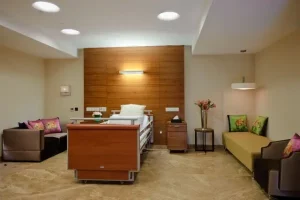 Complete 30 day HSCT done in hospital. Private deluxe rooms are very well served for patient and attendant comfort and equipped with HEPA Filter with Triple Level Air Filtration. No outside hospital stay avoids risk of infection during the aplastic phase, 24 x 7 nursing care and best medical attention. Advanced HSCT protocol used does not require any further chemo or treatment after leaving the hospital. Click here to get complete details
 International and Globally Renowned Accreditations. HSCT Hospital India is accredited by the Joint Commission International, USA, the National Accreditation Board for Hospitals and Healthcare Providers (NABH), and the National Accreditation Board for Laboratories (NABL) for processes and high quality patient care. Click here to know more

Answers to Common Questions About This Calculator
Is this the same as the score my neurologist writes?
No. The number in a medical record comes from a physical examination: tested muscle power, reflexes, coordination, sensation, corrected vision and an observed walk. This tool works from answers typed at a keyboard. Use it to understand the scale and to arrive at a consultation able to ask better questions, not as a substitute for the examination.
Why did my vision answer barely change the result?
Because visual grades are converted downward before the step is calculated. A grade of 6 counts as 4, and a grade of 5 counts as 3. Most online calculators skip this step, which is why they return a higher number than a neurologist would.
Why did the calculator stop using my other answers once I said I use a stick?
Because at 5.5 and above the scale reads walking alone. That is stated in the scoring rules rather than being a shortcut in this tool. A patient who needs a stick to cover 50 metres is 6.0 whatever their sensory or visual grades are.
Does an ankle brace count as a walking aid here?
No. An ankle foot orthosis is explicitly excluded from the definition. A stick, a crutch or another person to lean on is a walking aid. Answering as though a brace were an aid pushes the result a full step too high.
My result says it is an estimate. What does that mean?
Steps 4.0 and 4.5 can be reached by combinations of grades that the published definitions describe but never quantify. Where your answers land in that zone the calculator says so rather than presenting a figure as settled. A neurologist scoring in person resolves it.
Should I answer for a good day or a bad day?
Answer for what can be sustained, not for the best hour or the worst. The scale is scored on function that holds, which is why fatigue is graded in its own system rather than being allowed to move every other answer.
Are the answers I type into this calculator stored anywhere?
No. The scoring runs inside your browser. Nothing you select is sent to us or to anyone else, and nothing is saved when you close the page. If you want our team to look at your case, use the enquiry form on this page and tell us what you want us to see.
Which EDSS scores does HSCT Hospital India accept?
We ask for an EDSS below 7.0 before a case goes to formal evaluation, and the score is read alongside the MRI sequence over time, the relapse history and previous treatment. Send us your recent reports and our team will tell you where you stand.
Scoring rules follow the Neurostatus definitions, version 04/10.2, which are a modification of the scale published by Kurtzke in Neurology in 1983.