Chemotherapy for MS: What HSCT Does to the Immune System

Patients told that HSCT involves chemotherapy usually stop listening at the word. It is a fair word. The conditioning step is built around a cytotoxic chemotherapy drug, and the MS Society describes HSCT as an intense chemotherapy treatment for MS. What the word does not tell a patient is what the chemotherapy is for, how much of it there is, or what happens to the immune system afterwards.
What the Chemotherapy Is For
In cancer, chemotherapy is aimed at a tumour. In HSCT for multiple sclerosis it is aimed at the immune system, because the immune system is what is attacking the myelin. The step is called conditioning, and it clears the misdirected immune cells so that a new immune system can be rebuilt from the patient’s own stem cells, which were collected and frozen before the chemotherapy was given. What HSCT is sets out the procedure in full.
That ordering is the whole design. The stem cells come out first, so the chemotherapy can be given at a dose that clears the immune system, and the stored cells then go back in to shorten the period without one.
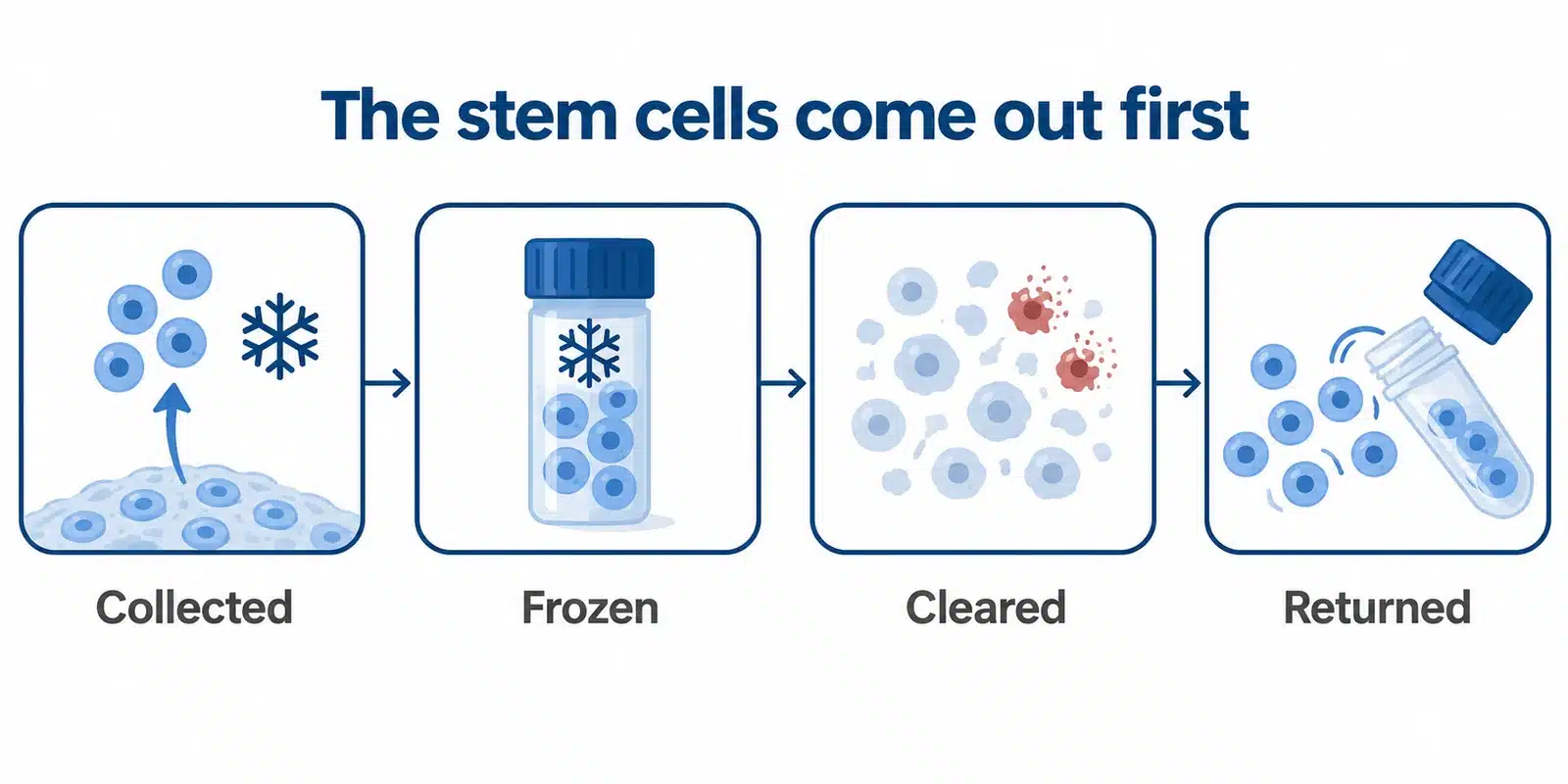
One of the two main drugs is not chemotherapy at all. Anti-thymocyte globulin, written as ATG, is an antibody rather than a cytotoxic drug, and it is given alongside the chemotherapy to remove the T cells that drive the disease.
How Much Chemotherapy, and of What Kind
Conditioning regimens are graded by whether they clear the lymphoid compartment alone or the bone marrow as well. The European Society for Blood and Marrow Transplantation classifies them as low, intermediate or high intensity, and states that the two intermediate intensity regimens have been used most commonly in MS.
The regimen that has become dominant is cyclophosphamide at 200 mg/kg with rabbit ATG. In the United Kingdom cohort of 364 patients treated between 2002 and 2023, that regimen accounted for 98 per cent of transplants. It is non-myeloablative, meaning it does not destroy the bone marrow.
| Regimen | Intensity | Used in MS |
|---|---|---|
| Cyclophosphamide 200 mg/kg with ATG | Intermediate, non-myeloablative | The standard. 98 per cent of United Kingdom transplants |
| BEAM with ATG | Intermediate, myeloablative | Common before 2016, now largely replaced |
| Busulfan or total body irradiation with cyclophosphamide | High | Not recommended for MS |
The high intensity regimens used in some cancer transplants, total body irradiation and busulfan, are explicitly not recommended for multiple sclerosis on grounds of toxicity. That is the honest comparison with cancer treatment: a difference in kind, not a smaller dose of the same thing.
What Resetting the Immune System Means
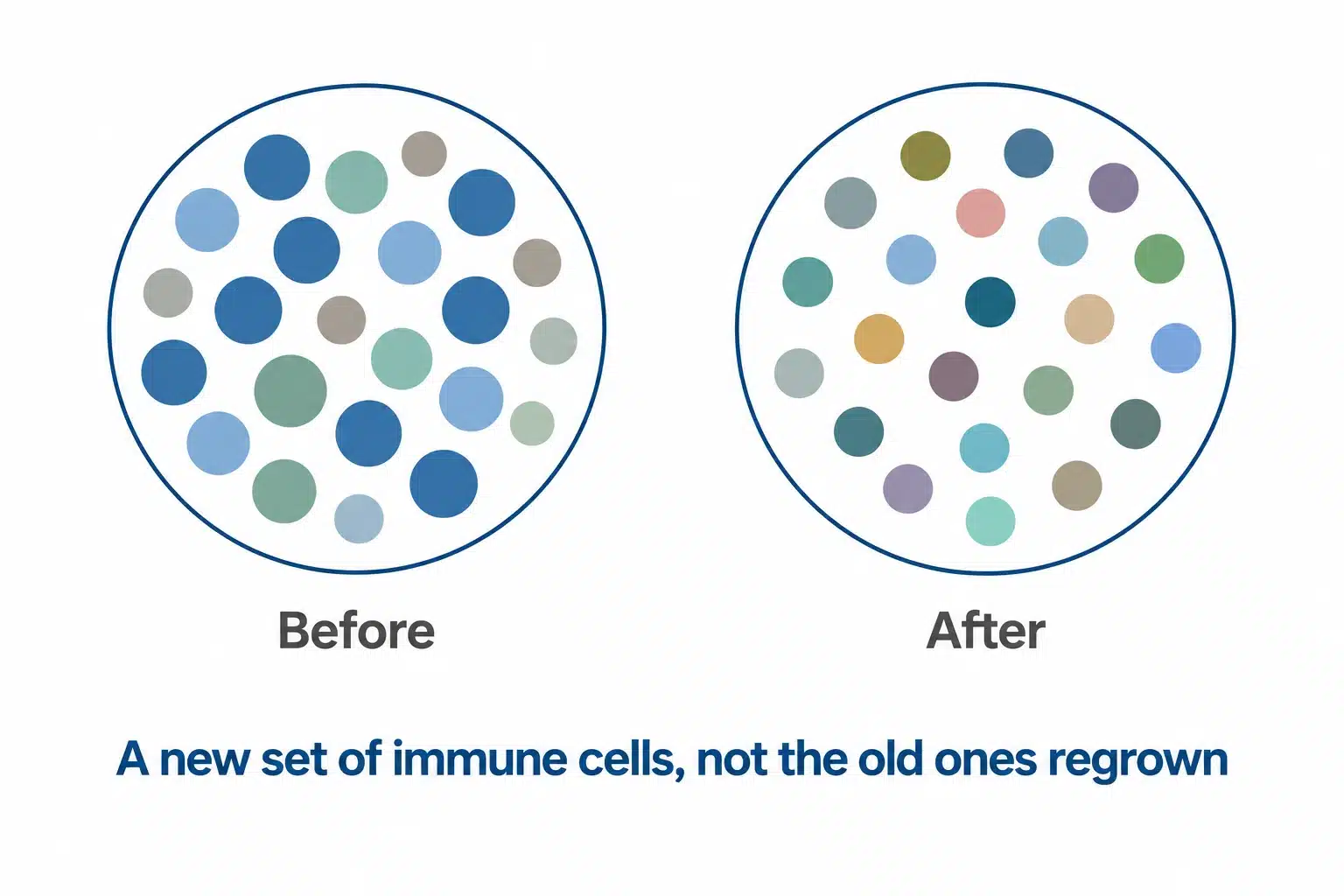
The phrase is used by the transplant field itself. The EBMT Autoimmune Diseases Working Party describes renewal of the T cell receptor repertoire, a resurgence of immune regulatory cells and depletion of pro-inflammatory T cell subsets, and calls it a resetting of immunological memory.
The measurement behind that is specific. In a study of 22 patients, a median of 81.5 per cent of the CD4 T cell clones present after transplant were new clones that had not been detectable before treatment, and the dominant clones present before treatment were undetectable afterwards. Those new cells carry the markers of thymic origin, meaning the thymus is producing a genuinely new repertoire rather than the old one regrowing.
The same mechanism is why the treatment is used beyond multiple sclerosis, in CIDP, systemic sclerosis, stiff person syndrome, lupus, myasthenia gravis and small fibre neuropathy. The full list is in the HSCT treatment guides.
Two things that reset does not mean. The CD8 compartment reconstitutes largely by expanding cells that were already there, so it is not renewed in the same way. And the treatment does not repair damage already done. It stops the attack. It does not itself rebuild myelin or repair nerves already damaged.
The Rebuild, Month by Month
| When | What is happening |
|---|---|
| Days 1 to 5 | Conditioning is given. The white cell count falls. |
| Around day 11 | Neutrophils engraft. Median 11 days in the United Kingdom cohort of 364 patients. |
| Around week 3 | Discharge. Median total admission was 20 days in a Swedish cohort. |
| Months 1 to 6 | Natural killer cells and CD8 T cells recover. Hair regrows. B cell numbers begin to return, mostly as naive B cells. |
| Months 3 to 12 | Preventive antibiotics and antivirals continue. Vaccinations restart. |
| Year 1 to year 2 | Naive CD4 T cells rebuild. Full recovery of this compartment takes up to two years. |
What to Expect From the Conditioning
Patients describe this period in their own words. Jukka, from Finland, filmed his account during the stay and describes daily blood counts, doctors twice a day and everything being disinfected around him. Dylan, a police officer from the United States, recorded his five months afterwards: off the steroid he had needed to function, working out daily, back at work, and in his words his hair coming back and everything falling back into place.
Hair loss is expected and temporary, usually regrowing between one and six months. Nausea, mouth soreness and fever during the low count period are common and are treated as they arise. High grade fever during the conditioning phase was recorded in 86 per cent of United Kingdom patients where this was documented.
Fertility is the effect that needs a conversation before treatment rather than after. Cyclophosphamide affects the ovaries and the testes, and fertility preservation should be discussed beforehand. It is not an absolute. In a study of 38 women treated with this regimen at a median age of 28, seven became pregnant afterwards, six of them spontaneously, and all the continued pregnancies led to live births.
The Risk Figure, and How It Changed
Treatment related mortality for HSCT in multiple sclerosis is 0.3 per cent among 349 patients transplanted after 2005, against 3.6 per cent among 415 patients transplanted before 2005. That is the figure published in the joint ECTRIMS and EBMT recommendations. The improvement is attributed to greater experience, better patient selection and accredited transplant technique.
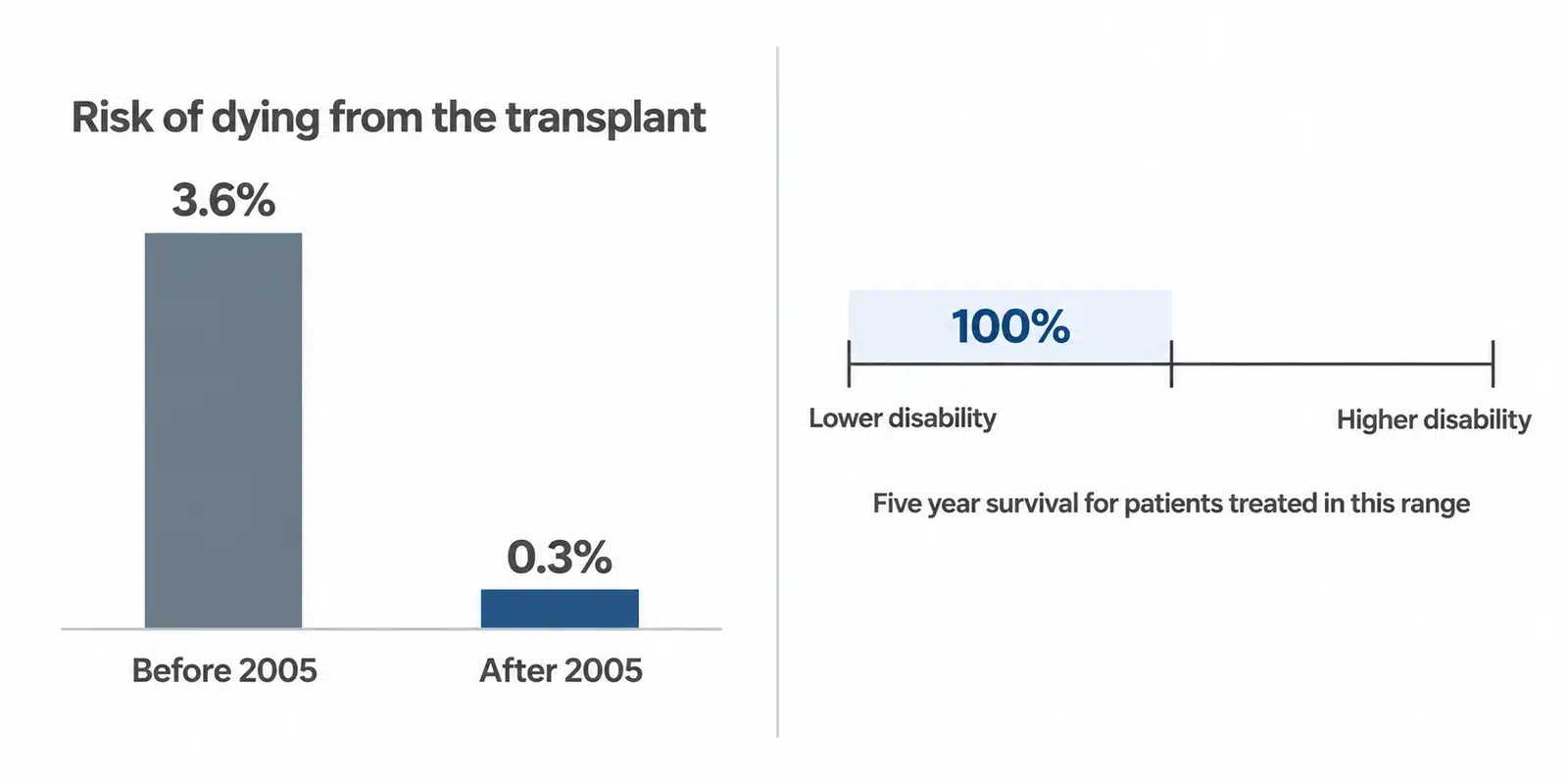
Where the risk sits is as important as the size of it. In the United Kingdom cohort of 364 patients, five year survival was 100 per cent for patients with an EDSS of 4.5 or below, and every death occurred in patients treated at an EDSS of 6.0 or above. That same United Kingdom series reports transplant related mortality of 1.4 per cent across 2002 to 2023, all of it in patients with advanced disability. Being assessed earlier, at a lower level of disability, is the single largest factor a patient can influence.
One caution on higher figures found elsewhere. They usually come from pooled analyses counting all deaths across several years of follow up, drawn from studies going back to the 1990s and including the high intensity regimens no longer used in MS. Those are not comparable with the 0.3 per cent figure, which counts deaths caused by the transplant itself.
Is It Right to Call It Chemotherapy for MS
Yes. The transplant guidelines call it conditioning chemotherapy, and the two largest United Kingdom MS charities use the word without hedging. Four things separate it from what a patient pictures when they hear the word.
- It is one treatment, not repeated cycles over months and years.
- The target is the immune system, not a tumour.
- One of the two main drugs, the ATG, is an antibody rather than chemotherapy.
- The regimen now used in almost every case does not destroy the bone marrow.
HSCT for MS at HSCT Hospital India
We treat multiple sclerosis patients at a JCI-USA accredited hospital in New Delhi that also holds NABH and NABL accreditation. Our doctors have treated more than 1500 MS patients, and patients come to us from 30 countries. The waiting list is short.
The all inclusive price is USD 30,000. That package covers a 30 day stay for the patient and one attendant, a deluxe private room with triple HEPA filtration, all hospital fees, all doctor fees, all medicines and all tests. The price is quoted before you travel and nothing is added later. Our HSCT cost by country comparison sets the same procedure against prices in Mexico, Russia and the USA, and what the treatment package includes lists it line by line.
An HSCT case manager reviews your medical history and tells you whether HSCT is appropriate for your form of MS, measured against the published thresholds in our HSCT eligibility criteria. Relapsing remitting, secondary progressive and primary progressive disease are all assessed. Patients who have been through it describe the experience in our patient testimonials.
Frequently asked questions about chemotherapy in HSCT
Will I lose my hair?
Almost certainly, and it grows back. The MS Trust puts regrowth at between one and six months, sometimes a slightly different colour or texture. It is treated as an expected effect rather than a complication, which is why the published trials do not even count it as an adverse event.
Is this the same chemotherapy that cancer patients have?
Some of the same drugs, used for a different purpose and at a different intensity. Cyclophosphamide is used in cancer treatment and in HSCT for MS. The regimens built on total body irradiation or busulfan, used in some cancer transplants, are not recommended for multiple sclerosis at all.
How long will I be in hospital?
Thirty days at HSCT Hospital India, covering the whole programme from mobilisation to reinfusion and the recovery that follows. How it works sets out each stage.
Will the chemotherapy affect my fertility?
It can, and it is a conversation to have before treatment rather than after. Fertility preservation should be discussed beforehand. It is not absolute: in a study of 38 women treated with this regimen at a median age of 28, seven became pregnant afterwards, six of them spontaneously.
Does having primary progressive MS rule me out?
Not here. Relapsing remitting, secondary progressive and primary progressive disease are all assessed on the individual case. Jukka, from Finland, has primary progressive MS and was treated in New Delhi.
Is it safer to go sooner?
The published data says yes. Five year survival in the United Kingdom series was 100 per cent for patients treated at an EDSS of 4.5 or below, and every death occurred in patients treated at 6.0 or above. The EDSS score calculator works out where you currently sit.
Where else is this done, and how does India compare?
Centres run HSCT for MS across Europe, Mexico, Russia, Israel and Singapore. Our guide to HSCT hospitals and medical centres worldwide compares them, and the cost by country guide compares the price.
Talk to HSCT Hospital India
HSCT Hospital India is a JCI-USA accredited hospital in New Delhi, accredited alongside NABH and NABL. More than 1500 multiple sclerosis patients have already been treated there, and patients come from 30 countries. Treatment is given in a deluxe private room with triple level HEPA air filtration, at one all inclusive price of 30,000 USD, with no long waiting list.
A world class team of HSCT specialists reviews each case and gives a free expert opinion on whether HSCT is suitable. There is no cost and no obligation. An HSCT case manager answers every enquiry, free of charge.
- HSCT for multiple sclerosis: the full treatment guide
- HSCT eligibility criteria: who is assessed, and against what
- EDSS score calculator
- HSCT cost compared by country
- What the HSCT treatment package includes
- All HSCT treatment guides by condition
- About HSCT Hospital India
- Patient stories and video testimonials
Popular Posts