CIDP Treatment Options: IVIG, Steroids, New Drugs and HSCT
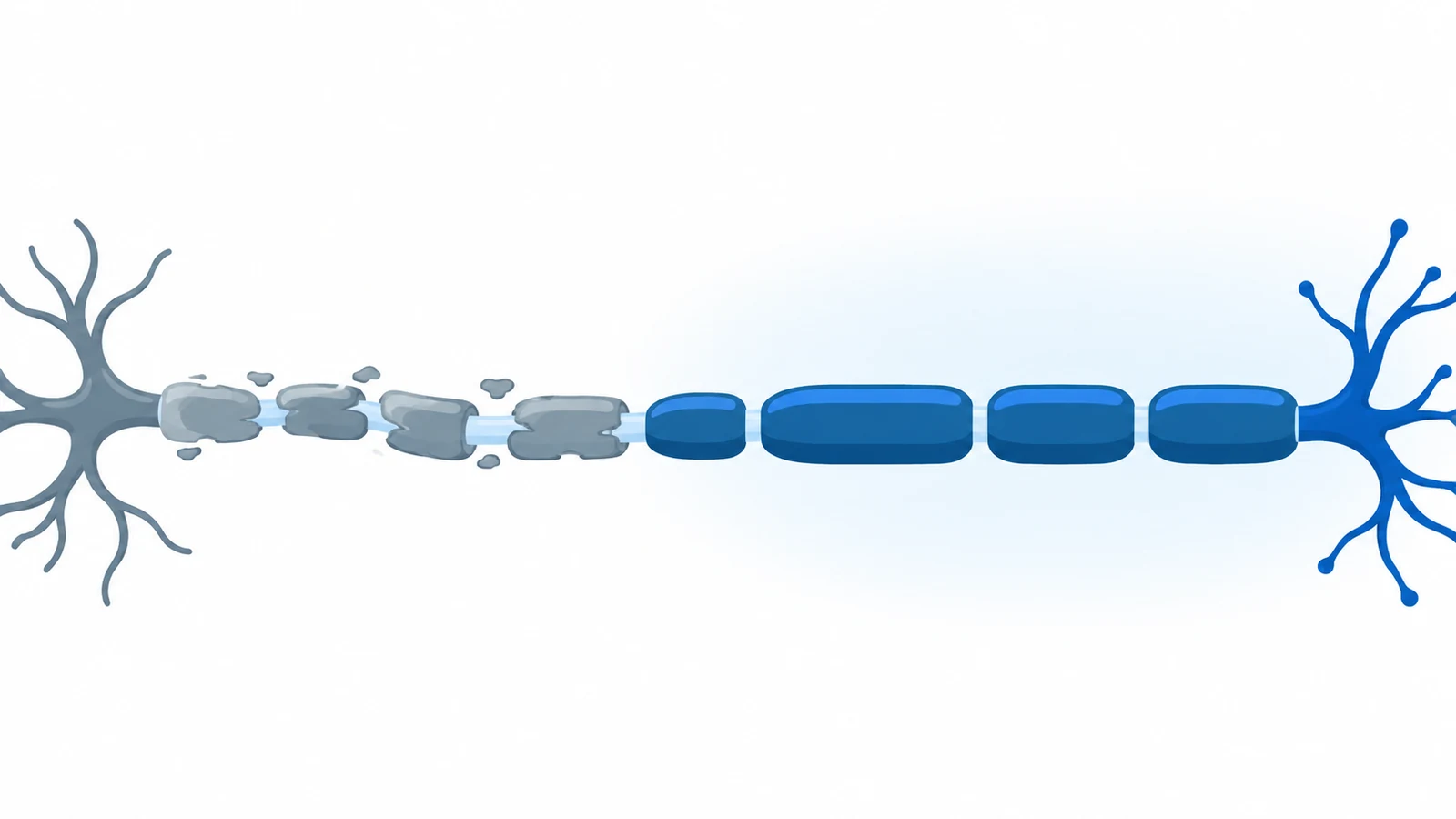
CIDP, chronic inflammatory demyelinating polyradiculoneuropathy, is treated with immunoglobulin, steroids, plasma exchange, newer drugs that lower antibody levels such as efgartigimod, immune suppressing drugs, and autologous haematopoietic stem cell transplantation (HSCT). The drug treatments control the immune attack on the nerves, and about 40 per cent of patients who respond need to keep taking treatment to stay well. HSCT resets the immune system with the patient’s own stem cells and aims for remission without ongoing treatment.
Most patients start on immunoglobulin or steroids and do well. A substantial group stays on repeat infusions for years, and a smaller group is not controlled by any of them. The CIDP treatment guide covers symptoms and diagnosis, and CIDP prognosis and life expectancy covers the long term outlook.
How is CIDP treated?
CIDP is treated first with intravenous immunoglobulin (IVIG) or corticosteroids, with plasma exchange when both fail. That order is set by the joint guideline of the European Academy of Neurology and the Peripheral Nerve Society, last revised in 2021, which strongly recommends all three. For motor CIDP, where weakness dominates without sensory loss, the guideline advises considering IVIG first, because steroids can make motor CIDP worse.
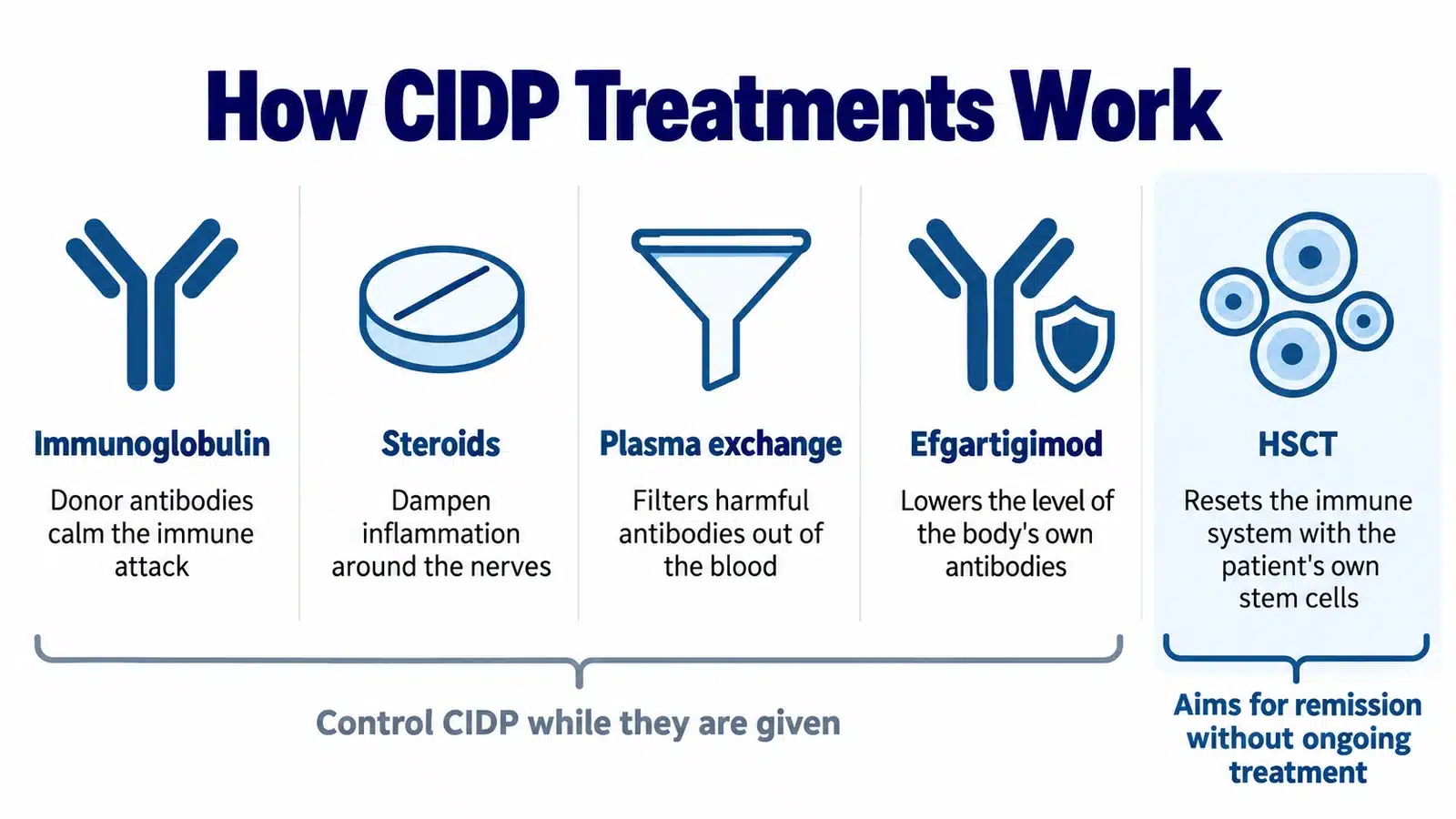
| Treatment | How it is given | How long it continues |
|---|---|---|
| IVIG | Infusion into a vein over several hours | Every 2 to 6 weeks as maintenance, for as long as the disease needs it |
| Subcutaneous immunoglobulin | Under the skin, usually at home | Weekly maintenance |
| Corticosteroids | Tablets daily, or high dose pulses by mouth or into a vein | Courses of months |
| Plasma exchange | Blood plasma is filtered through a machine | Short courses, repeated when the effect wears off |
| Efgartigimod | Injection under the skin | Once weekly, ongoing |
| Autologous HSCT | The patient’s own stem cells, after conditioning treatment | One treatment programme, a 30 day stay at HSCT Hospital India |
What is IVIG and how well does it work for CIDP?
IVIG, a concentrate of antibodies pooled from thousands of blood donors, improved disability in 54 per cent of CIDP patients in the ICE trial, against 21 per cent on placebo. It calms the immune attack on the nerves, and it is the most studied CIDP treatment.
The ICE trial was published in Lancet Neurology in 2008, and the patients who improved held that improvement to week 24. The 2013 Cochrane review of the randomised trials found that about three people need to be treated for one extra person to improve.
The usual starting dose is 2 g per kg of body weight, divided over two to five days. The maintenance dose used in the ICE trial, 1 g per kg every three weeks, is often treated as the standard. The guideline advises using the lowest dose and longest gap that holds the improvement, for example 0.4 to 1 g per kg every two to six weeks, and checking every 6 to 12 months whether the dose can be reduced or stopped. In ICE, serious side effects occurred in 0.8 per cent of IVIG infusions, against 1.9 per cent of placebo infusions.
What does long term IVIG involve?
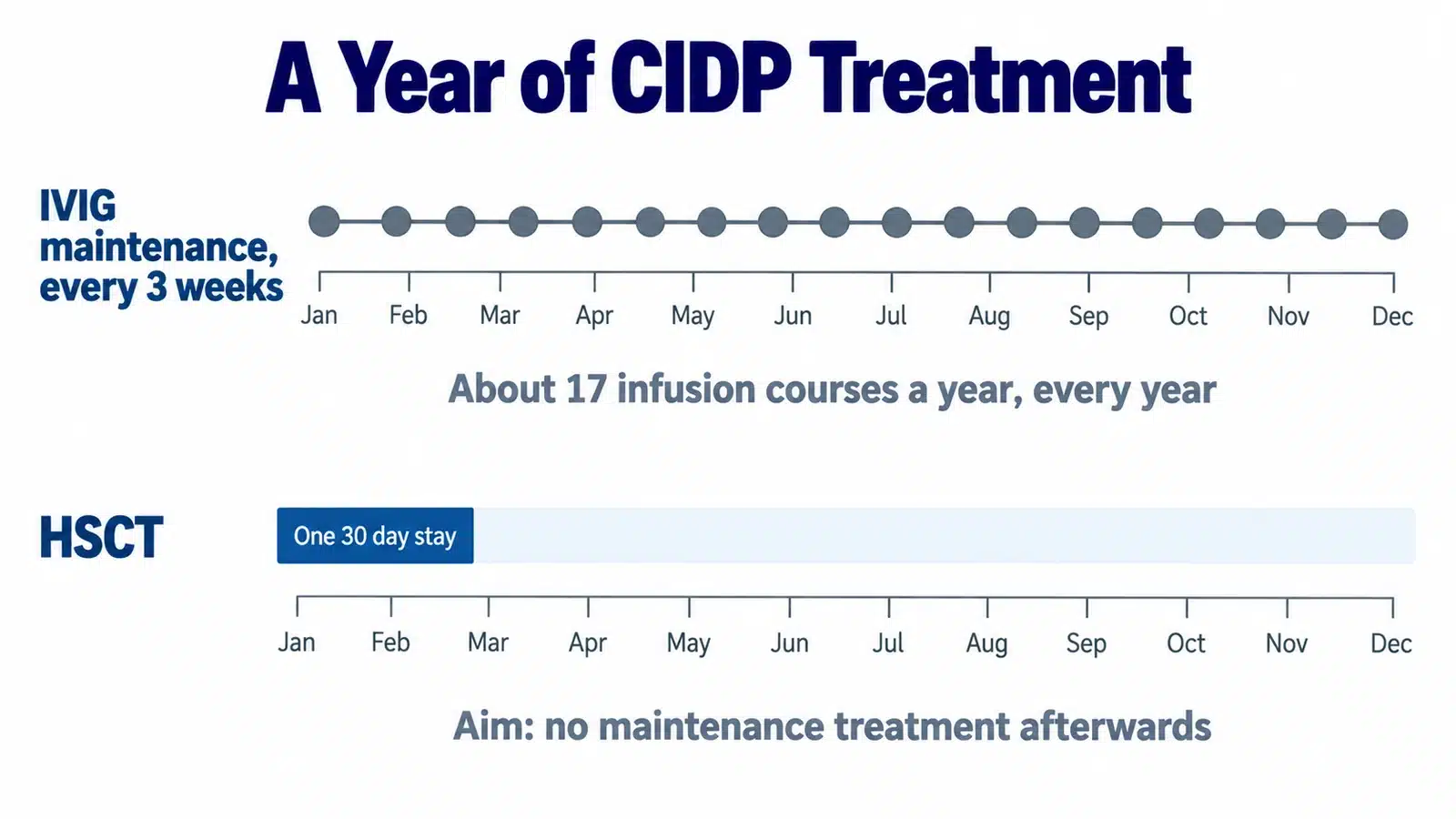
Long term IVIG usually means regular infusion courses for years. About 40 per cent of patients who respond to treatment remain dependent on it and relapse when it is stopped, according to a 2014 study in the Journal of Neurology, Neurosurgery and Psychiatry. The authors of the PATH trial, counting all CIDP patients rather than only those who respond, write that approximately two thirds need long term immunoglobulin.
At the trial schedule of one course every three weeks, that is about 17 infusion courses a year. Stopping is tried regularly: in a 2022 Dutch study published in Brain, 41 per cent of patients stayed stable 24 weeks after IVIG was stopped, and of those who worsened, 94 per cent were stable again within 12 weeks of restarting. The same experience with IVIG in small fibre neuropathy is described separately.
The cost is carried every year. A UK study put the annual cost for a patient on IVIG at GBP 49,430, using 2008 data. A 2026 Spanish analysis put IVIG maintenance at EUR 109,213 a year in 2024 prices.
A patient who has needed IVIG every few weeks for years, or who relapses each time the dose is lowered, can ask HSCT Hospital India whether a single 30 day HSCT programme suits their CIDP. The answer comes as a free expert opinion, with no cost and no obligation.
Can immunoglobulin be given at home?
Yes. Subcutaneous immunoglobulin (SCIG) is given under the skin, usually weekly, and can be given at home. The 2021 guideline strongly recommends it for maintenance and states no preference between IVIG and SCIG.
The PATH trial, published in Lancet Neurology in 2018, moved 172 patients who were stable on IVIG onto weekly SCIG or placebo. Relapse or withdrawal from the study occurred in 63 per cent on placebo, 39 per cent on the lower dose and 33 per cent on the higher dose. The US Food and Drug Administration approved Hizentra for CIDP maintenance on 15 March 2018, and HyQvia on 12 January 2024.
SCIG changes where and how immunoglobulin is given. It remains a treatment that continues for as long as the disease is active.
How do steroids compare with IVIG?
Steroids cost far less than IVIG and helped fewer patients in a head to head trial, but those who responded stayed well for longer after stopping. They are the other first treatment the guideline strongly recommends.
The IMC trial, published in Lancet Neurology in 2012, compared intravenous methylprednisolone with IVIG over six months. 52 per cent of patients stopped methylprednisolone early, against 13 per cent who stopped IVIG. The follow up study, published in 2015, found that 87.5 per cent improved on IVIG against 54.2 per cent on methylprednisolone. Most responders to either drug worsened eventually after stopping, 85.7 per cent after IVIG and 76.9 per cent after methylprednisolone, but those who responded to steroids stayed well longer: a median of 14 months before worsening, against 4.5 months after IVIG.
In the PREDICT trial of 40 newly diagnosed patients, the trial’s measure of remission at 12 months, a set level of improvement in mobility and disability, was reached by 10 of 24 patients on monthly pulsed dexamethasone and 6 of 16 on daily prednisolone, a difference too small to favour either. Long courses of steroids carry well known effects on bone strength, blood sugar and blood pressure.
When is plasma exchange used?
Plasma exchange is used when IVIG and steroids have not worked, where the 2021 guideline strongly recommends it. It removes the liquid part of the blood, which carries the harmful antibodies, and replaces it.
It works quickly. In a sham controlled trial published in Brain in 1996, 12 of the 15 patients who completed the trial, 80 per cent, improved substantially. The effect fades quickly too: 8 of those 12 relapsed within 7 to 14 days of the exchanges stopping. In the largest observational study, 3.9 per cent of plasma exchange sessions had complications.
What is efgartigimod (Vyvgart Hytrulo)?
Efgartigimod, sold in the United States as Vyvgart Hytrulo, is a weekly injection under the skin that helps the body clear its own IgG antibodies faster. The US Food and Drug Administration approved it for CIDP on 21 June 2024. It blocks a receptor called FcRn, which normally recycles antibodies in the body, so antibody levels fall, including any that contribute to the nerve damage.
In the ADHERE trial, published in Lancet Neurology in 2024, 322 patients received efgartigimod openly and 214 of them, 66 per cent, improved. The responders were then split between efgartigimod and placebo. Relapse occurred in 27.9 per cent on efgartigimod against 53.6 per cent on placebo, a 61 per cent lower risk. Serious side effects occurred in 5 per cent of patients in both groups.
The European Commission approved the injection, sold in Europe as Vyvgart, for progressive or relapsing active CIDP after prior steroids or immunoglobulin, on 19 June 2025. Efgartigimod is also used in myasthenia gravis, another antibody driven condition. Like immunoglobulin, it is a continuing treatment, given weekly.
What other drugs are used for CIDP?
Azathioprine, mycophenolate, ciclosporin, cyclophosphamide and rituximab may be considered when first line treatment is not enough. The 2021 guideline rates the evidence for the drugs it allows as very low certainty.
- Azathioprine, mycophenolate or ciclosporin may be considered to reduce the dose of IVIG or steroids.
- Cyclophosphamide, ciclosporin or rituximab may be considered when IVIG, steroids and plasma exchange have all failed.
- Methotrexate is weakly recommended against, and interferon beta 1a strongly recommended against.
Rituximab is the most discussed of these. The first placebo controlled trial, published in Brain in 2025, gave rituximab or placebo to 37 patients before their immunoglobulin was stopped and found no benefit: 63.2 per cent worsened on rituximab against 66.6 per cent on placebo. It is used in autoimmune nodopathy, a condition once grouped with CIDP and caused by antibodies against proteins at the nodes of Ranvier, the small gaps in the myelin coating along each nerve fibre, where the guideline says rituximab may be effective.
What new treatments for CIDP are in trials?
Riliprubart, empasiprubart and claseprubart are in phase 3 trials for CIDP and nipocalimab in a combined phase 2 and 3 trial, according to ClinicalTrials.gov as of September 2026. None is approved for CIDP yet.
| Drug | Trial | Stage |
|---|---|---|
| Riliprubart | MOBILIZE, and VITALIZE against IVIG | Phase 3 |
| Empasiprubart | Against IVIG, and against placebo | Phase 3 |
| Claseprubart (DNTH103) | CAPTIVATE | Phase 3 |
| Nipocalimab | Against placebo | Phase 2 and 3 |
Riliprubart, empasiprubart and claseprubart all target the complement system, part of the immune response that damages the nerve. Nipocalimab, like efgartigimod, blocks FcRn. None of these phase 3 trials had published results in CIDP by September 2026.
Patients weighing efgartigimod, or a place in one of these trials, against HSCT can ask HSCT Hospital India for a free expert opinion on whether HSCT fits their CIDP. An HSCT case manager answers free of charge.
Who is considered for HSCT for CIDP?
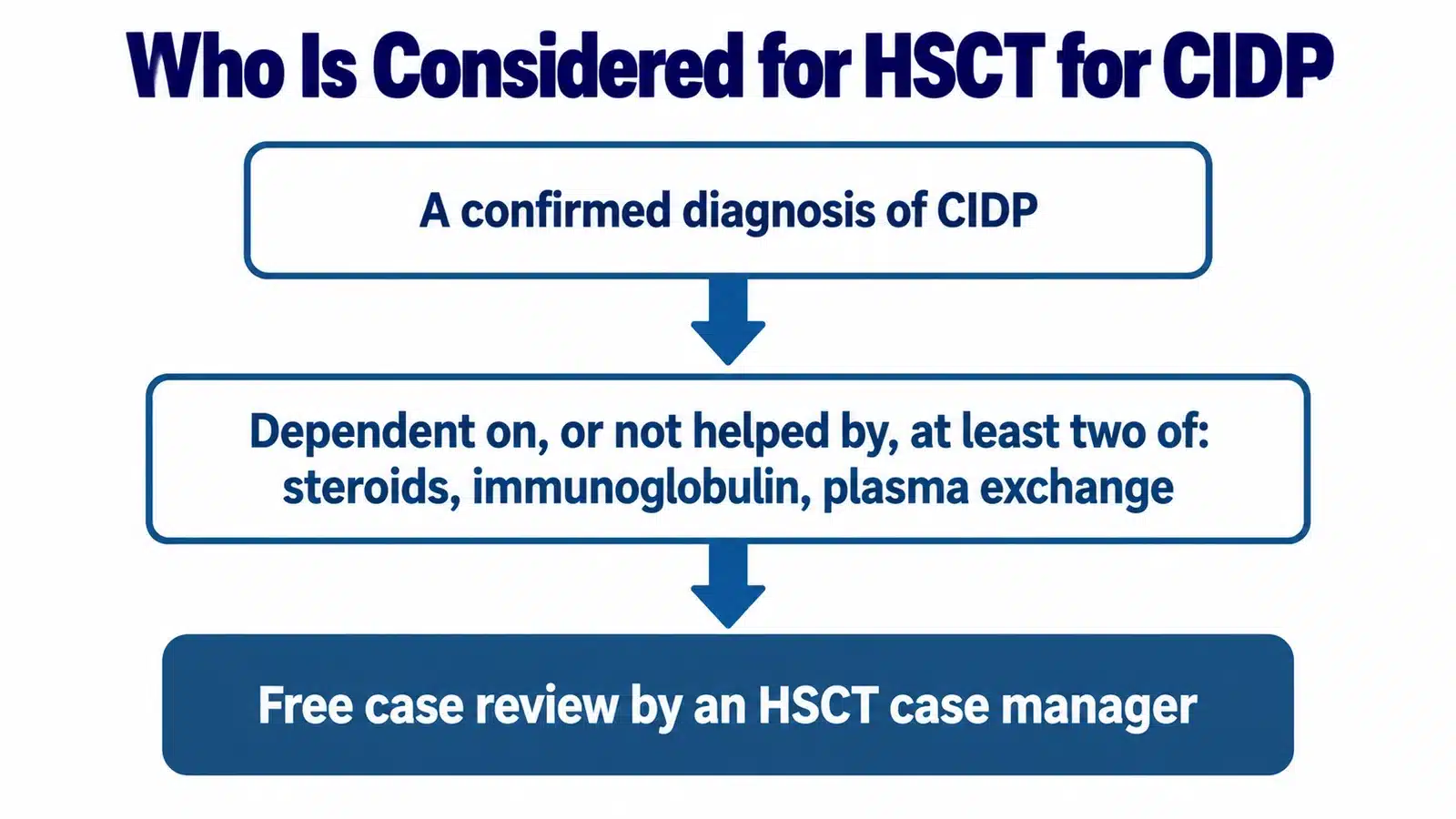
HSCT is considered for patients with confirmed CIDP who remain dependent on, or have not been helped by, standard treatment. In the largest published series, from Northwestern University in Chicago, patients qualified if they were dependent on or had failed at least two of the three standard treatments: steroids, immunoglobulin and plasma exchange.
The European Society for Blood and Marrow Transplantation lists treatment resistant CIDP as a clinical option for autologous HSCT. The 2021 neurology guideline finds the evidence insufficient so far, notes significant side effects and a risk of death, and advises HSCT only as a last resort option in specialised CIDP centres. That is the group HSCT Hospital India assesses. The diagnosis is confirmed again before HSCT is offered, because some patients labelled with CIDP turn out to have a different neuropathy, and each patient’s overall health is assessed before treatment and monitored throughout the stay, including for infection and virus reactivation. The HSCT for CIDP programme sets out the process for CIDP patients. The HSCT eligibility criteria set out the thresholds.
What results has HSCT shown in CIDP?
In the largest published series, from Northwestern University, 80 per cent of CIDP patients were off all CIDP treatment one year after HSCT and 83 per cent at five years, with no treatment related deaths and overall survival of 97 per cent. The series, published in the Journal of Neurology in 2020, treated 66 patients and analysed 60 of them, each followed for between two and five years. Every one had already failed or become dependent on standard treatment. Before HSCT, 33 per cent could walk without help; after it, 81 to 86 per cent could in each of the five years. The patients were conditioned with cyclophosphamide, rabbit antithymocyte globulin and rituximab. Eleven of the 60, 18 per cent, later restarted IVIG, plasma exchange or rituximab.
Smaller series point the same way. In Sweden, 8 of 11 patients were in drug free remission after HSCT. In Canada, all five treatment resistant patients came off their CIDP drugs, with no treatment related deaths. A 2023 meta analysis in the European Journal of Neurology included 89 patients from 11 studies; in the four studies that measured response, 87 per cent responded, and 81 per cent were free of all immune modulating or suppressive drugs. The year by year figures are set out in CIDP prognosis and the HSCT evidence.
How does HSCT for CIDP work?
HSCT for CIDP runs in four stages over one 30 day stay: Mobilisation, Harvest (Leukapheresis), Conditioning and Reinfusion of the patient’s own stem cells.
- Mobilisation. A growth factor moves the patient’s own blood stem cells out of the bone marrow and into the bloodstream.
- Harvest (Leukapheresis). The stem cells are collected from the blood and frozen.
- Conditioning. Chemotherapy and antibody treatment clear out the existing immune system, including the cells that damage the nerves.
- Reinfusion. The stored stem cells are returned and rebuild the immune system over about two weeks.
Patients stay in a deluxe private room with triple level HEPA air filtration while the new immune system recovers. How it works sets out each stage, and what HSCT is explains the procedure from the beginning. The same treatment is used for multiple sclerosis, where the randomised trial evidence is strongest, and for other conditions in the guide to HSCT for autoimmune diseases.
HSCT for CIDP at HSCT Hospital India
We treat CIDP at a JCI-USA accredited hospital in New Delhi, accredited alongside NABH and NABL. More than 1500 MS patients have been treated here, patients reach us from 30 countries, and our waiting list is short.
One all inclusive price of USD 30,000 covers the patient and one attendant for the full 30 day stay, with a deluxe private room, triple HEPA air filtration, every hospital and doctor fee, every medicine and every test included. We quote it before travel and add nothing later. Our HSCT cost by country comparison places that price beside Mexico, Russia and the USA, and what the treatment package includes lists it line by line.
Our patient testimonials include Dylan, treated for autoimmune small fibre neuropathy, another condition in which the immune system attacks the peripheral nerves. The medical team page introduces the specialists behind each opinion.
For CIDP patients whose disease, like that of the Northwestern patients, still depends on or has not responded to at least two of steroids, immunoglobulin and plasma exchange, our world class team of HSCT specialists gives a free expert opinion on whether HSCT suits their case. An HSCT case manager answers every question free of charge, with no obligation.
Frequently asked questions about CIDP treatment
What is the newest treatment for CIDP?
Efgartigimod, approved in the United States on 21 June 2024 as Vyvgart Hytrulo and in Europe on 19 June 2025. It is a weekly injection under the skin that lowers the level of the body’s own antibodies. Riliprubart, empasiprubart and claseprubart are in phase 3 trials.
What is the best treatment for CIDP?
The guideline recommends IVIG or steroids first, and most patients respond to one of them. The choice depends on the form of CIDP, other health conditions and how the patient responds. For patients who stay dependent on treatment, HSCT is studied as a single treatment programme aimed at remission without ongoing drugs, and in the Northwestern series 83 per cent were off all CIDP treatment at five years.
Can CIDP be treated without IVIG?
Yes: steroids are recommended as an equal first choice to IVIG, except in motor CIDP. Plasma exchange, subcutaneous immunoglobulin and efgartigimod are further options, and HSCT is considered for patients who remain dependent on, or have not been helped by, standard treatment.
What medications are used for CIDP?
The main medications are immunoglobulin, given into a vein or under the skin, corticosteroids such as prednisolone, dexamethasone and methylprednisolone, and efgartigimod. Azathioprine, mycophenolate, ciclosporin, cyclophosphamide and rituximab are used when those are not enough. Plasma exchange is a procedure rather than a medication.
Can HSCT replace IVIG for CIDP?
For many patients in the published series, yes. In the 60 patient Northwestern series, 80 per cent were off all CIDP treatment one year after HSCT and 83 per cent at five years, with no treatment related deaths. For a patient on IVIG today, a free expert opinion from HSCT Hospital India assesses whether HSCT could take its place, at no cost and with no obligation. HSCT for CIDP in India sets out the programme for CIDP patients.
Where else is HSCT for CIDP carried out?
Centres in the United States, Sweden, Canada and Mexico have published CIDP results. The guide to HSCT hospitals and medical centres worldwide compares centres in the United States, Canada and Mexico, and the cost by country guide compares the price.
Talk to HSCT Hospital India
Its accreditations are JCI-USA, NABH and NABL. Over 1,500 patients with multiple sclerosis have been treated at the hospital, from 30 countries. Every stay is priced at one all inclusive USD 30,000, fixed before travel, with no long waiting list.
Patients and families deciding between another year of IVIG, a newer drug and HSCT can ask for one free expert opinion covering their whole CIDP history. A world class team of HSCT specialists reviews each case, and an HSCT case manager answers every enquiry, with no cost and no obligation.
- CIDP: the full treatment guide
- CIDP prognosis, progression and life expectancy
- HSCT eligibility criteria: who is assessed, and against what
- HSCT for myasthenia gravis
- HSCT for small fibre neuropathy
- HSCT for stiff person syndrome
- HSCT cost compared by country
- What the HSCT treatment package includes
- All HSCT treatment guides by condition
- About HSCT Hospital India
- Patient testimonials
Popular Posts