CIDP Prognosis: Progression, Stages, Life Expectancy and Whether CIDP Can Be Cured
CIDP stands for chronic inflammatory demyelinating polyradiculoneuropathy. The immune system attacks the myelin covering of the peripheral nerves, and weakness and numbness build up over at least two months.
The published prognosis is better than most newly diagnosed patients expect. Mortality in CIDP is not raised above the general population. About a quarter of patients reach lasting remission off all treatment within five years. Stem cell transplant has been studied in the smaller group that stays dependent on repeat treatment. Our CIDP treatment guide covers diagnosis, symptoms and eligibility.
What is the usual course of CIDP?
CIDP follows three recognised patterns. About half of all cases follow the typical presentation, with symmetrical weakness in the arms and legs. Roughly one third follow a relapsing and remitting course, with attacks separated by recovery. Around 15% follow a course of continuous steady progression.
A population based study in Iceland tracked all 19 diagnosed cases in the country over 21 years. The course was relapsing and remitting in 21% and chronic progressive or single-episode in 79%, and many patients had no or only limited progression over an average 6.9 years of follow-up. Younger patients more often follow the relapsing and remitting course, and men are affected roughly twice as often as women.
Does CIDP get worse over time?
In treated patients, most do not. A five year follow-up of 38 CIDP patients in the Journal of Neurology, Neurosurgery and Psychiatry recorded what happened after immune treatment was started. Ten patients (26%) reached complete remission, defined as lasting more than two years with normal nerve test results. Twenty-three patients (61%) reached partial remission and were able to walk, 34% of them without any ongoing immune treatment and 26% with it. Five patients (13%) were left unable to walk, or relapsed every time treatment was reduced.
The same cohort reported that 39% still required immune treatment at five years. Across the wider literature, 54% of CIDP patients experience severe disability at some point, most often before treatment is optimised.
Progression is the exception once treatment is working.
What are the stages of CIDP, and is there a final stage?
CIDP has no staging system. There is no stage 1, stage 2 or stage 4, and no defined final stage. Neurologists describe the course pattern instead, and they measure lost function on scales such as the INCAT disability score and the MRC sum score for muscle strength.
The phrase “final stages” belongs to diseases with a predictable terminal course, and CIDP is not classified as a terminal illness. What changes over years is the amount of permanent nerve fibre damage.
Is CIDP fatal?
The published evidence says no for the great majority of patients. The Icelandic population study calculated a standardized mortality ratio of 0.9 over its 21 year period. A ratio of 1.0 means death rates identical to the general population.
CIDP attacks the peripheral nerves and does not attack the brain, the heart or the lungs. Deaths recorded in CIDP cohorts are usually linked to complications of severe immobility or to long term immune suppressing drugs.
What is the life expectancy with CIDP?
Life expectancy in chronic inflammatory demyelinating polyneuropathy, the condition CIDP stands for, is in line with the general population. The Icelandic mortality ratio of 0.9 is the clearest population level figure available, and no large cohort study has shown shortened survival. CIDP treatment is aimed at protecting function. The GBS CIDP Foundation International and the US National Institute of Neurological Disorders and Stroke both describe CIDP as treatable, and early diagnosis prevents severe disability.
Is CIDP curable?
No treatment for CIDP is described in the medical literature as a cure. The word used in every published cohort is remission.
Remission means the disease is inactive and the patient needs no treatment to stay that way. Relapse after remission remains possible. A cure would mean the immune system no longer carries the fault that caused the nerve damage, and no published CIDP trial has demonstrated that outcome.
Immunoglobulin, steroids and plasma exchange suppress the immune attack while they are being given. The 2024 Cochrane review of intravenous immunoglobulin pooled nine randomised trials with 372 participants, and found that IVIG more than doubles the chance of meaningful improvement in disability within six weeks, with a number needed to treat of 4. Those drugs lower disease activity and leave the underlying autoimmune process in place.
How many people with CIDP stay on treatment for life?
Roughly two thirds of patients respond initially to any single standard therapy, and about 80% respond to IVIG. Between 10% and 15% resist every standard treatment. Reported relapse rates run at about 45% after IVIG, about 50% after corticosteroids and about 67% after plasma exchange.
In 86 CIDP patients treated with IVIG, long term follow-up found 25.6% in remission, 65.1% stable on continuing treatment and 9.3% non-responders. Response can be slow, with a median time to response of 15 weeks in the PRISM study.
What happens when IVIG stops working?
Two different situations get described the same way. In the first, the patient never responded adequately. In the second, the effect has faded after years of benefit, or the gap between infusions keeps shortening.
A Dutch randomised withdrawal trial published in Brain enrolled 60 patients who had been stable on maintenance IVIG for at least six months. After withdrawal, 41% remained stable at 24 weeks and 28% were still stable at the end of the 52 week extension phase. Of those who did relapse, 94% were restabilised within 12 weeks on their previous treatment.
Observational data suggest that more than 30% of patients who fail first line therapies respond to drugs such as rituximab or cyclophosphamide. We have written separately about what to do when IVIG stops working, and about the overlap between CIDP and small fibre neuropathy. Every current option, from immunoglobulin and steroids to efgartigimod and the drugs now in trials, is compared in CIDP treatment options.
What drives long term disability in CIDP?
Two things drive it: nerve fibre loss and the delay before treatment starts. Myelin damage can be repaired. Nerve fibre loss is permanent.
A study in Clinical Neurophysiology followed 14 CIDP patients for 11 to 28 years. The nerve fibre loss present before any treatment strongly predicted disability decades later, while the amount of myelin damage did not. A larger study of 30 patients followed for 5 to 28 years reached the same finding, and the delay before treatment started predicted all three of its long term outcome scores.
Diagnostic delay is measurable. Among 60 consecutive patients at a UK specialist inflammatory neuropathy clinic, 68.3% had first been given a different diagnosis. In the 27 patients whose first diagnosis was something other than Guillain-Barre syndrome, mean diagnostic delay was 21.3 months. The German INHIBIT registry followed 30 patients and found that delay in starting treatment correlated with progression of nerve fibre damage.
Where does HSCT sit in CIDP treatment?
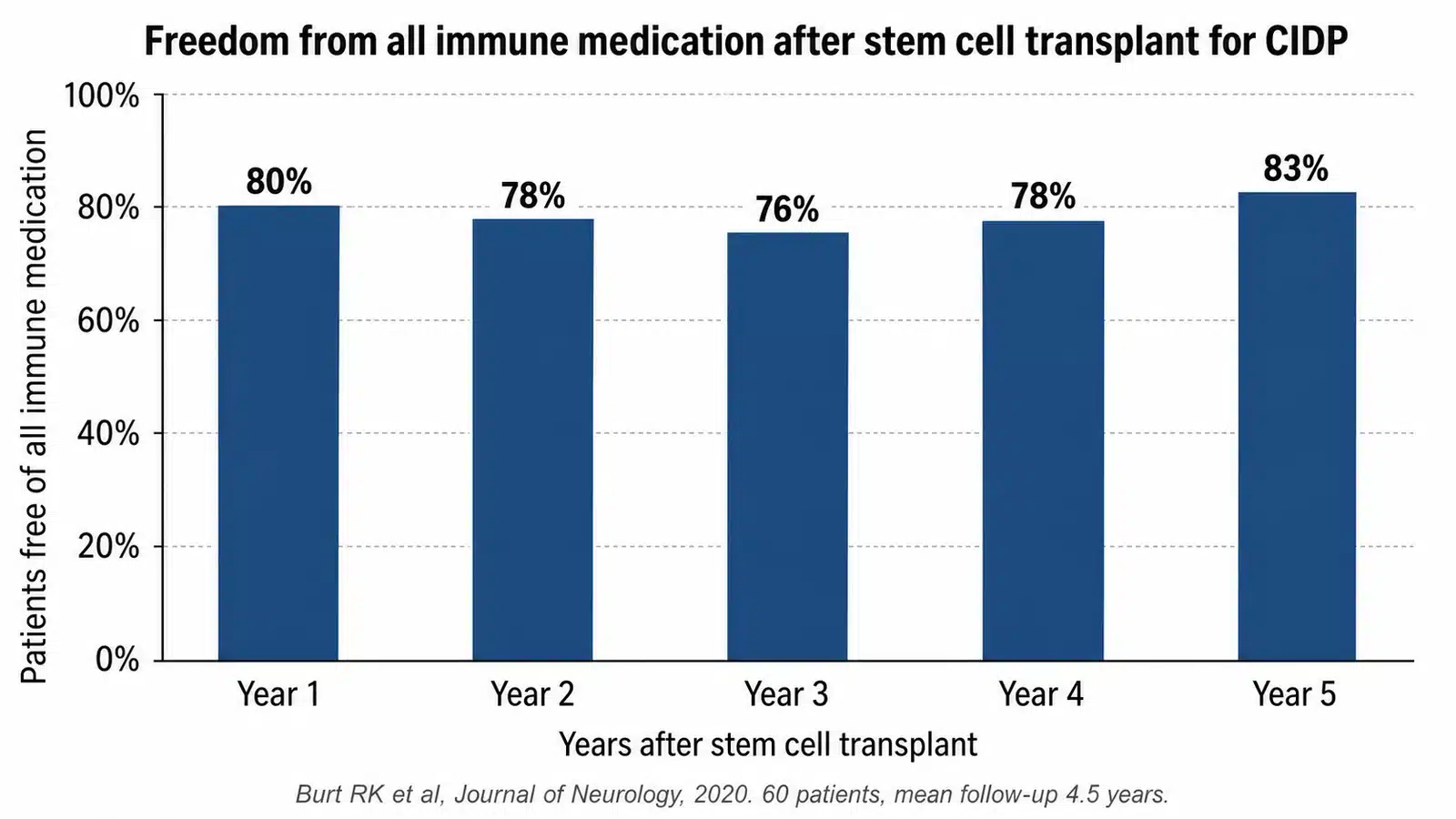
HSCT resets the immune system rather than suppressing it month after month. The largest published series comes from Northwestern University and appeared in the Journal of Neurology in 2020. Sixty-six patients who were dependent on, or had failed to respond to, IVIG or plasma exchange underwent HSCT, and 60 were analysed with a mean follow-up of 4.5 years.
Freedom from all immune medication was 80%, 78%, 76%, 78% and 83% at years 1 to 5. The proportion walking without assistance rose from 33% before transplant to between 81% and 86% across those five years. There were no treatment related deaths and overall survival was 97%. The authors stated that a randomised trial is now indicated.
A 2023 systematic review and meta-analysis in the European Journal of Neurology pooled 11 studies covering 89 CIDP patients treated with HSCT. Pooled responsiveness was 87.04% and pooled freedom from all immune suppressing drugs was 80.75%. A Canadian series in the Canadian Journal of Neurological Sciences followed five patients for a median of 41 months. All five came off CIDP immunotherapy and four improved markedly on muscle strength and disability scales. The fifth, who had long standing muscle wasting before transplant, showed no improvement.
| Measure | Standard immune treatment | Stem cell transplant (HSCT) |
|---|---|---|
| Largest published evidence | Cochrane review 2024, 9 randomised trials, 372 patients | Northwestern series 2020, 66 treated and 60 analysed |
| Free of all immune medication at 5 years | 26% in complete remission in a 38 patient cohort | 83% free of immune medication |
| Walking without assistance | 13% left unable to walk or relapsing on treatment reduction | Rose from 33% before transplant to 83% at year 5 |
| Treatment related deaths | Not a reported treatment risk | None in 66 patients, overall survival 97% |
| Status in the 2021 EAN/PNS guideline | Strongly recommended, first line and maintenance | Not among the recommended treatments |
Those figures come from different patient groups. Everyone in the transplant series was dependent on IVIG or plasma exchange, or had failed both, so that group started from a worse baseline. No randomised trial has compared HSCT against standard treatment in CIDP.
What do the CIDP guidelines say about HSCT?
The 2021 European Academy of Neurology and Peripheral Nerve Society guideline strongly recommends intravenous immunoglobulin, corticosteroids, subcutaneous immunoglobulin and plasma exchange. HSCT is not among the treatments it recommends. A UK specialist review in Practical Neurology summarised the position: the evidence for HSCT in treatment resistant CIDP remains insufficient, the risks of infection and long lasting low immunity are real, and HSCT should be used only in specialised centres after standard options.
HSCT for CIDP is therefore an option for people whose disease has not been controlled by standard treatment, supported by a large open series and a meta-analysis rather than by a randomised trial. Our guide to HSCT for autoimmune diseases covers the procedure, alongside the evidence in multiple sclerosis, where the randomised trial data are strongest.
HSCT for CIDP at HSCT Hospital India
We treat CIDP patients at a JCI-USA accredited hospital that also holds NABH and NABL accreditation. Our doctors have treated more than 1500 MS patients. The waiting list is short.
The all-inclusive price is USD 30,000. That package covers a 30 day stay for the patient and one attendant, a deluxe private room with triple HEPA filtration, all hospital fees, all doctor fees, all medicines and all tests. The full price is confirmed in writing before you book. Our HSCT cost by country comparison sets the same procedure against prices in Mexico, Russia and the USA.
An HSCT case manager reviews your medical history and tells you whether HSCT is appropriate for your form of CIDP. Patients who have been through it describe the experience in our patient testimonials. Get Free Expert Opinion Now.
Frequently asked questions about CIDP prognosis
Can CIDP go into remission without any treatment?
Remission without treatment happens in a minority of patients. In a five year follow-up of 38 CIDP patients, 34% were able to walk and remained in partial remission with no ongoing immune treatment. A Dutch trial found that 28% of patients on long term maintenance IVIG stayed stable after their infusions were stopped.
Does CIDP shorten life expectancy?
Published population data say it does not. A 21 year population based study in Iceland found a standardized mortality ratio of 0.9, with a 95% confidence interval of 0.3 to 2.2, and concluded that mortality in CIDP is not increased compared with the general population. CIDP is not classified as a terminal illness.
How long does it take to know whether IVIG is working?
Response takes longer than many patients are told. In the PRISM study the median time to response was 15 weeks, and only 29% of patients had responded by six weeks. The PRIMA and PRISM studies recorded overall response rates of 60.7% and 76.2%.
Can HSCT stop CIDP from coming back?
The published series report long drug free remission rather than a cure. In the 60 patient Northwestern series, 83% of patients were free of all immune medication five years after transplant, which means 17% were not. A 2023 meta-analysis of 89 patients reported pooled freedom from immune suppressing drugs of 80.75%.
Is it too late for HSCT if I have had CIDP for many years?
Length of illness matters less than how much nerve fibre has already been lost. Nerve fibre loss present before treatment predicted disability 11 to 28 years later in one long follow-up study, and myelin damage did not. An HSCT case manager reviews your recent test results and tells you the realistic outcome in your case. Get Free Expert Opinion Now.
Our full CIDP treatment guide covers diagnosis, eligibility and the HSCT process. StatPearls at the US National Library of Medicine publishes reference data on CIDP epidemiology and outcomes.
Popular Posts