Stem Cell Treatment for MS: Which One Has Evidence

“Stem cell treatment for MS” is used online to describe several different procedures, and only one of them has randomised trial evidence behind it. Knowing which is which protects both your money and your health.
People reach us after reading about stem cells for MS on forums, in news reports and on clinic websites. The same phrase gets applied to blood stem cell transplant, to mesenchymal cell infusions drawn from bone marrow or fat, and to cells derived from umbilical cord tissue. These are different procedures with different biology, different prices and very different levels of proof. This article separates them using published trials you can read yourself.
What does stem cell treatment for MS mean?
Stem cell treatment for MS covers any procedure that uses living cells rather than a drug to change the course of multiple sclerosis. The version tested in randomised trials is haematopoietic stem cell transplantation, shortened to HSCT, which uses your own blood forming stem cells to rebuild the immune system. Other approaches infuse mesenchymal cells harvested from bone marrow or fat tissue, or cells grown from umbilical cord tissue. Clinic websites often describe all of them with the same words.
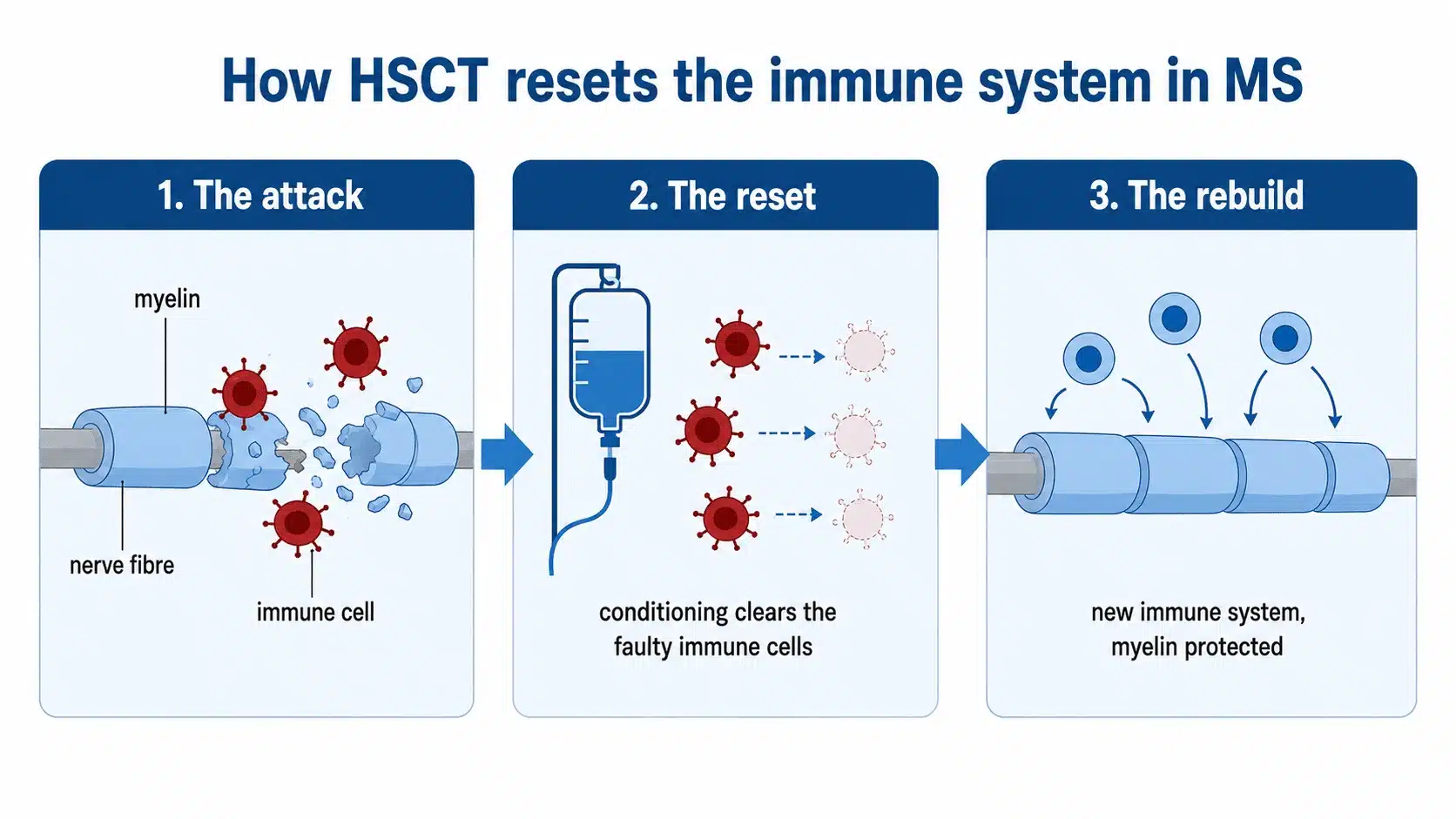
How does a stem cell transplant for multiple sclerosis work?
A stem cell transplant for multiple sclerosis works by clearing the immune cells that attack myelin, then rebuilding the immune system from stem cells taken from your own blood. MS damage occurs when immune cells strip the myelin coating from nerve fibres in the brain and spinal cord. Disease modifying drugs hold those cells back for as long as you keep taking them. HSCT clears them and restarts the immune system from cells collected from your own blood before treatment begins.
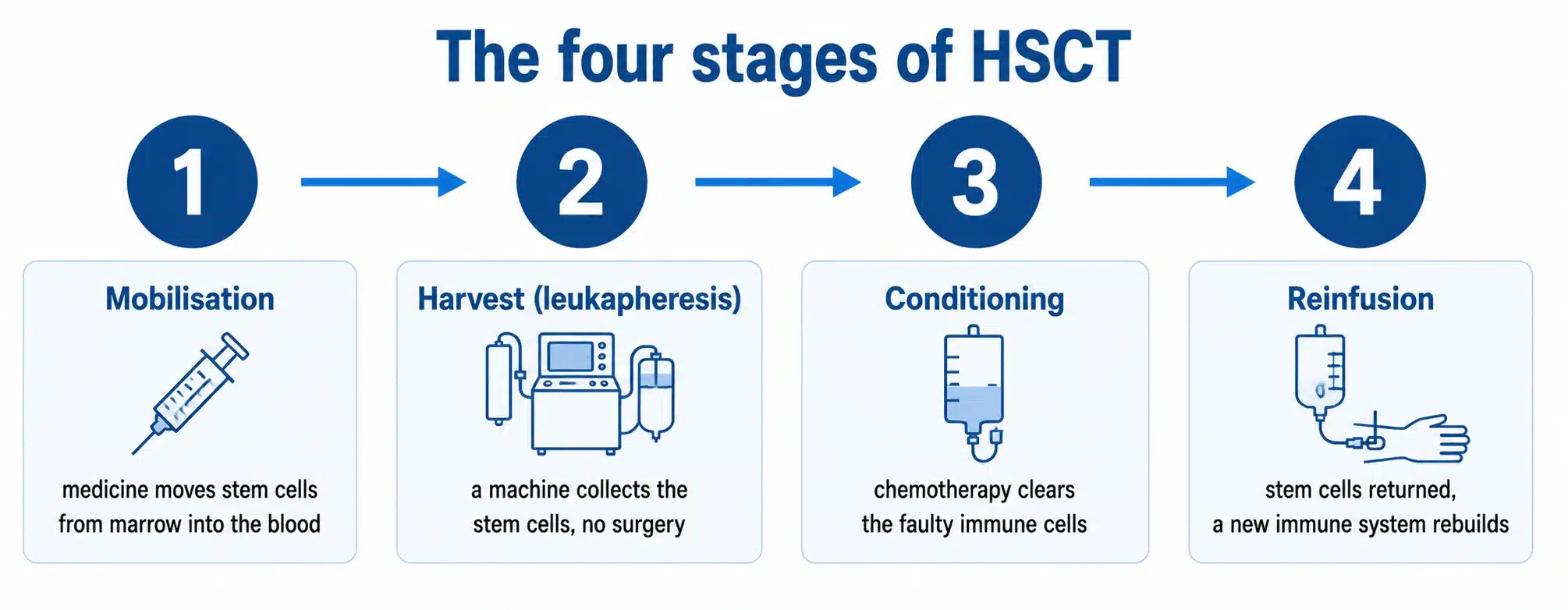
The procedure runs in four stages. Medicine moves stem cells from the marrow into the blood, a machine collects them without surgery, chemotherapy clears the faulty immune cells, and the collected cells are returned so a new immune system rebuilds. Because the cells come from your own body, there is no donor and no rejection risk. Our page on how HSCT works day by day sets out the full 30 day sequence.
Which stem cell therapy for MS has randomised evidence behind it?
HSCT is the stem cell therapy for MS that has been compared against active drug treatment in a randomised trial and come out ahead. The MIST trial, published in JAMA in 2019, randomised 110 people with relapsing remitting MS to either transplant or a disease modifying drug of higher efficacy than the one they were already taking. Disease progression occurred in 3 patients in the transplant group and in 34 patients in the drug group. Average disability scores fell from 3.38 to 2.36 in the transplant group during the first year and rose from 3.31 to 3.98 in the drug group. There were no deaths.
Mesenchymal cells have been put through the same kind of test. The MESEMS trial, published in Lancet Neurology in 2021, randomised 144 patients with active MS across 15 sites in nine countries to receive their own bone marrow derived mesenchymal cells or a placebo infusion. The infusions were safe and well tolerated. On the primary measure, the number of active lesions appearing on MRI over 24 weeks, the cell group and the placebo group scored the same. The authors concluded that the study does not support using bone marrow derived mesenchymal cells to treat active multiple sclerosis.
Umbilical cord derived cells sit earlier in the research pipeline. The published human work in MS is small and uncontrolled. One frequently cited 2014 report in Cell Transplantation followed 23 patients, of whom 13 received cord derived mesenchymal cells alongside steroid treatment while the other 10 received steroids alone, with no randomisation and no placebo. The US Food and Drug Administration sets out in its consumer alert which stem cell products carry approval in the United States. That list contains blood forming cells derived from umbilical cord blood, approved for disorders that affect the production of blood and not approved for any other use.
How do the treatments sold as stem cell treatment for MS compare?
Three distinct procedures are marketed under the phrase stem cell treatment for MS, and they differ in the cells used, in what happens to the immune system, and in the strength of the published evidence.
| Procedure | Cells used | What happens to the immune system | Randomised evidence in MS | Where it is done |
|---|---|---|---|---|
| HSCT, haematopoietic stem cell transplant | Your own blood forming stem cells, collected from your bloodstream | Chemotherapy clears the attacking immune cells, then the immune system rebuilds from the returned cells | MIST randomised 110 patients against drug therapy and reported 3 progressions after transplant against 34 on drugs | Hospital transplant units under haematology and neurology |
| Mesenchymal cell infusion | Mesenchymal cells taken from bone marrow or fat tissue | Cells are infused into the bloodstream and the existing immune system stays in place | MESEMS randomised 144 patients against placebo and found the same number of active MRI lesions in both groups | Research trials, and private clinics in several countries |
| Umbilical cord derived cell infusion | Cells grown from donated umbilical cord tissue or cord blood | Cells are infused into the bloodstream and the existing immune system stays in place | Published human studies in MS are small and uncontrolled, such as a 23 patient report from 2014 | Private clinics, and early stage research |
Who is suitable for stem cell treatment for MS?
The people who gain most from stem cell treatment for MS are younger, have relapsing remitting disease, have lived with MS for a shorter time and still walk independently. A 2026 real world study of 364 UK patients treated across 14 British centres reported relapse free survival of 94.6 per cent at two years and 88.6 per cent at five years. Progression free survival and disease free status were both significantly higher in the relapsing remitting group than in the progressive group. Disability improved in 24.2 per cent of relapsing remitting patients at two years.
Your disability score guides that judgement, and our page on the EDSS scale and what each score means explains how it is measured. The 2025 ECTRIMS and EBMT recommendations describe transplant as a treatment option for relapsing forms of MS that have not responded to disease modifying therapy. Our full guide to HSCT for multiple sclerosis covers the treatment itself. The thresholds applied at assessment, including the age and EDSS ranges and the imaging activity required in the preceding 12 months, are set out on the page on HSCT eligibility criteria in multiple sclerosis.
Where can you get stem cell treatment for MS?
HSCT for MS is performed in specialist hospital transplant units in Europe, North America, Russia, Mexico and India. Access through a national health system depends on where you live and on how your case is graded, which is why many patients travel. Our page on HSCT for MS in the UK sets out the NHS route and the alternatives for British patients. Paul from Ireland describes his experience of treatment in India, and Shelly from Canada was still doing well more than eight years after her transplant.
At HSCT Hospital India the treatment takes place in a JCI-USA accredited hospital, and one attendant stays with you throughout.
How much does stem cell treatment for MS cost?
Stem cell treatment for MS at HSCT Hospital India costs 30,000 US dollars, quoted as one all inclusive figure. That price covers pre-testing, MRI and the full HSCT treatment, up to 30 days of hospital stay, doctors’ fees, tests and consultations, medicines and consumables, neuro-physiotherapy, food and laundry for both you and your attendant, and airport pick-up and drop-back. The HSCT treatment package page lists every inclusion in full.
The same procedure is priced at 150,000 to 200,000 US dollars in the United States, around 54,500 US dollars in Mexico and 40,000 to 45,000 US dollars in Russia, as set out on our HSCT cost by country comparison.
What are the risks of stem cell treatment for MS?
HSCT carries risks that are managed inside a hospital with intensive care support, and the published figures let you weigh them. The UK study of 364 patients reported treatment related mortality of 1.4 per cent, five deaths within 100 days across the whole cohort. In the MIST trial there were no deaths among the transplanted patients and no severe toxicities outside the blood system. The conditioning chemotherapy causes low blood counts, raised infection risk, hair loss and fatigue, and it can affect fertility, so fertility preservation is discussed before treatment starts. Your HSCT case manager takes you through each of these before you travel.
What should you ask before booking any stem cell treatment for MS?
Four questions tell you which procedure a clinic is actually offering. Which cells are used, and where do they come from. Does the immune system get cleared and rebuilt, or are cells simply infused into the bloodstream. Which published randomised trial supports the specific procedure being sold. Which hospital admits you, with what accreditation and what intensive care cover, if a complication occurs.
A programme that answers all four in writing gives you something to check. Our medical staff will review your diagnosis, your MRI reports and your current medication and tell you whether transplant fits your case.
Frequently asked questions about stem cell treatment for MS
Is stem cell therapy for MS a cure?
The published evidence describes long remission rather than cure. The MIST randomised trial and the UK cohort of 364 patients both report extended periods without relapse and without new MRI activity after HSCT, and a proportion of patients recover some function. Existing nerve damage does not reverse, and outcomes vary between patients.
What is the difference between HSCT and mesenchymal stem cell therapy for MS?
HSCT uses your own blood forming stem cells and involves chemotherapy that clears the attacking immune cells before the immune system rebuilds. Mesenchymal therapy infuses a different cell type and leaves the existing immune system in place. The MESEMS randomised trial found no difference between mesenchymal infusion and placebo on active MRI lesions in people with active MS.
How much does stem cell treatment for MS cost in India?
Stem cell treatment for MS at HSCT Hospital India costs 30,000 US dollars as a single all inclusive figure. It covers pre-testing, MRI, the full treatment, up to 30 days of hospital stay, doctors’ fees, medicines, neuro-physiotherapy, food and laundry for you and one attendant, and airport transfers.
Does stem cell treatment work for progressive MS?
Results in progressive MS are more modest than in relapsing remitting MS. In the UK study of 364 patients, progression free survival and disease free status were both significantly higher in the relapsing remitting group. Suitability in progressive disease depends on whether inflammatory activity is still present, which your neurologist assesses from your MRI.
How long does stem cell treatment for MS take?
The hospital phase at HSCT Hospital India runs up to 30 days from admission to discharge, covering mobilisation, harvest, conditioning and reinfusion. Immune recovery continues for months afterwards, and most patients return to normal activity gradually over the first year.
Popular Posts