CIDP Treatment Cost: IVIG, Plasma Exchange and HSCT Compared
Medically reviewed by the board of haematologists at HSCT Hospital India, whose transplant physicians hold DM Clinical Haematology qualifications and fellowship training in stem cell transplantation. The programme runs at a JCI-USA, NABH and NABL accredited hospital that has treated more than 1500 patients.
Last reviewed: 29 October 2026.
CIDP, short for chronic inflammatory demyelinating polyradiculoneuropathy, is usually treated for years, and most of the cost comes from intravenous immunoglobulin, known as IVIG. IVIG is a drip of antibodies collected from thousands of blood donors. In UK studies, a patient on IVIG costs GBP 49,430 to GBP 107,000 a year, and a Spanish study put it at EUR 109,213. That cost returns every year the treatment continues.
Steroids cost far less, and plasma exchange usually costs less than IVIG. Autologous haematopoietic stem cell transplantation, known as HSCT, works differently, because it is one treatment programme rather than a treatment that repeats. Every figure on cost comes from a named study. It shows what you, your insurer or your health service pay for each option over time.
How much does CIDP treatment cost each year?
CIDP treatment costs most when it includes regular IVIG, and studies from four countries show the same pattern. These figures come from national health services and insurance claims, and each one is in the currency and year the study used.
| Country and study | What was measured | Cost |
|---|---|---|
| United Kingdom, southeast England, 2008 data | The study measured the total yearly cost for each patient on IVIG, across CIDP and two related nerve conditions. | Each patient on IVIG cost GBP 49,430 a year, against GBP 9,046 for patients not on IVIG. |
| United Kingdom, London clinic, 2025 | The study measured treatment costs for patients who were stable on IVIG. | Treatment cost GBP 107,000 a year for each person. |
| Spain, 2024 prices | The study measured the yearly cost of IVIG maintenance, including travel and time off work. | IVIG maintenance cost EUR 109,213 a year for each patient. |
| United States, insurance claims 2010 to 2016 | The study measured CIDP treatment costs over the first two years for patients given IVIG. | IVIG patients averaged USD 165,000 in CIDP treatment costs over 24 months. |
| Canada, five year cost model | The study compared five years of IVIG with five years of steroids. | IVIG cost CAD 124,065 over five years, against CAD 2,196 for steroids. |
Table 1. Published costs of CIDP treatment in four countries, in the currency and year of each study.
The UK study of 2008 also found that IVIG was the most important single driver of cost. In the United States study, CIDP treatment made up about half of all the healthcare costs of a person with CIDP. Those patients cost 7.5 times as much as matched people without CIDP over the same two years.
Why does IVIG cost so much?
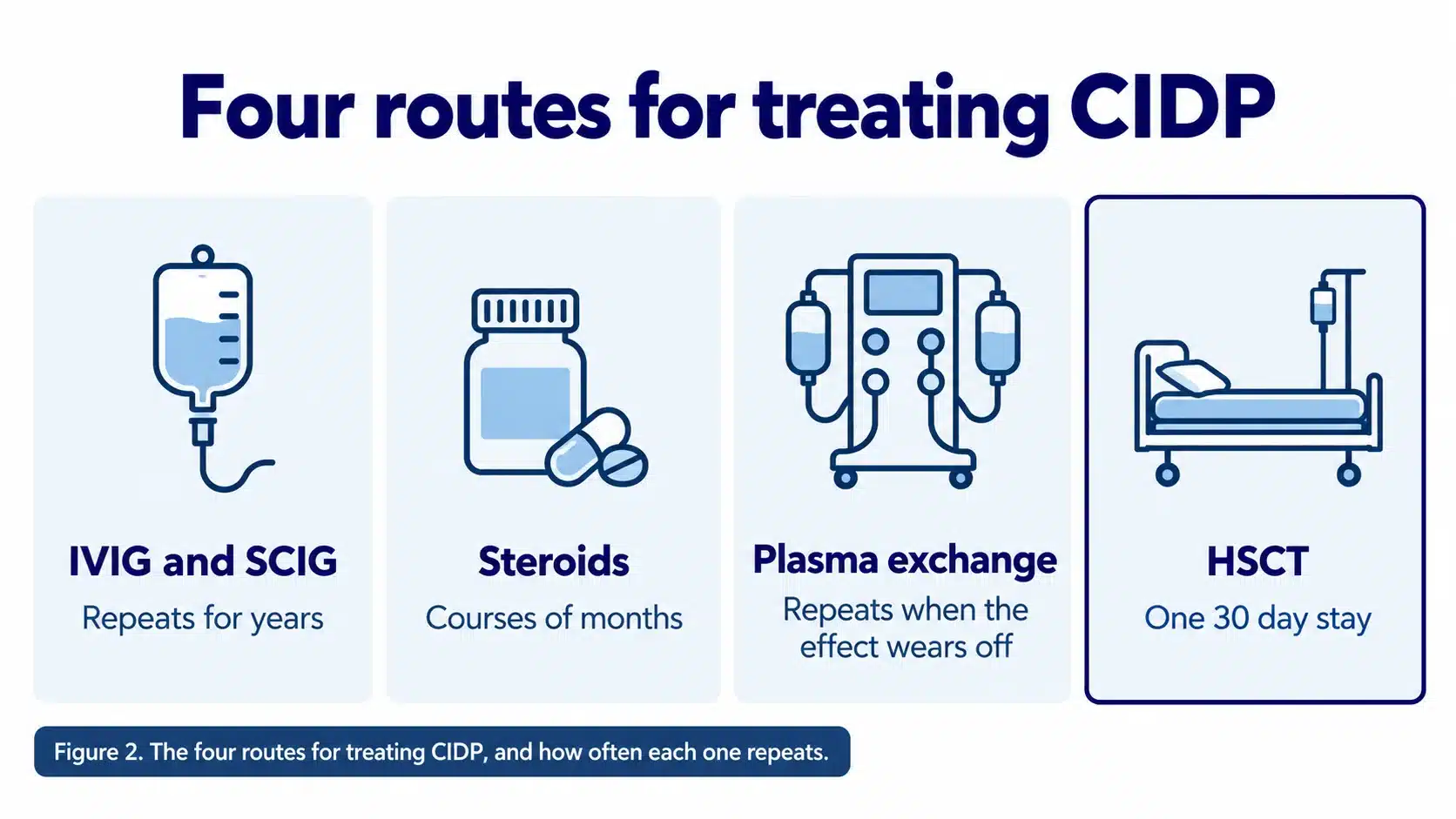
IVIG costs so much because the dose is set by body weight and the infusions repeat for years. The usual first course is 2 g of IVIG for every kg you weigh, spread over two to five days. After that, most patients need regular top up infusions, called maintenance, to stop the weakness returning.
A UK clinic in Birmingham measured both parts of the bill (Rajabally and Afzal, Journal of Neurology, 2019). The drug itself cost GBP 37,660 a year for each patient. The infusions, the cost of giving it, added GBP 17,115, so the total was GBP 54,775 a year. The clinic fitted each patient’s dose to their own response, and this saved GBP 6,506 to GBP 13,506 a year against the standard schedule.
The standard schedule in trials is 1 g per kg every three weeks. For a person who weighs 70 kg, that is 70 g of IVIG at every visit, about 17 times a year. The 2021 European guideline for CIDP names high cost as one of the main problems with IVIG. It also names the inconvenience for patients and the need for a needle in a vein each time.
Does immunoglobulin under the skin at home cost less?
Immunoglobulin under the skin, called subcutaneous immunoglobulin or SCIG, costs a little less than IVIG. It is the same kind of antibody product, given weekly into the fat under the skin, usually at home. Because you give it yourself or with a carer, there is no hospital visit to pay for.
A 2026 Spanish analysis put SCIG at EUR 98,162 a year, against EUR 109,213 for IVIG (de Pedro and colleagues, 2026). Almost all of that difference came from giving the treatment, not from the drug. The drug is still bought every week, so SCIG lowers the bill by about a tenth. It continues while the disease stays active.
How much do steroids cost compared with IVIG?
Steroids cost a small fraction of IVIG, and the 2021 guideline recommends them as an equal first choice in most forms of CIDP. A Canadian model compared the two over five years (Blackhouse and colleagues, Cost Effectiveness and Resource Allocation, 2010). IVIG cost CAD 124,065 over that time, and steroids cost CAD 2,196.
The same model counted the side effects of long steroid courses, such as broken bones, diabetes, cataract, glaucoma and serious infection. Even with those included, IVIG cost far more for the benefit it gave. Steroids are not suitable for everyone, though. In motor CIDP, where weakness comes without loss of feeling, steroids can make the condition worse, so IVIG is usually tried first. The CIDP treatment guide explains the forms of CIDP and how each is diagnosed.
How much does plasma exchange cost?
Plasma exchange usually costs less than IVIG, although no trial in CIDP has measured its cost. In plasma exchange, a machine separates out the plasma, the liquid part of your blood that holds the harmful antibodies, and puts back a replacement fluid in its place. A 2026 review of the randomised trials compared the two in other nerve conditions (Kimber and colleagues, BMC Neurology, 2026). IVIG cost about 1.4 times as much as plasma exchange in myasthenia gravis, and about 1.5 times as much in Guillain-Barré syndrome.
Plasma exchange has to be repeated often, because its effect wears off quickly. In a 1996 trial, 8 of the 12 patients who improved had relapsed one to two weeks after their last exchange. Complications occurred in 3.9% of sessions in the largest observational study of plasma exchange. For these reasons, the guideline places plasma exchange third for long term treatment, after steroids and IVIG.
Can the cost of IVIG be lowered by trying to stop it?
Yes, for some patients. The guideline advises reviewing the dose once or twice a year in the first two to three years, to see whether it can be reduced or stopped. A London clinic offered a planned trial off IVIG to patients who had been stable for a year (Koay and colleagues, 2025). Of the 12 who agreed, 8 stayed stable without IVIG for 12 months or more.
Those 8 patients saved the health service GBP 855,000 a year between them. Everyone who worsened during the trial recovered to their earlier level once IVIG was restarted. A larger Dutch trial found a smaller share able to stop (Adrichem and colleagues, Brain, 2022). In that trial, 41% were stable 24 weeks after IVIG was withdrawn. For the rest, IVIG and its yearly cost continue.
How much does HSCT for CIDP cost?
HSCT for CIDP is paid for once, and the price depends on the country and the hospital. In HSCT, your own blood stem cells are collected and frozen. Chemotherapy and antibody treatment, called conditioning, then clear out the immune cells that damage the nerves. The stored stem cells are returned to rebuild the immune system.
| Where | Cost of HSCT for CIDP | What the figure covers |
|---|---|---|
| Northwestern University, Chicago, United States | The average cost was USD 108,577 for each patient. | It is the hospital’s own cost for 19 patients treated from 2017 to 2019, ranging from USD 56,327 to USD 277,119. |
| National Health Service, United Kingdom | The cost is about GBP 30,000 to GBP 35,000. | It is an NHS estimate that leaves out hospital overheads. |
| HSCT Hospital India, New Delhi | The price is USD 30,000, all inclusive. | It covers the full 30 day stay for you and one attendant, with every hospital fee, test and medicine. |
Table 2. The cost of HSCT for CIDP in the United States, the United Kingdom and at HSCT Hospital India.
The Northwestern figures come from the team that published the largest CIDP series (Frontiers in Neurology, 2021). Their patients had needed treatment for an average of six years before HSCT. The same paper noted that the UK estimate looks lower partly because public hospitals do not add their running costs to each patient’s bill.
Is HSCT cheaper than years of IVIG?
Over several years, HSCT usually costs less than IVIG, because its cost is paid once and IVIG is paid every year. The Northwestern team compared the two and concluded that HSCT is more cost effective than long term IVIG in patients with chronic CIDP. They added that the result depends on which patients are chosen, the treatment plan used and the country.
The comparison only holds if HSCT works, and the largest series reports how often it did. In the 60 patient Northwestern series, one year after HSCT, 80% needed no CIDP treatment at all (Journal of Neurology, 2020). At five years, 83% were off all treatment. There were no treatment related deaths. Eleven of the 60, about 18%, later restarted IVIG, plasma exchange or rituximab, so their treatment costs returned.
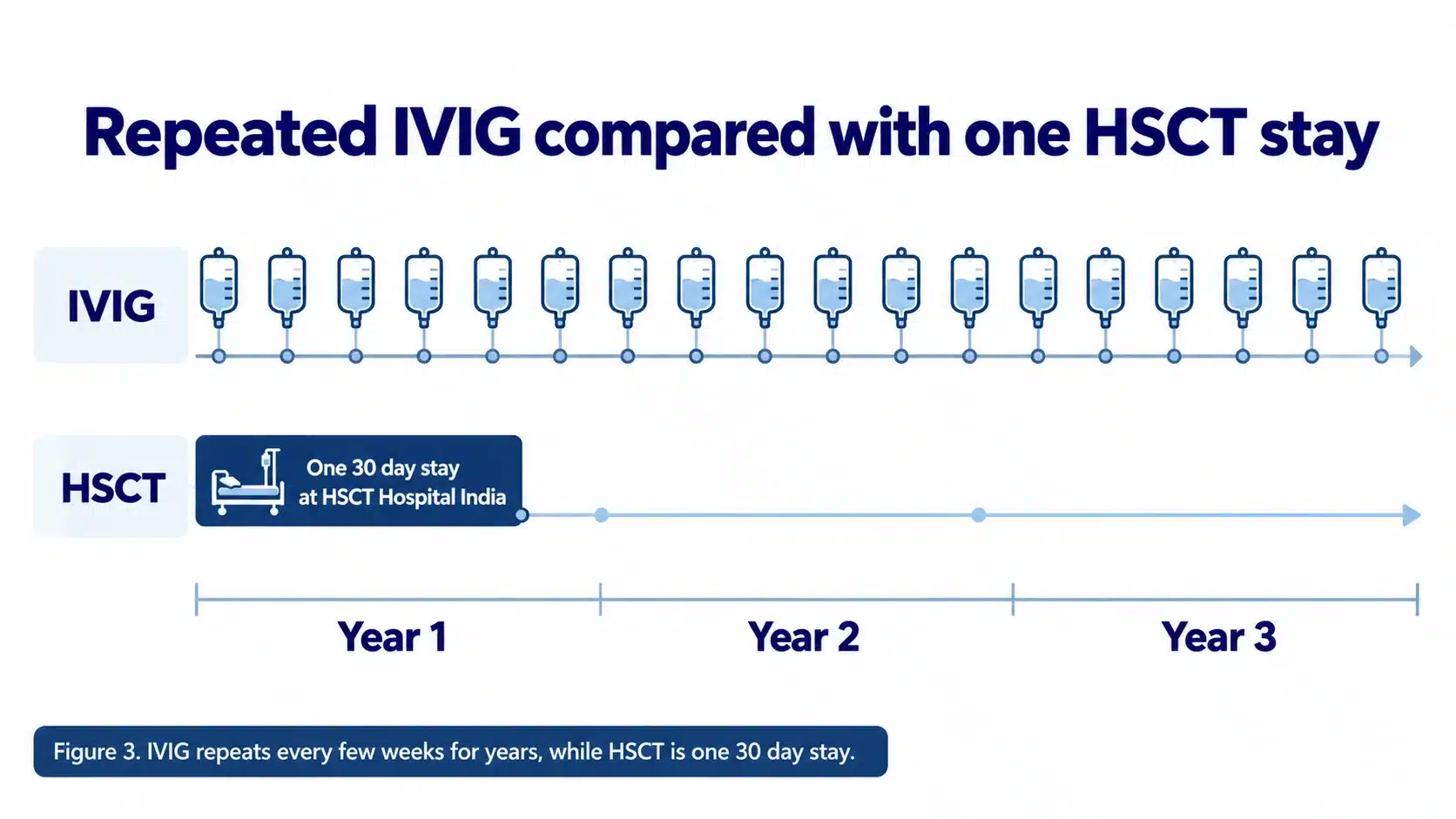
The US patients on IVIG averaged USD 165,000 over two years. That is five and a half times the USD 30,000 for HSCT at HSCT Hospital India. In the UK, one year of IVIG at GBP 49,430 or more already costs more than the NHS estimate for HSCT.
HSCT carries real risks, and the guidelines treat it with care. The 2021 European guideline finds the evidence so far insufficient. Because of the side effects and a risk of death, it advises HSCT only as a last resort in specialised centres. The European Society for Blood and Marrow Transplantation, known as EBMT, rates HSCT a clinical option for CIDP that resists standard treatment. Most of the early risk is infection in the two weeks after conditioning, while your new immune system rebuilds, and this is why the whole stay at HSCT Hospital India is inpatient.
What does the USD 30,000 at HSCT Hospital India include?
The USD 30,000 at HSCT Hospital India includes the complete HSCT and the full 30 day stay, for you and one attendant. The price is confirmed to you in writing before you travel.
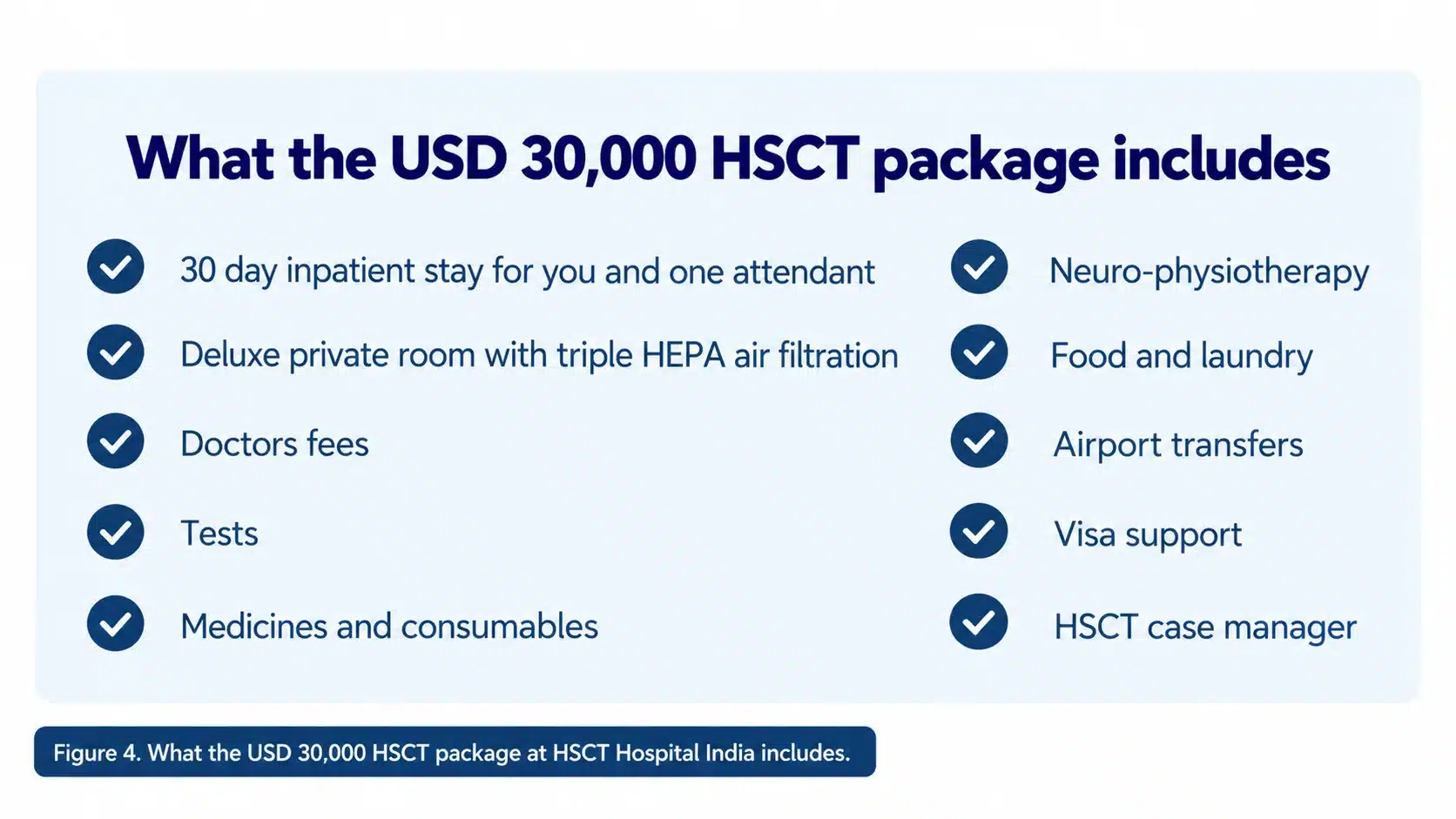
You stay as an inpatient for all 30 days, in a deluxe private room with triple level HEPA air filtration. One attendant shares your room, with their meals and laundry covered. Doctors fees, tests, medicines, consumables and neuro-physiotherapy throughout the stay are all in the price. So are airport transfers, visa support and a dedicated HSCT case manager.
Nurses are on the ward 24 hours a day through the two weeks after conditioning, so a fever is caught and treated at once by the hospital’s own doctors. The protocol is non-myeloablative, the approach developed by the Northwestern University team. Non-myeloablative means the chemotherapy resets the immune system without destroying the bone marrow. No chemotherapy is needed after you go home.
Only two costs fall outside the price: your international flights, and a complication that keeps you in hospital past day 30. The HSCT treatment package lists every inclusion, and HSCT cost by country compares the price with Mexico, Russia and the USA.
Who is a candidate for HSCT for CIDP?
HSCT is considered when your CIDP is confirmed and still depends on, or has not responded to, standard treatment. In the Northwestern series, patients were accepted when two of the three standard treatments, steroids, IVIG and plasma exchange, had failed or could not be stopped.
The HSCT specialists at HSCT Hospital India check the diagnosis again before HSCT is offered. They also look at your general health, your other medical conditions and how your CIDP has behaved on treatment. The diagnosis is checked again because some patients with a CIDP label turn out to have a different nerve condition.
Dylan, a police officer from New Jersey, came to HSCT Hospital India with autoimmune small fibre neuropathy, a different autoimmune nerve condition. Five months after HSCT, he reported that about 95% of his symptoms had gone, and he was back at work. He describes it in Dylan’s patient story, one of our patient testimonials.
The CIDP treatment options guide explains each treatment in detail, and HSCT for CIDP in India sets out our programme.
Use the enquiry form to send your diagnosis, your nerve test results and your treatment history, including how often you have IVIG. Our HSCT specialists look at each case at no cost, and your HSCT Case Manager writes back to you with their opinion.
Frequently asked questions
Is subcutaneous immunoglobulin cheaper than IVIG for CIDP?
Yes, slightly. A 2026 Spanish analysis put SCIG at EUR 98,162 a year against EUR 109,213 for IVIG. Most of the saving came from not needing a hospital visit. The drug is still needed every week, so the cost continues for as long as the treatment does.
Is HSCT cheaper than IVIG for CIDP?
Over several years, yes, for patients in whom HSCT works. HSCT is paid for once, while IVIG costs GBP 49,430 to GBP 107,000 a year in UK studies and EUR 109,213 a year in Spain. In the Northwestern series, 83% of patients were off all CIDP treatment five years after HSCT.
Is the USD 30,000 price at HSCT Hospital India fixed?
Yes, it is. The price covers the full 30 day stay for you and one attendant and is given to you in writing before you travel. Only international flights, and a complication that keeps you in hospital beyond 30 days, are outside it.
Can stopping IVIG lower the cost of CIDP treatment?
Yes, when your CIDP has been stable for some time. In a London clinic, 8 of 12 stable patients who tried stopping IVIG stayed stable for a year or more, and between them they saved GBP 855,000 a year. Patients who worsened recovered once IVIG was restarted.
Why does HSCT cost less in India than in the United States?
Chemotherapy drugs are traded worldwide, so they cost much the same in every country. What costs far less in India is the hospital bed and the specialist staff. Neither the 30 day inpatient stay nor the protocol is shortened to reach the price.
References
- Mahdi-Rogers M, McCrone P, Hughes RA. Economic costs and quality of life in chronic inflammatory neuropathies in southeast England. European Journal of Neurology. 2014;21:34 to 39. doi:10.1111/ene.12245
- Koay S, Chen YC, Ransley G, et al. Safety and cost analysis of immunoglobulin cessation trials in chronic inflammatory demyelinating polyradiculoneuropathy. Journal of the Peripheral Nervous System. 2025;30:e70007. doi:10.1111/jns.70007
- de Pedro S, Presa M, Gamez J, et al. Cost analysis of immunoglobulin maintenance treatment of patients with chronic inflammatory demyelinating polyneuropathy in Spain. PharmacoEconomics Open. 2026;10:381 to 391. doi:10.1007/s41669-025-00633-8
- Divino V, Mallick R, DeKoven M, Krishnarajah G. The economic burden of CIDP in the United States: a case control study. PLoS One. 2018;13:e0206205. doi:10.1371/journal.pone.0206205
- Blackhouse G, Gaebel K, Xie F, et al. Cost utility of intravenous immunoglobulin compared with corticosteroids for the treatment of chronic inflammatory demyelinating polyneuropathy in Canada. Cost Effectiveness and Resource Allocation. 2010;8:14. doi:10.1186/1478-7547-8-14
- Rajabally YA, Afzal S. Clinical and economic comparison of an individualised immunoglobulin protocol vs. standard dosing for chronic inflammatory demyelinating polyneuropathy. Journal of Neurology. 2019;266:461 to 467. doi:10.1007/s00415-018-9157-4
- Van den Bergh PYK, van Doorn PA, Hadden RDM, et al. European Academy of Neurology and Peripheral Nerve Society guideline on diagnosis and treatment of chronic inflammatory demyelinating polyradiculoneuropathy, second revision. Journal of the Peripheral Nervous System. 2021;26:242 to 268. doi:10.1111/jns.12455
- Kimber C, Malouf R, Javan J, et al. Clinical and economic outcomes of therapeutic plasma exchange and intravenous immunoglobulin for treating adults with autoimmune neurological disorders: a systematic review and meta analysis. BMC Neurology. 2026. doi:10.1186/s12883-026-04780-1
- Hahn AF, Bolton CF, Pillay N, et al. Plasma exchange therapy in chronic inflammatory demyelinating polyneuropathy: a double blind, sham controlled, cross over study. Brain. 1996;119:1055 to 1066. doi:10.1093/brain/119.4.1055
- Adrichem ME, Lucke IM, Vrancken AFJE, et al. Withdrawal of intravenous immunoglobulin in chronic inflammatory demyelinating polyradiculoneuropathy. Brain. 2022;145:1641 to 1652. doi:10.1093/brain/awac054
- The cost effectiveness of immunoglobulin vs. hematopoietic stem cell transplantation for CIDP. Frontiers in Neurology. 2021;12:645263. doi:10.3389/fneur.2021.645263
- Hematopoietic stem cell transplantation for chronic inflammatory demyelinating polyradiculoneuropathy. Journal of Neurology. 2020;267:3378 to 3391. doi:10.1007/s00415-020-10010-6
- Sharrack B, Saccardi R, Alexander T, et al. Autologous haematopoietic stem cell transplantation and other cellular therapy in multiple sclerosis and immune mediated neurological diseases: updated guidelines and recommendations from the EBMT. Bone Marrow Transplantation. 2020;55:283 to 306. doi:10.1038/s41409-019-0684-0
Popular Posts