HSCT for MS in the USA: Cost, Access and Eligibility
Medically reviewed and approved by the board of haematologists at HSCT Hospital India, whose transplant physicians hold DM Clinical Haematology qualifications and fellowship training in stem cell transplantation. The programme runs at a JCI-USA, NABH and NABL accredited hospital that has treated more than 1500 patients.
HSCT for MS in the USA is offered mainly inside clinical trials, because the Food and Drug Administration has not approved it as a treatment for multiple sclerosis. The largest American trial, BEAT-MS, accepts people aged 18 to 55 and assigns half of them to drugs instead of HSCT. At HSCT Hospital India in New Delhi, every accepted patient receives HSCT, for US $30,000 all-inclusive during one stay of up to 30 days.
HSCT stands for haematopoietic stem cell transplantation. Your own blood forming stem cells are collected first and stored. Chemotherapy then removes the immune cells that attack myelin, the coating that protects your nerves. Your stored cells are returned afterwards, and from them your body grows new blood and immune cells.
American patients who look into HSCT usually meet the same four questions. They ask whether they can get it at home, whether insurance will pay, what it costs and which chemotherapy is used. Each of those questions is answered for the United States and for New Delhi.

How does HSCT in the USA compare with HSCT Hospital India at a glance?
For an American patient the biggest differences are the route in, the age and disability limits and the price. Each cell in the table is taken from what the trial registry, the insurers and HSCT Hospital India publish.
| Question | United States | HSCT Hospital India, New Delhi |
|---|---|---|
| How do I get HSCT? | In the United States you apply to a clinical trial such as BEAT-MS at an academic centre. | You apply directly to HSCT Hospital India, and its specialists review your case without charge. |
| Who can take part? | BEAT-MS accepts adults aged 18 to 55 with an EDSS score of 6.0 or lower and recent relapses. | HSCT Hospital India assesses patients up to about 60 and considers progressive MS. |
| Will I actually receive HSCT? | In BEAT-MS half of the participants are assigned to MS drugs instead of the transplant. | Every patient HSCT Hospital India accepts receives HSCT. |
| Which chemotherapy is used? | BEAT-MS gives high dose BEAM chemotherapy. | HSCT Hospital India uses cyclophosphamide with ATG, the protocol tested in the MIST trial. |
| Will insurance pay? | Medicare and large private plans such as Aetna classify HSCT for MS as experimental. | At HSCT Hospital India you pay one fixed price yourself. |
| What does it cost? | Patients who pay privately in the United States are quoted 150,000 to 200,000 US dollars. | HSCT Hospital India charges US $30,000 all-inclusive for you and an attendant. |
| How long am I away? | A private inpatient course in the United States runs for six to seven weeks. | In New Delhi the whole treatment takes a single admission of 30 days or fewer. |
Can I get HSCT for MS in the United States?
You can, but almost always as a participant in a clinical trial. The National Institutes of Health called HSCT for MS experimental when it announced the current American trial in January 2020. That trial is BEAT-MS, registered as NCT04047628, and it opened in December 2019 with a target of 156 participants.
BEAT-MS compares HSCT with the strongest licensed MS drugs over three years. Its sites include Stanford, Mayo Clinic in Rochester, Cleveland Clinic, Mount Sinai, Northwestern, Penn, Duke and Washington University in St Louis. The registry record, last updated on 2 January 2026, still lists the trial as recruiting.
The entry rules are narrow. You must be 18 to 55, have an EDSS score of 6.0 or lower and have had at least two episodes of disease activity in the last three years. EDSS, the Expanded Disability Status Scale, is the 0 to 10 score neurologists use for walking and daily function. A patient who is 57, or whose last relapse was two years ago, falls outside these rules.
Randomisation is the second hurdle. In a randomised trial, chance decides which treatment each person gets, so half of the BEAT-MS participants receive drugs instead of HSCT. The scale itself is explained on the EDSS page.
Why do American MS patients look abroad for HSCT?
Most American patients look abroad after finding that the trial route does not fit them. The highest volume HSCT for MS programme in the country, at Northwestern Memorial Hospital in Chicago, stopped accepting new patients in 2019. Since then the main route at home has been the BEAT-MS trial.
In 2021 the National Multiple Sclerosis Society published its position in JAMA Neurology. Its advisory committee said HSCT may be a useful option for people with relapsing MS whose disease stays active despite a high efficacy drug. It named people under 50 with MS for under ten years as the best candidates, which leaves many older patients and people with progressive MS outside that group.
Christa Blanco from Ohio is one example. An earlier skin cancer ruled her out of the American trials she applied to, and she travelled to New Delhi instead. Her account is told further down, with patients from California, North Carolina and other states.
Will my insurance pay for HSCT for MS?
In most cases American insurance does not pay for HSCT for MS. Medicare follows national coverage determination 110.23, which lists the conditions, mostly blood cancers, for which this transplant is covered. Multiple sclerosis is not on that list.
Private plans take the same view in their policy documents. Aetna clinical policy bulletin 0606, last reviewed in September 2025, lists multiple sclerosis among the conditions for which stem cell transplantation is considered experimental. Other national plans publish similar bulletins.
If your plan refuses, you can ask the plan itself to look again, and then ask for an independent external review. HealthCare.gov sets the rules for that review. You file within four months of the final refusal, and a standard review is decided within 45 days. Because the reviewer checks the plan’s own policy, an appeal against a policy that calls HSCT experimental often fails.
Many American patients therefore pay for treatment themselves. Ways families raise the money are set out in the guide to paying for HSCT abroad.
Which chemotherapy is used in the American trial, and which one does HSCT Hospital India use?
The chemotherapy step is called conditioning, and it is where the two programmes differ most. Conditioning removes the immune cells behind MS before your stem cells are returned. Its strength decides how hard the treatment is on your body and how long recovery takes.
BEAT-MS uses a high dose regimen called BEAM, named after its four chemotherapy drugs. A high dose regimen of this kind clears the bone marrow as well as the immune cells. For this reason recovery after BEAM takes longer, and patients stay in hospital for weeks.
HSCT Hospital India uses the non-myeloablative protocol developed by Dr Richard Burt, which pairs cyclophosphamide with ATG. Non-myeloablative means the dose clears the immune cells that damage myelin without setting out to destroy the bone marrow. ATG, short for anti-thymocyte globulin, is an antibody that removes the T cells behind those attacks.
This protocol is one of the two conditioning regimens named in the 2025 joint recommendations of ECTRIMS and the European Society for Blood and Marrow Transplantation. The regimens used in the United States, India, Mexico and Russia are compared in the guide to HSCT protocols for MS.

What did the MIST trial show for the protocol used at HSCT Hospital India?
The protocol used in New Delhi was tested in MIST, a randomised trial run at centres in the United States, Europe and South America. Its results appeared in JAMA in 2019. MIST took in 110 people with relapsing remitting MS, the form of MS in which attacks come and then ease.
Half of the patients had HSCT, and half moved to a different or stronger MS drug. Over the follow up, MS worsened in 3 of the 52 patients who had HSCT. On the drugs, it worsened in 34 of 51, and no patient in the trial died.
These results are why HSCT Hospital India gives this protocol to every MS patient. You have the treatment once, and no further chemotherapy follows it at home. Ten year results are covered in the article on long term results of HSCT for MS.
 Get HSCT India Brochure Emailed to you
How much does HSCT for MS cost in the United States?
The clearest published figure for an American hospital comes from Chicago. Northwestern Memorial Hospital added up the cost of every HSCT it gave for relapsing remitting MS between January 2017 and January 2019. The average came to 85,184 US dollars, published in Multiple Sclerosis and Related Disorders in 2020.
That figure is the hospital’s own cost, before any profit or fees billed to patients. Americans who pay privately are quoted 150,000 to 200,000 US dollars for a six to seven week course in hospital. The same 2020 paper put American MS drugs at 80,000 to 100,000 US dollars per patient per year, for every year they are taken.
About 727,000 American adults were living with MS in 2010, according to a national estimate published in Neurology in 2019. For many of them, one year of MS drugs costs more than the full treatment in New Delhi.
Can HSCT Hospital India review my case if I cannot get into an American trial?
Yes, we do. Many American patients apply after being told they are too old for BEAT-MS, too disabled or without a recent relapse. The HSCT specialist doctors at HSCT Hospital India read each case on its own medical history, without charge.
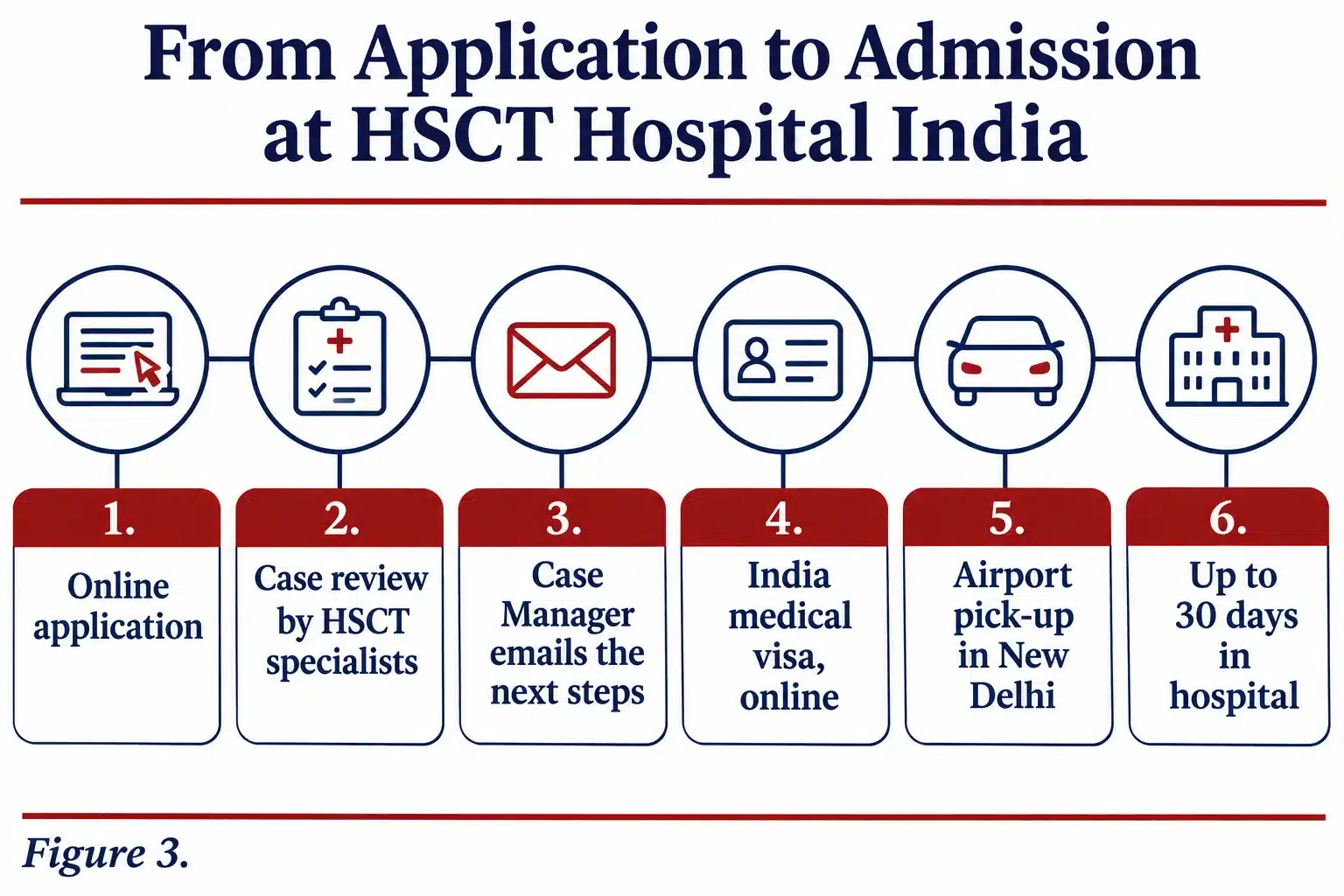
You can apply without new scans or an MRI, because every test the specialists need is done after you arrive. From there the route has six steps. You apply online, the specialists review your case and an HSCT Case Manager emails you their opinion. The Case Manager then helps with the India medical visa, the hospital meets you at New Delhi airport, and you are admitted.
There is no long waiting list for MS patients. When your case is accepted, you and your Case Manager agree a start date that suits your travel.
What does the US $30,000 price at HSCT Hospital India include?
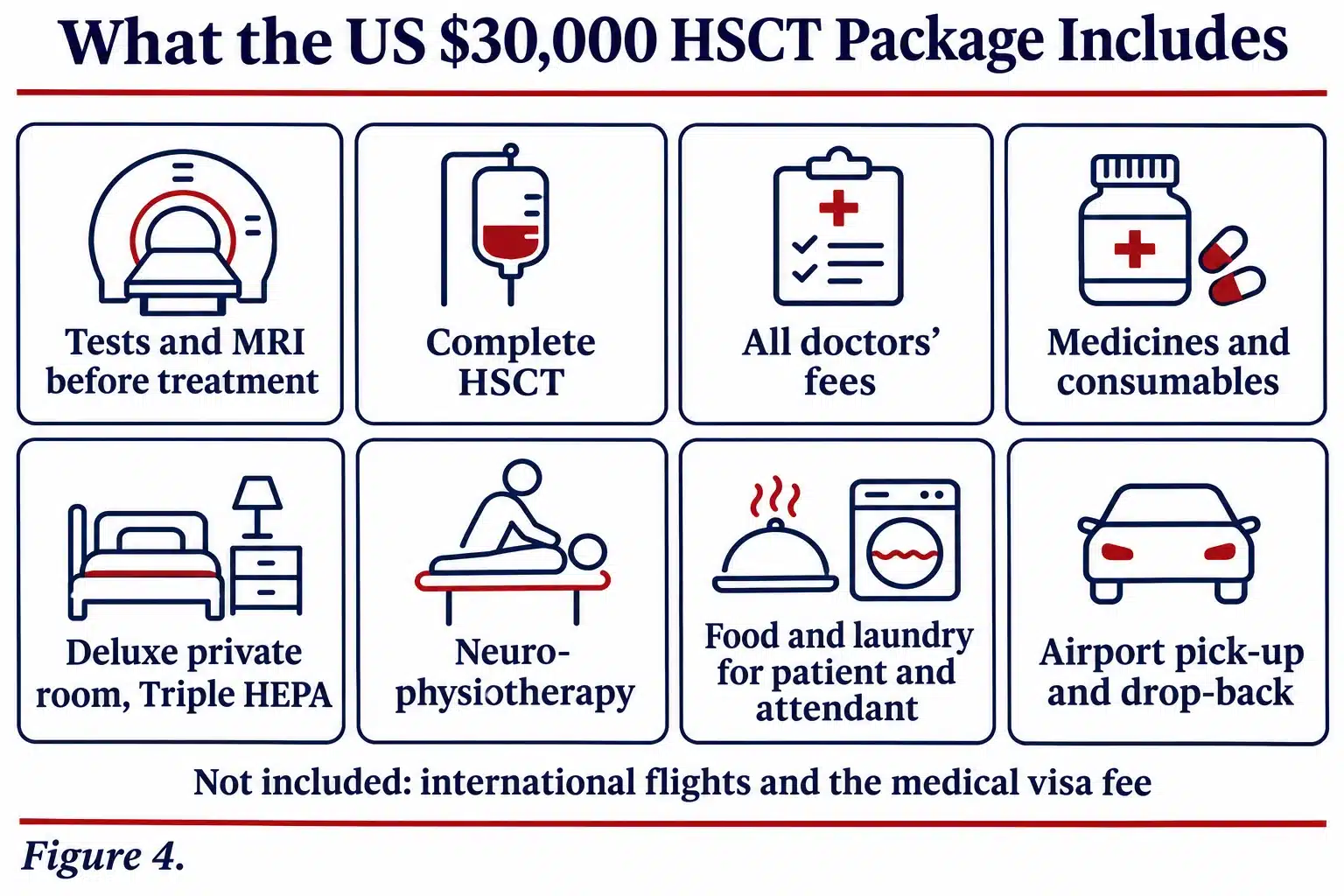
HSCT Hospital India charges one price of US $30,000 for the whole admission of up to 30 days. You receive no separate bill for tests, drugs or nursing while you are on the ward. A charge is added only in the rare case that a stay runs past 30 days.
The price covers the tests and consultations before treatment, the MRI and the complete HSCT. It also covers the deluxe private room, doctors’ fees, medicines, consumables and neuro-physiotherapy. Food and laundry for both the patient and the attendant are part of it, and so are airport pick-up and drop-back.
Your flights and the medical visa fee sit outside the price. If nobody can travel with you, a full time private nurse can be your attendant for an extra US $1,500. Prices in other countries are compared in the guide to HSCT cost by country.
How long would I be away from home?
A private HSCT course in an American hospital runs for six to seven weeks as an inpatient. BEAT-MS then measures its results over the three years after treatment. Travel inside the United States is short, but the hospital stay is long.
In New Delhi you are treated within a single admission of up to a month. A hospital driver meets you when you land in New Delhi. You fly home on the last day, with no hotel nights before or after the stay.
How is the 30 day stay in New Delhi different from an American transplant ward?
The biggest difference for an American patient is the strength of the chemotherapy and the length of the stay that follows. In BEAT-MS the high dose BEAM regimen clears the bone marrow, so recovery on the ward takes weeks longer. In New Delhi the milder cyclophosphamide and ATG protocol lets the whole programme, from the first tests to the flight home, fit inside one admission.
Your stay runs in four stages: mobilisation, the harvest of your stem cells, conditioning and reinfusion. After conditioning your infection-fighting white cells fall to their lowest, which doctors call the aplastic phase. Because of it you stay on the ward throughout, in a private room with triple level HEPA air filtration, with nurses and HSCT specialists there day and night. Each stage is set out day by day in the guide to how HSCT works at HSCT Hospital India.
Who can stay with me in New Delhi?
Your attendant shares your private room at HSCT Hospital India for the whole stay. Their bed, meals and laundry are part of the US $30,000. American patients have come with a parent or a close friend.
Christa came with her mother, and Kathryn came with a friend of forty years. The attendant helps you through flights and keeps you company, while the nurses handle your medical care. If you travel alone, the hospital can arrange a private nurse as your attendant for US $1,500.
Which types of MS does HSCT Hospital India accept for HSCT?
HSCT Hospital India treats relapsing remitting MS and progressive MS, both secondary progressive and primary progressive. The specialists assess patients up to about 60, and up to an EDSS score of 6.5. At 6.5 a person needs two walking aids, such as two sticks, to walk about 20 metres.
You do not need to have tried drugs such as Ocrevus or Tysabri first. Any past illness, including an earlier cancer, is read as part of your own case. Every check the specialists make is listed in the guide to HSCT eligibility criteria.
 Request a Call Back
What happens after I fly home to the United States?
You go home with a Discharge Summary for your own doctor and an Aftercare Manual for you. Your local doctor can arrange the blood tests in it, every two weeks for the first two months and then monthly. For the first month you wear a mask in public, starting on the flight.
No further chemotherapy is needed in the United States. Most patients are back to their normal activities two to four months after treatment. You send your results to the HSCT Hospital India team, who follow your recovery from New Delhi.
What do American MS patients say about HSCT Hospital India?
Patients from many American states have described their treatment in New Delhi in their own words. Their reasons for coming differ, from trial rules to cost to the wish for a full inpatient stay. Four of their accounts follow, each with a video recorded at the hospital.
Christa, relapsing remitting MS, Ohio
Christa Blanco was 45 and had lived with relapsing remitting MS for fifteen years, three of them unable to work. A past melanoma excluded her from the American trials she applied to. She decided in January, applied in April and arrived in New Delhi on 30 June, with her mother Kay as her attendant.
There were things that I had researched that I still had a little bit of questions about or didn’t fully understand, which he explained completely, down to a level that I could explain it to my grandkids.
Christa, Ohio
When we first got here I was worried, but after watching them work with Christa and take care of her, I knew there wasn’t going to be any need to worry.
Kay, Christa’s mother
Read her full account: Christa from the USA.
David, primary progressive MS, California
David Ellis was diagnosed with primary progressive MS in 2011 and had moved through Copaxone, Tysabri and Ocrevus. He arrived using a cane and could not lift his left leg without help. He recorded his video at the end of his 30 days.
The results have been really positive. I can actually point to some things that I could not do before.
David, California
Read his full account: David Ellis from the USA.
Kathryn, multiple sclerosis, United States
Kathryn had lived with MS for 30 years when she came to New Delhi. Her friend Corrinne travelled with her as her attendant. By the end of treatment, Corrinne says, Kathryn was walking better, could feel things she had not felt before, and her vertigo had gone.
On a daily basis I receive physical therapy that I have never had before, which has helped me to improve immensely, to the point that I am getting to go home real soon.
Kathryn, United States
Read her full account: Kathryn from the USA.
Justin, multiple sclerosis, North Carolina
Justin chose HSCT Hospital India after his own research. He caught an infection during his stay, and the team treated it at once. He expected to go home stronger than he arrived, thanks to the physiotherapists.
My body caught an infection, and they reassured me they knew exactly what to do. They did their protocol. I received all the correct medications in the correct way. I didn’t get any other infections.
Justin, North Carolina
Read his full account: Justin from the USA.
More accounts, many of them filmed, are on the HSCT Hospital India patient stories page. The programme itself is described in full in the guide to HSCT for MS at HSCT Hospital India.
Frequently asked questions from American MS patients about HSCT in India
Is HSCT for MS FDA approved in the United States?
No, the Food and Drug Administration has not approved HSCT as a treatment for multiple sclerosis. In the United States it is offered mainly inside clinical trials such as BEAT-MS. At HSCT Hospital India in New Delhi, HSCT for MS is given at a JCI-USA accredited hospital for US $30,000 all-inclusive.
Which US hospitals perform HSCT for MS?
The BEAT-MS trial runs at academic centres including Stanford, Mayo Clinic in Rochester, Cleveland Clinic, Mount Sinai, Northwestern, Penn and Duke. Places go only to participants who meet the trial’s age, disability and relapse rules. HSCT Hospital India accepts direct applications and assesses patients up to about 60.
Will my insurance cover HSCT for MS?
Usually it will not. Medicare’s national coverage determination 110.23 does not list multiple sclerosis, and Aetna policy bulletin 0606 classifies stem cell transplantation for MS as experimental. You can appeal, first to your plan and then to an independent external review. Many American patients pay for HSCT at HSCT Hospital India themselves, at one price of US $30,000.
How much does HSCT for MS cost in the USA compared with India?
A private place in an American hospital costs 150,000 to 200,000 US dollars. A Northwestern study of its own HSCT patients put the average hospital cost at 85,184 US dollars. HSCT Hospital India charges US $30,000 for up to 30 days, including the room, tests, medicines and meals for you and your attendant.
Can I have HSCT if I do not qualify for BEAT-MS?
Yes, many American patients outside the trial rules are assessed at HSCT Hospital India. The specialists review your medical history without charge, including any past illness. You can apply without new scans, because every test is done in New Delhi.
Does HSCT work for progressive MS?
HSCT Hospital India treats secondary progressive and primary progressive MS as well as relapsing remitting MS. The 2025 ECTRIMS and EBMT recommendations report five year progression free survival between 33% and 71% in secondary progressive MS. Your HSCT specialists confirm suitability once your tests in New Delhi are complete.
Which chemotherapy does HSCT Hospital India use?
HSCT Hospital India uses Dr Richard Burt’s non-myeloablative protocol of cyclophosphamide with ATG. It was tested in the MIST randomised trial, published in JAMA in 2019, where MS worsened in 3 of 52 HSCT patients against 34 of 51 on drugs. The American BEAT-MS trial gives a stronger, high dose BEAM regimen instead.
How long does HSCT take in New Delhi?
At HSCT Hospital India the whole treatment is completed during one admission of up to 30 days. You spend every day on the ward, in a private room with triple level HEPA air filtration. The hospital meets you at New Delhi airport and drives you back on the last day.
How soon can I start treatment at HSCT Hospital India?
Admission at HSCT Hospital India comes without a long wait. Its HSCT specialists review your application without charge, and an HSCT Case Manager emails you their opinion and the next steps. Once your case is accepted, your Case Manager agrees a start date with you and guides your India medical visa application.
Why Choose HSCT Hospital India for Life Changing Multiple Sclerosis Treatment

 Complete 30 day HSCT done in hospital. Private deluxe rooms are very well served for patient and attendant comfort and equipped with HEPA Filter with Triple Level Air Filtration. No outside hospital stay avoids risk of infection during the aplastic phase, 24 x 7 nursing care and best medical attention. Advanced HSCT protocol used does not require any further chemo or treatment after leaving the hospital. Click here to get complete details
 International and Globally Renowned Accreditations. HSCT Hospital India is accredited by the Joint Commission International, USA, the National Accreditation Board for Hospitals and Healthcare Providers (NABH), and the National Accreditation Board for Laboratories (NABL) for processes and high quality patient care. Click here to know more

Real Patients, Real Stories
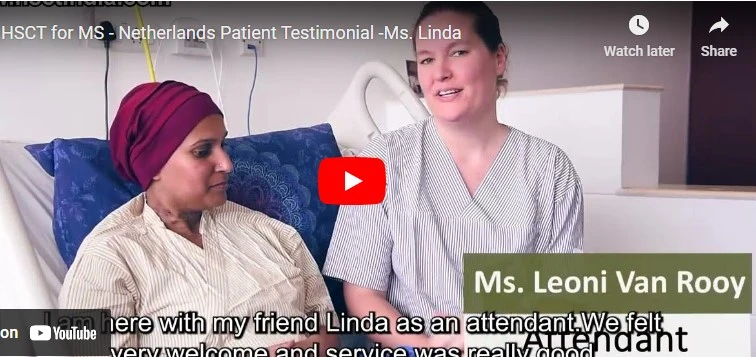
Linda’s Story: MS patient from Netherlands talks about her HSCT Treatment at HSCT Hospital India
Linda from the Netherlands, diagnosed with MS in 2007, describes her HSCT for multiple sclerosis at HSCT Hospital India on video.

Primary Progressive MS: David Ellis on His HSCT Treatment in India
David Ellis from California, with primary progressive MS since 2011, arrived using a cane. After HSCT he could lift his left leg again.
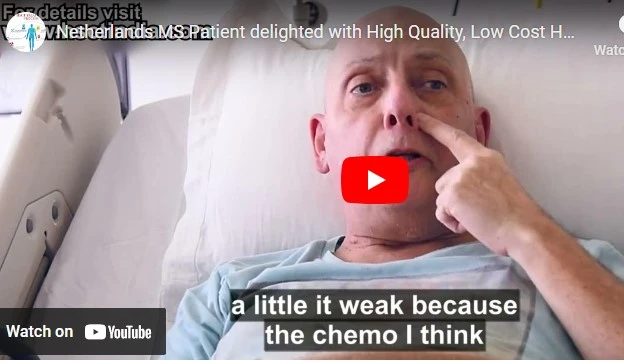
Netherlands MS Patient delighted with High Quality, Low Cost HSCT for MS Treatment
Watch this video where Mr. Jacobus from the Netherlands shares his happy experience about travelling to India with his girlfriend as a Caregiver for HSCT
References
- ClinicalTrials.gov. Best Available Therapy Versus Autologous Hematopoietic Stem Cell Transplant for Multiple Sclerosis (BEAT-MS). NCT04047628. Record updated 2 January 2026.
- Burt RK, Balabanov R, Burman J, et al. Effect of Nonmyeloablative Hematopoietic Stem Cell Transplantation vs Continued Disease-Modifying Therapy on Disease Progression in Patients With Relapsing-Remitting Multiple Sclerosis: A Randomized Clinical Trial. JAMA. 2019;321(2):165 to 174.
- Miller AE, Chitnis T, Cohen BA, et al. Autologous Hematopoietic Stem Cell Transplant in Multiple Sclerosis: Recommendations of the National Multiple Sclerosis Society. JAMA Neurology. 2021;78(2):241 to 246.
- Burt RK, Tappenden P, Han X, Quigley K, Arnautovic I, et al. Health economics and patient outcomes of hematopoietic stem cell transplantation versus disease-modifying therapies for relapsing remitting multiple sclerosis in the United States of America. Multiple Sclerosis and Related Disorders. 2020;45:102404.
- Wallin MT, Culpepper WJ, Campbell JD, et al. The prevalence of MS in the United States: A population-based estimate using health claims data. Neurology. 2019;92(10):e1029 to e1040.
- Centers for Medicare and Medicaid Services. National Coverage Determination 110.23, Stem Cell Transplantation. Aetna Clinical Policy Bulletin 0606, last reviewed 10 September 2025.
- Muraro PA, Mariottini A, Greco R, et al. Autologous haematopoietic stem cell transplantation for treatment of multiple sclerosis and neuromyelitis optica spectrum disorder: recommendations from ECTRIMS and the EBMT. Nature Reviews Neurology. 2025;21(3):140 to 158.