HSCT for MS Review: Su from the UK on HSCT in India
by admin
Patient account published with the patient's consent. Clinical details checked and approved by the board of haematologists at HSCT Hospital India, whose transplant physicians hold DM Clinical Haematology qualifications and fellowship training in stem cell transplantation. The programme runs at a JCI-USA, NABH and NABL accredited hospital that has treated more than 1500 patients. Page last updated: 16 October 2026.
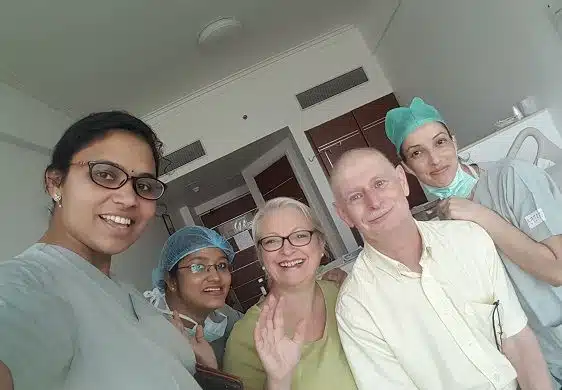
Su from England chose HSCT Hospital India for multiple sclerosis after researching MS treatments around the world. Su did not meet the qualifying criteria for comparable treatment in England, and the cost of private treatment there was too high. After returning home, Su wrote that the hospital was still answering questions and monitoring blood results.
In MS, the body’s own white blood cells harm myelin, the insulating sheath around nerve fibres in the brain and spinal cord. HSCT, which stands for autologous haematopoietic stem cell transplantation, uses chemotherapy against the faulty immune cells. The patient’s own stem cells, collected and frozen beforehand, are then returned to form new immune cells.
Su from the UK: HSCT for MS at a Glance
Patient
Su lives in England, in the United Kingdom.
Why treatment abroad
The qualifying criteria in England ruled Su out of comparable treatment there, and private treatment cost too much.
How the hospital was chosen
Su corresponded at length with every hospital on a shortlist and chose HSCT Hospital India for its answers and its package.
Before treatment
Detailed tests in New Delhi confirmed that Su was fit for the procedure.
During treatment
The consultant and the team visited twice a day and adjusted the treatment to Su’s needs.
After returning home
The hospital went on answering questions and monitoring Su’s blood results.
Price of the programme today
Up to 30 days in hospital are covered by a single all inclusive fee of 30,000 US dollars.
Why Su could not have HSCT in England
Su looked into MS treatments in many countries before choosing one. HSCT was the treatment Su wanted, and two things stopped Su having it in England. Su fell outside the qualifying criteria, and the cost of private therapy was too high.
"Following extensive research into various therapies available all over the world for MS, We found HSCT hospital in India to be a possible option for treatment. We were unable to access comparable treatment in England due to not meeting the qualifying criteria and the costs of private therapy was prohibitive."
Su, MS patient from the UK, written after returning to England
Today, the NHS funds HSCT for MS in England only, and only for patients who fit published criteria. Those criteria, from the London MS-AHSCT Collaborative Group and published by AIMS Charity, include an age of 18 to 65 and 15 years or less since diagnosis. They also set an EDSS score of 6.5 or lower, EDSS being the scale neurologists use to score disability in MS from 0 to 10. A neurologist makes the referral, and a panel then decides. The routes open to UK patients are compared in HSCT for MS in the UK.
Su compared several hospitals before choosing. The HSCT India brochure, sent to you by email, gives the facts that comparison needs: the treatment stages, the 30 day stay and the single all inclusive price.
How Su compared hospitals and chose HSCT Hospital India
Su wrote to every hospital on the shortlist that offered HSCT, and the exchanges went on for some time. HSCT Hospital India answered each question within 24 hours and in detail. Su says no question had to be asked twice, and those answers built confidence in the consultant and the team.
"Every question that was put to HSCT Hospital was answered within 24hrs and in detail. No question had to be asked twice. With this feedback it gave me confidence in the consultant, his team and the procedure they carry out and we decided that HSCT Hospital was able to provide the most comprehensive package that met our needs."
Su, MS patient from the UK, written after returning to England
The package Su chose covers the hospital stay, doctors’ fees, tests and consultations, medicines, consumables and physiotherapy. Food and laundry for the patient and one attendant, and transfers to and from the airport, are part of that price as well.
Su asked questions before deciding, and you can do the same. Send your medical reports through the form, and the HSCT specialist doctors give their opinion free of charge. The reply comes by email from an HSCT case manager.
Tests on arrival and twice daily visits in New Delhi
Support for Su and the attendant started on arrival at Delhi airport. After admission came a period of detailed tests to make sure Su was fit for the treatment. Su calls the procedure arduous and exacting, and the tests check that a patient is strong enough for it before it begins.
"From time of arrival at the airport in Delhi every care and support was offered to ensure that our needs were met. There was a period of detailed physiological testing to ensure that I was fit to undertake what proved to be an arduous and exacting procedure."
Su, MS patient from the UK, written after returning to England
Once the doctors confirmed that Su was suitable, treatment started straight away. The consultant and the team came to see Su twice a day, and the treatment was adjusted to Su’s needs.
"Once the decision had been made that I was suitable for the programme the treatment was started immediately. Twice daily visits from the consultant and his team ensured that treatment was tailored to meet the individual’s requirements."
Su, MS patient from the UK, written after returning to England
Su went through the four stages of the programme. The first two release stem cells into the blood and collect them for storage. In the third, chemotherapy takes out the immune cells responsible for MS, and in the fourth the stored cells go back in through a drip. The protocol is non-myeloablative, which means the chemotherapy removes those immune cells while the bone marrow keeps its ability to recover.
What Su says patients and attendants should prepare for
Su names two hard parts of the stay: lost sleep and a limited diet. Nurses checked on the patient through the night as well as the day, so normal sleep was lost. That was a strain on both Su and the attendant. The diet for patients is limited, and dieticians help with the choices.
"Throughout the stay all staff, nursing, medical and support were professional, friendly and attentive offering a personal touch. Diet is (for the patient) limited but dieticians are on hand to help with making choices."
Su, MS patient from the UK, written after returning to England
"Anyone considering taking this path needs to be aware that with the need for frequent monitoring throughout the 24hr period normal sleep patterns are lost, putting a physiological and psychological strain on both patient and attendant. There is a requirement for flexibility to allow nursing staff to maintain vigilance for any changes in the patient’s condition and subsequent variation in treatment to ensure optimum recovery in the time available."
Su, MS patient from the UK, written after returning to England
Nurses check through the night because, after conditioning, the immune system is at its lowest for several days, a stretch doctors call the aplastic phase. Watching for change at night as closely as by day means an infection or a fever is picked up quickly. Patient and attendant share one deluxe private room, where triple level HEPA filters clean the air.
Questions about what the stay is like for a patient and an attendant are easier to talk through. An HSCT case manager will ring you at a time you pick, and the call is free.
Follow up from HSCT Hospital India after Su returned to England
Back in England, Su stayed in contact with the hospital. Su writes that HSCT Hospital India went on answering questions and monitoring blood results after the return home.
"Following our return to England, HSCT Hospital India has continued to be available to answer any questions we have and monitor blood results."
Su, MS patient from the UK, written after returning to England
At home, blood counts are checked twice a month at first, then once a month until they are normal, and the results go to the hospital. HSCT Hospital India sees most of its patients back to their normal routine two to four months after treatment. The first year at home is described in HSCT recovery time.
HSCT for MS patients from the UK
HSCT Hospital India reviews each UK patient on their own medical records. The HSCT specialist doctors decide from that review, whatever the NHS decided earlier.
The hospital has treated over 1,500 MS patients, who came from more than 30 countries. Its facilities are accredited by JCI-USA, the Joint Commission International, and by NABH and NABL in India. There is no long waiting list.
Following extensive research into various therapies available all over the world for MS, We found HSCT hospital in India to be a possible option for treatment.
We were unable to access comparable treatment in England due to not meeting the qualifying criteria and the costs of private therapy was prohibitive. We had lengthy correspondence with all the hospitals on our list, offering this treatment.
Every question that was put to HSCT Hospital was answered within 24hrs and in detail. No question had to be asked twice. With this feedback it gave me confidence in the consultant, his team and the procedure they carry out and we decided that HSCT Hospital was able to provide the most comprehensive package that met our needs.
From time of arrival at the airport in Delhi every care and support was offered to ensure that our needs were met. There was a period of detailed physiological testing to ensure that I was fit to undertake what proved to be an arduous and exacting procedure.
Once the decision had been made that I was suitable for the programme the treatment was started immediately. Twice daily visits from the consultant and his team ensured that treatment was tailored to meet the individual’s requirements.
Throughout the stay all staff, nursing, medical and support were professional, friendly and attentive offering a personal touch. Diet is (for the patient) limited but dieticians are on hand to help with making choices.
Anyone considering taking this path needs to be aware that with the need for frequent monitoring throughout the 24hr period normal sleep patterns are lost, putting a physiological and psychological strain on both patient and attendant. There is a requirement for flexibility to allow nursing staff to maintain vigilance for any changes in the patient’s condition and subsequent variation in treatment to ensure optimum recovery in the time available.
Following our return to England, HSCT Hospital India has continued to be available to answer any questions we have and monitor blood results.
Best regards, SU from UK.
Wherever you live in the UK, you can have your records reviewed before you commit to anything. The hospital’s HSCT specialist doctors give the opinion, without charge or obligation.
 Get HSCT India Brochure Emailed to you
 Request a Call Back