Plasma Exchange for CIDP: How It Works, Results and Next Steps
Medically reviewed by the board of haematologists at HSCT Hospital India, whose transplant physicians hold DM Clinical Haematology qualifications and fellowship training in stem cell transplantation. The programme runs at a JCI-USA, NABH and NABL accredited hospital that has treated more than 1500 patients.
Last reviewed: 19 November 2026.
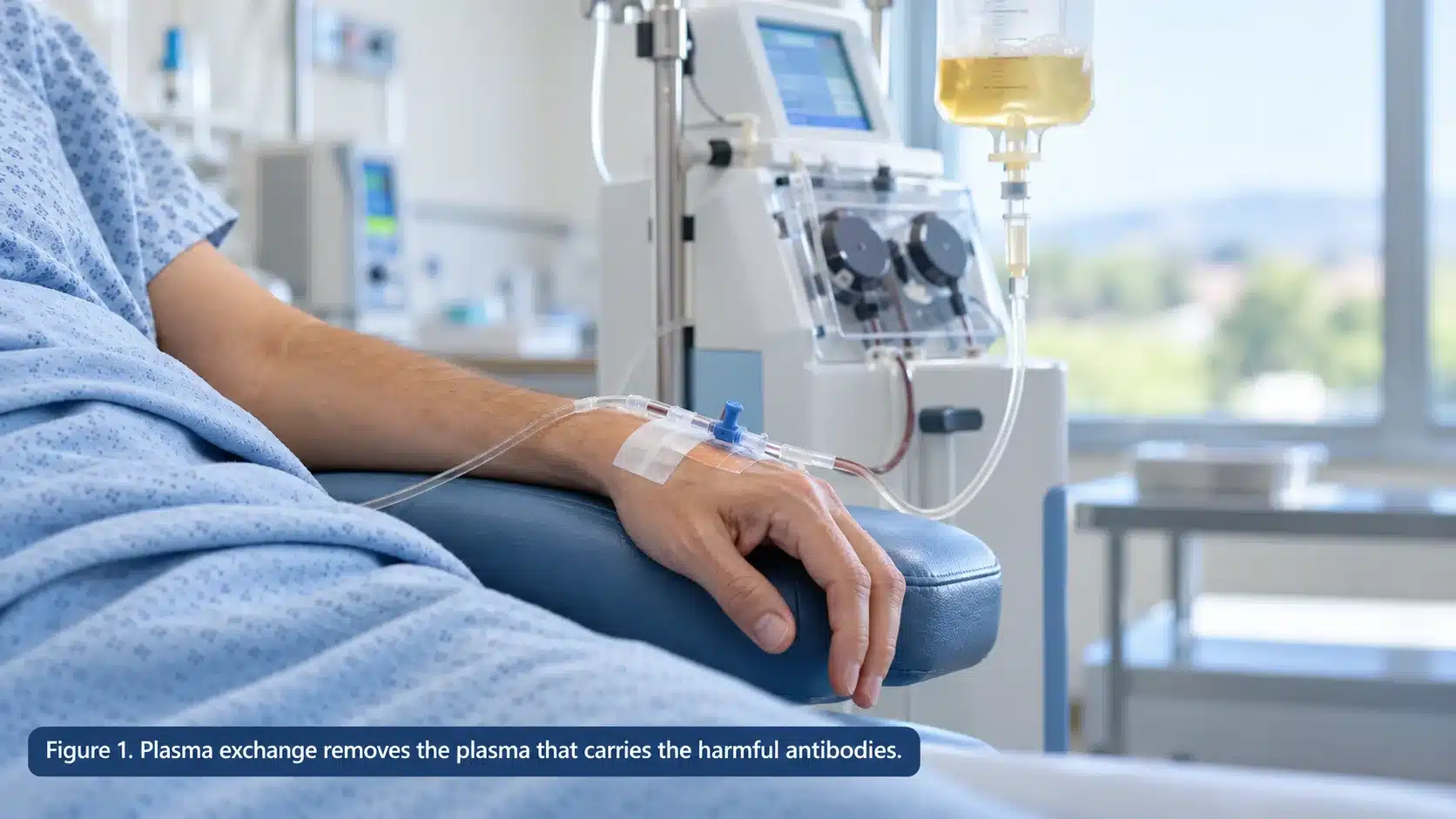
Plasma exchange is one of the standard treatments for CIDP, short for chronic inflammatory demyelinating polyradiculoneuropathy. In CIDP, the immune system damages myelin, the fatty coating around the nerves in the arms and legs, and this causes weakness and numbness. Plasma exchange removes the plasma, the liquid part of the blood that carries the antibodies, and replaces it. It is also called plasmapheresis, or PLEX for short.
Plasma exchange works quickly, and its effect also fades quickly. That is why it is usually given in repeated courses rather than once. Every figure comes from the two randomised trials of plasma exchange in CIDP, the Cochrane reviews or the 2021 European guideline. For CIDP that keeps returning on standard treatment, HSCT Hospital India offers HSCT in one 30 day stay in New Delhi.
What is plasma exchange for CIDP, and how is it done?
Plasma exchange filters your blood through a machine in a hospital unit. Blood is drawn from a vein, and the machine separates the plasma from the blood cells. The plasma is removed, and your blood cells are returned with a replacement fluid, often albumin, a protein found in normal blood.
Each session takes several hours, and you lie or sit in a treatment chair while it runs. Some patients need a central line, a thin tube placed in a large vein, when the arm veins are not suitable for repeated sessions. The aim of each session is to lower the level of the antibodies that attack the nerves, so the nerves can start to work better.
How many plasma exchange sessions will I need for CIDP?
A course of plasma exchange for CIDP is usually about five sessions over two weeks, according to the Cochrane review of the treatment. The two trials that tested it used longer courses. One gave 10 exchanges over four weeks, and the other gave six exchanges over three weeks.
After the first course, the number of sessions depends on how long your improvement lasts. In practice, people with CIDP often need repeated courses, or plasma exchange combined with other treatment, because the benefit does not hold on its own. Your neurologist sets the timing of each new course by watching when the weakness starts to return.
How well does plasma exchange work for CIDP?
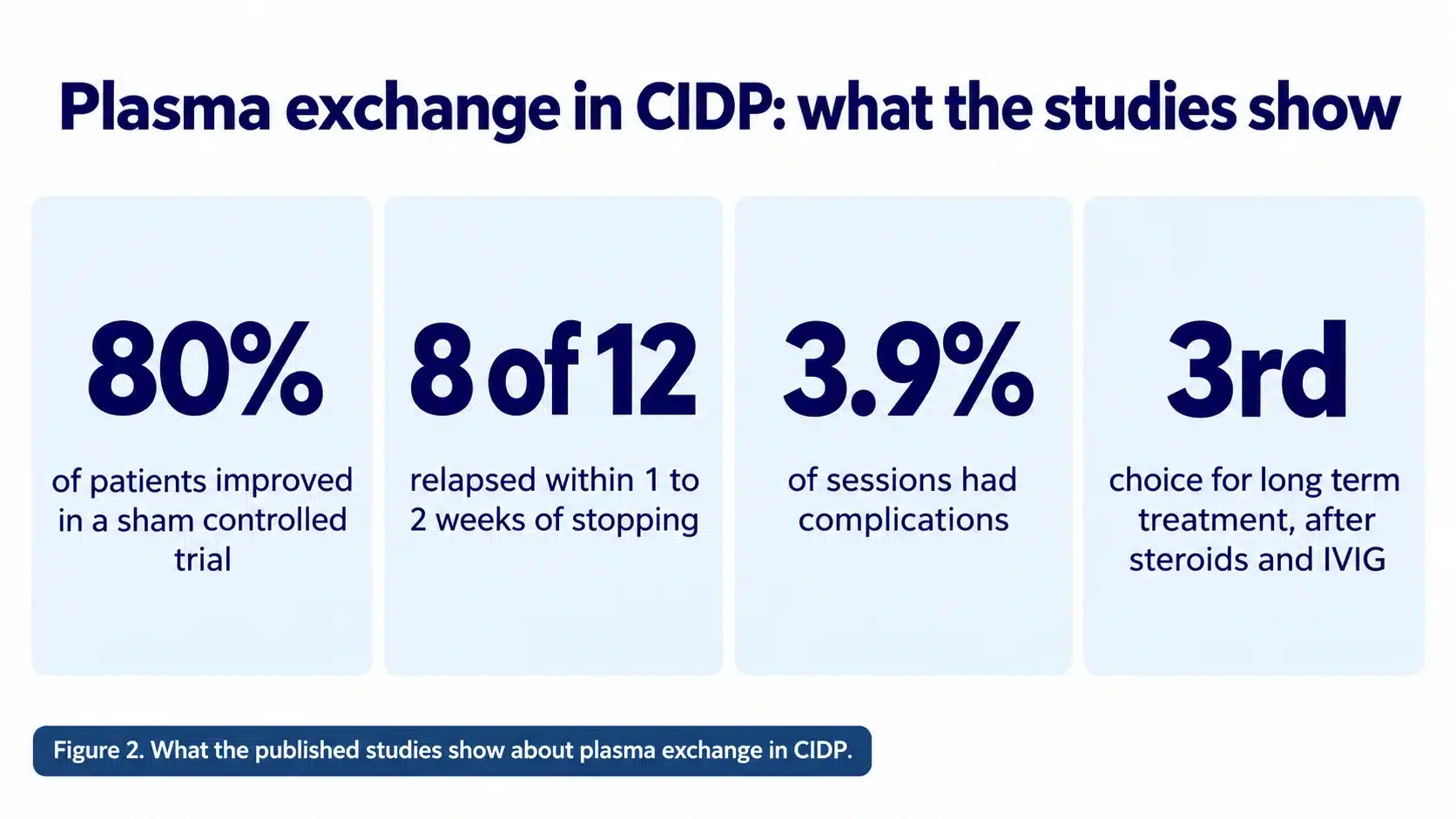
Plasma exchange improves CIDP in most patients in the short term, and both randomised trials found this. In a trial published in Brain in 1996, 18 patients with untreated CIDP received real or sham plasma exchange, where the blood is taken out and returned without being changed. Of the 15 who completed the trial, 12, or 80 per cent, improved substantially with real plasma exchange.
The earlier trial, from the Mayo Clinic, was published in the New England Journal of Medicine in 1986. It compared three weeks of plasma exchange in 15 patients with sham exchange in 14. Nerve test results improved in the plasma exchange group, and some patients also improved clearly on examination, while others did not change.
The Cochrane review combined both trials, 59 patients in all. It found high quality evidence that plasma exchange improves the signs of CIDP that a neurologist measures, and moderate quality evidence that it improves disability. Every result in both trials was short term, measured after three or four weeks.
How long does the benefit of plasma exchange last?
The benefit of plasma exchange usually lasts days to weeks, not months. In the 1996 trial, 8 out of 12 patients who had improved were weaker again 7 to 14 days after their final exchange. The authors described this as a rapid deterioration once the exchanges stopped.
This happens because plasma exchange removes the antibodies but does not stop the immune system from making more. Once the level builds up again, the nerve damage starts again. For you, this means plasma exchange controls CIDP while it is given, and it has to be repeated for as long as the disease stays active.
What side effects can plasma exchange cause, and how are they managed?
Most plasma exchange sessions pass without a problem. In the largest observational study, 3.9 per cent of sessions had a complication, according to the Cochrane overview of CIDP treatments. The Cochrane review notes that a complication can sometimes be serious, and this is why plasma exchange is given only in a hospital unit.
In the unit, staff watch you throughout each session, so a problem is picked up while the exchange is running. If you have a central line, it is cleaned and checked between sessions, because a line left in place for weeks can become infected.
Is plasma exchange better than IVIG for CIDP?
Plasma exchange and IVIG worked about equally well when they were compared directly. IVIG, short for intravenous immunoglobulin, is a drip made from antibodies donated by many blood donors. In a trial of 20 patients published in the Annals of Neurology in 1994, there was no clear difference in benefit between the two.
The difference lies in how each is given. IVIG is a drip through a small needle in the arm, and immunoglobulin can also be given under the skin at home. Plasma exchange needs a machine, a specialised unit and often a central line. Because of this, the 2021 guideline from the European Academy of Neurology and the Peripheral Nerve Society starts treatment with IVIG or steroids.
The two treatments differ less in cost than in convenience. A 2026 review in BMC Neurology found that In that review, a course of IVIG ran to roughly 1.4 times the price of plasma exchange for myasthenia gravis, and roughly 1.5 times for Guillain-Barré syndrome. CIDP itself has no trial comparing the two on price. Our CIDP treatment cost guide sets out the published figures for each treatment.
When is plasma exchange used in CIDP?
Plasma exchange is used when IVIG and steroids have not worked, and the 2021 guideline strongly recommends it at that point. Over the long term, the guideline ranks it behind both steroids and IVIG.
The full order of treatment is explained in our CIDP treatment options guide. That guide also covers efgartigimod and the other newer drugs. How CIDP is confirmed, and its different forms, are covered in the CIDP treatment guide.
What are my options if plasma exchange keeps wearing off?
If your CIDP still depends on plasma exchange, IVIG or steroids, autologous haematopoietic stem cell transplantation, known as HSCT, is considered. Autologous means the stem cells are your own. In HSCT, your own blood stem cells are gathered and stored frozen. Chemotherapy then removes the immune cells attacking your nerves, and the stored cells are given back so that new immune cells develop from them.
The largest published series comes from Northwestern University in Chicago (Journal of Neurology, 2020). Each patient had either not responded to, or could not come off, at least two of steroids, immunoglobulin and plasma exchange. Of the 60 patients analysed, 80 per cent needed no CIDP treatment one year after HSCT, and 83 per cent at five years. There were no treatment related deaths.
The same series also records who needed treatment again. Eleven of the 60, about 18 per cent, later restarted IVIG, plasma exchange or rituximab. Before HSCT, 33 per cent of the patients could walk without help, and after it, 81 to 86 per cent could in each of the five years. Each year of follow up is broken down in CIDP prognosis and the HSCT evidence.
The guidelines treat HSCT with care. In the 2021 European guideline, the evidence for HSCT in CIDP is judged not yet sufficient. That guideline reserves HSCT for specialised CIDP centres as a last resort, because of its side effects and a risk of death. The European Society for Blood and Marrow Transplantation lists CIDP that resists standard treatment as a clinical option for HSCT.
How does HSCT for CIDP work at HSCT Hospital India?
HSCT for CIDP at HSCT Hospital India runs in four stages during one 30 day stay. The stages are Mobilisation, Harvest (Leukapheresis), Conditioning and Reinfusion. In mobilisation, a growth factor moves your stem cells out of the bone marrow and into the blood, and in the harvest they are collected and frozen.
Conditioning is the chemotherapy and antibody treatment that clears out the immune cells behind the nerve damage. HSCT Hospital India follows the non-myeloablative protocol first tested at Northwestern University in Chicago. Non-myeloablative means the chemotherapy is strong enough to reset the immune system but leaves the bone marrow able to recover. Your stored stem cells are then returned, and the new immune system rebuilds over about two weeks.
Most of the early risk is infection in those two weeks, while your new immune system recovers. Because of this, you stay in hospital for the whole 30 days, in a deluxe private room whose air passes through three levels of HEPA filters. Nurses cover the ward day and night, so any fever is picked up and treated straight away. You do not need any further chemotherapy once you are home.
Before HSCT is offered, your CIDP diagnosis is reviewed afresh by the HSCT specialists at HSCT Hospital India. A second look matters for CIDP, since a share of patients given that label prove to have another kind of neuropathy. Your overall health is assessed too, along with your response to each treatment so far, including how often plasma exchange has been needed.
What does HSCT at HSCT Hospital India cost, and what is included?
HSCT at HSCT Hospital India costs one all inclusive price of USD 30,000, given to you in writing ahead of travel. That single price covers every stage of HSCT and all 30 days in hospital, for you and an attendant. HSCT Hospital India holds JCI-USA accreditation alongside NABH and NABL, more than 1500 MS patients have been treated here, and patients come from 30 countries.
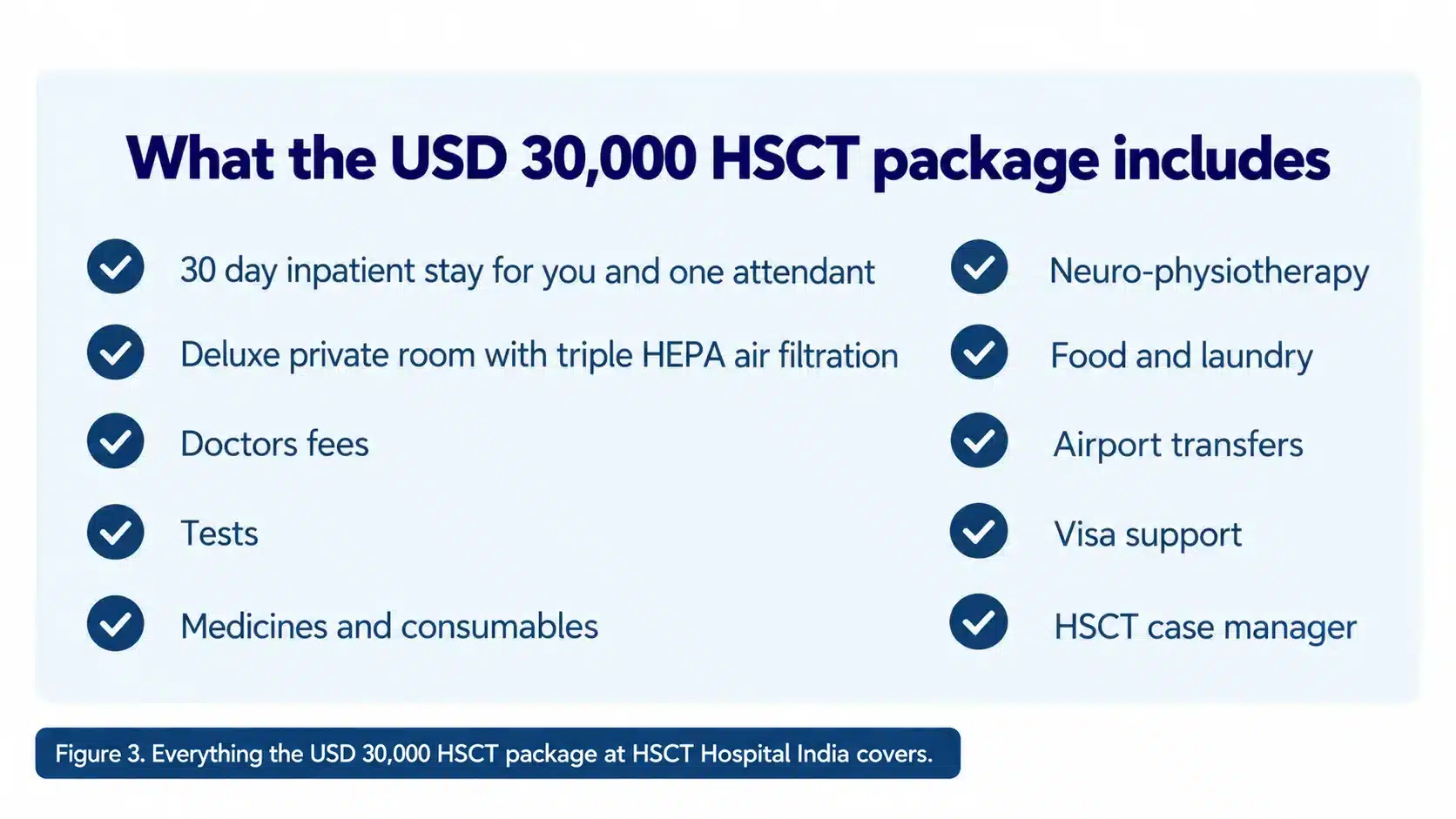
The price takes in every doctors fee, test, medicine and consumable, and neuro-physiotherapy runs throughout the stay. Your attendant shares your room, with food and laundry for both the patient and the attendant included. Airport pick-up and drop-back, help with your visa and your own HSCT case manager are included as well. The two things it does not cover are international flights and any extra hospital days beyond day 30 caused by a complication.
There is no long waiting list. The HSCT treatment package lists every inclusion. Dylan, a US police officer, was treated at HSCT Hospital India for autoimmune small fibre neuropathy, another condition in which the immune system damages the nerves. He tells his story in Dylan’s patient story.
Use the enquiry form to tell us your diagnosis and the treatments you have had, including how often you need plasma exchange. The HSCT specialists review your case without charge, and an HSCT Case Manager replies with their opinion and answers your questions. You can apply without scans or test results.
Frequently asked questions
Does plasma exchange work for CIDP?
Yes, in the short term for most patients. In a sham controlled trial published in Brain in 1996, 12 of the 15 patients who completed it, 80 per cent, improved substantially with plasma exchange. The Cochrane review of both randomised trials found high quality evidence that it improves the signs a neurologist measures. The benefit usually fades within weeks, so courses are repeated.
How many sessions of plasma exchange are needed for CIDP?
A course is usually about five sessions over two weeks, according to the Cochrane review. The two randomised trials used six exchanges over three weeks and 10 exchanges over four weeks. After the first course, sessions are repeated when the weakness starts to return. Many patients with CIDP need repeated courses for as long as the disease stays active.
How long does plasma exchange last in CIDP?
The benefit usually lasts days to weeks. In the 1996 Brain trial, eight of the 12 who had responded slipped back within 7 to 14 days of stopping. This happens because the immune system keeps making the antibodies that plasma exchange removes. For this reason, the 2021 guideline ranks plasma exchange behind steroids and IVIG for treatment over the long term.
Is plasma exchange or IVIG better for CIDP?
Neither was clearly better when they were compared directly. In a 1994 trial of 20 patients in the Annals of Neurology, plasma exchange and IVIG gave similar benefit. IVIG is easier to give, because it needs only a drip, and immunoglobulin can also be given under the skin at home. The 2021 European guideline therefore starts treatment with IVIG or steroids and uses plasma exchange when those have not worked.
Can HSCT replace plasma exchange for CIDP?
For some patients, yes. The Northwestern University series treated 60 patients who had failed or depended on at least two of steroids, immunoglobulin and plasma exchange. Five years after HSCT, 83 per cent of them needed no CIDP treatment. At HSCT Hospital India, HSCT is one 30 day inpatient stay for one all inclusive price of USD 30,000. The HSCT specialists review each case without charge before treatment is offered.
References
- Hahn AF, Bolton CF, Pillay N, et al. Plasma exchange therapy in chronic inflammatory demyelinating polyneuropathy. A double blind, sham controlled, cross over study. Brain. 1996;119:1055 to 1066. doi:10.1093/brain/119.4.1055
- Dyck PJ, Daube J, O’Brien P, et al. Plasma exchange in chronic inflammatory demyelinating polyradiculoneuropathy. New England Journal of Medicine. 1986;314:461 to 465. doi:10.1056/NEJM198602203140801
- Mehndiratta MM, Hughes RAC, Pritchard J. Plasma exchange for chronic inflammatory demyelinating polyradiculoneuropathy. Cochrane Database of Systematic Reviews. 2015;CD003906. doi:10.1002/14651858.CD003906.pub4
- Oaklander AL, Lunn MPT, Hughes RAC, et al. Treatments for chronic inflammatory demyelinating polyradiculoneuropathy (CIDP): an overview of systematic reviews. Cochrane Database of Systematic Reviews. 2017;CD010369. doi:10.1002/14651858.CD010369.pub2
- Dyck PJ, Litchy WJ, Kratz KM, et al. A plasma exchange versus immune globulin infusion trial in chronic inflammatory demyelinating polyradiculoneuropathy. Annals of Neurology. 1994;36:838 to 845. doi:10.1002/ana.410360607
- Van den Bergh PYK, van Doorn PA, Hadden RDM, et al. European Academy of Neurology and Peripheral Nerve Society guideline on diagnosis and treatment of chronic inflammatory demyelinating polyradiculoneuropathy, second revision. Journal of the Peripheral Nervous System. 2021. doi:10.1111/jns.12455
- Kimber and colleagues. Clinical and economic outcomes of therapeutic plasma exchange and intravenous immunoglobulin for treating adults with autoimmune neurological disorders: a systematic review and meta analysis. BMC Neurology. 2026. doi:10.1186/s12883-026-04780-1
- Hematopoietic stem cell transplantation for chronic inflammatory demyelinating polyradiculoneuropathy. Journal of Neurology. 2020;267:3378 to 3391. doi:10.1007/s00415-020-10010-6
- Sharrack B, Saccardi R, Alexander T, et al. Autologous haematopoietic stem cell transplantation and other cellular therapy in multiple sclerosis and immune mediated neurological diseases: updated guidelines and recommendations from the EBMT. Bone Marrow Transplantation. 2020;55:283 to 306. doi:10.1038/s41409-019-0684-0
Popular Posts