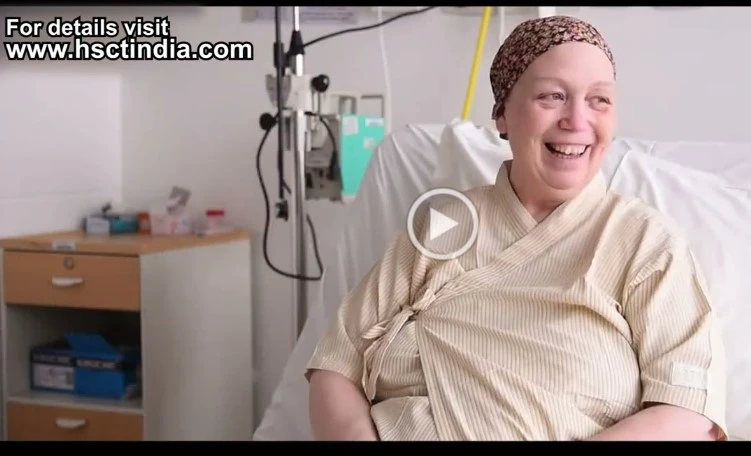
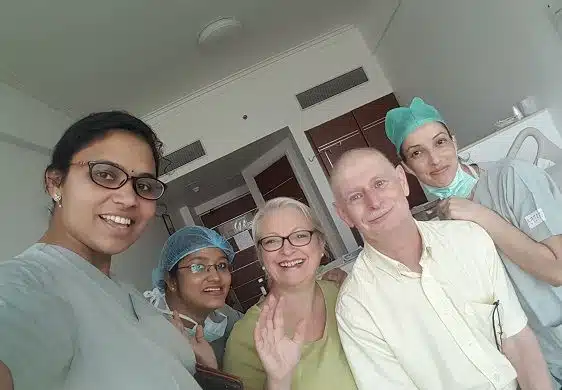
Janet, a teacher and machinist from Canada, was diagnosed with relapsing remitting multiple sclerosis in her early forties. Within four years she could no longer work, her hands and her left side were numb, and she needed help at home with simple tasks. She came to HSCT Hospital India in New Delhi for HSCT, with her daughter as her attendant. Five months after treatment, she wrote to her HSCT Case Manager that her new MRI showed no new lesions.
In MS, white blood cells damage myelin, the fatty sheath that insulates nerve fibres in the brain and spinal cord. Where myelin is damaged, signals to the hands, legs and eyes slow down or fail, which is what Janet describes in her video. HSCT, short for haematopoietic stem cell transplantation, clears those white blood cells with chemotherapy. The patient’s own stem cells, collected and frozen beforehand, are then given back, and they produce new blood and immune cells.
Janet from Canada: HSCT for MS at a Glance
Patient
Janet is from Canada, and she worked as a substitute teacher and a machinist.
Condition
She was diagnosed with relapsing remitting MS in her early forties.
Before HSCT
Her hands and her left arm and leg were always numb, she lost her balance and she could no longer work.
MS medicines before HSCT
Her family says a first medicine costing 25,000 dollars a year did not stop her MS, and a second cost 55,000 dollars a year.
Attendant
Her daughter came with her to India and stayed with her through the treatment.
After HSCT
Five months after treatment, she wrote that her MRI showed no new lesions.
Price of the programme today
HSCT Hospital India charges 30,000 US dollars, all inclusive, for up to 30 days in hospital.
How MS changed Janet’s life before HSCT
Janet’s first sign came on a drive to work in the dark, when the road did not look right to her. She taught that day, went home for a nap, and woke up barely able to reach the kitchen table. An MRI followed, and three months later her doctor gave her the diagnosis.
"My hands are always numb now. My left side, my left arm, and my left leg are always numb. I lose my balance now. I avoid stairs because I’m afraid of falling."
Janet, MS patient from Canada
Janet says her MS kept getting worse little by little. She had trouble cooking because her fingers did not work properly, and she began to forget things. She once called her eldest daughter at university to wish her a happy birthday on the wrong day.
Work went too. Janet had held two jobs, as a machinist and as a substitute teacher, and she says she can no longer do either. She often taught the most difficult students and had the patience for them. Teaching again was the reason she gave for wanting treatment.
"I would like to get better so that way I can teach again."
Janet, MS patient from Canada
A patient in Canada can ask for the HSCT Hospital India brochure by email. It explains each stage of treatment, the 30 day stay and what the single price includes.
Janet’s family says her first MS medicine cost 25,000 dollars a year and did not stop her MS from getting worse. Her second medicine cost 55,000 dollars a year. She was not able to join a clinical trial of HSCT in Canada, and the treatment was not offered to her at home.
Her family found a programme abroad quoted at about 80,400 US dollars, which they could not afford after years without her income. They then found HSCT Hospital India, where one all-inclusive price covers the treatment and the 30 day stay. Prices in other countries are compared on the page about HSCT cost by country.
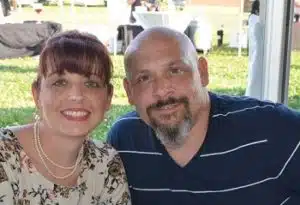
Janet’s daughter Chantel, then a 20 year old student at York University, speaks in the video too. She says her mother found it hard to ask for help, so she asked on her behalf.
"What it would mean for me if my mom were to get this treatment is I would get my mom back. She would be herself again and I could tell her things and she would remember them."
Chantel, Janet’s daughter
Patients in Canada and elsewhere can send their diagnosis, MRI report and the MS drugs they have tried through the enquiry form. There is no fee for the review by the specialist doctors of HSCT Hospital India, and an HSCT Case Manager emails the answer.
What HSCT at HSCT Hospital India involved for Janet
Janet came to New Delhi with her daughter, who shared her private room through the stay. HSCT at HSCT Hospital India is one in-patient stay of up to 30 days. It starts with a full medical evaluation and follows four stages in a fixed order: mobilisation, collection of the stem cells, conditioning and reinfusion.
In mobilisation, a growth factor and a short course of chemotherapy move stem cells from the bone marrow into the blood. A machine then collects them over several hours, and they are frozen. Conditioning uses cyclophosphamide and anti-thymocyte globulin, or ATG, to clear the immune cells behind the MS. The frozen stem cells are then thawed and given back through a drip.
In the days after reinfusion, the blood counts are at their lowest, a stretch doctors call the aplastic phase. Every patient at HSCT Hospital India stays in hospital through these days, in a deluxe private room with Triple HEPA air filtration. Nurses are present day and night, so a fever is treated as soon as it starts. Each stage is explained in the MS treatment guide.
Janet’s MRI five months after HSCT, in her own words
Five months after treatment, Janet wrote to her HSCT Case Manager in India about her latest MRI scan. An MRI shows lesions, the areas of damage to myelin, and a new lesion is a sign that MS is still active. Janet wrote that her scan showed none.
"I had a MRI a week ago, September 18 2017. I showed no new lesions, and repair had begun on the left side of the brain. I was not expecting such good news."
Janet, MS patient from Canada
Janet’s HSCT in her own words: before and after
Before: body
Her hands and her left side were always numb, and she avoided stairs for fear of falling.
Before: daily life
She could not work and depended on her family for simple tasks such as cooking.
Before: medicines
Her family says two MS medicines, at 25,000 and 55,000 dollars a year, did not stop her MS.
After: MRI at five months
She wrote that her scan showed no new lesions.
After: her own words
She wrote that she was not expecting such good news.
After the 30 day stay, recovery continues at home, and most patients return to their usual activities within 2 to 4 months. What to expect month by month is explained in how long it takes to recover after HSCT for MS. What happens if MS becomes active again is covered in can MS come back after HSCT.
Travelling from Canada to New Delhi raises questions about flights, the Indian medical visa and bringing a family member. An HSCT Case Manager can phone you to go through them, free of charge.
For a Canadian patient, the first step is the enquiry form with recent MRI reports and a list of past MS medicines. The HSCT specialist doctors at HSCT Hospital India read these and send a free opinion on whether HSCT is likely to help. If it is, an HSCT Case Manager plans the visa and travel. Treatment starts only after a full medical evaluation in New Delhi.
HSCT Hospital India has treated more than 1,500 people with MS, from over 30 countries, since 2016, using the non-myeloablative protocol developed by Dr Richard Burt. The hospital holds JCI-USA accreditation from the Joint Commission International, as well as NABH and NABL, India’s national boards for hospitals and laboratories. The price of 30,000 US dollars is all inclusive for up to 30 days. It covers treatment, the private room and the attendant’s stay, with food and laundry for both, and airport pick-up and drop-back. There is no long waiting list.
Janet: I sometimes have a problem cooking now, because my fingers don’t work right, trying to even just mix stuff up in the frying pan. I have to depend on Vince to help me with simple things like that.
Janet: I would like to get better so that way I can teach again. A lot of times I got the difficult students, but I had the patience for them and really did well with those students. So I’d love to go back to doing that. Currently I’m not working because of my MS. I used to work both as [a] machinist and teaching. I would do both jobs. But now I can’t do either one.
Janet: I noticed when I drove to work in the morning time it was dark. The road just didn’t seem right. But I worked through it. And then that Monday I substituted. I went home and I said to my youngest daughter, “Oh, I just need a nap.” I laid down for the nap and I got up and I could barely get to the kitchen table. We’ll do an MRI and take it from there. So I waited [and] three months later I go back and see him.
Janet: There are a lot of things that I used to do but I can’t do now. It just keeps little by little getting worse and worse. I never thought I’d be this bad, but I am. My hands are always numb now. My left side, my left arm, and my left leg are always numb. I lose my balance now. I avoid stairs because I’m afraid of falling. I never did that before. I forget things now. My oldest daughter, she’s in university. I had called her up thinking that it was her birthday, but it wasn’t. I felt really bad about doing that.
Chantel: My mom has trouble asking for help, so I’m asking for her. My name is Chantel. I am Janet’s daughter. I’m 20 years old. I go to York University. We’re really hoping that she can get into this treatment, because it would really give her her life back. What it would mean for me if my mom were to get this treatment is I would get my mom back. She would be herself again and I could tell her things and she would remember them.
Before booking anything, a Canadian patient can find out whether HSCT is likely to help. The review by the HSCT specialist doctors at HSCT Hospital India costs nothing and carries no obligation.
Why Choose HSCT Hospital India for Life Changing Multiple Sclerosis Treatment
HSCT Hospital India is one of the finest private hospitals in India and Accredited by JCI-USA. Most Affordable, 30,000 US $ HSCT package includes complete treatment cost for 30 days in hospital stay in a deluxe private room, Doctors Fee, Tests and Consultations, Medicines, Consumables, Physiotherapy and also Food and Laundry for both the patient and the attendant, Airport Transfers etc. Large number of patients from Europe, America and Australia already treated successfully. Click here to know more
Complete 30 day HSCT done in hospital. Private deluxe rooms are very well served for patient and attendant comfort and equipped with HEPA Filter with Triple Level Air Filtration. No outside hospital stay avoids risk of infection during the aplastic phase, 24 x 7 nursing care and best medical attention. Advanced HSCT protocol used does not require any further chemo or treatment after leaving the hospital. Click here to get complete details
International and Globally Renowned Accreditations. HSCT Hospital India is accredited by the Joint Commission International, USA, the National Accreditation Board for Hospitals and Healthcare Providers (NABH), and the National Accreditation Board for Laboratories (NABL) for processes and high quality patient care. Click here to know more
More than 1,500 patients from Europe, America and Australia have already been treated successfully at HSCT Hospital India. Our multi-disciplinary team reviews every multiple sclerosis referral, including the EDSS recorded by the treating neurologist, the MRI sequence over time and the relapse history, before any decision is taken. Click here to watch patient testimonial videos
Gudrun R travelled from the United Kingdom to HSCT Hospital India for HSCT for relapsing remitting multiple sclerosis. She arrived pushing a rollator, able to stand for two or three minutes before she needed to rest.
Five weeks later she was walking with a stick, and taking short walks without it.
Her neurology team at home had advised her against coming. She came anyway, and she filmed what happened.
Gudrun R is one of more than 1500 MS patients treated at HSCT Hospital India. The published HSCT success rates for MS are reported across the wider medical literature.
Gudrun R: HSCT for MS Results at a Glance
Patient
Gudrun R, United Kingdom
Condition
Relapsing remitting multiple sclerosis, diagnosed 22 October 2007
Treatment
Autologous HSCT at HSCT Hospital India, New Delhi
Time in hospital
Five weeks, with her husband beside her as attendant
Walking before
Rollator. Two to three minutes standing, then rest.
Walking after
Stick. Short distances with no stick at all.
Pain reported
None
In her words
“Every single day after the stem cell transplant I have achieved one thing.”
Gudrun had her transplant at HSCT Hospital India in New Delhi, a hospital accredited by JCI-USA, NABH and NABL. It has treated more than 1500 MS patients who came from 30 countries.
The HSCT specialists there give a free expert opinion on any case sent to them, and asking costs nothing and commits you to nothing. Replies come personally from a case manager, in English, on email or WhatsApp.
Gudrun R is from the United Kingdom. She was diagnosed with relapsing remitting multiple sclerosis on 22 October 2007 and lived with it for over a decade before she looked into haematopoietic stem cell transplantation, the procedure usually written as HSCT.
She travelled to HSCT Hospital India with her husband Mark, who stayed with her as her attendant for the full five weeks. She arrived on a Monday, the 14th of May.
Life Before HSCT
Gudrun describes a steady decline rather than a sudden collapse. Around the house she could manage two or three minutes on her feet, then had to stop and rest, then go again. She used a mobility scooter at home and a wheelchair for longer distances, and on the day she travelled she was walking with a rollator.
She is direct about where she believed that was heading. In her own words she was going down and down, and expected to end up bedridden within a year, or two, or three.
What Her Own Neurology Team Told Her
Gudrun raised HSCT with her MS team in the United Kingdom the previous October. They advised her against it and invited her and Mark to a seminar, which included a half hour section on stem cell treatment.
Both of them came away from that half hour feeling it had been built to put them off. The treatment was described to them as quite painful. When Mark asked about MRI scanning, her neurologist closed the conversation by telling her to go ahead and do it if she wanted to.
She took him at his word. What she experienced at HSCT Hospital India was different from what she had been prepared for, and she says so plainly on camera: no pain at all.
Why She Chose HSCT Hospital India
Gudrun and Mark researched which countries offered the procedure. She looked at Russia first, then found India, and says she had not realised until then that it was an option.
She completed the eligibility form, went through the criteria and was approved. A date was set for arrival, the information pack followed, and payment and communication were straightforward. Her account of the administration is short because nothing about it gave her trouble.
Gudrun received autologous non myeloablative HSCT. Autologous means her own stem cells were used rather than a donor’s. Non myeloablative means the conditioning chemotherapy is dosed to reset the immune system rather than to clear the bone marrow completely. The procedure runs in four stages.
Stage
What happens
What Gudrun reports
1. Mobilisation
Growth factor medication moves stem cells out of the bone marrow into the bloodstream.
No pain.
2. Harvest (Leukapheresis)
Blood passes through a machine that separates and stores the stem cells, then returns the blood.
No pain.
3. Conditioning
Chemotherapy clears the misdirected immune system.
No pain.
4. Reinfusion
Her own stored stem cells go back in and rebuild the immune system, with platelet support alongside.
Sitting still for the platelets, dropping from three hours to fifteen minutes across the stay.
Every nursing aspect, in her description, was spot on. She rates the food the same way, and says her own daily treatments ran as regular as clockwork.
What Changed, and When
Gudrun worked through physiotherapy in stages after her reinfusion. Within two or three minutes of one of those sessions she was walking with a stick. Her rollator went that same afternoon and she did not go back to it.
From that point she set herself one thing a day. Getting out of bed. Walking with the rollator. Walking with the stick. Then a few short distances with no stick at all.
Before HSCT
By the end of her five week stay
Walking with a rollator
Walking with a stick, rollator no longer used
Two to three minutes on her feet, then rest
Short distances covered with no stick at all
Mobility scooter at home, wheelchair for distance
Building toward doing her own grocery shopping alone
Expected to be bedridden within one to three years
Achieving one new thing every day since reinfusion
She keeps her stick with her for security and for confidence, and is already walking short distances without it. Her doctor called her every day through the stay, and she describes the response from the doctors and the physiotherapist as thumbs up, high fives and fist bumps.
Her stated aim when she goes home is to do her own grocery shopping, by herself.
HSCT Hospital India sees patients at every stage of MS, from a recent diagnosis to long term progressive disease. Specialists review each case one by one and give a free opinion on whether HSCT is suitable, without cost or obligation.
“What my expectations were, from what my neurologist had told me, were quite different to what actually happened. No pain. Absolutely no pain whatsoever.”
“Every single day after the stem cell transplant I have achieved one thing. One thing every day.”
“I would definitely, definitely recommend this. My aim is to do my shopping, my grocery shopping, by myself, and everything else by myself. That’s my aim, and I can’t wait.”
Mark, her husband, was in the room with her for the whole five weeks. His summary is that the attendant is an essential part of the stay, because however good the staff are, the patient needs support from home as well. Gudrun’s reply to him on camera was that he saved her life.
Gudrun’s Video Testimonial
Full Transcript
Gudrun: I’m Gudrun from the UK. I was diagnosed with MS, relapsing remitting, on 22 October 2007, so it’s been quite a few years I’ve had it.
I decided back last October that I’d look into having stem cell treatment. I’d heard about it, where to have it done, things like that. I approached my MS team and they advised me against it, but invited me to a seminar where they were discussing stem cell treatment. Me and my husband went along to that for a few hours. They did talks and everything, as a seminar, and they did a half hour section on the stem cell. Me and my husband found it very, very negative. He explained the treatment as quite painful. It just was trying to put us off, really. He didn’t really want anyone to do it. And my neurologist, when my husband questioned him about MRIs and all this, at the end of it just said, go ahead, do it if you want to. It felt like, you know, just go ahead if you want to.
So I said to my husband, well, yeah, I’m going ahead with it. So we’ll find out what countries to go to, find out all the information. And I came across India, because at that time I was researching Russia, and then India, because I didn’t realise. So I picked India to have a look at. I filled in the form and heard back. We filled in the forms, all the criteria, and I was approved. Then she found a date, the 14th of May, Monday the 14th of May, as the date of arrival. Confirmed all that, sent out all the information, got the ball rolling, basically. And I arrived here on the 14th of May, all sorted. Payments easy. Communication very good. Everything went very smoothly.
And I arrived here, and what my expectations were, from what my neurologist had told me, were quite different to what actually happened. No pain. Absolutely no pain whatsoever. The only uncomfortable little bit was when the platelets went in. The first few days was about three hours of being sort of motionless, and then the following couple of days after, it went down to about an hour, and then the last couple of days of the platelets it went down to fifteen minutes and I was, as I call it, back in the room.
Every nursing aspect has been spot on. Perfect. All the food has been perfect. Everything, cups of tea and biscuits, spot on. And my treatments that I do myself have been as regular as clockwork. All the exercises with my physiotherapist, stage by stage. Within two minutes, three minutes I was walking with a stick. My rollator went within that afternoon and I was walking with my stick. And today I’ve got some more exercises to do, squats and everything. I will build on that.
Every single day after the stem cell transplant I have achieved one thing. One thing every day. Like getting out of bed, walking with a rollator, walking with my stick. And I’ve done a few little walks without my stick as well, but I keep my stick on me just for security, just to get my confidence. And taking my pills all the time, and that will be ongoing for when I go home. Dr G calling every day, giving me the thumbs up. I’ve had a couple of high fives and a couple of fist bumps off the doctors, and the physio. So everyone’s been really pleased.
I would definitely, definitely recommend this. To me it’s going to put my MS behind the door and lock it. That’s how I feel about it. Previously, before the stem cell, I was just going down, down, down, down, down, to end up probably within the year, maybe two years, maybe three, bedridden. Not doing anything, because all I was doing was walking around the house for two minutes at a time, three minutes, and I’d have to stop and rest, do some more, stop and rest. It was just a downward spiral. I use my scooter at home, I use my wheelchair for long distances.
I intend to improve on that, using a trolley, and I’ll build myself up, which I will, with the exercise. My aim is to do my shopping, my grocery shopping, by myself, and everything else by myself. That’s my aim, and I can’t wait. I’m really looking forward to it.
Mark, Gudrun’s husband and attendant: Hi, my name is Mark. I came over to support my wife, Gudrun. We were met by the doctor, where we had a meeting that explained everything that was going to happen, so she expected everything to go like clockwork, which it did.
The room itself, we’ve stayed here now for five weeks, which is a long time to be stuck in one room, but the service has been excellent. We’ve been having regular food. Because we’re English speaking it took a little bit of time, but we were shown how to find the English channels, so we’re watching the BBC News, and film channels are on twenty four hours, so if you wanted to watch a film you were okay. Saying that, we were both in bed for nine o’clock, because we were up at six with the cleaner lady and the cups of tea and things, which is great.
Overall it’s been a really positive experience. She’s really happy, and I’m happy that she’s happy. The attendant is an essential part, because if the attendant wasn’t here to help me, I would have struggled a little bit.
Gudrun: You saved my life.
Mark: It’s just important to have someone to support whoever is having the treatment done, because however good these people are, they need the support from the home. And we’re just looking forward now to going home in two days’ time and carrying on the good work that these guys have done.
Talk to HSCT Hospital India
Patients stay in a deluxe private room fitted with triple level HEPA air filtration. One all inclusive price of 30,000 USD covers the programme, without a long waiting list.
To find out whether HSCT is suitable for your own MS, send your reports for a free review by the HSCT specialist team. A case manager will answer you personally and talk it through at whatever stage you are at.
Athena B travelled from Tunisia to New Delhi for treatment of her secondary progressive multiple sclerosis at HSCT Hospital India. Before treatment, she wrote, her MS was getting worse every month and no other standard treatment was left for her. Three weeks after she returned home, she wrote that she was recovering well and working with a physiotherapist.
Multiple sclerosis, or MS, is an immune condition in which white blood cells damage myelin, which coats and protects the nerves of the brain and spinal cord. Secondary progressive MS, shortened to SPMS, begins after years of relapsing MS, once recovery between relapses stops being complete and disability keeps growing. In autologous haematopoietic stem cell transplantation, known as HSCT, chemotherapy removes the immune cells behind MS. The patient’s own stored stem cells are then given back to build a new set of immune cells.
Athena from Tunisia: HSCT for MS at a Glance
Patient
Athena B lives in Tunisia, in North Africa.
Condition
She had secondary progressive MS, which she wrote was getting worse every month.
How she found the hospital
She learned about the hospital in Facebook groups about HSCT, from patients treated there before her.
Application
Her application went in during December 2017, and she was offered an arrival date of 11 March.
Treatment
Her treatment was autologous HSCT, carried out at the hospital in New Delhi.
After HSCT
Three weeks after returning home, she wrote that she was recovering well and seeing a physiotherapist.
Price of the programme today
The programme costs 30,000 US dollars all inclusive, covering up to 30 days in hospital.
Secondary progressive MS that was getting worse every month
By the time Athena applied, her MS had reached the secondary progressive stage. She describes it worsening from one month to the next, with no other standard treatment left for her to try. Because of that, she wanted to start treatment as soon as she could.
"My decision was done and I was impatient to get the treatment as my case of SPMS was getting worse every month with no alternative classical solutions."
Athena B, MS patient from Tunisia, written three weeks after returning home
The HSCT specialist doctors at HSCT Hospital India assess primary and secondary progressive MS case by case. The deciding question is whether a recent MRI still shows inflammation. How that assessment works is explained in HSCT for progressive MS.
Athena read the hospital website in full before she applied. Ask for the HSCT India brochure and it arrives by email, setting out the treatment stages, the 30 day stay and what the one price covers.
How Athena found HSCT Hospital India through earlier patients
Athena started her research in HSCT groups on Facebook. Patients who had already been treated at HSCT Hospital India encouraged her to apply. She then read through the hospital website before she sent her application.
"I researched HSCT groups on Facebook and received encouragement from previous patients who had HSCT at HSCT Hospital India. After I thoro[u]ghly checked out the website www.hsctindia.com, I applied in December 2017 and wa[s] offered an appointment to arrive at HSCT Hospital India on March 11, which I confirmed immediately."
Athena B, MS patient from Tunisia, written three weeks after returning home
Her application followed the route every patient takes. The HSCT specialist doctors read the form and the medical reports sent with it, and an HSCT case manager writes back with their opinion. Athena was then given a confirmed arrival date. No patient starts treatment until the doctors have examined them in person after arrival.
Athena’s first step was the application form, and yours is the same. Send your diagnosis, recent medical reports and the medicines you have tried. The HSCT specialist doctors review them free of charge.
Staff met Athena at New Delhi airport and took her through admission. She describes that welcome in her message.
"The staff took me in charge as soon as I arrived starting receiving me at the New Delhi airport."
Athena B, MS patient from Tunisia, written three weeks after returning home
Her treatment followed four stages, called mobilisation, harvest, conditioning and reinfusion. Mobilisation relies on a growth factor plus brief chemotherapy, which make stem cells leave the marrow and enter the bloodstream. A machine then collects and freezes them, a step called leukapheresis. Conditioning uses cyclophosphamide with anti-thymocyte globulin, or ATG, to clear the immune cells that drive MS. After that, the frozen stem cells go back in through a drip.
"Nurses and doctors at HSCT Hospital India are really lovely people : always available, responding to each demand, competent and very efficient."
Athena B, MS patient from Tunisia, written three weeks after returning home
Athena writes that the treatment was not easy. Side effects are expected after conditioning, and the nurses watch for them day and night. In the days after reinfusion, immunity is at its lowest, a stretch doctors call the aplastic phase. Each patient spends it in a deluxe private room with triple level HEPA air filtration, so that a fever or an infection is found and treated early.
"The follow up of HSCT transplant and its secondary effects were very efficiently managed by the medical and nursing team of HSCT Hospital India."
Athena B, MS patient from Tunisia, written three weeks after returning home
Athena three weeks after returning home to Tunisia
Athena wrote her message three weeks after she got home. She says she is recovering well and working regularly with a physiotherapist, as she had been advised to. She calls it early days and offers to share her progress later.
"I’m back home from India and it has been 3 weeks now, I’m recovering well and working regularly with a physiotherapist to optimize the treatment results as recommended. It’s still early days but I will be happy to share with you all my future progress after HSCT at HSCT Hospital India."
Athena B, MS patient from Tunisia, written three weeks after returning home
Recovery continues at home for months after the 30 day stay, while the new immune system matures. Two to four months after HSCT, most patients treated by HSCT Hospital India have resumed normal daily life, as set out in HSCT recovery time. During that time, blood counts are checked regularly, and neuro physiotherapy, meaning exercise guided by a physiotherapist, rebuilds strength and balance.
Coming from Tunisia means planning a flight to New Delhi, a medical visa for India and the stay of the person who travels with you. An HSCT case manager can call you to answer them, at no charge.
Patients from Tunisia apply the same way Athena did, through the enquiry form with their medical reports. The HSCT specialist doctors give a free opinion first. An HSCT case manager then helps plan the visa and the travel, and there is no long waiting list.
More than 1,500 MS patients from over 30 countries have had HSCT at the hospital. Its accreditations are JCI-USA, awarded by the Joint Commission International, plus NABH and NABL, the Indian national standards for hospitals and laboratories. The 30,000 US dollar price includes the hospital stay, doctors’ fees, tests and consultations, medicines and consumables, and neuro-physiotherapy. Food and laundry for the patient and one attendant, and airport pick-up and drop-back, come within the same price.
I researched HSCT groups on Facebook and received encouragement from previous patients who had HSCT at HSCT Hospital India. After I thoro[u]ghly checked out the website www.hsctindia.com, I applied in December 2017 and wa[s] offered an appointment to arrive at HSCT Hospital India on March 11, which I confirmed immediately.
My decision was done and I was impatient to get the treatment as my case of SPMS was getting worse every month with no alternative classical solutions.
The staff took me in charge as soon as I arrived starting receiving me at the New Delhi airport.
Nurses and doctors at HSCT Hospital India are really lovely people : always available, responding to each demand, competent and very efficient.
The treatment is very safe though it’s not easy but everybody at HSCT Hospital India was so encouraging and helpful. The follow up of HSCT transplant and its secondary effects were very efficiently managed by the medical and nursing team of HSCT Hospital India.
I’m back home from India and it has been 3 weeks now, I’m recovering well and working regularly with a physiotherapist to optimize the treatment results as recommended. It’s still early days but I will be happy to share with you all my future progress after HSCT at HSCT Hospital India.
Best regards, Athena B from Tunisia.
Patients with secondary progressive MS can ask for their own case to be read before deciding anything. The opinion comes from the hospital’s HSCT specialist doctors, and it costs nothing.
David Karczewski from the United States came to HSCT Hospital India in New Delhi for HSCT to treat his multiple sclerosis. Before treatment he used a walker, his legs and feet were numb, and he had trouble with speech and finding words. Eleven months after HSCT, he wrote that he no longer used a walker and that the feeling had come back in his feet and legs.
In MS, white blood cells damage myelin, the fatty sheath that insulates nerve fibres in the brain and spinal cord. Where myelin is damaged, signals to the legs, the hands and the muscles of speech slow down or fail, which matches what David describes. HSCT, short for haematopoietic stem cell transplantation, clears those white blood cells with chemotherapy. The patient’s own stem cells, collected and frozen beforehand, are then given back, and they produce new blood and immune cells.
David from the USA: HSCT for MS at a Glance
Patient
David Karczewski is from the United States.
Condition
He was living with multiple sclerosis and had daily symptoms in his legs, his speech and his energy.
Before HSCT
His legs and feet were numb, he used a walker, he stuttered and found it hard to find words, and he was always tired.
Treatment
He had HSCT at HSCT Hospital India in New Delhi and then followed the hospital’s plan for recovery at home.
After HSCT
Eleven months after treatment, he wrote that the feeling had come back in his feet and legs and that he no longer used a walker.
Price of the programme today
HSCT Hospital India charges 30,000 US dollars, all inclusive, for up to 30 days in hospital.
How MS affected David’s life before HSCT
David lists his daily symptoms himself. His legs and feet were numb, his balance and the use of his hands were poor, and he was tired all the time. He also had trouble with speech, which for him meant stuttering and losing words in the middle of a sentence.
"My MS journey started like most people. My daily symptoms included numbness in my legs and feet, speech issues chronic fatigue, balance and dexterity just to name a few. I was constantly thinking of my future with MS and the prognosis did not look good."
David Karczewski, MS patient from the USA, eleven months after HSCT
These symptoms come from damage in different parts of the nervous system. Numbness and poor balance follow damage in the spinal cord and the pathways to the legs. Stuttering and word finding problems follow damage in the brain areas that control speech and language.
A patient in the United States can ask for the HSCT Hospital India brochure by email. It explains each stage of treatment, the 30 day stay and what the single price includes.
David writes that HSCT was a family decision as well as a personal one. He did not want to wait and see how his MS would progress, so he chose HSCT, which clears the immune cells that cause the damage.
"I wasn’t going to leave it up to the Gods to determine my fate, I still had some fighting to do. HSCT was a family decision as well as a deep personal one."
David Karczewski, MS patient from the USA, eleven months after HSCT
For patients in the United States, HSCT for MS is offered mainly inside clinical trials or at a few centres, and insurance cover is approved case by case. The price difference between the United States and India is set out in HSCT cost by country. Insurance, tax relief and fundraising are covered in how to pay for HSCT abroad.
To ask about HSCT for your own MS, send your diagnosis, your most recent MRI report and the medicines you have used through the enquiry form. The specialist doctors at HSCT Hospital India assess every case for free, and you receive their reply by email from an HSCT Case Manager.
HSCT at HSCT Hospital India is one in-patient stay of up to 30 days. It starts with a full medical evaluation and follows four stages in a fixed order: mobilisation, collection of the stem cells, conditioning and reinfusion.
In mobilisation, a growth factor and a short course of chemotherapy move stem cells from the bone marrow into the blood. A machine then collects them over several hours, and they are frozen. Conditioning uses cyclophosphamide and anti-thymocyte globulin, or ATG, to clear the immune cells behind the MS. The frozen stem cells are then thawed and given back through a drip.
In the days after reinfusion, the blood counts are at their lowest, a stretch doctors call the aplastic phase. Every patient at HSCT Hospital India stays in hospital through these days, in a deluxe private room with Triple HEPA air filtration. Nurses are present day and night, so a fever is treated as soon as it starts. Each stage is explained in the MS treatment guide.
David eleven months after HSCT, in his own words
After the hospital stay, David returned home and followed the plan HSCT Hospital India gave him for recovery. Eleven months after treatment, he wrote about what had changed. He describes his recovery as slow and lists each change himself.
"I am now eleven months post HSCT. Recovery is slow but for me its truly a blessing. I am excited about the little things. I have feeling back in my feet and legs. I am not using a walker any more. My balance is almost normal. I have mostly clear thoughts and my stuttering and word find is significantly reduced. I am sleeping less than I used to and my energy levels have increased."
David Karczewski, MS patient from the USA, eleven months after HSCT
David’s HSCT in his own words: before and after
Before: legs and feet
His legs and feet were numb.
After: legs and feet
He wrote that the feeling had come back in his feet and legs.
Before: walking
He used a walker.
After: walking
He wrote that he no longer used a walker and that his balance was almost normal.
Before: speech
He stuttered and had trouble finding words.
After: speech
He wrote that his stuttering and word finding problems were much reduced.
After: energy
He wrote that he was sleeping less and had more energy.
Recovery after HSCT continues at home for months after the 30 day stay, and most patients return to their usual activities within 2 to 4 months. What to expect month by month is explained in how long it takes to recover after HSCT for MS.
"I am not going to tell you that this will surely work for you, but I will say this: At HSCT Hospital there is a better than average chance that if you are committed to getting back to normal, this is your best choice. I wish you well in your journey and I hope this helps in your decision process."
David Karczewski, MS patient from the USA, eleven months after HSCT
Travelling from the United States to New Delhi raises questions about flights, the Indian medical visa and bringing a family member. An HSCT Case Manager can phone you to go through them, free of charge.
For a patient in the United States, the first step is the enquiry form with recent MRI reports and a list of past MS medicines. The HSCT specialist doctors at HSCT Hospital India read these and send a free opinion on whether HSCT is likely to help. If it is, an HSCT Case Manager plans the visa and travel. Treatment starts only after a full medical evaluation in New Delhi.
HSCT Hospital India has treated more than 1,500 people with MS, from over 30 countries, using the non-myeloablative protocol. The hospital holds JCI-USA accreditation from the Joint Commission International, as well as NABH and NABL, India’s national boards for hospitals and laboratories. The price of 30,000 US dollars is all inclusive for up to 30 days. It covers treatment, the private room and the attendant’s stay, with food and laundry for both, and airport pick-up and drop-back. There is no long waiting list.
Before booking anything, a patient in the United States can find out whether HSCT is likely to help. The review by the HSCT specialist doctors at HSCT Hospital India costs nothing and carries no obligation.
Why Choose HSCT Hospital India for Life Changing Multiple Sclerosis Treatment
HSCT Hospital India is one of the finest private hospitals in India and Accredited by JCI-USA. Most Affordable, 30,000 US $ HSCT package includes complete treatment cost for 30 days in hospital stay in a deluxe private room, Doctors Fee, Tests and Consultations, Medicines, Consumables, Physiotherapy and also Food and Laundry for both the patient and the attendant, Airport Transfers etc. Large number of patients from Europe, America and Australia already treated successfully. Click here to know more
Complete 30 day HSCT done in hospital. Private deluxe rooms are very well served for patient and attendant comfort and equipped with HEPA Filter with Triple Level Air Filtration. No outside hospital stay avoids risk of infection during the aplastic phase, 24 x 7 nursing care and best medical attention. Advanced HSCT protocol used does not require any further chemo or treatment after leaving the hospital. Click here to get complete details
International and Globally Renowned Accreditations. HSCT Hospital India is accredited by the Joint Commission International, USA, the National Accreditation Board for Hospitals and Healthcare Providers (NABH), and the National Accreditation Board for Laboratories (NABL) for processes and high quality patient care. Click here to know more
More than 1,500 patients from Europe, America and Australia have already been treated successfully at HSCT Hospital India. Our multi-disciplinary team reviews every multiple sclerosis referral, including the EDSS recorded by the treating neurologist, the MRI sequence over time and the relapse history, before any decision is taken. Click here to watch patient testimonial videos
Kathryn from the United States had lived with multiple sclerosis for 30 years when she came to HSCT Hospital India for treatment. Her friend of 40 years, Corrinne, travelled with her as her attendant. By the end of the treatment, Corrinne says, Kathryn could walk better, could feel things she had not felt before, and her vertigo had gone.
In MS, the short name for multiple sclerosis, the immune system damages myelin. Myelin is the insulating layer around the nerve fibres of the brain and spinal cord. HSCT, short for autologous haematopoietic stem cell transplantation, uses the patient’s own blood forming stem cells to rebuild that immune system. Chemotherapy first clears out the faulty immune cells, and the stored stem cells are then returned to grow new ones. Kathryn and Corrinne recorded this video in hospital, shortly before Kathryn went home.
Kathryn from the USA: HSCT for MS Results at a Glance
Patient
Kathryn is from the United States.
Condition
She had lived with multiple sclerosis for 30 years.
Treatment
She had autologous HSCT at HSCT Hospital India in New Delhi.
Attendant
Corrinne, her friend of 40 years, travelled with her as her attendant.
Physiotherapy
She had physiotherapy every day of her stay, and she says it was therapy she had never had before.
Walking
Corrinne says Kathryn can walk better.
Feeling
Corrinne says Kathryn can feel things she could not feel before.
Vertigo
Corrinne says the vertigo that was the first symptom of Kathryn’s MS has gone.
Recorded
The video was recorded in hospital, shortly before Kathryn went home.
Package price today
One all inclusive price of 30,000 US dollars covers a stay of up to 30 days.
Why Kathryn came to HSCT Hospital India after 30 years of MS
Kathryn had lived with MS for 30 years before HSCT, and Corrinne had watched the disease progress through all of those years. Corrinne describes the trip to India as Kathryn’s final effort to get help.
"This was her final, [last ditch] effort to try to get help to [delay] all of the processes that this disease has caused over 30 years."
Corrinne, Kathryn’s friend and attendant
Every patient’s route to HSCT Hospital India starts with a free case review. HSCT specialist doctors read the patient’s medical records before any trip is planned. Their initial opinion says whether HSCT suits that patient’s case.
Patients in the United States can ask HSCT Hospital India for its brochure by email, free of charge. It sets out the 30 day treatment, the stay in New Delhi and each item the single price of 30,000 USD includes.
What HSCT at HSCT Hospital India involved for Kathryn
Kathryn says the doctors and nurses looked after her personal needs as well as her medical ones.
"I have had nothing but great service and great doctors and great nurses here. They are very concerned about not only my health needs but my personal needs."
Kathryn, MS patient from the United States
The treatment follows four stages within one stay in hospital. The first is called mobilisation. A short course of chemotherapy and a growth factor injection move stem cells out of the bone marrow and into the blood. In the second stage, the harvest, those stem cells are collected from the blood by a machine, a little like giving blood. Doctors call this step leukapheresis, and the collected cells are frozen until they are needed.
The third stage is conditioning, when chemotherapy clears out the immune cells that were attacking the nerves. HSCT Hospital India uses a non-myeloablative regimen, which suppresses the bone marrow without destroying it. It is the same approach used in the MIST trial. In the fourth stage, reinfusion, the stored stem cells go back into the bloodstream so they can rebuild the immune system. Each stage is explained in more detail in the HSCT for multiple sclerosis guide.
How daily physiotherapy helped Kathryn during her stay
Kathryn had physiotherapy every day of her stay, and she says it was therapy she had never had before. In the video she calls it physical therapy.
"On a daily basis I receive physical therapy that I have never had before, which has helped me to improve immensely, to the point that I am getting to go home real soon."
Kathryn, MS patient from the United States
Neuro physiotherapy is included in the package at HSCT Hospital India. It is exercise guided by a physiotherapist and planned to rebuild strength, balance and movement. Because the whole treatment is given as an in-patient stay, sessions can take place every day, as they did for Kathryn.
Patients with MS can ask whether HSCT suits their own case. HSCT specialist doctors at HSCT Hospital India review the details each patient sends. An HSCT case manager then replies personally, free of charge and with no obligation.
What changed for Kathryn by the end of treatment, according to Corrinne
Corrinne has been Kathryn’s friend for 40 years and watched her MS progress over 30 of them. She says Kathryn had never felt so good or looked so good as she did at the end of her stay.
"She can feel things that she could not feel before. Her mind is better, and her overall attitude and body is just better."
Corrinne, Kathryn’s friend and attendant
What Corrinne reports after Kathryn’s HSCT
Walking
Corrinne says Kathryn can walk better because of the programme.
Feeling
She says Kathryn can feel things she could not feel before.
Thinking
She says Kathryn’s mind is better, and so is her overall attitude.
Bowel function
She says Kathryn has full function again, which she had not had in 30 years.
Vertigo
She says the vertigo that was the first symptom of Kathryn’s MS is now gone.
Corrinne also credits the doctors with caring about what Kathryn wanted, as well as what she needed.
"The doctors care about everything, not just their own needs and wants, but they care about her needs and wants at the same time."
Corrinne, Kathryn’s friend and attendant
Travelling from the United States with a friend as attendant
Corrinne came from the United States as Kathryn’s attendant, and the two of them shared a deluxe private room for the whole stay. An attendant stays in the patient’s room throughout treatment, so the person who travels with the patient is close by at every stage. The room has triple level HEPA air filtration, which uses fine filters to take dust and germs out of the air.
The filtration protects the patient in the days after conditioning, when the body’s defences are at their lowest. For this reason the whole treatment is given in hospital, with nursing care around the clock. The attendant’s stay, food and laundry are included in the one all inclusive price, along with airport pick-up and drop-back.
Patients travelling from the United States usually have practical questions about flights, the medical visa and who comes with them. An HSCT case manager will call at a time that suits the patient, at no cost.
Patients from the United States begin with the same free case review as every other patient at HSCT Hospital India. They complete the online application form, and HSCT specialist doctors review it and give an initial opinion. An HSCT case manager then helps plan the trip, and on arrival in New Delhi a full medical evaluation confirms that HSCT suits the patient.
More than 1,500 people with MS, from over 30 countries, have been treated in the world class facilities of HSCT Hospital India. Those facilities are accredited by the Joint Commission International of the USA, known as JCI-USA. They are also accredited by NABH and NABL, India’s national accreditation boards for hospitals and for laboratories. One all inclusive price of 30,000 US dollars covers a stay of up to 30 days, and there is no long waiting list.
Cost and access for American patients are set out on the HSCT for MS in the USA page. David Ellis, who travelled from California, tells his own story on the David Ellis from the USA page. Each step of the process is described on the How It Works page. The checks behind the initial opinion are on the HSCT eligibility criteria page.
Transcript of the video
Kathryn: My name is Kathryn. I am from the United States. I am at [name unclear] hospital in India, having a stem cell [transplant] for MS. [The] hospital is [JCI accredited] and has very good doctors, and they have excellent [staff]. And I have had MS for 30 years. I have had nothing but great service and great doctors and great nurses here. They are very concerned about not only my health needs but my personal needs. On a daily basis I receive physical therapy that I have never had before, which has helped me to improve immensely, to the point that I am getting to go home real soon. And I will spread the word [about] that hospital and the stem cell transplant program.
Corrinne: My name is Corrinne [family name unclear]. I am from the USA, and I have been Kathryn’s friend for 40 years, and I have watched her MS progress over 30 years. And until she came here to this wonderful place, she has never felt so good and looked so good, and her body is just in so much better shape. This was her final, [last ditch] effort to try to get help to [delay] all of the processes that this disease has caused over 30 years. And because of this program she can walk better. She has no [word unclear]. She can feel things that she could not feel before. Her mind is better, and her overall attitude and body is just better. Her [word unclear] and [bowels] have full function, which she never had in 30 years. She does not have vertigo, which was her first primary symptom of the disease. It is now gone also. And the staff here, I cannot tell you how great the staff is here. The doctors care about everything, not just their own needs and wants, but they care about her needs and wants at the same time, and trying to get her better from the ravages of this disease.
Patients in the United States can have their own case reviewed by the HSCT specialist doctors at HSCT Hospital India before deciding anything. An HSCT case manager answers personally, free of charge, with no obligation.
Su from England chose HSCT Hospital India for multiple sclerosis after researching MS treatments around the world. Su did not meet the qualifying criteria for comparable treatment in England, and the cost of private treatment there was too high. After returning home, Su wrote that the hospital was still answering questions and monitoring blood results.
In MS, the body’s own white blood cells harm myelin, the insulating sheath around nerve fibres in the brain and spinal cord. HSCT, which stands for autologous haematopoietic stem cell transplantation, uses chemotherapy against the faulty immune cells. The patient’s own stem cells, collected and frozen beforehand, are then returned to form new immune cells.
Su from the UK: HSCT for MS at a Glance
Patient
Su lives in England, in the United Kingdom.
Why treatment abroad
The qualifying criteria in England ruled Su out of comparable treatment there, and private treatment cost too much.
How the hospital was chosen
Su corresponded at length with every hospital on a shortlist and chose HSCT Hospital India for its answers and its package.
Before treatment
Detailed tests in New Delhi confirmed that Su was fit for the procedure.
During treatment
The consultant and the team visited twice a day and adjusted the treatment to Su’s needs.
After returning home
The hospital went on answering questions and monitoring Su’s blood results.
Price of the programme today
Up to 30 days in hospital are covered by a single all inclusive fee of 30,000 US dollars.
Why Su could not have HSCT in England
Su looked into MS treatments in many countries before choosing one. HSCT was the treatment Su wanted, and two things stopped Su having it in England. Su fell outside the qualifying criteria, and the cost of private therapy was too high.
"Following extensive research into various therapies available all over the world for MS, We found HSCT hospital in India to be a possible option for treatment. We were unable to access comparable treatment in England due to not meeting the qualifying criteria and the costs of private therapy was prohibitive."
Su, MS patient from the UK, written after returning to England
Today, the NHS funds HSCT for MS in England only, and only for patients who fit published criteria. Those criteria, from the London MS-AHSCT Collaborative Group and published by AIMS Charity, include an age of 18 to 65 and 15 years or less since diagnosis. They also set an EDSS score of 6.5 or lower, EDSS being the scale neurologists use to score disability in MS from 0 to 10. A neurologist makes the referral, and a panel then decides. The routes open to UK patients are compared in HSCT for MS in the UK.
Su compared several hospitals before choosing. The HSCT India brochure, sent to you by email, gives the facts that comparison needs: the treatment stages, the 30 day stay and the single all inclusive price.
How Su compared hospitals and chose HSCT Hospital India
Su wrote to every hospital on the shortlist that offered HSCT, and the exchanges went on for some time. HSCT Hospital India answered each question within 24 hours and in detail. Su says no question had to be asked twice, and those answers built confidence in the consultant and the team.
"Every question that was put to HSCT Hospital was answered within 24hrs and in detail. No question had to be asked twice. With this feedback it gave me confidence in the consultant, his team and the procedure they carry out and we decided that HSCT Hospital was able to provide the most comprehensive package that met our needs."
Su, MS patient from the UK, written after returning to England
The package Su chose covers the hospital stay, doctors’ fees, tests and consultations, medicines, consumables and physiotherapy. Food and laundry for the patient and one attendant, and transfers to and from the airport, are part of that price as well.
Su asked questions before deciding, and you can do the same. Send your medical reports through the form, and the HSCT specialist doctors give their opinion free of charge. The reply comes by email from an HSCT case manager.
Tests on arrival and twice daily visits in New Delhi
Support for Su and the attendant started on arrival at Delhi airport. After admission came a period of detailed tests to make sure Su was fit for the treatment. Su calls the procedure arduous and exacting, and the tests check that a patient is strong enough for it before it begins.
"From time of arrival at the airport in Delhi every care and support was offered to ensure that our needs were met. There was a period of detailed physiological testing to ensure that I was fit to undertake what proved to be an arduous and exacting procedure."
Su, MS patient from the UK, written after returning to England
Once the doctors confirmed that Su was suitable, treatment started straight away. The consultant and the team came to see Su twice a day, and the treatment was adjusted to Su’s needs.
"Once the decision had been made that I was suitable for the programme the treatment was started immediately. Twice daily visits from the consultant and his team ensured that treatment was tailored to meet the individual’s requirements."
Su, MS patient from the UK, written after returning to England
Su went through the four stages of the programme. The first two release stem cells into the blood and collect them for storage. In the third, chemotherapy takes out the immune cells responsible for MS, and in the fourth the stored cells go back in through a drip. The protocol is non-myeloablative, which means the chemotherapy removes those immune cells while the bone marrow keeps its ability to recover.
What Su says patients and attendants should prepare for
Su names two hard parts of the stay: lost sleep and a limited diet. Nurses checked on the patient through the night as well as the day, so normal sleep was lost. That was a strain on both Su and the attendant. The diet for patients is limited, and dieticians help with the choices.
"Throughout the stay all staff, nursing, medical and support were professional, friendly and attentive offering a personal touch. Diet is (for the patient) limited but dieticians are on hand to help with making choices."
Su, MS patient from the UK, written after returning to England
"Anyone considering taking this path needs to be aware that with the need for frequent monitoring throughout the 24hr period normal sleep patterns are lost, putting a physiological and psychological strain on both patient and attendant. There is a requirement for flexibility to allow nursing staff to maintain vigilance for any changes in the patient’s condition and subsequent variation in treatment to ensure optimum recovery in the time available."
Su, MS patient from the UK, written after returning to England
Nurses check through the night because, after conditioning, the immune system is at its lowest for several days, a stretch doctors call the aplastic phase. Watching for change at night as closely as by day means an infection or a fever is picked up quickly. Patient and attendant share one deluxe private room, where triple level HEPA filters clean the air.
Questions about what the stay is like for a patient and an attendant are easier to talk through. An HSCT case manager will ring you at a time you pick, and the call is free.
Follow up from HSCT Hospital India after Su returned to England
Back in England, Su stayed in contact with the hospital. Su writes that HSCT Hospital India went on answering questions and monitoring blood results after the return home.
"Following our return to England, HSCT Hospital India has continued to be available to answer any questions we have and monitor blood results."
Su, MS patient from the UK, written after returning to England
At home, blood counts are checked twice a month at first, then once a month until they are normal, and the results go to the hospital. HSCT Hospital India sees most of its patients back to their normal routine two to four months after treatment. The first year at home is described in HSCT recovery time.
HSCT for MS patients from the UK
HSCT Hospital India reviews each UK patient on their own medical records. The HSCT specialist doctors decide from that review, whatever the NHS decided earlier.
The hospital has treated over 1,500 MS patients, who came from more than 30 countries. Its facilities are accredited by JCI-USA, the Joint Commission International, and by NABH and NABL in India. There is no long waiting list.
Following extensive research into various therapies available all over the world for MS, We found HSCT hospital in India to be a possible option for treatment.
We were unable to access comparable treatment in England due to not meeting the qualifying criteria and the costs of private therapy was prohibitive. We had lengthy correspondence with all the hospitals on our list, offering this treatment.
Every question that was put to HSCT Hospital was answered within 24hrs and in detail. No question had to be asked twice. With this feedback it gave me confidence in the consultant, his team and the procedure they carry out and we decided that HSCT Hospital was able to provide the most comprehensive package that met our needs.
From time of arrival at the airport in Delhi every care and support was offered to ensure that our needs were met. There was a period of detailed physiological testing to ensure that I was fit to undertake what proved to be an arduous and exacting procedure.
Once the decision had been made that I was suitable for the programme the treatment was started immediately. Twice daily visits from the consultant and his team ensured that treatment was tailored to meet the individual’s requirements.
Throughout the stay all staff, nursing, medical and support were professional, friendly and attentive offering a personal touch. Diet is (for the patient) limited but dieticians are on hand to help with making choices.
Anyone considering taking this path needs to be aware that with the need for frequent monitoring throughout the 24hr period normal sleep patterns are lost, putting a physiological and psychological strain on both patient and attendant. There is a requirement for flexibility to allow nursing staff to maintain vigilance for any changes in the patient’s condition and subsequent variation in treatment to ensure optimum recovery in the time available.
Following our return to England, HSCT Hospital India has continued to be available to answer any questions we have and monitor blood results.
Best regards, SU from UK.
Wherever you live in the UK, you can have your records reviewed before you commit to anything. The hospital’s HSCT specialist doctors give the opinion, without charge or obligation.

 Get HSCT India Brochure Emailed to you
 Request a Call Back
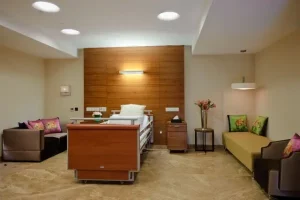 Complete 30 day HSCT done in hospital. Private deluxe rooms are very well served for patient and attendant comfort and equipped with HEPA Filter with Triple Level Air Filtration. No outside hospital stay avoids risk of infection during the aplastic phase, 24 x 7 nursing care and best medical attention. Advanced HSCT protocol used does not require any further chemo or treatment after leaving the hospital.
 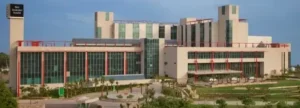 International and Globally Renowned Accreditations. HSCT Hospital India is accredited by the Joint Commission International, USA, the National Accreditation Board for Hospitals and Healthcare Providers (NABH), and the National Accreditation Board for Laboratories (NABL) for processes and high quality patient care.